
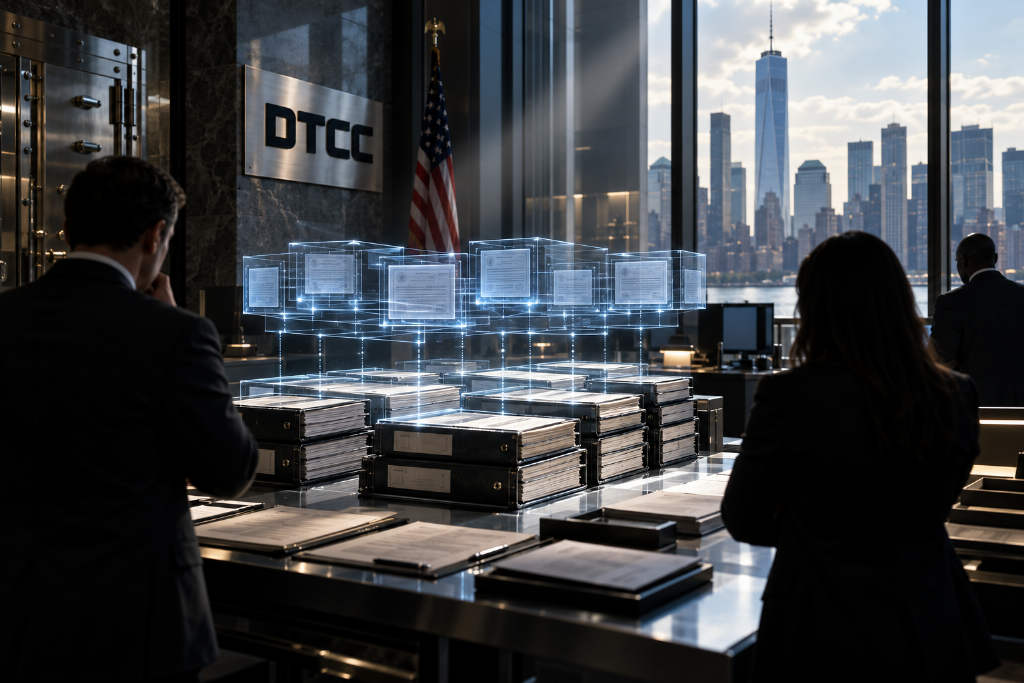
DTCC’s Depository Trust Company, or DTC, launched the DTCC Tokenization Service on Oct. 28, 2026. Twenty DTC participants have signed onboarding agreements, including JPMorgan, Citi, State Street, Morgan Stanley, Bank of America, Barclays and UBS, with additional activations set to roll out over time.
The launch quickly triggered headlines suggesting that $30 trillion in U.S. equities had moved on-chain. That is not what DTCC is doing. The service creates a digital copy of the official ownership record already maintained on DTC’s books for custody-held securities, and that copy can move onto a blockchain or back into the traditional format. The U.S. stock market itself has not been transferred onto a public chain.
DTC is mirroring entitlements, not issuing new securities
What investors see in a brokerage account is, in legal terms, a securities entitlement recorded on DTC’s ledger rather than a stock certificate. DTC is now creating an on-chain mirror of that same entitlement. The underlying custody-held security remains in place on a 1:1 basis, while the CUSIP, ownership, economic rights and investor protections stay unchanged.
DTC is not issuing any new security through this process. It is taking an existing custody position, minting a "tokenized entitlement," and delivering it to a registered wallet controlled by a participant. In this setup, "on-chain" refers to the entitlement record moving on-chain, not to the creation of a new stock or bond.
One security, two forms
DTCC drew the operational boundary in specific terms. If both sides are using registered wallets on the same network, the token can move peer to peer on a 24/7 basis, and transfer and settlement happen at the same time rather than waiting for T+1.
That does not apply to every movement. Conversions between traditional and tokenized form, along with cross-chain transfers, still have to go through DTC’s conversion service. That service is available on business days from 2:00 to 18:00 Eastern Time, with a target completion time of 15 minutes.
More than 30 securities were eligible for conversion on day one. The list covers some Russell 1000 constituents, ETFs tied to major indexes and U.S. Treasuries. The first two supported networks are Canton and DTCC’s own private Besu network. Other networks are planned for 2027.
The $30 trillion figure cited by DTCC refers to the total market capitalization of securities within the convertible universe. It describes the scope that could be tokenized under the service, not the amount that has already been minted.
Access is restricted to institutions
The service is not open to the public. Only DTC participants can connect directly, and the tokens can move only between wallets that those participants have registered. This is a controlled institutional channel, not an open DeFi venue and not a new retail trading app.
The legal basis comes from a no-action letter issued by the U.S. Securities and Exchange Commission’s Division of Trading and Markets to DTC on Dec. 11, 2025. SEC staff said that, if DTC operated the service as described, they would not recommend enforcement action for three years. That is a time-limited staff position, not an act of Congress and not a permanent authorization.
SEC Commissioner Hester Peirce described the move as a gradual step toward bringing markets on-chain, while also warning that it remains a pilot with operating limits.
Before the formal launch, DTC had already completed a limited set of live production transactions with more than 30 institutions on July 15 this year, covering collateral, lending, repo and entitlement delivery. Even so, signing institutions and generating real volume are different things. DTCC did not disclose minting volume or transfer counts on launch day.
Canton was not the only network in the story
Crypto markets initially treated the launch as an exclusive catalyst for Canton. Market data cited in the source showed CC trading at about $0.10 around the launch, roughly flat over 24 hours and down about 11% over seven days, without the kind of breakout that many associated with the "$30 trillion on-chain" narrative.
One reason is the multi-chain design. DTCC Chief Digital Officer Nadine Chakar said plainly that no single chain can handle the scale DTCC needs. Besu and Canton went live side by side on day one. Stellar is expected to join in the first half of 2027, and Circle’s Arc is also on the roadmap.
Authorized tokenization and third-party tokenization are diverging
A separate development on the same day pushed the tokenized stock debate in another direction. According to The Wall Street Journal, JPMorgan, AMD and Coca-Cola joined the group opposing unauthorized third-party tokenization of their shares, bringing the list to 33 companies.
Those third-party products track price only, do not grant voting rights and can be subject to takedown requests from issuers. DTCC, by contrast, is offering a digital representation tied to the same CUSIP and the same rights. The two models are competing over what the term "tokenized stock" should actually mean.
Citi’s global head of tokenized securities and crypto, Nadine Teychen, said the industry would move toward DTCC-style digital twins and that buyers need to understand exactly what they are purchasing. Citi Research, in its mid-2026 base case, projected tokenized assets would reach $5.5 trillion by 2030. That forecast is about the end of the decade, not proof that this launch has already delivered that scale.
The door is open, but scale is still missing
The weight of this launch will be measured by usage rather than by the length of the participant list. Twenty signed institutions show that major firms do not want to miss the official channel, but that does not mean all 20 are already running meaningful flow through it.
The firms that are absent also matter. Industry publication Ledger Insights noted that Bank of New York Mellon, the largest U.S. custodian, and Goldman Sachs, which took part in the July pilot, were not among the first wave of participants.
A harder constraint comes from settlement mechanics. In the traditional system, net settlement at the National Securities Clearing Corporation, or NSCC, can reduce actual settlement activity to about 2% of gross trading volume. If an on-chain setup lacks both netting and on-chain cash, then the efficiency case for 24/7 transfers is only partially built. Cross-chain capability and on-chain cash settlement are both still on the 2027 roadmap.
There is also no answer yet on what happens after the three-year no-action window expires. The entry point is now in place. Whether that amounts to opening a new door or moving the market into a new house will depend on the next few quarters: minting volume, whether collateral use cases can run in production, and when tokenized deposits or stablecoins are brought into the system.



