
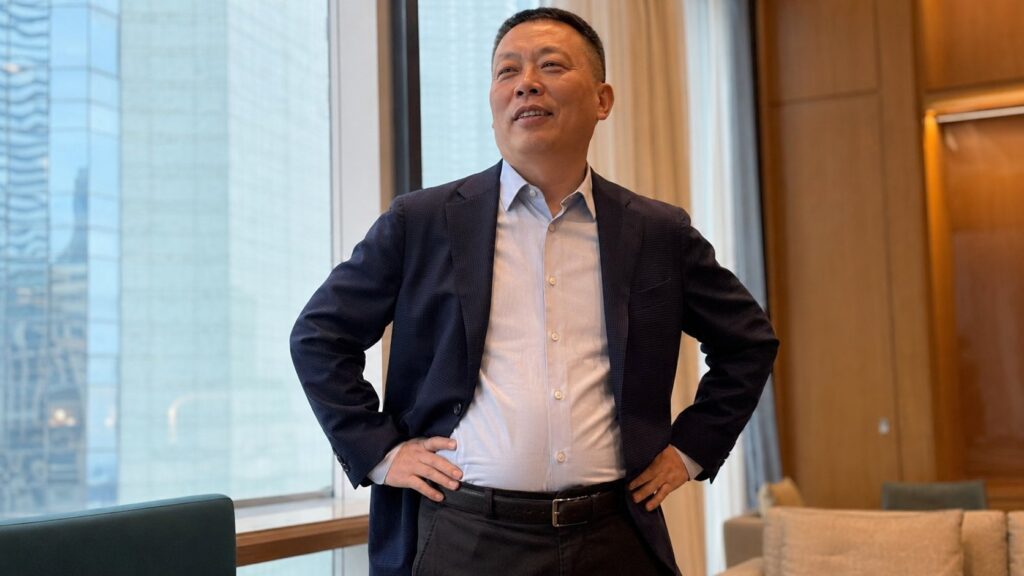
Duan Yongping, founder of BBK, said on social media that he is prepared to put up Kweichow Moutai shares against any domestic Chinese fund in a RMB 100 million wager over 10 years. He said directly that the arrangement is meant to imitate Warren Buffett’s famous bet.
Duan said the condition is that both sides must first agree on a donation recipient, and that the winner’s gains should go to an organization recognized by both parties. He said he would donate to the BBK Experimental School, adding: 「There are too many details here to explain clearly. Unless a highly credible institution can step forward to handle this. If both sides agree, the money can be donated first, and the loser can pay the other side after 10 years.」
The BBK Experimental School he named is located in Chang’an Town, Dongguan. The school has a total investment of RMB 1.6 billion. OPPO and vivo each hold 45%, while Xiaotiancai is the other investor, making it a joint project backed by three companies under Duan’s umbrella.
Modeled on Buffett’s earlier wager
Warren Buffett said publicly in 2007 that an S&P 500 index fund would outperform a handpicked group of hedge funds over 10 years. The challenge was accepted by Ted Seides of asset management firm Protégé Partners, who selected five funds of funds to compete. The clock ran from Jan. 1, 2008 to Dec. 31, 2017.
The outcome was not close. The Vanguard S&P 500 index fund chosen by Buffett returned 125.8% over the decade. The five fund portfolios selected by Seides posted 21.7%, 42.3%, 87.7%, 2.8% and 27.0%, and none of them beat Buffett’s pick.
The way the stake was handled also became part of the story. The two sides initially each put up $320,000 to buy zero-coupon U.S. Treasuries, with the value expected to grow to $1 million after 10 years. In 2012, with the bonds already near face value, they shifted the money into Berkshire Hathaway Class B shares. By the final settlement, the amount had grown to $2.22 million, all of which was donated to Girls Inc. of Omaha.
The report said Buffett was not really betting on stock selection, but on cost structure. Index funds charge very low management fees, while hedge funds typically charge a 2% management fee plus a 20% performance fee. Over a decade, that gap is hard to overcome through stock picking alone. Duan’s wager is different. He is betting on his judgment about one company, putting a single stock against the domestic fund industry.
Moutai’s 10-year performance
The figures cited in the report favor Duan’s argument. Kweichow Moutai closed at RMB 310.19 on Aug. 31, 2016 and at RMB 1,355.29 on Aug. 13, 2026. On price alone, that represents a 4.37x gain, or 336.9% cumulatively, with an annualized return of 15.9%.
Including reinvested dividends, Moutai’s total return over the decade reached 395.3%, close to a fivefold increase, with an annualized return of 17.4%. For comparison, the mixed equity fund index returned 126.55% over the past 10 years, with the figure calculated through April 27, 2026. Over the same period, the CSI 300 rose 50.70%. The report said that, over that 10-year window, Moutai outperformed the average level of actively managed funds by three times.
Funds have been cutting exposure
Another contrast comes from mutual fund positioning. In the second quarter of 2026, Kweichow Moutai dropped out of the top 10 heavily held public mutual fund stocks and ranked 14th. The number of funds holding Moutai fell to 984, down by 367 from the previous quarter. Moutai’s share of fund stock investment market value dropped to 0.53%, down 0.64 percentage points in a single quarter and below the average since 2009.
The broader baijiu sector has also seen outflows. Its heavy-position ratio fell from 4.51% in the previous quarter to 2.09%. The number of funds holding Wuliangye dropped to 72, down 148, while funds holding Luzhou Laojiao fell to 90, down 29. The report said capital has been moving toward hard technology, while the institutions Duan wants to challenge have been stepping away from the stock he is backing.
Duan’s recent trades
The report also listed Duan’s own recent moves. On Jan. 27, he exited his long-held China Shenhua H shares, cashing out about HK$649.3 million. Around the same time, he bought roughly 77,200 shares of Moutai through the Shanghai-Hong Kong Stock Connect program at prices between RMB 1,329.72 and RMB 1,331.00, with about RMB 103 million deployed.
Based on Moutai’s Aug. 13 close of RMB 1,355.29, that position was sitting on an unrealized gain of less than 2%. The report added that he is not only betting on Moutai. A Hong Kong Stock Exchange disclosure dated Aug. 12 showed that H&H International Investment, under Duan, increased its stake in Pop Mart from 5.55% to 7.70% on Aug. 6.