
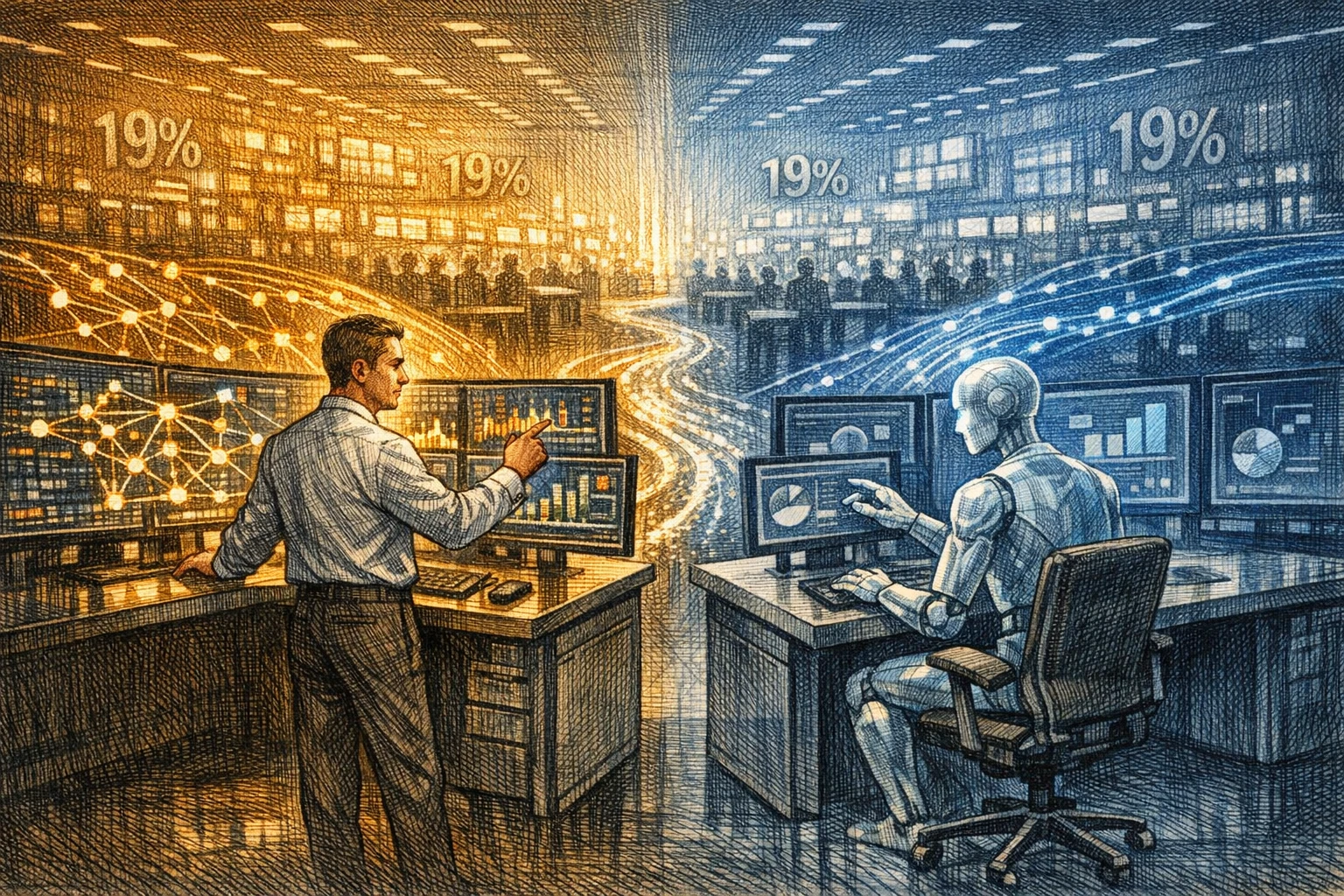
DWF Ventures said in its report Will Agents take over DeFi that automation and AI agents now represent roughly 19% of all on-chain activity. The share is already meaningful. Full end-to-end autonomy, though, is still out of reach. The report says most agents today remain closer to analyst or copilot systems than fully independent actors that can fund themselves, execute, and keep adapting without human oversight.
Agent activity is rising fast, but the stack is not fully autonomous
Over the past year, agent-driven activity has grown steadily in both transaction count and volume. According to the report, more than 17,000 agents have been launched since 2025, and automated or agent-based flows now account for over 19% of all on-chain activity. DWF Ventures also cited an estimate that more than 76% of stablecoin transfer volume is generated by bots.
That growth does not mean the market has solved autonomous execution. Most of the infrastructure being built today is aimed at two use cases: channels between agents and agent calls initiated by humans. Stablecoin payments are widely supported, but the underlying rails still depend on traditional payment gateways, which leaves centralized counterparties in the loop. In other words, the fully autonomous version of DeFi agents has not arrived.
Yield optimization is where agents are already proving useful
The report draws a sharp line between narrow and complex tasks. In tightly defined use cases such as yield optimization, agents are already delivering strong results. Liquidity provision is one of the clearest examples. DWF Ventures said agent-controlled TVL in this segment is above $39 million, a figure that counts assets deposited directly into agents and excludes capital routed through vault structures.
One of the main examples in the report is Giza Tech’s ARMA, launched late last year to improve yield capture across major DeFi protocols. ARMA has attracted more than $19 million in assets under management and generated over $4 billion in agent trading volume. That turnover suggests active rebalancing rather than passive allocation. The report said ARMA produced more than 9.75% annualized yield on USDC, and even after rebalancing costs and a 10% performance fee, returns still came in above standard lending rates on Aave or Morpho.
Even here, DWF Ventures does not present the category as fully proven. Scale remains an open question. These agents have yet to be tested at the size and market depth seen across the largest DeFi venues.
In trading, human participants still hold a wide lead
Results shift once the task becomes multi-layered. Trading is the clearest case. The report says most current models still work from human-defined inputs and operate inside preset rules, even when machine learning lets them revise behavior based on fresh data. Fully autonomous trading agents are not showing consistent edge yet.
DWF Ventures pointed to a human-versus-agent competition hosted by Trade XYZ. Each account started with $10,000, with no limits on leverage or trading frequency. The outcome was heavily tilted toward humans: the best human traders outperformed the best agents by more than 5x. That gap stands out because it suggests current agents still struggle when trading requires judgment across changing conditions rather than execution inside a narrow mandate.
Model choice matters, but risk discipline matters more
The report also cited an agent-versus-agent competition run by Nof1, where models including Grok-4, GPT-5, Deepseek, Kimi, Qwen3, Claude, and Gemini were tested across different risk settings, from capital preservation to maximum leverage. Performance varied widely, and the spread could not be explained by model branding alone.
Several factors showed a strong relationship with results. Holding period was one. Models that kept positions open for around 2 to 3 hours on average performed much better than those that flipped positions frequently. Expected value was another. Only the top 3 models posted positive expectancy, meaning most models logged more losing trades than winning ones. Leverage also mattered: strategies averaging around 6x to 8x leverage outperformed those running above 10x, where losses accelerated faster.
Prompt design had a visible effect as well. DWF Ventures said Monk Mode was the best-performing prompt strategy, while Situational Awareness ranked last. The pattern in the data suggests that approaches centered on tighter risk control and fewer external information sources did better. On the base-model side, Grok 4.20 outperformed other models by more than 22% across prompt strategies and was the only model with positive average profitability.
Trust, privacy, and crowding remain open risks for DeFi agents
DWF Ventures said the sector still lacks a complete framework for evaluating agents. Historical returns are useful, but they do not tell the full story. The report places more weight on behavior across different volatility regimes, the quality and diversity of data sources, and the presence of audited smart contracts and proper custody design. In stressed markets, disciplined loss control becomes a key signal.
The trade-off between transparency and privacy is also unresolved. Transparent agents can be copied, front-run, or arbitraged because their moves become predictable. Private agents avoid that exposure, but create another problem: builders may retain an information advantage over users and extract value through opacity. The report also warns about strategy crowding. If many agents are trained on similar datasets and optimize for similar objectives, they may converge on the same trades and the same exits, which can compress returns.
DWF Ventures noted that ERC-8004 went live in January 2026 as the first on-chain registry designed to let autonomous agents discover each other, build verifiable reputation, and collaborate. Even so, risks such as sybil attacks and collusive reputation remain unresolved. The report’s conclusion is narrow but clear: agent activity is still accelerating, and the next phase of DeFi will depend not only on model quality but on trusted infrastructure for execution, security, and coordination.