
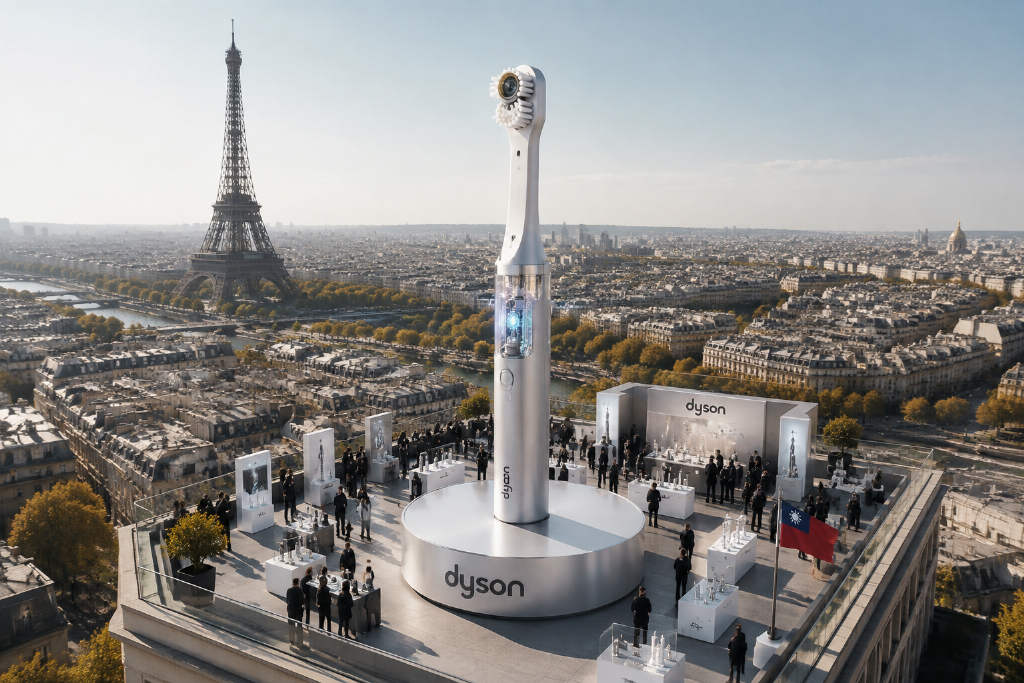
Dyson on Sept. 1 unveiled the Dyson CameraJet in Paris, describing it in an official release as the world’s first toothbrush with both a built-in camera and a rinse jet. The product is priced at NT$16,990 in Taiwan and went on sale the same day through Dyson’s website and department store counters.
A six-year bet on the gaps between teeth
James Dyson personally introduced the product in Paris. Dyson said the project took six years to develop and focused on an area many people neglect in daily oral care: the spaces between teeth, where plaque commonly forms.
In the company’s account, brushing is both time-consuming and awkward, and while most people know they should do it well, many do not. Dyson said its research found that the spots users consistently miss are the same places where plaque most easily builds up.
How the camera and rinse system works
According to the release, the CameraJet system is built around what Dyson calls “Gap Optical Targeting.” The camera analyzes 28 live images per second to identify interdental gaps, then triggers a targeted mouthrinse spray within 100 milliseconds. Dyson said the full decision-making stack runs on 16 million lines of code.
The camera itself is a 0.1-megapixel unit with a surface area of just 1 mm², paired with an LED light source to operate inside the mouth. The rinse jet uses a 21-degree conical stream design and releases about 0.11 to 0.15 ml of mouthrinse each time, which Dyson said is equivalent to one rinse.
Dyson contrasted that design with the needle-like streams commonly used in standard oral irrigators, saying those can injure gums, while the conical jet is intended to remove plaque more gently across a wider area.
The handle includes a 12.5 ml anti-gravity capsule reservoir. A medical-grade silicone diaphragm maintains pressure so water flow is unaffected whether the brush is upright, tilted or inverted. The brush head vibrates 245 times per second. Its inner blue bristles are for stain removal, while the outer green bristles are for gum care. An RFID chip in the head tracks wear automatically, and the device can connect to a mobile app over Bluetooth for live intraoral viewing.
Modes, charging and connectivity
CameraJet offers three usage modes: a 3-minute rinse-and-brush mode, a 2-minute standard brushing mode, and a 1-minute-20-second flossing mode. Users can also choose from three intensity levels.
The refill base has a 200 ml water capacity and doubles as a charging dock. Dyson said an 8-hour charge delivers up to 10 days of battery life. The U.S. version is priced at $499, comes in Ceramic Ultra Blue and Ceramic Pink, and supports 2.4GHz WiFi connectivity.
Trained on 470,000 dental images
Dyson said the machine-learning model behind the product was trained on 470,000 dental images and that development spanned six years from start to finish.
The company also said it worked with the National University of Singapore Faculty of Dentistry in a five-year funded research partnership. That collaboration produced what Dyson called a proprietary plaque surrogate, allowing engineers to tune the algorithm repeatedly without rerunning a full clinical process after every change.
As described in the source article, the artificial plaque can be replicated and repeatedly tested in a lab setting, replacing human clinical workflows that can take months and reducing iteration cycles from years to daily testing.
The 69% plaque-removal claim lacks independent validation
Dyson said laboratory testing showed CameraJet improved plaque removal by 69% in hard-to-clean areas compared with a “market-leading premium electric toothbrush.”
The article also raised a key limitation: the plaque surrogate, laboratory environment and benchmark product were all chosen by Dyson itself. The figure was not presented as the result of validation by an independent third party or a clinical institution.
The same issue applies to privacy claims. Dyson said the camera operates only during live viewing or automatic rinse-jet use, and that no images are recorded or stored on the product or in the cloud, keeping them private. But the source article said that assurance currently rests on the manufacturer’s own statement, without third-party auditing or independent verification.
That leaves the real-world effect on plaque removal to be assessed over time and through outside validation.