
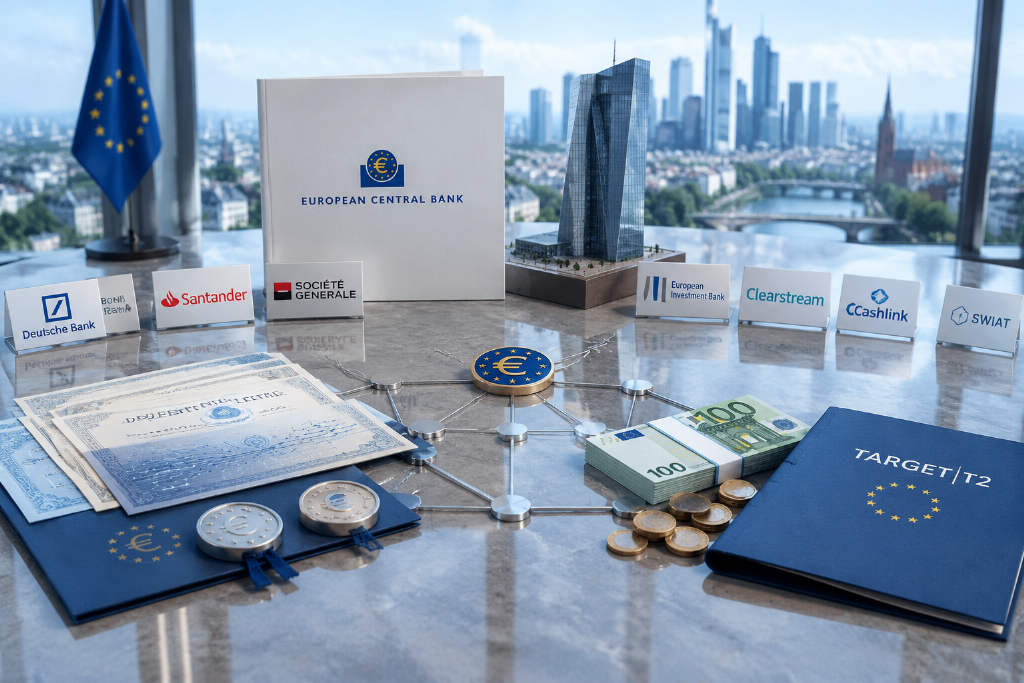
The European Central Bank opened its Pontes settlement service on the morning of Sept. 21, 2026. The first group of participants includes 13 banks, among them Deutsche Bank, Santander, Société Générale and the European Investment Bank, as well as market infrastructure operators such as Clearstream, Cashlink and SWIAT. They can trade tokenized bonds and other wholesale assets on distributed ledger platforms while settling the cash leg back in Eurosystem central bank money.

Financial institutions have spent the past few years moving bond issuance, registration and transfer onto distributed ledgers. The cash side of the trade often stayed elsewhere. Assets could move on-chain while funds moved through traditional accounts, leaving participants to wait, reconcile records and manage the order of settlement. Pontes is built to handle that interface. It links market DLT platforms with TARGET services so that assets and central bank money can settle under the same transaction conditions.
Tokenized assets still need synchronized cash settlement
Once a bond is tokenized, the issuer can place holder registration, coupon payments and transfer rules into one digital process. The basic problem does not disappear: how to synchronize the buyer’s payment with the seller’s delivery of securities. If one side completes first and the other side fails later, the party that already delivered takes principal risk. That is why securities settlement has long relied on central bank money and delivery-versus-payment, or DvP.
Under DvP, delivery of securities takes effect only when the corresponding payment is completed. Traditional securities infrastructure can already do this. Tokenized assets, though, are spread across different DLT platforms, while cash is recorded in central bank accounts within TARGET. Each platform has its own transaction state, sequencing and technical interface. As the number of projects rises, so does the cost of connecting them.
Some pilots have used commercial bank deposit tokens or stablecoins as on-chain payment instruments. Those assets fit ledger-based trading more closely, but they introduce the credit risk of the issuing bank or private issuer. They also split the same euro into liabilities of different institutions. For large banks and securities infrastructure providers, central bank money remains the preferred asset for final settlement. Once the trade is complete, participants hold a claim on the central bank and the clearing relationship ends there.
That is why Pontes focuses on the cash leg. It offers a common settlement path for different market platforms. Issuance platforms continue to determine how assets are created and transferred, while settlement funds move through interfaces controlled within the Eurosystem. Platforms can keep their own ledgers and still share the same central bank money settlement base.
Two cash routes under one service
According to the ECB’s design, participants can choose between two methods on a trade-by-trade basis. One uses cash tokens in a Eurosystem DLT environment. The other settles directly through T2 real-time gross settlement accounts. Both routes are backed by the participant’s central bank money in T2. The difference is whether the cash state is mirrored inside the DLT environment.

When cash tokens are used, a bank first funds tokenized cash from its T2 account. A node controlled by the ECB then increases the corresponding balance. After the asset trade is completed, participants can redeem the cash tokens back into T2 funds. In this setup, the “token” is a technical representation of central bank money for wholesale use. It is limited to settlement between eligible financial institutions and is distinct from retail wallet balances or euro stablecoins issued by private companies.
When participants choose direct T2 settlement, Pontes uses Hash-Link to tie the asset action on the DLT platform to the payment in T2. Hash-Link converts the transaction conditions into a cryptographic commitment that both systems can verify. If the asset side meets the conditions, the cash side executes. If either leg fails, the whole transaction returns to an undelivered state. The market platform only needs to pass the necessary transaction status, and T2 only processes the conditions tied to payment.
This dual-track design leaves banks with a practical choice. Institutions that already built DLT cash workflows can use cash tokens and keep the trade inside a more unified technical environment. Institutions that prefer existing liquidity management and account operations can call T2 directly. For platform operators, the same asset network can serve members using different cash models, reducing the pressure to force every participant through the same system overhaul at the same time.
A tokenized bond trade can therefore be broken into a sequence of linked actions. Buyer and seller first agree on bond quantity, price and settlement time on the market DLT platform. The platform locks the seller’s asset and sends the settlement conditions to Pontes. The buyer chooses either cash tokens or direct T2 payment. Pontes checks the status on both sides and then triggers delivery of funds and assets. The result flows back to the platform and to the bank’s internal books for positions, accounting and client reporting. From order entry to final booking, the trade follows one state chain, with manual reconciliation largely reserved for exception handling.
The synchronization matters even more in repo and package trades. A repo includes a securities transfer, a cash payment and a future reverse transaction, with multiple dates and amounts that must line up precisely. Platforms can encode those conditions into the trade workflow, while Pontes handles central bank money payments at each settlement point. That gives banks a way to use tokenized assets in ordinary wholesale funding, extending activity from bond issuance into ongoing trading and liquidity management.
Legal finality stays in T2
The most important legal feature of Pontes is that settlement finality remains anchored in T2. ECB service documentation states that Pontes operates outside the technical boundary of TARGET while relying on TARGET’s existing legal, regulatory and functional framework. The related payments obtain finality in T2 under Article 18 of Part 1 of Annex I to Guideline (EU) 2022/912 on TARGET.

Settlement finality determines when a payment becomes irrevocable. It also determines whether a completed transaction remains effective after an institution enters insolvency proceedings. A tokenized platform may show a transaction as confirmed at the technical level, but financial institutions still need to know which system, which account and which point in time that confirmation maps to in legal terms. By keeping finality in T2, participants can continue to rely on a legal basis they already know from central bank money settlement.
The legal records for the asset leg and the cash leg still sit in different systems. T2 confirms finality of the euro payment. The DLT platform confirms transfer of the tokenized asset under its own rules. Pontes makes those two states conditional on each other. Platform operators therefore need to define the effective time of the asset transfer, the conditions for reversal and the process for disputes, and they need to align those rules with the payment status in T2. Technical synchronization alone is not enough. It has to fit the rulebooks on both sides to produce full DvP.
That also explains why Pontes is built as a connector rather than a replacement. DLT platforms handle asset programming, holder registration and trade workflows. TARGET handles central bank money accounts and final settlement. The two sides exchange only the necessary status through controlled interfaces while keeping their existing responsibilities. In a European market split across multiple jurisdictions, central securities depositories and trading venues, that architecture is easier to extend from current business arrangements.
Eligibility follows existing boundaries as well. Market participants using Pontes must have access to T2. Platform operators are expected to come mainly from central securities depositories regulated under the Central Securities Depositories Regulation, DLT market infrastructures under the EU DLT pilot regime, and payment systems supervised under relevant EU or European Economic Area frameworks. Existing admission standards for financial market infrastructure remain in place, with Pontes adding a new settlement interface on top.
From 2024 experiments to a live service
Pontes did not start from scratch. In 2024, the Eurosystem ran large-scale exploratory work on wholesale central bank money settlement. It involved 64 participants from nine jurisdictions and processed close to €1.6 billion. The tests covered tokenized bonds, repos, funds and cross-border payments, and they examined three technical approaches at the same time: the trigger solution from the Deutsche Bundesbank, the TIPS Hash-Link from the Bank of Italy, and the DL3S model from the Banque de France.
Those experiments produced two direct conclusions. First, the market does want a settlement asset without credit risk for DLT-based asset trading. Second, different platforms are unlikely to migrate to one common technical network in the short term. Pontes combines the lessons from those three experiments into an ongoing service, giving platforms a common set of access and certification requirements while preserving multiple cash settlement methods.

Once a project moves from testing into production, the center of gravity changes. A demonstration can be watched trade by trade by a project team. A live service needs stable opening hours, recovery procedures, fee standards, version control and participant support. The ECB chose a phased rollout, with limited participants and functions at the start, followed by longer operating windows and incremental improvements. That pace fits the risk tolerance of financial market infrastructure.
The initial participant list also shows where the first demand is coming from: the bond market. The European Investment Bank, KfW and NRW.BANK have all been involved in digital bond experiments for years. Clearstream provides issuance and custody infrastructure. Several commercial banks act at once as underwriters, investors and settlement banks. Once they connect to the same central bank money rail, new digital bond projects can avoid negotiating and building a separate cash arrangement for each model.
How quickly the service expands beyond that first group will depend on connection costs and day-to-day usability. Participants need to complete interface development, pass certification tests, arrange T2 accounts and operations staff, and feed Pontes status into accounting, risk and client reporting systems. For platforms with limited volume, shared technology providers or central securities depositories may become the main entry point. Banks with larger volumes have more reason to build direct connections so they can control liquidity and operating hours.
Central securities depositories are likely to act as connectors in that expansion. They already manage securities accounts, corporate actions and settlement data. That gives them a way to link Pontes cash interfaces to multiple issuers and investors. Smaller banks can then join tokenized trading through existing infrastructure instead of building a full DLT settlement stack on their own.
How Pontes could reshape roles in tokenized markets
For issuers, Pontes reduces uncertainty around the cash settlement model. In the past, launching a tokenized bond meant choosing an asset platform, deciding how investors would pay, determining when funds would become final and arranging how banks would move liquidity. With a stable central bank interface in place, issuers can spend more effort on investor reach, asset terms and secondary trading.
For banks, Pontes connects DLT activity to the existing central bank account system. Banks still manage T2 balances and intraday liquidity, while also offering clients payment, custody and trading services for tokenized assets. As operating hours are extended over time, evening funding, collateral handling and staffing will require new arrangements. Faster settlement also shifts funding preparation away from batch management and toward more real-time control.

For market platforms, connecting to Pontes means access to a regulated cash rail. Platforms still need to meet identity, technical certification, information security and operational requirements, and they still need to govern their own asset rules. What the central bank money channel removes is the need to build a proprietary settlement token. It also gives clients direct access to a common asset without credit risk. Different platforms can then compete on asset functionality and service quality while sharing the same monetary anchor.
Pontes is also positioned to coexist with commercial bank deposit tokens and stablecoins. Central bank money suits final interbank settlement. Deposit tokens are more useful for banks serving corporate clients. Stablecoins are easier to take into public blockchains and global wallets. Each form of money serves a different user base, compliance boundary and availability window. The harder industry question becomes whether those forms can convert smoothly and whether platforms can preserve atomic execution and compliance records during that conversion.
Cross-border use cases will also raise demand for payment-versus-payment, or PvP. If two currencies can be delivered in sync across different systems, the principal risk of one side paying before the other side does can be reduced. Pontes’ Hash-Link design provides a technical basis for conditional linkage, but any move into multi-currency settlement would still require coordination with other central bank systems on operating hours and legal finality. It looks more like a European cash rail that can keep adding connections than a closed network that can settle global cross-border flows on its own.
From Pontes to Appia
The ECB describes Pontes as the near-term solution. Its longer-term project is called Appia. Pontes addresses the immediate question of how DLT platforms connect to central bank money. Appia is meant to cover the broader European tokenized finance ecosystem, including common standards, interoperability arrangements and market structure. The Eurosystem plans to produce an Appia blueprint in 2028, and the data and operating experience from Pontes are expected to feed into that design.
Three indicators will show how far Pontes can go: whether operating hours match real market demand, whether more platforms can connect at a manageable cost, and whether cross-platform trades can keep delivering assets and funds in sync. If those conditions hold, digital bonds may move beyond a small set of pilots and into routine issuance and secondary trading.
That is where Pontes matters most. Europe has chosen to turn the scarcest piece of public infrastructure, central bank money settlement, into a service that multiple platforms can connect to. Tokenized assets can remain distributed across different ledgers, while final settlement still returns to a shared monetary anchor. For institutional markets, that bridge may matter more than creating yet another digital asset.
