
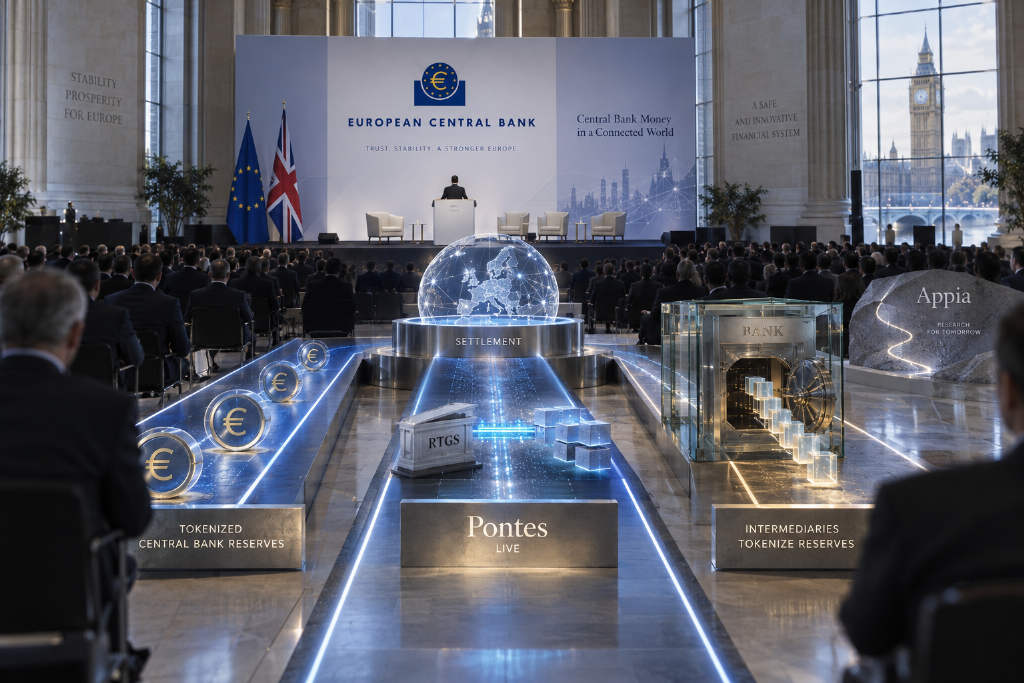
European Central Bank Executive Board member Isabel Schnabel set out three models for putting central bank money onchain in a speech delivered on Oct. 1 at the Bank of England’s "The Future of Money" conference in London. According to an ECB presentation, she said these approaches could modernize how central banks implement monetary policy.
Three models for onchain central bank money
The first model is direct issuance. In that setup, the central bank issues tokenized reserves on a programmable platform, and the reserves themselves exist as native tokens.
The second model is bridge synchronization. A central bank’s real-time gross settlement system, or RTGS, connects to a distributed ledger platform through an interoperability layer. The two sides are linked by hash values and trigger each other, while the reserves themselves are not tokenized.
The third model uses private intermediaries. Private institutions tokenize reserves held at the central bank and issue settlement tokens fully backed by those reserves. The presentation specifically notes that, under this model, the reserves remain offchain and the token represents a claim on the private institution rather than a direct claim on the central bank.
Atomicity and programmability at the center of tokenized settlement
The presentation says tokenization can make settlement faster, safer and smarter. It points to two core features.
One is atomicity, meaning all sides of a transaction settle at the same time or the transaction does not go through at all. The other is programmability, which allows settlement to run automatically according to predefined rules.
Schnabel also said modern fiat money is built on a two-tier structure, with bank deposits held by the public mapped 1:1 to wholesale central bank money. If central bank money can be provided onchain, a tokenized financial system could replicate that same structure, with tokenized bank deposits corresponding to tokenized wholesale central bank money.
Pontes is already live under the ECB’s current approach
According to the presentation, the ECB is currently following the second model. Pontes, which went live on Sept. 21, combines a bridge-based setup with the Eurosystem’s own distributed ledger and provides tokenized central bank money for settling transactions on distributed ledger platforms.
Market participants can choose to settle through TARGET2 or through a distributed ledger. The next steps include adding round-the-clock service and decentralized programmable functions.
The ABMedia report notes that Chain News had previously reported on the launch of Pontes and on the ECB’s purchase of tokenized securities with its own funds.
Appia studies three long-term tokenization structures
A separate project, Appia, is focused on longer-term tokenization architecture. The presentation says it is examining three directions: a single shared ledger, interconnection between a Eurosystem ledger and market ledgers, and a structure in which multiple shared ledgers coexist.
The presentation groups both Pontes and Appia under wholesale central bank digital currency work. The corresponding retail-side project is the digital euro.