


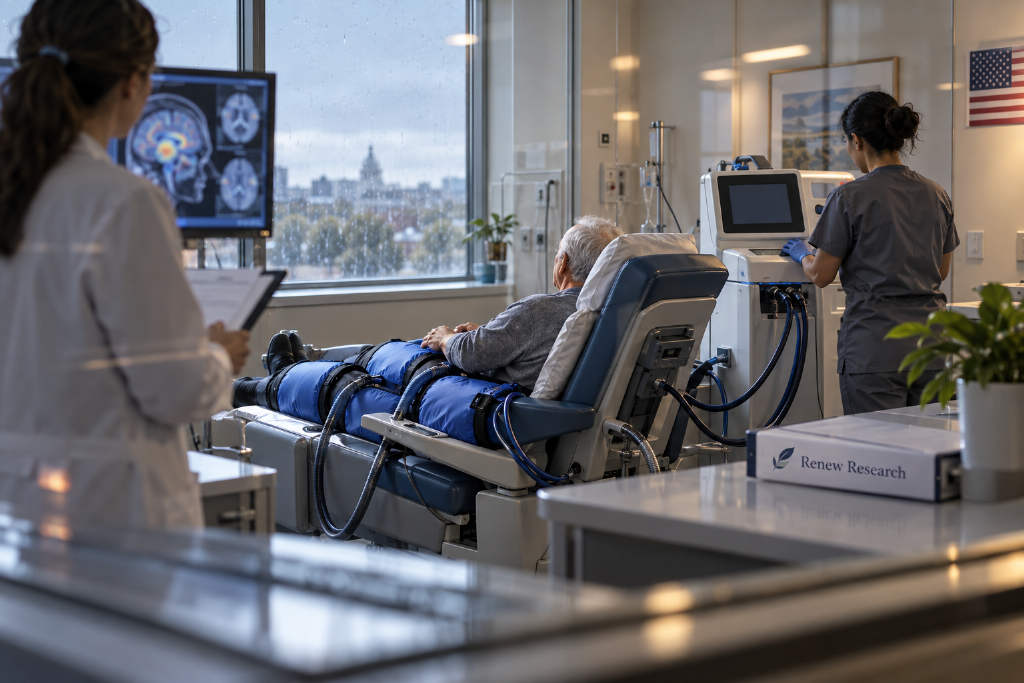
A multi-center randomized trial covered by ScienceAlert reported that enhanced external counterpulsation, or ECP, produced improvements relative to baseline in 190 patients with early Alzheimer’s-related cognitive impairment. The report said about 84% of patients showed better memory and thinking during treatment, and roughly 75% were still above baseline six months after treatment ended.
How the ECP study was set up
According to ScienceAlert, ECP uses inflatable cuffs wrapped around the calves, thighs, and buttocks. The cuffs apply pressure in sync with the heartbeat, pushing blood back toward the heart and potentially improving arterial function. The U.S. Food and Drug Administration has already cleared the therapy for angina, acute myocardial infarction, and congestive heart failure, though it is not commonly used in clinical practice.
The paper said the trial lasted 12 months and used a multi-center, randomized, sham-controlled design. It enrolled 190 people who had been clinically diagnosed with mild cognitive impairment due to Alzheimer’s disease or mild Alzheimer’s disease. The full-pressure group received 150–300 mmHg synchronized with the ECG waveform. The sham group received about 25 mmHg without synchronization. Participants underwent the first 35 sessions three to five times a week for one hour each, then twice a week until the six-month mark, followed by observation through week 52 after treatment stopped.
Scale results and the improvement rates cited in the report
In time-averaged assessments from weeks 12 to 24, the full-pressure group performed better than the sham group on daily function and cognitive measures. Mean change on the ADCS-ADL scale was 2.57 versus -0.49 in the sham group, with p=0.036. On VADAS-cog, the figures were 9.95 versus 5.22, with p=0.005. ScienceAlert said the benefit remained present at week 52.
ScienceAlert also cited Jack Juni of device maker Renew Research, who said about 78% of patients had improved from their own baseline after six months. He added that the average cognitive scale gain was about 5 points, which he roughly described as equivalent to regaining one to two years of function. The report separately said about 84% improved during treatment and about 75% were still above baseline six months after stopping therapy.
Why the findings drew attention
The report said the result has drawn attention because many approved Alzheimer’s treatments aim to slow decline, while this trial was framed around patients doing better than where they started. The author team, which included researchers affiliated with the University of Kansas Medical Center, emphasized the role of the vascular system. KU Medical Center news had also previously discussed the Moriarty team and context involving a diabetes subgroup.
ECP is non-invasive and relatively low-cost, which is another reason the findings have been watched closely. At the same time, the report noted that some improvement also appeared in the sham group, so placebo effects, practice effects, or low-pressure pulse effects cannot be fully ruled out. The key evidence in support of efficacy is that the full-pressure group outperformed the sham group.
Funding, diagnosis, and regulatory limits
The trial was funded by Renew Research, and some authors were company employees or had received support from the company. The report said those conflicts should be part of how the findings are read. The study was single-blind, and a sham setup could not fully function as a perfect placebo.
The participants were enrolled based on clinical criteria rather than blood or imaging biomarkers confirming amyloid pathology. That means the cohort may have included cognitive impairment caused by factors other than Alzheimer’s pathology, which calls for caution in interpretation.
On the regulatory side, the Cerezen device has received certification in the European Union for mild cognitive impairment due to Alzheimer’s disease and mild Alzheimer’s disease. The U.S. FDA has not granted equivalent clearance. The report added that the company had sent a letter complaining about review delays, which does not mean the treatment has been cleared in the United States.
The original article also stressed that the report is not medical advice and should not be used by individuals to arrange treatment on their own. Larger samples and longer follow-up are still needed to test reproducibility and long-term safety.