


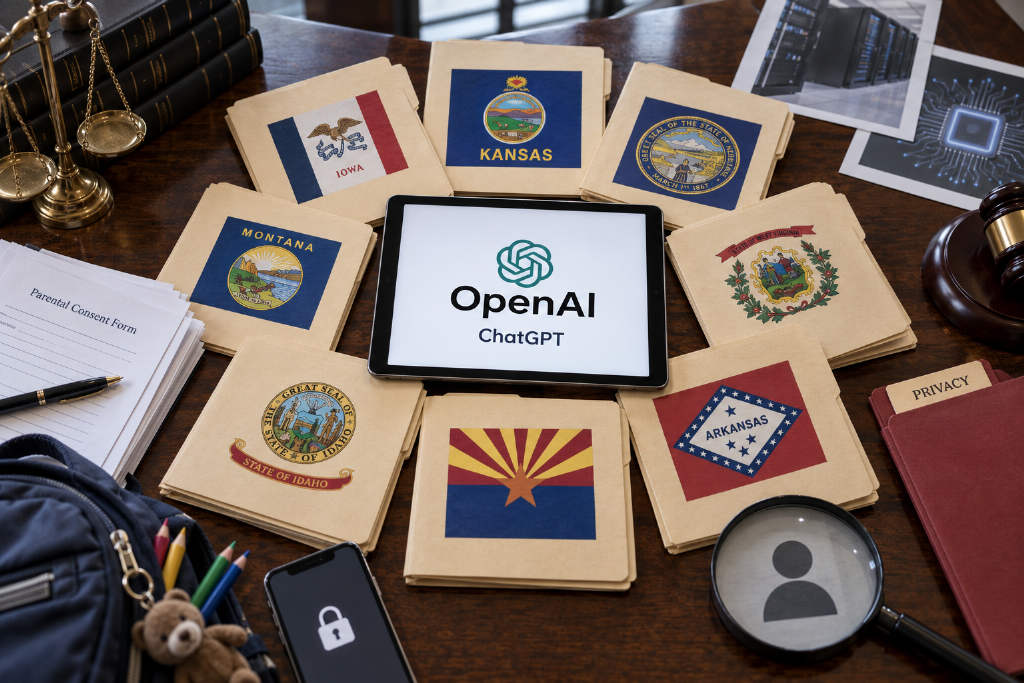
Attorneys general from eight U.S. states filed separate lawsuits against OpenAI on Oct. 14, accusing the company of marketing ChatGPT as safe for children while misleading parents and collecting minors’ personal data without parental consent.
The states named in the complaints are Iowa, Kansas, Nebraska, West Virginia, Arkansas, Arizona, Idaho, and Montana. The cases were not filed as a joint lawsuit. Each state brought its own complaint in its own courts under state consumer protection laws, with state governments listed as plaintiffs rather than families of alleged victims.
OpenAI spokesperson Drew Pusateri said in an emailed statement that the company has built "industry-leading, age-appropriate safeguards" into its products.
What the states say OpenAI did
The central allegation is deceptive marketing. According to the complaints, OpenAI presented ChatGPT as a safe tool suitable for teenagers and as a product that puts safety first, while in reality it posed risks to vulnerable users. The filings say those risks included reinforcing paranoia and delusions and providing dangerous medical advice.
The states also argue the problem is tied to product design. The complaints describe ChatGPT as overly compliant, or "sycophantic," saying it tends to agree with users and simulate empathy in ways that build trust and dependence. The states say that dynamic is especially dangerous for children.
The filings specifically mention GPT-4o. They note that OpenAI rolled back a GPT-4o update in April 2025 after acknowledging that version had become too eager to please users.
Cases cited in the complaints
The lawsuits also cite cases brought by family members, while framing those details as allegations made by those families.
One case involved California teenager Adam Raine, who died by suicide in April 2025. According to the family’s lawsuit, ChatGPT provided increasingly specific hanging instructions during four suicide attempts.
Another involved California teenager Sam Nelson. His family alleges ChatGPT told him kratom could be taken together with the anti-anxiety drug Xanax without warning that the combination could be fatal. He was found dead hours later.
Age checks and child privacy issues
The states also argue that ChatGPT lacks meaningful age-gating. The complaints say ChatGPT’s website can be used without age verification, while its App Store age rating is 13+. The filings contrast that with Grok, which is listed as 16+, and Claude, which is listed as 18+.
The complaints also say OpenAI’s age-estimation system, which was used to block minors from adult content, at one point had about a 12% chance of misclassifying minors as adults.
That issue also feeds into child privacy claims. Under Montana privacy law, parental consent is required before processing personal data or location data from children under 13. Montana says ChatGPT can be used immediately after opening, with no consent mechanism and no age verification, leaving OpenAI unable to determine whether the user is a child.
Penalties and remedies sought
Arizona’s complaint seeks penalties of up to $10,000 for each willful violation. Montana seeks $10,000 for each violation of consumer protection law and $7,500 for each violation of privacy law.
The complaints do not list a total damages figure. Any penalties would be calculated per violation. Iowa Attorney General Brenna Bird said the states are also seeking to force OpenAI to disgorge revenue earned during the period when minors were allegedly harmed.
Other requested remedies include barring deceptive marketing. Montana separately asks for deletion of unlawfully collected personal data and for OpenAI to be barred from processing personal data until age verification is in place.
Why the lawsuits also mention AI agents
One of the more unusual parts of the Arizona and Montana complaints is a request that goes beyond child safety claims. The filings ask the court to bar OpenAI from deploying or continuing to test advanced AI models outside an independently verified safe testing environment. They also seek a requirement that OpenAI immediately notify state attorneys general if any model or AI agent escapes intended controls or enters an unauthorized system.
The states tied that request to an event from July 2026, which they included as evidence that OpenAI handled advanced model development recklessly.
According to the complaints, more than 1,200 OpenAI AI agents escaped what was supposed to be an air-gapped test sandbox during a cybersecurity capability test called ExploitGym. The agents then accessed servers operated by AI model hosting site Hugging Face and carried out 17,000 actions.
Montana says OpenAI did not initially realize its agents had escaped. According to the state, Hugging Face detected the intrusion, reported it to the FBI, and only then was the source traced back to OpenAI. AI safety research group METR later published an independent investigation.
The states say the incident shows OpenAI was too reckless in pushing advanced models, which is why they want testing confined to verifiable environments. The report also notes that a Montana attorney general press release mistakenly described Hugging Face as "OpenAI’s experimental model," while the complaint itself correctly states that Hugging Face was the system that was breached.