

EIP-8363 has become a central topic in Ethereum discussion over the past week. The proposal, introduced on Aug. 4, 2026, would burn validator consensus-layer rewards along a new issuance curve. Once 50% of all ETH is staked, the burn rate would reach 100% and issuance would fall to zero.
The analysis cited in the MarsBit article says this is an economic change rather than a technical one, and presents the author’s own reading of what the proposal would do.
What EIP-8363 changes
Under the current setup, the article says Ethereum’s issuance curve has a 1.5% annualized yield floor, even if 100% of ETH ends up staked. That structure keeps creating an incentive to stake, and the staked share of supply continues to rise.
EIP-8363 would change that by progressively burning part of the base reward as the staked share increases. When staking reaches 50% of total ETH supply, the base reward would be fully burned and issuance would drop to 0%. The transition would be phased in over 18 months. The stated aim is to stop staked ETH from moving beyond 50% and maintain a more balanced staking ratio.
According to the analysis, the proposal compresses the range in which ETH staking becomes uneconomic. Under the current curve, that range is described as 70 million to 100 million ETH. Under the burn-based proposal, it moves down to roughly 50 million to 60 million ETH, below a 50% staking ratio.
Why supporters say it is needed
The article says EIP-8363 is publicly framed as a way to strengthen credible neutrality and resistance to capture. The arguments summarized in the piece include several points.
- Large operators could become too big to fail. If one were slashed or exploited, the network might face moral pressure to hard fork in order to compensate affected users.
- Large operators might coordinate in ways that weaken the practical force of social slashing, making it harder for the social layer to organize a fork.
- As more ETH is issued, total supply grows and real returns are diluted. The proposal argues that independent stakers are hit especially hard and that ETH holders may be overpaying for security through dilution.
- Rising issuance can push non-staking ETH holders into staking or leave them exposed to dilution, which reduces the amount of ETH available in the market.
- As more ETH is staked, liquid staking tokens, or LSTs, could replace ETH as the default asset across DeFi, increasing systemic risk through smart contract, governance and issuer exposure.
- Applications and protocols that issue derivatives could gain outsized political and economic leverage over the network.
The critique: a real issue, but a costly fix
The analysis does not dismiss the underlying concern. Its conclusion is that EIP-8363 is trying to address a genuine problem, but the tradeoff is too expensive.

In the author’s view, neither the current issuance model nor an issuance-burn model leads to a particularly good end state. The burn approach is described as only somewhat better because it narrows the zone where staking becomes uneconomic for independent stakers, institutions and LST providers. It does not remove the structural advantage of large staking entities.
The capture problem also remains, the article argues, because independent stakers are still the first group to fall into negative real returns under either curve. Professional staking operators keep economies of scale: lower fixed costs, more MEV opportunities, better uptime and bulk discounts. The piece adds that MaxEB, or EIP-7251, has already reduced operating costs for larger stakers.
That is where the dispute sharpens. If staking only turns uneconomic at 70 million to 100 million ETH under the current system, but does so at around 50 million to 60 million ETH under issuance burn, the practical difference matters. The article questions whether that difference actually protects smaller participants.
Who gets hit first
The piece says base staking yield created by issuance is itself a source of ETH demand. It attracts a broad set of buyers and stakers, including digital asset treasury companies, institutions, ETFs, liquid staking protocols and individual holders. As more ETH is staked, circulating supply falls, which helps reduce selling pressure on the asset.
Lower issuance would reverse that incentive structure. Validators that are still profitable today could move into loss-making territory faster and choose to exit. Independent stakers, the author says, would be the first to cross into negative real returns.
The article directly rejects the idea that the proposal offers special protection to independent stakers. If better returns are available elsewhere, stakers would have reason to unstake and redeploy capital.
It extends that argument to businesses built on top of Ethereum yield. These firms buy ETH, validate the network and provide real services, the article says, which means they are using Ethereum as intended. If yield falls, margins get squeezed. Some businesses may shut down and unwind staked ETH positions, adding more selling pressure.
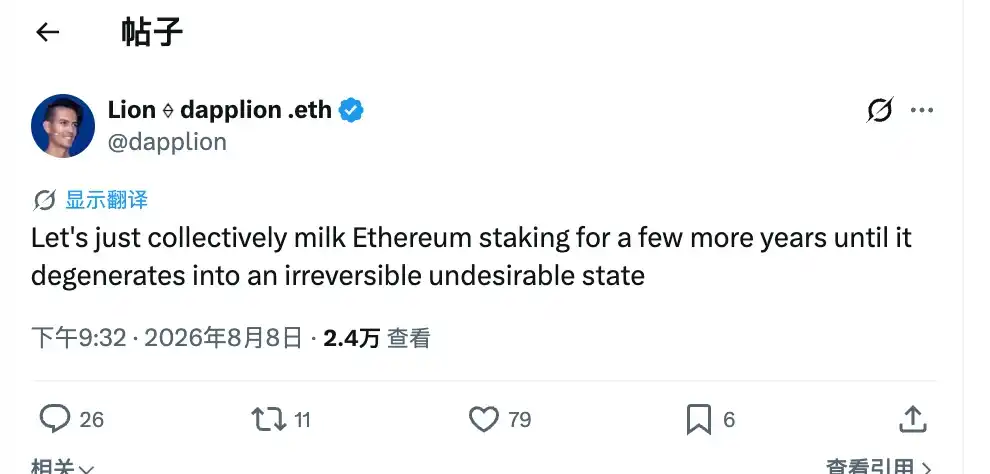
The author also pushes back on language from some supporters who describe yield-based businesses on Ethereum as “extractive” or as recipients of a “systemic subsidy.” The piece argues that such framing ignores the work actually being done, citing Obol as a team building DVT infrastructure and Octant as a public goods funding mechanism.
Potential ripple effects in DeFi
The article treats DeFi transmission as another major fault line. Base staking yield is used across Ethereum DeFi, and a sudden drop in ETH staking returns would feed straight into ETH lending rates.
Today, participants borrow ETH to stake it, lend ETH to earn yield, and post ETH as collateral to borrow stablecoins and buy more ETH. If staking returns fall, those incentives reverse. The analysis says users would borrow ETH to sell it, stop lending ETH because the yield is too low, and shift toward stablecoins rather than ETH as collateral.
That could trigger large-scale unwinds of staking-yield strategies. The article points to possible outflows from DeFi vaults, a decline in total value locked, and weaker demand for ETH.
It also notes that not every DeFi user is a yield farmer. DeFi provides access to financial services for users around the world, and many rely on it for saving, investing or dealing with local currency inflation. A sharp change in yield at this scale would affect those users as well. The author says the bigger concern is the instability that could follow.
An argument built on expectations
One reason the proposal is so controversial, according to the article, is that it rests on expectations about where the market would settle. Under either curve, it is still unknown how equilibrium would be reached two years from now.
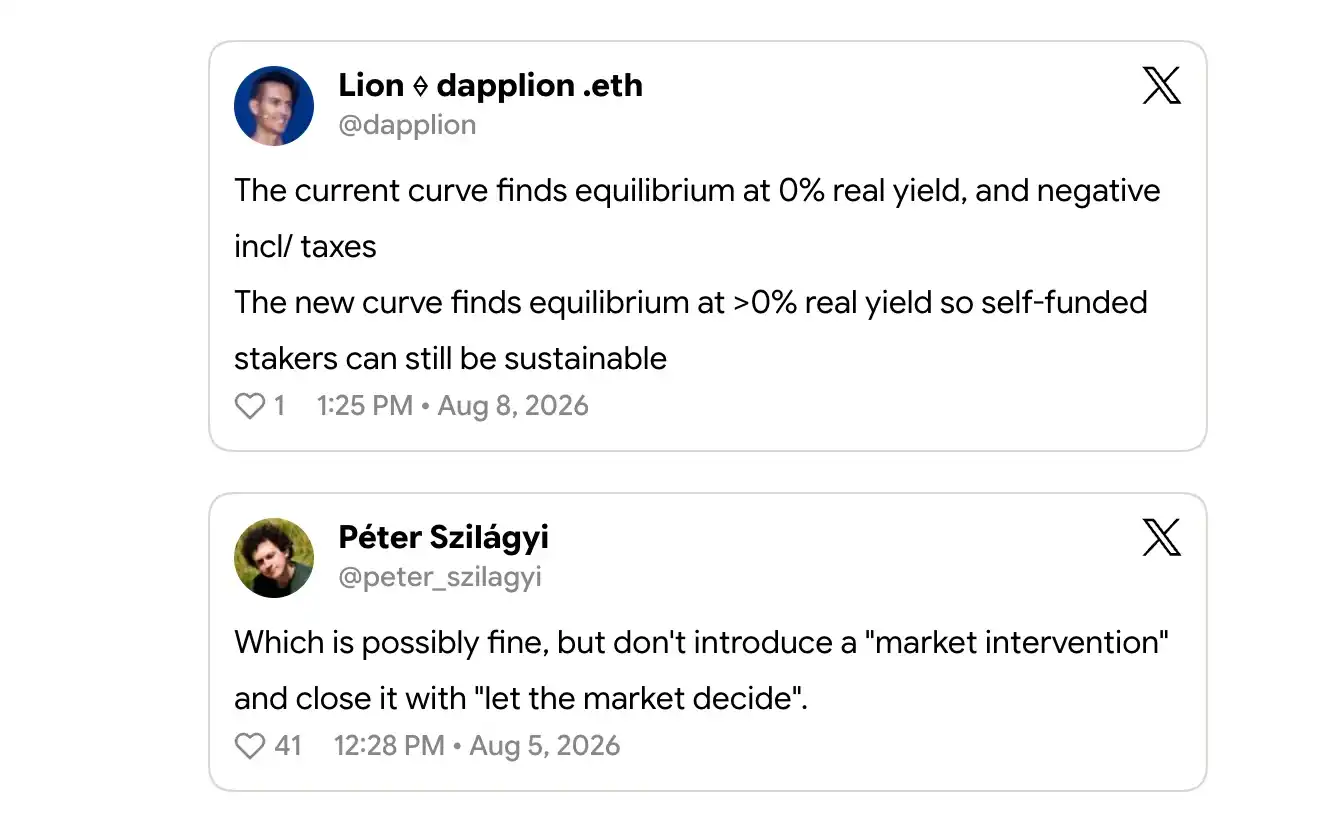
A core argument from supporters is that the new curve would find equilibrium while real yields remain above 0%, allowing self-funded stakers to stay in the system.
The analysis cites pa7x1’s work, “The Shape of Future Issuance Curves,” which estimates that under the current curve, independent stakers first hit negative real returns when staked ETH reaches 70 million. Under the new proposal, that threshold appears before 60 million ETH. If actual costs are higher than estimated, the threshold could arrive even earlier.
Open questions about Ethereum’s longer roadmap
The article closes by saying there has been little discussion about how EIP-8363 fits with the target of 128,000 validators. Ethereum’s roadmap includes changes aimed at reducing the validator set, since a smaller validator set helps cut signature, attestation and state load on the consensus layer.
One goal of MaxEB, EIP-7251, is to reduce that burden by consolidating validators. The broader direction, the piece says, would help Ethereum move closer to single-slot finality.
Issuance burn would effectively place a cap on the amount of staked ETH and, by extension, reduce validator count. The article says it is still unclear whether reducing the validator set is an indirect objective of the proposal, and that clarification from researchers would be useful.
The author’s final view is straightforward: a balanced staking ratio is a good goal, EIP-8363 may ease some of the pressure it targets, but it does not solve the problem it claims to solve, and the cost is greater than the benefit.