

A draft Ethereum proposal known as EIP-8363 has set off a broad fight across the ecosystem by targeting one of the network’s core economic assumptions: validator issuance should not keep flowing forever if too much ETH ends up staked.
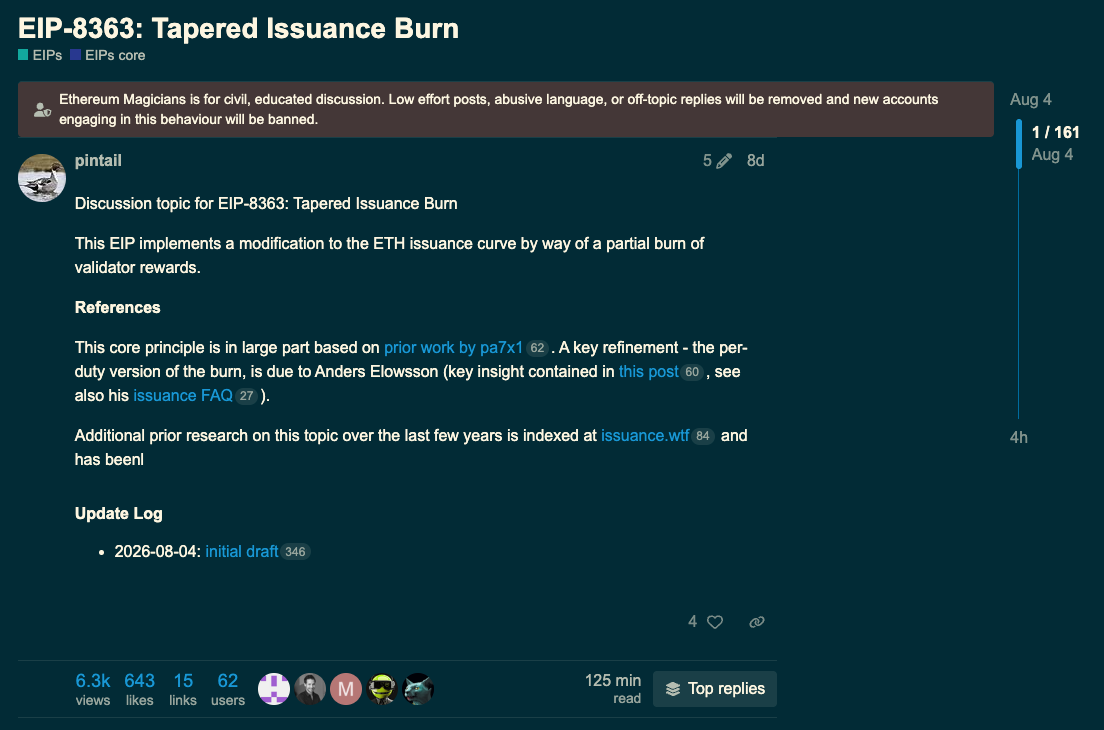
The proposal, titled “Tapered Issuance Burn,” says that as staked ETH moves closer to half of total supply, newly issued rewards that would otherwise go to validators should be burned on a rising scale until they fall to zero. In practical terms, staking yields would keep shrinking as the network staking ratio rises.
The argument has spread across Ethereum researchers, DeFi founders, and publicly listed ETH treasury companies that depend on staking income. Aave founder Stani Kulechov described it as one of the most heavily resisted proposals in Ethereum’s history. The topic was given a dedicated 30-minute slot at the Aug. 6 core developers meeting, ACDC #184.
What EIP-8363 would change
Under Ethereum’s current issuance model, more staked ETH leads to more total issuance, even though rewards are diluted across a larger validator set and APR falls as participation increases. One feature of the current design is that issuance never fully shuts off. The source article says validators would still receive a floor return of about 1.5% even if 100% of ETH were eventually staked.
The authors of EIP-8363 argue that this always-on model creates a structural problem. If ETH staking pays more than alternative crypto yields, capital has an incentive to keep moving into staking, pushing the staking ratio higher over time. In their view, very high staking penetration risks concentrating ETH in the hands of centralized entities such as exchanges, custodians, and ETF issuers rather than individuals directly participating in network security.
The proposal responds with a tapering mechanism. As total staked ETH approaches 60.25 million ETH, described in the article as roughly 50% of current supply, the protocol would burn an increasing share of issuance rewards instead of paying them out. Once staking reaches that line, net validator income from issuance would drop to zero.
Two points matter here. First, the mechanism would only affect issuance rewards. It would not touch execution-layer income, including transaction fees and MEV, or miner extractable value as referenced in the source. Validators would still have other revenue streams even if issuance fell away. Second, the slashing framework would remain unchanged. Validators that go offline or misbehave would still be penalized, but with lower earnings it would take longer to recover those losses.
The proposal has six co-authors, including Ethereum Foundation researcher Justin Drake and EthCC co-founder Jérôme de Tychey. It remains in Draft status and is still far from inclusion in a future hard fork.
The case from supporters
Supporters are working from a familiar line inside Ethereum research circles: network security does not scale linearly with the amount of ETH staked. At some point, the marginal security benefit of additional stake starts to fade, while the political and economic side effects get worse. In that reading, letting staking grow without any upper bound may add less security than many assume, while increasing concentration among large institutions.
That is why some backers see an explicit limit as preferable to an open-ended issuance curve.
They also argue that maintaining the current reward schedule could push ETH net supply growth toward 1% a year. For holders who do not stake, that functions like hidden inflation. Limiting issuance, on this view, would support Ethereum’s long-term scarcity narrative. The article says Grayscale’s research team expressed a similar position earlier this year, arguing that controlling inflation and strengthening ETH’s role as a store-of-value asset would be positive for price over the long run.
Another pro-EIP argument centers on independent stakers. Institutional staking providers often carry management fees and compliance costs. A home validator running a node directly may have far fewer overhead expenses. If aggregate yields compress and market returns move closer to a low-risk premium, lean independent operators could be in a better position to stay in business than intermediaries that need richer yields to cover costs.
The case from critics
Opponents say the mechanism could intensify the same centralization pressures it claims to address.
Stani Kulechov calculated that, at the current staking ratio and including both issuance rewards and MEV income, validator returns would fall from about 2.86% to 1.48%, close to a 50% drop. His argument is that once returns approach zero, the actors left staking will be those with structural, compliance, or product reasons to do it anyway, namely exchanges, custodians, and institutional ETFs. In that scenario, the market participants pushed out first would be ordinary stakers and smaller independent operators who are there mainly for economic return.
Critics also point to the transition design. During that period, nominal rewards received by validators would first be temporarily raised, then gradually pushed lower, while about half is burned. In countries that tax staking income on receipt, such as the United States, that could leave independent stakers with sharply higher taxable income on paper, potentially even doubling it, while cash flow does not improve in the same way.
There is also a DeFi angle. ETH staking yield has long acted as an informal reference rate for on-chain lending and derivatives pricing. If that yield moves close to zero, some strategies, including borrowing ETH to short ETH, could lose economic coherence. Critics say that could ripple through lending protocols and the business models behind liquid staking tokens, or LSTs.
The founder of ether.fi said the proposal was disappointing across the board. Lido’s team argued that issuance rewards do not only buy slashable stake. They also support node operator diversity and censorship resistance, both of which may become harder to maintain if rewards are compressed toward zero.
The article also notes that some of the loudest critics, including Aave, Lido, and ether.fi, are directly tied to staking and DeFi revenue streams. Ethereum co-founder Vitalik Buterin has not publicly commented on the proposal so far, and co-author Justin Drake has also not spoken publicly about it for some time.
How much yield could change
Using the formula described in the proposal, the article estimates that at a staking ratio of about 34%, net validator returns from issuance would fall from roughly 2.6% to around 1.2%. If the staking ratio rises to 50%, that issuance component would be eliminated entirely.
That is only the issuance side. Fees and MEV would remain intact, so the decline in actual total validator income would be smaller than a full halving. The article places the broad reduction in total returns at around 40%.
Market reaction and the treasury-company question
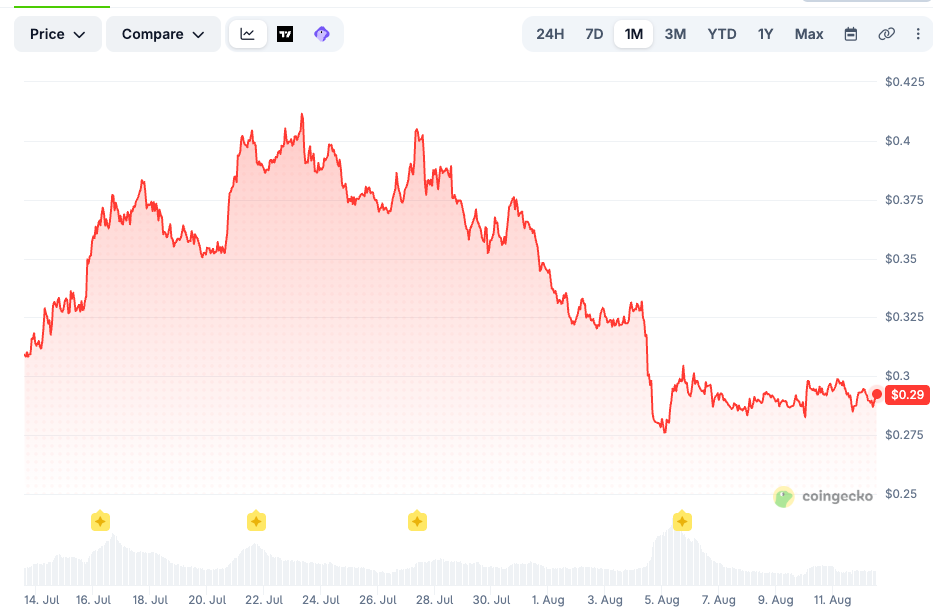
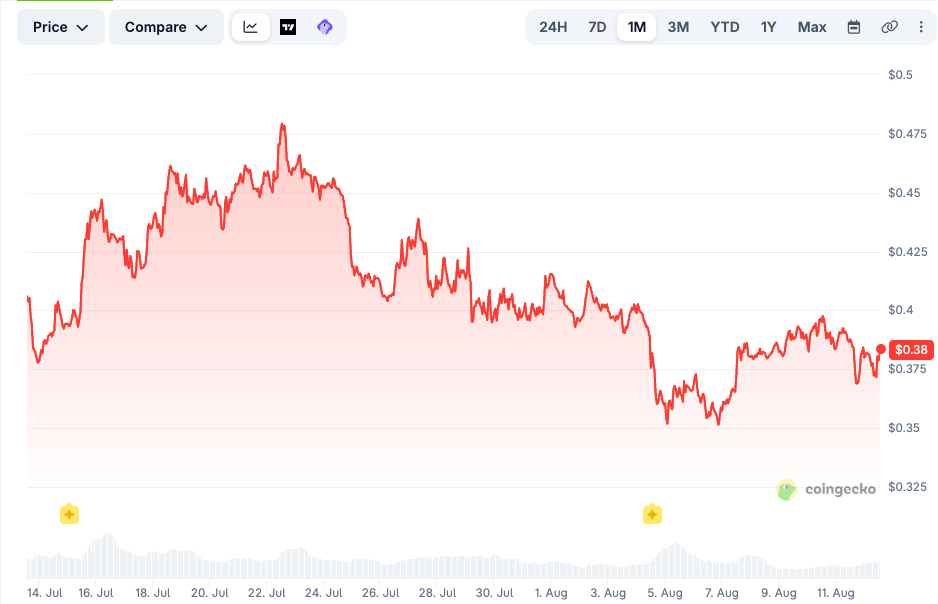
The immediate market reaction showed up first in liquid staking names. The article says Lido and Ether.fi each fell by more than 10% after the proposal became a focus of attention.
Lido saw a visible decline at the start of the month, according to the source.
Ether.fi’s price action was cited alongside it.
A larger question is what happens to listed ETH treasury companies whose business model depends on staking income. Over the past year and more, a group of such companies has entered U.S. public markets. Their model is relatively direct: raise capital, buy large amounts of ETH, stake those holdings, book recurring yield as revenue, and pitch investors on growing ETH exposure per share.
Industry data cited in the article says that among treasury companies that separately disclose staking income, staking accounts for about 60% of reported revenue on average. For some firms, it is close to the whole story.
Different exposure across firms
BitMine (BMNR) is described as the largest ETH treasury by holdings, with about 5.8 million ETH, around 87% of which is staked. Its annualized staking income is said to be in the range of more than $200 million. If net consensus yield were roughly cut in half, its annualized staking income would drop from about $257 million to roughly $120 million to $130 million.
SharpLink (SBET), the second-largest ETH treasury, is backed by Consensys and Ethereum co-founder Joe Lubin, according to the article. Nearly all of its holdings are staked, and staking income makes up 97% of its quarterly revenue. That leaves the company exposed to a revenue decline of more than 35%, based on the estimates cited.
SharpLink CEO Joseph Chalom, formerly BlackRock’s head of digital assets, has publicly opposed the proposal. His position is that native staking yield is one of ETH’s biggest differentiators against Bitcoin. If that edge is weakened, the carrying cost of owning ETH rises for institutions, and over time some capital could move elsewhere.
Bit Digital (BTBT) stands apart. The company shifted into an ETH staking and treasury model in June 2025, but its dependence on staking has been lower and is falling. As of May 31, only about 74,163 ETH, or roughly 46% of its holdings, was staked, down from about 89% at one point earlier. The company said it reduced the staking ratio to preserve flexibility and pursue higher-yield opportunities. It also held about 27 million shares of WhiteFiber (WYFI), valued at about $755.6 million in May, making it less reliant on staking than BitMine, SharpLink, or Ether Machine.
The article stresses that the clearest market reaction so far has been in liquid staking protocol tokens such as Lido (LDO) and ether.fi (ETHFI), both of which fell by more than 10% within a day or two of the proposal gaining attention. By contrast, spot ETH and the share prices of several treasury companies have not yet shown obvious moves that can be directly tied to EIP-8363. For now, those assets still appear to be driven more by ETH price fluctuations themselves.
Where the proposal stands now
EIP-8363 remains far from implementation.
It is still at the Draft stage and has not entered a formal path toward inclusion in a scheduled Ethereum upgrade. At the Aug. 6 core developers meeting, participants raised repeated concerns about smaller validators and centralization risk. According to the article, the recommendation after discussion was to consider removing the proposal from the Hegotá upgrade process.
In the proposal list that was later confirmed for that upgrade, EIP-8363 was not included.
That leaves its future unresolved. The article says community consensus is deeply split, with neither side close to overwhelming the other in the near term.
The more practical conclusion in the source is narrower than a yes-or-no call on this specific draft. Even if EIP-8363 never ships in its current form, the underlying question is unlikely to disappear: should Ethereum place some kind of upper bound on staking participation? Future versions could return with a minimum yield floor, a longer transition period, or a redesigned trigger threshold in response to the objections now dominating the debate.