
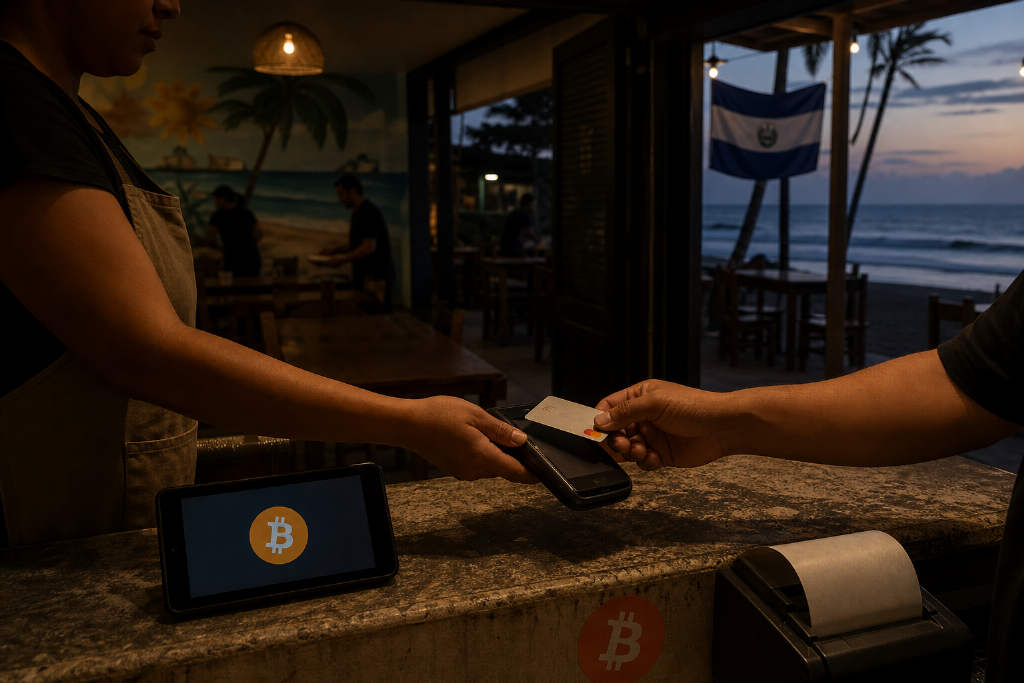
Bitcoin payments appear to be fading in El Zonte, the Salvadoran town known internationally as “Bitcoin Beach,” once treated as a bellwether for real-world BTC spending. Bitcoin Core developer Jon Atack said a restaurant where he recently paid in Bitcoin told him his transaction was the first BTC payment the business had received in August.
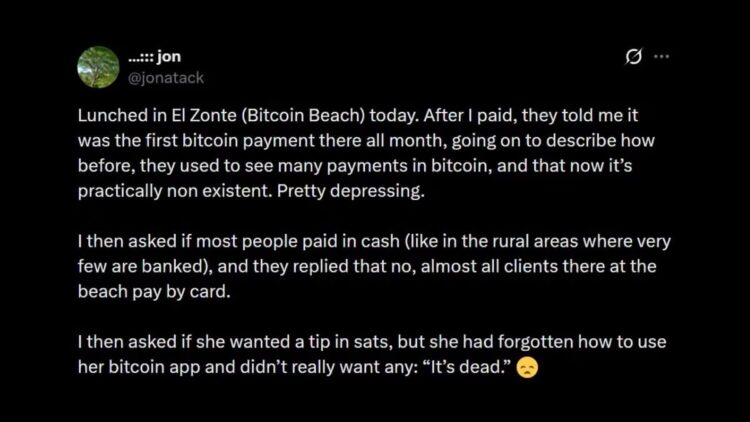
Atack, who has lived in El Salvador since 2022, shared his experience from a recent meal in El Zonte. According to his account, restaurant staff said Bitcoin payments used to be common but are now “almost nonexistent.” When he asked what customers mostly use today, staff told him that nearly everyone in the beach area pays by credit card.
Atack also said he offered a tip in satoshis, but the worker declined after saying they had forgotten how to use the Bitcoin app.
The observation comes from a single merchant, so it cannot on its own stand in for all of El Zonte or the country’s full Bitcoin payments picture. Other visitors have said they were still able to spend Bitcoin in El Zonte recently, and some businesses continue to display signs saying they accept BTC.
National surveys point to a steady decline in usage
What Atack described tracks with survey data from recent years. Research from the public opinion institute at Central American University (UCA) found that only 8.1% of Salvadorans used Bitcoin in 2024 to purchase goods or pay for services. That was the lowest reading since Bitcoin became legal tender in 2021.
The same series showed usage at 25.7% in 2021, 21% in 2022, 12% in 2023, and 8.1% in 2024. The 2024 survey covered 1,266 respondents, with a 95% confidence level and a margin of error of about 2.75 percentage points.
A separate survey conducted by Francisco Gavidia University reached a similar result. About 92% of respondents said they did not use Bitcoin for transactions in 2024, putting actual usage at about 7.5%.
Those surveys are based mainly on self-reported usage and do not directly measure national merchant transaction volume. Even so, the longer-term data shows a continued drop in the share of Salvadorans using Bitcoin for day-to-day payments.
Policy changed in 2025 as Bitcoin acceptance became voluntary
El Salvador formally granted Bitcoin legal tender status in September 2021, becoming the first country to do so. The government rolled out the Chivo Wallet, installed Bitcoin ATMs, and put in place U.S. dollar conversion mechanisms in an effort to drive adoption among consumers and merchants.
That policy shifted in 2025. To secure a $1.4 billion financing program from the International Monetary Fund (IMF) lasting 40 months, El Salvador amended its Bitcoin Law. Private businesses were no longer required to accept Bitcoin, and taxes had to be paid in U.S. dollars.
The government also removed parts of the framework that had supported free conversion between Bitcoin and dollars, while gradually reducing public-sector involvement in Chivo Wallet. Businesses can now decide whether to keep offering Bitcoin payments based on customer demand, operating costs, and their own preference.
The report says that after the rules were loosened, merchants with little real transaction demand had less reason to keep maintaining payment equipment and operating procedures tied to Bitcoin. It also notes that Bitcoin price volatility, the learning curve involved in wallet use, and a tendency among holders to keep coins for the long term may affect willingness to spend it in daily transactions.
Government BTC holdings and retail payment use are moving in different directions
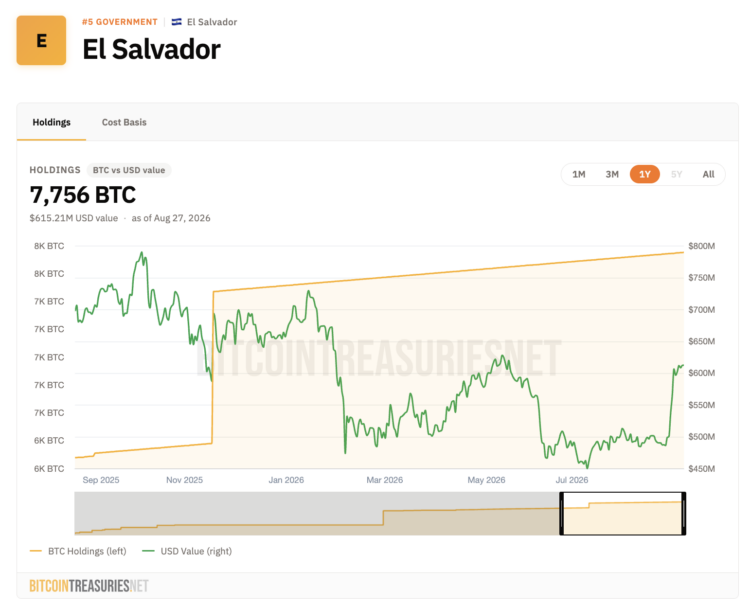
Retail usage has weakened, but government-related Bitcoin holdings remain under close watch. Public tracking data shows that as of Aug. 25, wallets linked to El Salvador held about 7,756 BTC worth roughly $615 million. The headline figure shows holdings up by about 240 BTC so far this year.
IMF documents, however, offer a different reading of those holdings. Documents signed by the Salvadoran government and the IMF indicate that after the financing program was approved, the public sector’s total Bitcoin position did not actively increase. Some of the growth shown in government wallets may reflect transfers between addresses controlled by different parts of the government.
That means changes seen in public wallet balances cannot be used on their own to measure how often Salvadorans are paying with Bitcoin.
El Zonte was an early starting point for El Salvador’s Bitcoin experiment. Local communities were promoting the Lightning Network and Bitcoin payments before the national policy took effect. The infrastructure is still there. The unresolved issue is whether people will actually choose to use it for coffee, meals, and everyday shopping.