
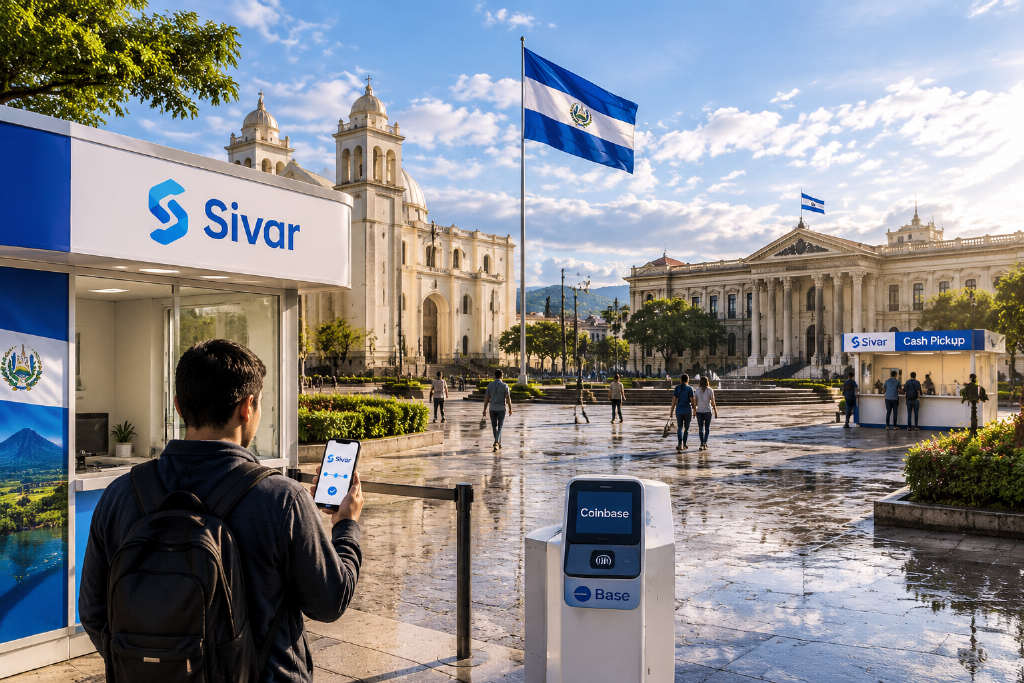
El Salvador’s government and startup Modveon have launched Sivar, a national app that allows U.S. residents to send money to people in El Salvador for a flat $2 fee, no matter the transfer size, as long as the recipient has completed identity verification.
The transfer moves as a stablecoin on Base, Coinbase’s blockchain. The national launch was announced Tuesday by the government and Modveon.
Five-year agreement with a Salvadoran public institution
Modveon signed a five-year agreement with AAB, a Salvadoran public institution whose full name is Agencia Administradora de Fondos Bitcoin, or Bitcoin Fund Management Agency. According to the release, the contract took effect this month and places Modveon in charge of developing the app and handling its day-to-day operations.
The release also said AAB is one of Modveon’s investors. The Palo Alto company has raised $10 million in a round it first announced in February. Backers also include Coinbase Ventures and Firebolt Ventures.
How Sivar handles transfers
Coinbase said its infrastructure manages Sivar payments from end to end. U.S. senders fund transfers through Coinbase Onramp, each user receives a non-custodial wallet inside the app, and recipients can withdraw cash at more than 1,000 locations across El Salvador.
According to Coinbase, the app keeps the crypto layer out of sight for users.
The release said remittances to El Salvador totaled about $9 billion last year, with roughly 92% of that money coming from the U.S. In a company blog post, Coinbase Chief Policy Officer Faryar Shirzad said, 「Salvadorans send billions of dollars home every year, and too much of it disappears into fees.」
More than payments
Payments are only one part of Sivar. Salvadoran users verify their accounts with the national identity card known as the DUI. After that, they can post, join local communities organized down to the district level, and vote in polls.
Modveon said more than 25,000 Salvadorans used Sivar during a phased rollout before the national launch.
Bill payments, merchant payments, and payments between citizens and the government are planned, depending on product, partner, and regulatory availability.
Shift from bitcoin legal tender to stablecoin rails
El Salvador made bitcoin legal tender in 2021 and launched Chivo, a government-backed bitcoin wallet.
In early 2025, lawmakers amended the Bitcoin Law to make bitcoin acceptance voluntary for businesses. That change was a condition of a $1.4 billion loan agreement with the International Monetary Fund, which also said the government’s role in Chivo would be gradually wound down.
Stablecoin remittance services have also attracted major funding this year. Félix, a WhatsApp-based remittance service for Latinos in the U.S., raised $200 million in equity and credit in September. Andreessen Horowitz led the equity portion.