
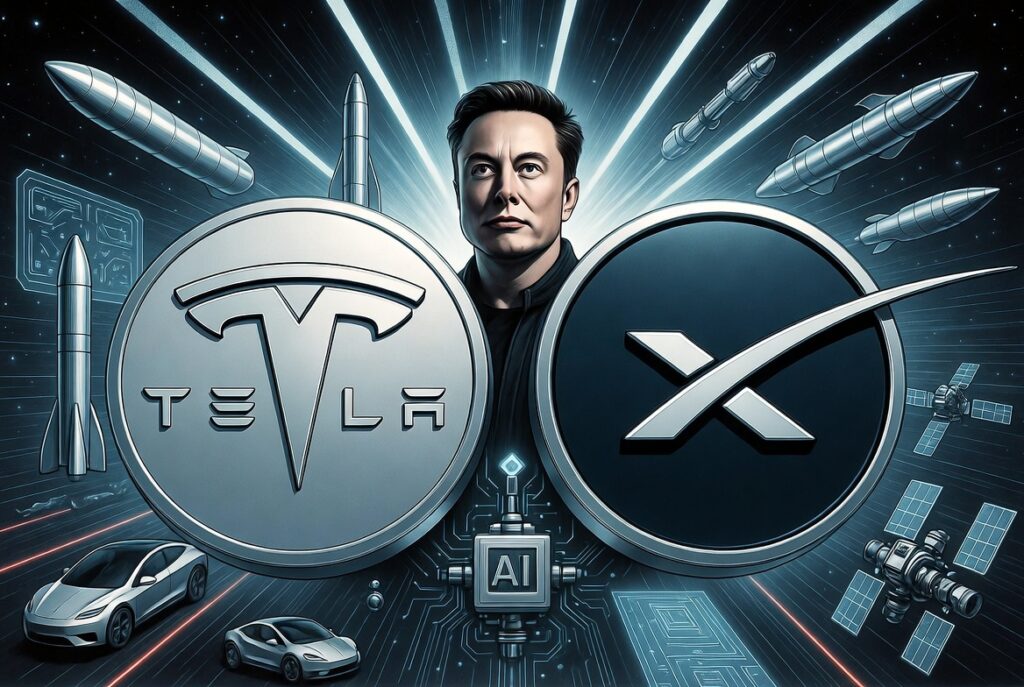
Wall Street is openly discussing whether Elon Musk could eventually merge SpaceX and Tesla after SpaceX completed a record-setting initial public offering in June, according to CNN Business. The idea now hanging over Tesla’s July 22 earnings call is the possible creation of a technology company worth about $3 trillion.
Merger speculation moves to the center of the Tesla earnings discussion
After SpaceX’s high-profile market debut, attention quickly shifted to what Musk might do next. CNN Business said one of the most talked-about scenarios on Wall Street is a combination of SpaceX and Tesla, creating a company large enough to rival Microsoft in market value.
JPMorgan analyst Rajat Gupta said the strategic case is strong. A merger, he argued, would let Musk bring the two companies under a single vision, mission, and engineering leadership structure, while also unlocking large operating synergies.
AI strategy and ownership structure are driving the debate
Gupta also pointed to financial advantages. A combined company could have an easier time raising capital in public markets and could improve efficiency by integrating AI operations, giving the group a stronger position in the race around artificial intelligence.
Control is another key part of the argument. The report said Musk holds more than 80% voting power at SpaceX, but only about 20% control at Tesla. If the two companies were combined, his effective control over Tesla’s business would rise sharply, which could reduce outside shareholder pushback over his decisions.
Investor focus around Tesla has already changed. Even though expectations for quarterly EV sales remain solid, the report said Wall Street is treating that as a secondary issue. The attention has shifted toward Robotaxi, humanoid robots, and developments tied to SpaceX.
Analysts see a path to a deal before 2027
Both companies’ elevated valuations are now closely tied to expectations for AI breakthroughs, the report said. It also noted that Tesla and SpaceX formed a joint venture called Terafab in March and set up a dedicated microchip factory in Austin, Texas.
Based on those links, Wedbush analyst Dan Ives said the probability of a merger before 2027 is above 80%. He said, “From a data engineering and Musk ownership perspective, this is such a logical move.”
Ross Gerber, an early Tesla investor, took a similar view. For investors who trust Musk, he said, such a structure would be a “more attractive overall investment” and would allow them to more directly “invest in Elon.”
Regulation and valuation risk remain major obstacles
For all the excitement, the report also laid out major barriers. JPMorgan warned that Tesla operates a large gigafactory in China and depends heavily on the country for sales and profits, while SpaceX has deep ties to the U.S. government and military. That combination could trigger tougher national security reviews and broader regulatory scrutiny in both countries if a merger were pursued.
There is also the question of how durable the valuation would be. Analysts said Tesla and SpaceX each carry valuations of roughly $1 trillion, and much of that rests on what the report called “Elon’s magic.” If that premium fades after a merger, or if Musk’s past controversies resurface, the value of a $3 trillion combined group could swing sharply.
For now, the market is waiting to see whether Musk addresses any of the speculation during Tesla’s earnings call after the close on July 22.