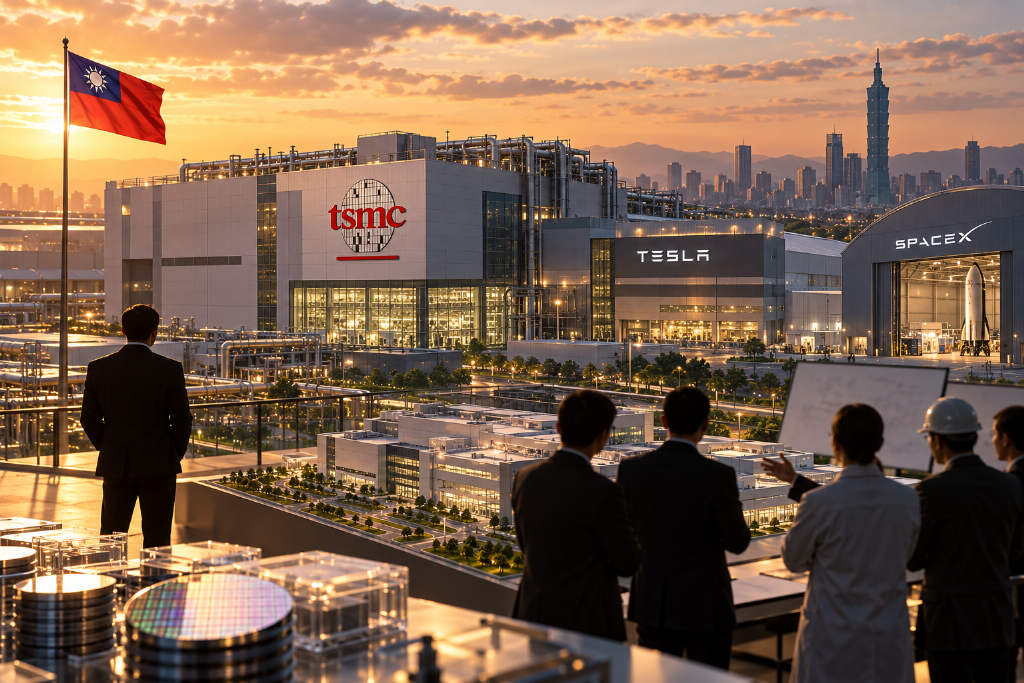
Elon Musk is reportedly taking a more practical line on the Terafab wafer fab project with Taiwan Semiconductor Manufacturing Co. (TSMC), with DIGITIMES saying the two sides are preparing to reopen talks.
Musk had previously insisted that Tesla and SpaceX would build and run Terafab on their own, while TSMC would be allowed to lease only part of the facility. That position now appears to be softening, though no revised agreement has been confirmed.
Musk’s stance appears to be shifting
According to DIGITIMES, Musk had originally pushed for Terafab to be built and operated independently. The latest report says he has shown more flexibility toward working with the world’s leading advanced chipmaker, and both sides are now planning to renegotiate.
That marks a contrast with the situation in early October. At that time, Musk said on X that Terafab had to be built and operated by his own side, and that TSMC could at most sublease part of the plant. The project has been described as a source of advanced semiconductors for AI computing, autonomous driving, robotics, and SpaceX’s long-term orbital computing plans.
Execution challenges reportedly mounted
DIGITIMES said the change in tone comes after the project proved harder to move forward than expected. Packaging operations in Texas, PCB capacity, chip yields, and construction speed have all reportedly lagged behind the original plan, prompting Musk to reassess whether an independent semiconductor manufacturing system is realistic.
That lines up with comments Musk made in an interview earlier this month, when he identified PCB, optical modules, transformers, and thermal hardware as the areas under the greatest pressure.
TSMC says any fab must be run by TSMC
TSMC Chairman C.C. Wei said at an earnings conference on the 15th that the company had been in contact with the Terafab team. He also made TSMC’s position clear: any wafer fab would have to be operated by TSMC.
Supply-chain talk cited in the report suggests negotiations may move toward a structure in which TSMC takes over the main construction and operating work. Equity ownership and investment proportions are still under discussion.
That direction is close to an earlier view from JPMorgan. If a partnership is finalized, process technology and control would still remain with TSMC, and the arrangement could resemble joint-venture models such as JSMC and ESMC, with TSMC holding a majority stake.
A separate independent semiconductor analyst said TSMC has typically remained the majority shareholder in its overseas joint ventures, while advanced process technology is also subject to strict controls in Taiwan. On that basis, the two sides may struggle to reach common ground on control.
Intel’s place in the project is still unclear
Intel joined the Terafab plan in April this year, and Chief Executive Officer Lip-Bu Tan said publicly on Oct. 7 that the company would continue to participate. If TSMC becomes the leading party, however, it is still unclear how Intel and TSMC would divide responsibilities.
So far, neither side has disclosed a signing structure, investment amount, or capacity allocation. No revised agreement has been confirmed. For now, the discussion remains driven by supply-chain claims and analyst interpretation, while attention is fixed on whether TSMC would secure operating control, how equity would be split, and whether Intel’s role would change.