

HyperEVM has long been seen as the weakest link in the Hyperliquid ecosystem. Its performance limits mean it still cannot fully serve as the execution layer for complex applications designed to run persistently around Hyperliquid. Kinetiq is now trying to close that gap.

Kinetiq started with kHYPE, a liquid staking product for HYPE, and has grown into the largest protocol by total value locked in the Hyperliquid ecosystem, with TVL of about $1.3 billion. It later expanded from staking into trading through Markets.xyz, a perpetuals venue based on HIP-3. The product drawing the most attention now is Elysium, Kinetiq’s new Hyperliquid Layer 2.
Elysium runs in parallel with HyperCore
Elysium uses the Arbitrum Orbit stack. Transactions execute on L2, state settles to HyperEVM, and HYPE acts as the native gas token. Kinetiq’s stated performance target is 300 million gas per second with block times of 100 to 200 milliseconds, or roughly two orders of magnitude more throughput than HyperEVM. The testnet is already live.
Speed is only the first layer of the pitch. Elysium is also designed to let smart contracts use the trading infrastructure that already exists on HyperCore. HyperEVM’s current L1Read interface mainly offers best bid and ask data from the order book. Elysium plans to let contracts read deeper order book levels, pricing, account balances, and positions on demand. It also plans to support lower-latency order placement from applications into HyperCore.
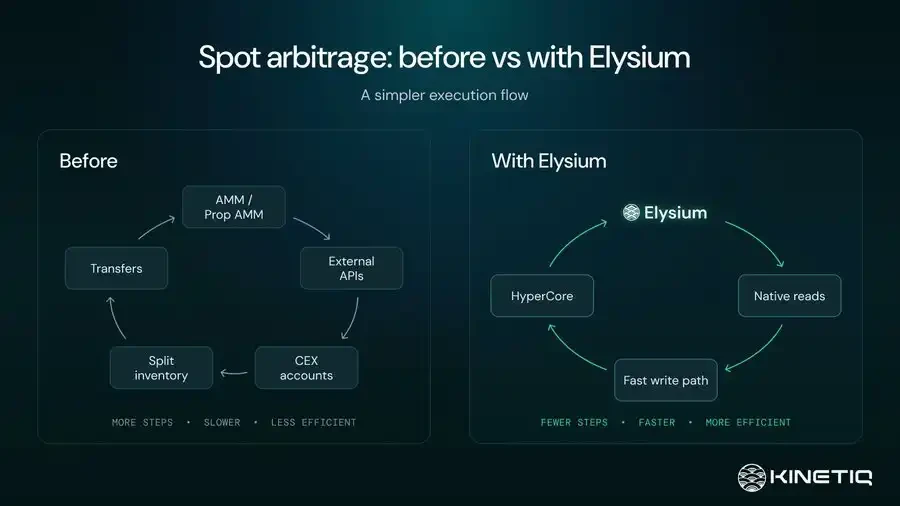
That opens the door to strategies that are difficult to run on HyperEVM today. A proprietary market maker running PropAMM on Elysium, for example, could keep updating quotes based on inventory and market conditions, then hedge on HyperCore after trades are filled. Arbitrage systems could also watch the spread between AMMs and the order book at the same time, cutting dependence on external oracles and accounts spread across multiple venues.
A path for new tokens from launch to mature trading
Elysium is also framed as infrastructure for taking new assets from cold start to a more established trading market.
At the moment, Hyperliquid does not yet have what the article describes as a stable path for asset issuance. In the proposed flow, a newly issued token could first find price discovery inside an AMM on Elysium. As liquidity grows, professional market makers could begin quoting deeper spot liquidity. The token could then be mapped to HyperEVM and linked to HyperCore’s spot order book. Once the spot market matures, the project could then seek a listing on the HIP-3 perpetuals market. In that setup, issuance, spot trading, and derivatives would form a single pipeline.
How value may flow to KNTQ and HYPE
Elysium gives Kinetiq’s token, KNTQ, a relatively direct revenue route. Under the published allocation plan, 25% of sequencer fees goes to application builders that consume blockspace, 25% goes to the Kinetiq treasury, and the remaining 50% is used for open-market KNTQ buybacks and burns. If Elysium gains traction, that framework would be a clear positive for KNTQ.
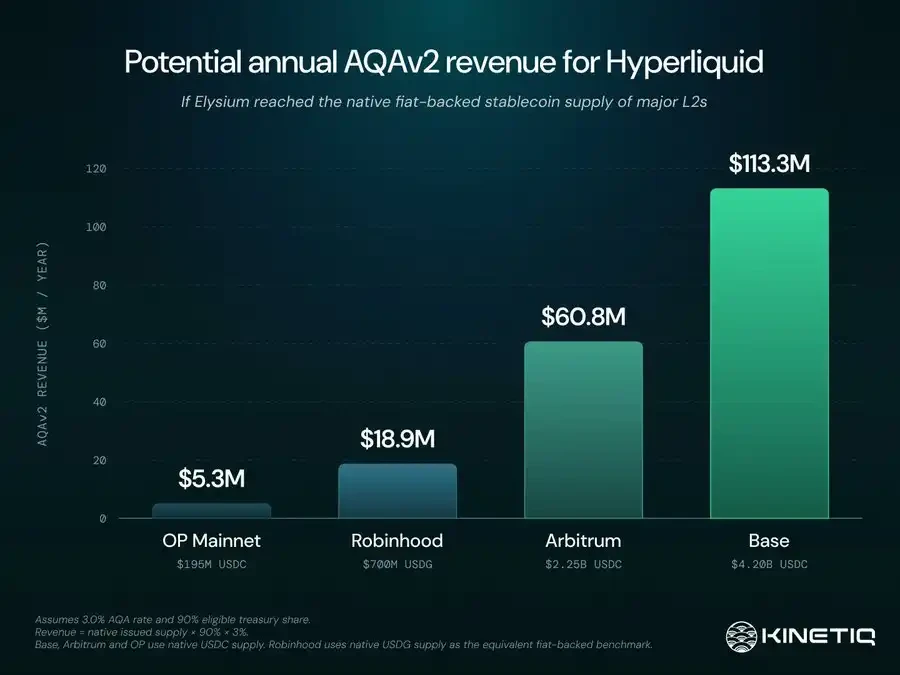
For HYPE, the path is less direct. First, HYPE is the native gas token of Elysium. Second, if AMMs on Elysium generate enough volume and enough spread, market makers and arbitrage traders would return to HyperCore to hedge and match orders, creating new order book fees there.
USDC circulating on Elysium could also add to Hyperliquid’s revenue. USDC on Elysium is backed by native USDC on HyperEVM. Under AQAv2, Hyperliquid can receive a share of yield generated from native USDC reserves on its network. If Elysium succeeds in bringing in new outside capital, even funds used mainly on the L2 side could still expand USDC reserves across the network, which in turn could lift Hyperliquid revenue and HYPE buybacks.
Ascend becomes the first announced deployment
Ascend, co-founded by KOL CryptoTomYT, is the first project to say it will deploy on Elysium. Based on the information now available, it is shaping up to be the chain’s leading launchpad.
Ascend’s documentation says tokens will go directly into a closed hook-based trading pool, without a separate bonding curve phase. At launch, pricing will be quoted in USDC or supported tokenized real-world assets. Trading volume, unique holders, market capitalization, and holder concentration will determine whether a project earns “Ascended” status. Qualified projects can receive platform buybacks and added visibility, and then seek a move into HyperCore spot markets and the HIP-3 perpetuals market.

One of Ascend’s more distinctive mechanics is that users can convert HYPE deposited into the platform into Kinetiq’s kHYPE. The staking yield generated by kHYPE is then used to buy newly listed tokens that have gained “Ascended” status, and those tokens are distributed to stakers. In practical terms, that gives users a way to stake HYPE and gain exposure to higher-quality meme coins launched through the platform.
Ascend does not plan to issue its own platform token. Its proposed trading fee is 1%, with 25% of that fee going to developers. Active creators or project takeover operators recognized by the platform can receive 50%. Of net protocol revenue, 90% is set aside to buy HYPE and 10% to buy KNTQ.
Mainnet timeline is now one month away
According to the article, Elysium mainnet is scheduled to go live in one month. Whether Hyperliquid’s community enthusiasm can carry over and turn Elysium into the next catalyst for HYPE will be something the market watches from here.