
Unitree’s IPO sharpened attention on embodied intelligence
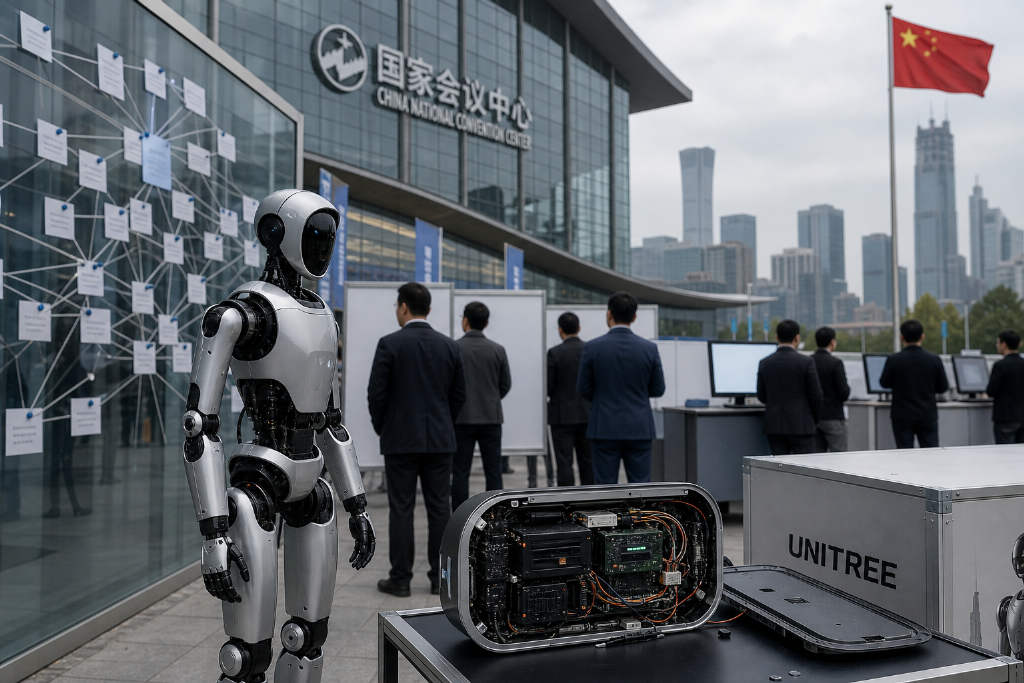
Unitree Technology listed on Shanghai’s STAR Market on Aug. 19, 2026 at an offering price of 150.8 yuan. On its first trading day, the company reached a market value of 341.8 billion yuan, with a price-to-earnings ratio above 219. The company, described by China’s capital market as the country’s first A-share listed humanoid robot company, turned one point into a clear market signal: embodied intelligence is no longer being treated as a lab concept alone.
Still, the mood inside the industry is more measured than the market reaction might suggest. On Aug. 20, one day after the listing, Unitree founder Wang Xingxing said at the main forum of the World Robot Conference that embodied intelligence could be 2 to 3 years away from its real “ChatGPT moment” in a fast scenario, or 5 to 10 years away in a slower one.
IT Juzi used data through Aug. 20, 2026 to map where the sector stands, where capital is going, where founders are building companies, and which investors are taking the biggest positions. The article is drawn from a talk delivered by Liu Xiaoqing, director of analysis at IT Juzi, at an offline salon on Aug. 22. The original piece was published by the WeChat account IT桔子 (ID: itjuzi521) and credited to Judy.
Why embodied intelligence broke out after 2023
In IT Juzi’s framing, embodied intelligence means giving AI a body. Large language models have made most of their progress in digital environments, where text goes in and text comes out. Embodied intelligence aims at a different problem: enabling AI not just to think, but to see, move and manipulate objects in the physical world. If a large model is the brain of the digital world, embodied intelligence is the combination of brain and body for the physical world.
That sets it apart from conventional industrial robots. Factory robotic arms typically follow fixed programs and lose flexibility when products or settings change. Embodied systems are meant to support autonomous perception, generalizable reasoning and adaptive execution. In plain terms, they are expected to respond to changing situations instead of repeating one script.
IT Juzi attributes the post-2023 surge to four forces arriving at the same time. First, large-model capabilities began spilling into robotics as multimodal models, world models and simulation data technologies matured. Second, hardware costs kept falling, including joint modules, sensors and compute chips, bringing down the cost of building a humanoid robot. Third, local governments rolled out specialized policy support for robot industries, pairing funding with land and talent programs. Fourth, Unitree’s IPO and its 341.8 billion yuan valuation gave the broader market a visible proof point that the sector can produce outsized returns.
Yet Wang’s comments at the WRC main forum also underscored the technical limits that remain. He said the biggest bottleneck today is poor generalization. In a fixed setting, a robot’s success rate may approach 100%, but change the environment, or even just the object, and the rate can drop sharply. He compared this with language models operating in digital space, where there is effectively no physical loss. Every interaction a robot has with the real world introduces deviation and loss, he said, and AI still cannot autonomously correct the micro-level errors involved in the “last few centimeters, or even millimeters.”
Wang’s benchmark for a true “ChatGPT moment” is a robot placed into any unfamiliar environment and able to complete roughly 80% of tasks through voice instructions alone. The time range he gave — 2 to 3 years at the fast end, 5 to 10 years at the slow end — shows how much uncertainty still exists, even among leading founders.
He also disclosed a direction Unitree is exploring: “physical AI robot self-evolution,” a closed loop in which AI searches papers, writes code, runs simulation validation, performs real-machine tests and scores the results itself. If that path works, the industry’s ramp could arrive faster than many expect, according to the report.
425 startups and a market still in acceleration mode
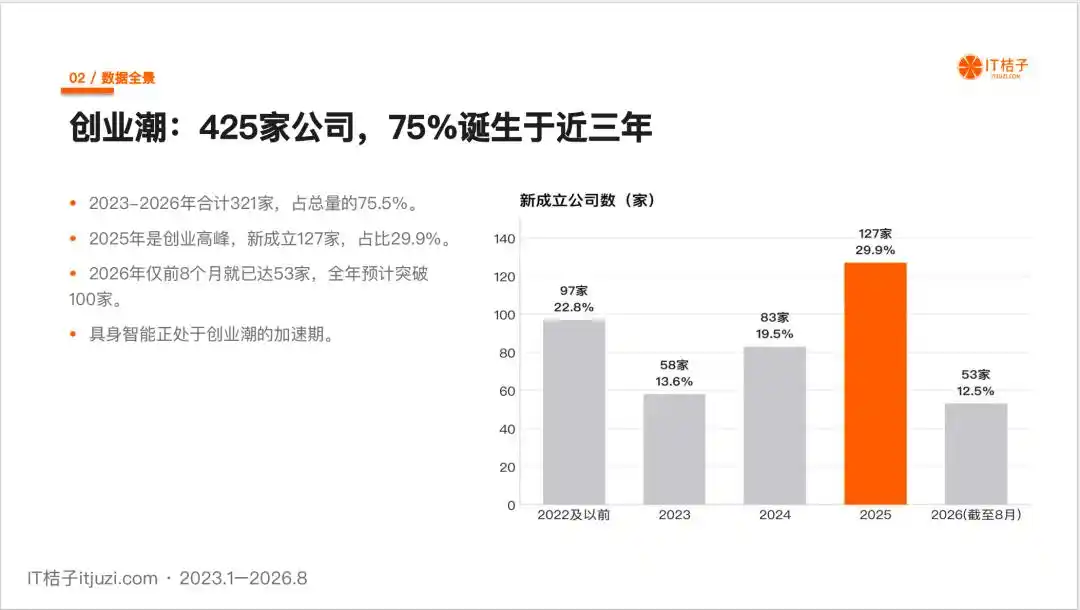
As of August 2026, China had 425 embodied intelligence startups. The more telling figure is structural: 321 of them, or 75%, were founded between 2023 and 2026.
The peak year for company formation was 2025, when 127 startups were created. In the first eight months of 2026, another 53 appeared. At that pace, the full-year total could exceed 100. IT Juzi argues this is not a story of steady linear growth. It is an acceleration phase, and one that shows the market has moved from concept validation to broad entrepreneurial consensus.
There is also a note of caution in the numbers. While 53 new companies in eight months is still a fast clip, the annualized pace is below the 127 recorded for all of 2025. The report says that may mean the first wave of exploratory startup formation is nearing its top, and later entrants will need harder differentiation to stand out.
Beijing, Guangdong and Shanghai dominate the map
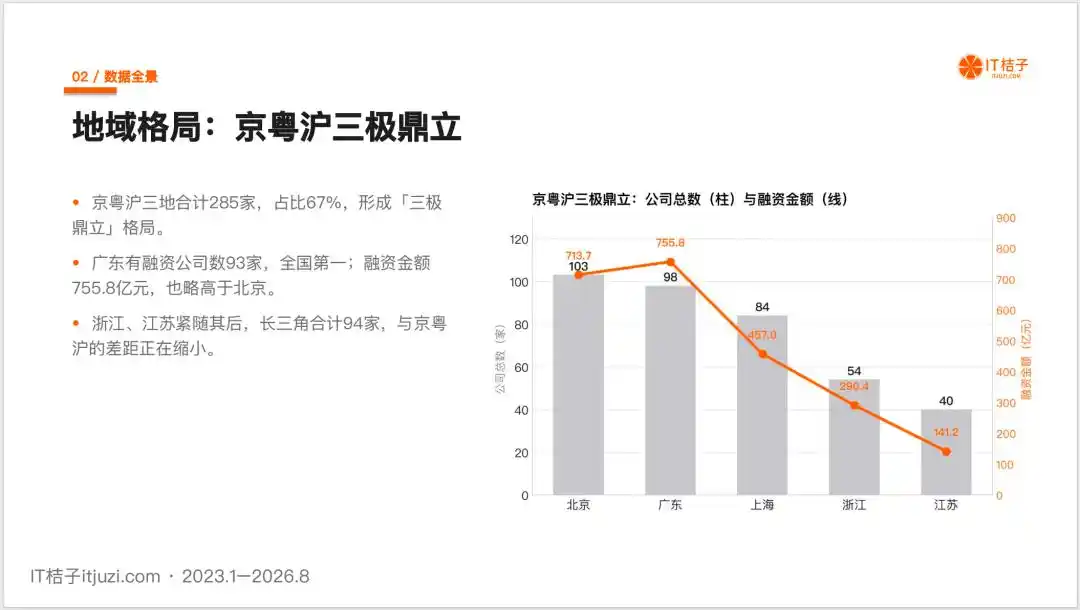
The geographic distribution is highly concentrated. Beijing, Guangdong and Shanghai together account for 285 companies, or 67% of the national total.
Within that group, Guangdong has edged ahead of Beijing on financing metrics. Guangdong has 93 funded companies versus Beijing’s 91, and 75.58 billion yuan in financing compared with Beijing’s 71.37 billion yuan. IT Juzi reads that as more than startup activity alone. It says Guangdong now also holds an advantage in how capital evaluates the region.
The report ties that edge to the Pearl River Delta supply chain. Founders can source almost every major component — from molds and sensors to motors — within roughly an hour’s travel, according to the article.
Zhejiang, with 54 companies, and Jiangsu, with 40, follow behind. Together they bring the Yangtze River Delta total for those two provinces to 94, narrowing the gap with the three leading poles. Even so, IT Juzi says embodied intelligence still has a high regional threshold. Teams outside the core zones face steeper costs in talent access, supply-chain coordination and investor reach.
Funding rounds show an inverted pyramid
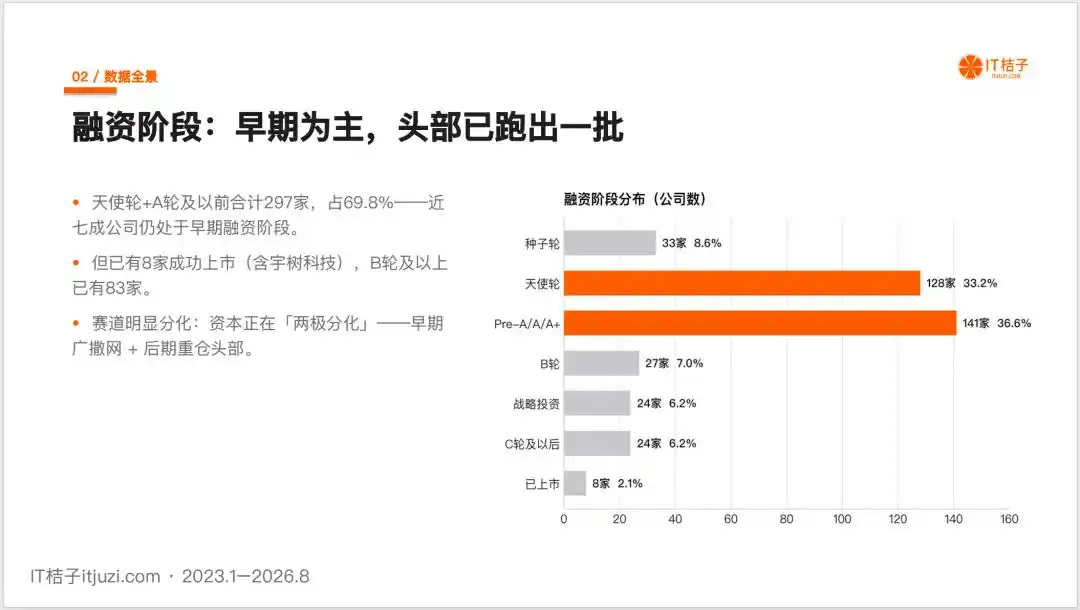
Among 385 companies that have already raised outside capital, financing rounds form a clear inverted pyramid. A total of 297 companies are at angel, Series A or earlier, accounting for 69.8% of the funded set.
At the same time, the field is already separating into tiers. Eight companies, including Unitree, have gone public, while 83 are at Series B or beyond. IT Juzi describes the capital pattern as “large on both ends, small in the middle.” Investors spread bets widely at the start, then add heavily to the companies that break out.
That leaves firms stuck between Series A and Series B under the greatest pressure. The article says this barbell structure has appeared repeatedly in AI, semiconductors and other technology-heavy sectors. In its view, the pattern reflects standard risk control logic in high-risk industries: diversify through many small early checks, then use larger late-stage checks to lean into companies that look more certain.
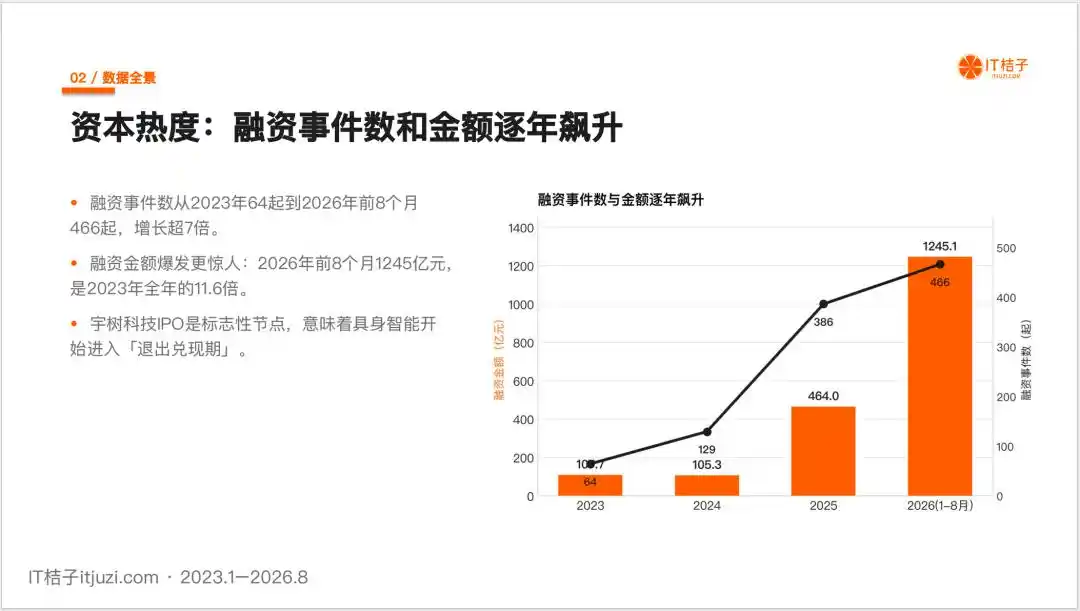
Funding volume jumped to 124.51 billion yuan in eight months
One set of numbers gives the clearest view of how quickly investor appetite has climbed.
- In 2023, the sector recorded 64 financing events worth 10.77 billion yuan.
- In 2024, deal count doubled to 129 while total value stayed broadly flat, suggesting smaller early-stage checks drove the increase.
- In 2025, the market accelerated to 386 events totaling 46.4 billion yuan.
- In the first eight months of 2026, it reached 466 events and 124.51 billion yuan, 11.6 times the amount raised in all of 2023.
For IT Juzi, the main point is not growth by itself but accelerating growth. Each year’s increment has expanded, which indicates money is not entering at a constant pace.
The report gives two reasons. First, IPOs and late-stage financings involving companies such as Unitree have demonstrated a workable exit path and drawn more capital into the market. Second, embodied intelligence has increasingly been accepted by mainstream funds as the “second half” of the AI narrative, shifting from a niche tracked mostly by early tech specialists to a broader allocation target.
853 institutions joined the field
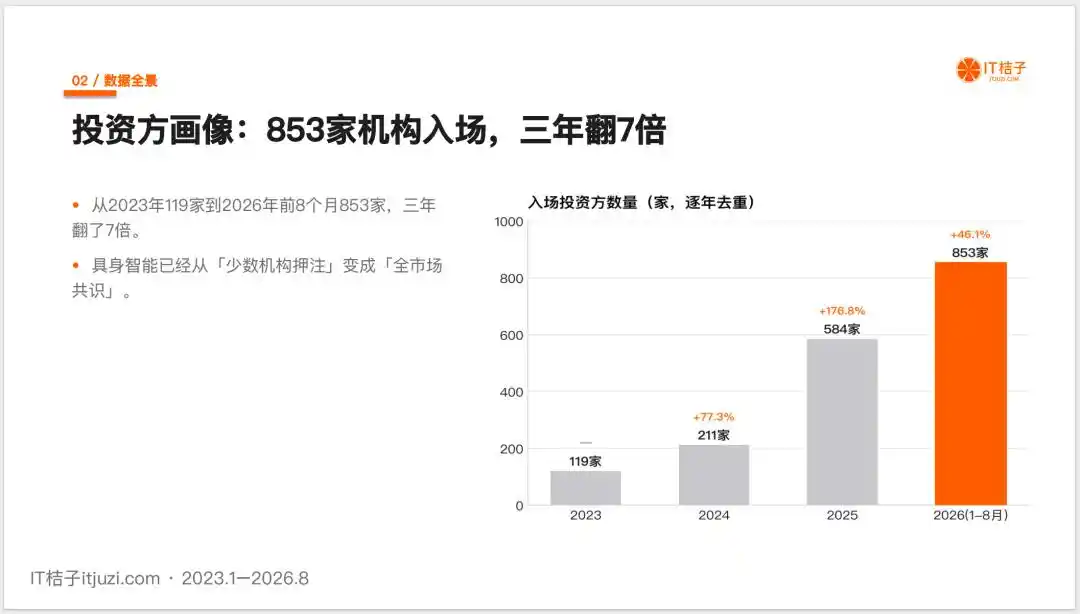
IT Juzi says 853 institutions participated in embodied intelligence investing in the first eight months of 2026. In the report’s reading, that means the field is no longer reserved for a small circle of early-stage tech funds. It has become a market-wide consensus trade.
By growth rate, 2025 was the strongest year for new investor participation, with the number of investors rising 176.8%. In 2026, growth slowed to 46.1%. The article does not treat that as a cooling signal. Instead, it suggests most of the institutions likely to enter have already done so, leaving less room for incremental expansion.
For founders, the implication is a shift in the fundraising contest. The question becomes less whether money is available and more whether a company can secure better money — investors with stronger judgment, industrial links and resource support.
Who is investing the most
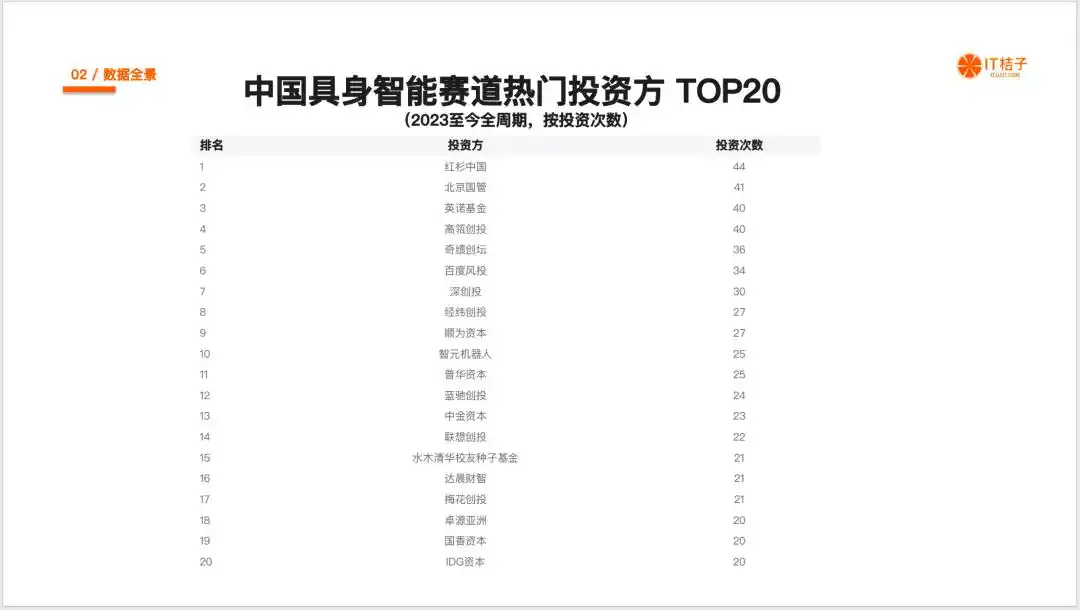
Looking at the top 20 investors by full-cycle deal count, the capital stack spans market-driven venture firms, state-backed institutions and industrial investors.
Sequoia China ranks first with 44 investments totaling 23.06 billion yuan. GL Ventures follows with 40 investments and 20.57 billion yuan. Both stand out for the breadth and intensity of their deployment.
State capital is also prominent. Beijing State-owned Capital Operation and Management ranks second by deal count with 41 investments. Shenzhen Capital Group has 30 and CICC Capital has 23. IT Juzi says these state-backed investors are not acting as simple financial buyers. Their role also carries explicit industrial policy guidance.
MiraclePlus ranks fifth with 36 investments. The report highlights the firm’s seed and angel focus and says its frequency in embodied intelligence points to unusually dense positioning in the sector. AgiBot ranks tenth with 25 investments. Unlike a conventional VC, it is itself a leading embodied intelligence company, and its activity is presented as evidence that top companies are beginning to build their own industrial ecosystems through upstream and downstream investment.
Only one university-linked fund appears in the top 20: the Tsinghua Alumni Seed Fund, ranked fifteenth with 21 investments. IT Juzi says that again reflects the strength of the Tsinghua system in incubating embodied intelligence companies.
The investor roster also changed year by year. In 2023, early-stage firms such as BlueRun Ventures and MiraclePlus were especially active. In 2025, state capital and industrial capital entered at scale. By 2026, top-tier institutions had moved in across the board, including 29 investments by Sequoia China, 24 by GL Ventures and 16 by Baidu Ventures. The article sums up the rhythm as a three-stage path: early probing, mid-stage acceleration and late-stage showdown.
Market-oriented VC remains the main force
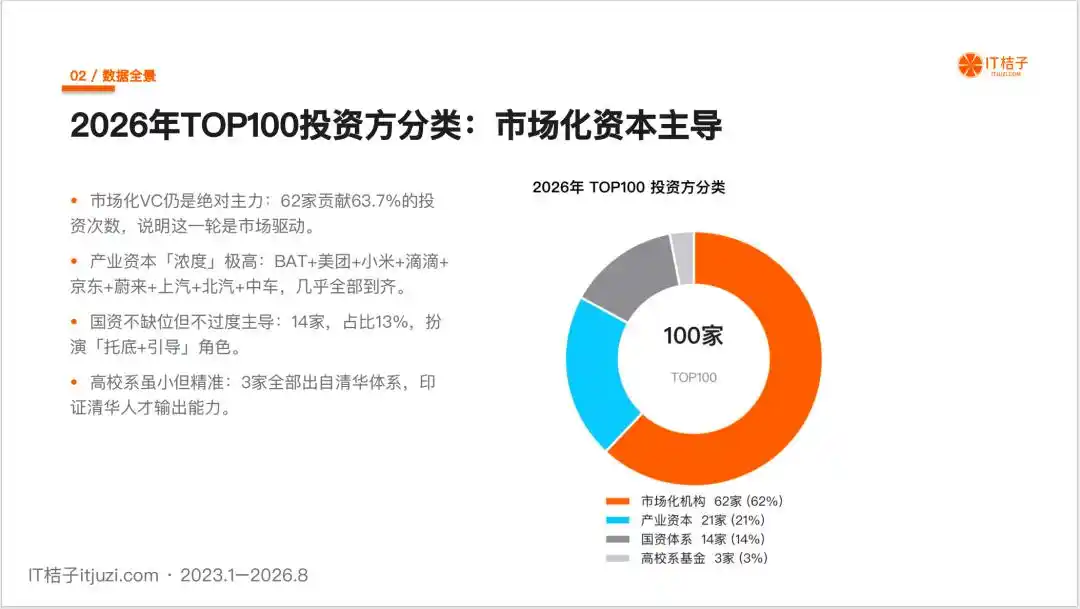
Classifying the top 100 investors in 2026 by type produces a clearer picture of the capital base. Market-oriented venture firms dominate: 62 institutions accounted for 63.7% of total deal count. IT Juzi says that is a healthy sign because it suggests embodied intelligence is being driven mainly by market allocation rather than by policy alone.
Industrial investors also show remarkable concentration. There are 21 of them, including Baidu, Alibaba, Tencent, Meituan, Xiaomi, Didi, JD.com, NIO, SAIC, BAIC and CRRC. The report says these companies are positioning strategically rather than just buying financial exposure. In terms of activity, Baidu Ventures made 34 investments, Xiaomi — through Shunwei Capital — made 27, and Lenovo Capital made 22.
State-backed investors account for 14 institutions, or 13%, and play what the report calls a “floor support plus guidance” role. University-linked capital is smaller but targeted. Only three such funds appear: Tsinghua Alumni Seed Fund, Mudhua Kechuang and Leaguer Capital, all tied to the Tsinghua system, with 25 investments combined.
Founders come disproportionately from elite academic backgrounds
IT Juzi examined the educational background of core founding teams and found a strong academic profile across the sector. Tsinghua University stands far ahead. A total of 96 entrepreneurs in embodied intelligence came from Tsinghua, accounting for nearly one-quarter of those the firm was able to track.
Those 96 founders are spread across 75 companies that have raised more than 78.2 billion yuan combined, or 1.023 billion yuan per company on average. Some 57% hold doctoral degrees, and their median financing amount is 210 million yuan. The report says that median is 10 times the level seen among founders without elite-school backgrounds.
The broader C9 League also dominates. Six of the top 15 schools are C9 members — Tsinghua, Shanghai Jiao Tong University, Peking University, Harbin Institute of Technology, Zhejiang University and the University of Science and Technology of China — accounting for 200 founders in total, close to half of the measured sample.
Returnees from overseas universities are another significant group. A total of 146 founders have educational backgrounds from top foreign schools, including 15 from Stanford University. Stanford is the only overseas university in the top 15. Their median financing amount is 150 million yuan, 7.5 times that of ordinary founders, according to the article.
IT Juzi says that profile makes embodied intelligence look much more like biopharma or semiconductors than a low-barrier internet startup field. Academic background and research experience are close to baseline requirements for many teams.
From building bodies to building brains
The biggest structural shift in the data appears in the distribution of funding rounds across sub-sectors from 2023 to August 2026.
In 2023, humanoid robots led by deal count with a 34.4% share. Embodied brain systems were second at 25%. By 2026, the order had flipped: embodied brain systems reached 38.8%, ahead of humanoid robots at 21.1%.
Put simply, investor attention is moving from building the body to building the brain.
Robot components are also emerging quickly. That segment had only five financing events in 2024, jumped to 55 in 2025, and reached 53 again in the first eight months of 2026. As full-machine production advances, upstream segments such as dexterous hands and joint modules are drawing much more funding activity.
The story changes somewhat when measured by financing value rather than event count. Humanoid robots still lead with 84.05 billion yuan in total funding. Embodied brain systems are second at 63.45 billion yuan, but the pace is sharp: 45.25 billion yuan of that came in just the first eight months of 2026, bringing the category much closer to humanoid robots.
Service robots have raised 17.27 billion yuan in total, including 14.22 billion yuan in the first eight months of 2026. Robot components rose from 100 million yuan in 2024 to 9.66 billion yuan in the first eight months of 2026, the fastest acceleration among the tracked categories.
IT Juzi draws a distinction between breadth and depth. Deal count shows where investor attention is spreading, from full machines into brains and components. Funding value shows where large checks still cluster, and that remains concentrated in leading humanoid robot makers. In other words, investors are broadening their search into brains and parts while still placing the biggest wagers on full-machine leaders.
Five takeaways from the dataset
Capital is in, but the industry threshold has not arrived
Wang’s WRC comments set a wide timeline for a true breakthrough: 2 to 3 years at the fastest, 5 to 10 years at the slowest. Primary-market money, however, has already moved far ahead of that timeline. The 124.51 billion yuan raised in the first eight months of 2026 is 11.6 times the full-year 2023 total. IT Juzi says that means investors are positioning now for an industrial takeoff they expect later. This is still a deployment phase, not a harvest phase.
Humanoid robots are the common denominator, but brains may decide the winners
Humanoid robots remain the largest sub-sector by company financing count and cumulative capital raised, with 313 financing events and 84.05 billion yuan in total. Yet embodied brain systems have already overtaken them in current funding heat, with a 38.8% share of 2026 deal count versus 21.1% for humanoid robots. The article compares this with the smartphone industry, where device makers built the market but operating systems and chips shaped user experience and ecosystem control. IT Juzi says embodied intelligence is moving in a similar direction, with brain-layer leaders rising in strategic importance.
The startup wave is still running, but the window is narrowing
Three-quarters of the sector’s 425 companies were founded in the last three years, and nearly 70% of funded companies are still at early stages. On the surface, that suggests abundant room for new entrants. But the rise of the components segment — from five financings in 2024 to 55 in 2025 — shows the supply chain is extending rapidly downward, and early movers are already building moats.
The report cites two dexterous-hand companies as examples: Lingxin Qiaoshou at a 15 billion yuan valuation and Linjiedian at a 10 billion yuan valuation. Its conclusion is that once a chokepoint segment breaks through, capital is willing to assign a high premium. That also means latecomers face a steeper catch-up cost. For new founders, the question is not only whether to build, but what to build. In crowded full-machine and humanoid tracks, IT Juzi says more practical openings may lie in less-covered gaps such as sensors for specific scenarios, joint components using specific materials, or data services tied to specific industries.
Geographic concentration still shapes outcomes
Beijing, Guangdong and Shanghai account for 67% of company formation and more than 60% of financing. IT Juzi says embodied intelligence entrepreneurship is tightly linked to local hardware supply chains, AI talent density and the strength of state-backed guidance. The Pearl River Delta’s hardware ecosystem, Beijing’s concentration of AI talent, and Shanghai’s international resources and industrial base form the core barriers in each region.
The article also raises an open question: as the industry expands into more cities, could a second tier emerge? It points to Suzhou, Hefei, Wuhan and Chengdu as cities with stronger manufacturing bases or AI research resources that may become hosts for the next wave of embodied intelligence startups.
Big Tech talent spillover is converging with industrial capital
Among the top 100 investors of 2026, 21 are industrial capital players, including Baidu, Alibaba, Tencent, Meituan, Xiaomi, Didi, JD.com, NIO, SAIC, BAIC and CRRC. IT Juzi says these groups are building their own embodied intelligence ecosystems rather than making passive financial bets.
At the same time, founding teams at multiple leading embodied intelligence companies come from Huawei, DJI, Baidu and Tencent. The article says that as people with large-scale engineering experience leave major companies to start new ventures, and as industrial capital brings operating resources into the market, competition will move faster from lab-level technical comparison to a race in industrialization speed.
Separate data on university-linked investors points in the same direction. Three Tsinghua-affiliated funds made 25 investments combined, suggesting universities are not only supplying talent to the sector but also serving as key nodes in incubation. Research, talent development and startup formation are beginning to operate as a closed loop in embodied intelligence.