
Enflame Technology has set the offer price for its STAR Market initial public offering at RMB 142.18 a share, with planned proceeds of RMB 6.119 billion. Based on that pricing, the company’s implied valuation is expected to exceed RMB 60 billion, putting it at the top of the so-called group of four domestic GPU startups referenced in the report.
On Sept. 2, Enflame formally opened online and offline subscription for the offering. The source report said that, by a rough calculation, if the stock rises more than 400% on its first trading day, one winning lot of 500 shares would generate paper profit of more than RMB 280,000.
Tencent shows up again in the strategic placement roster
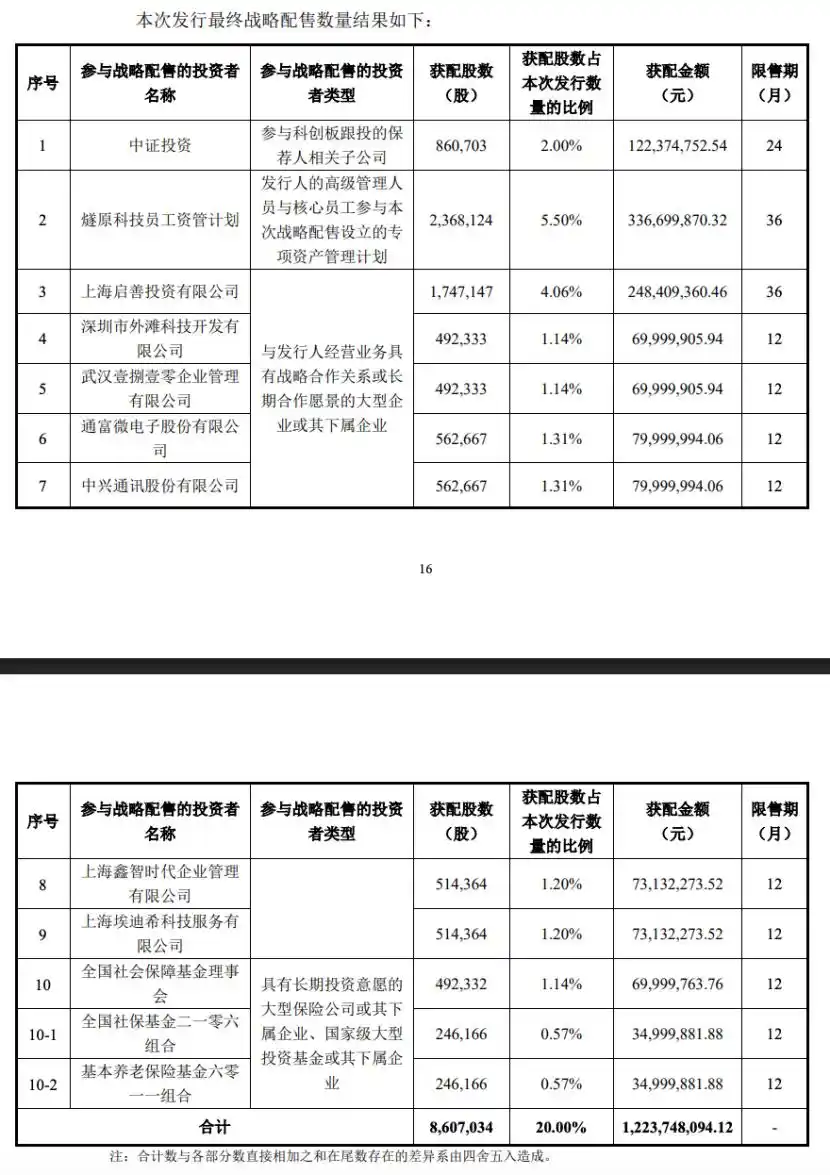
According to Enflame’s STAR Market IPO issuance announcement, the company plans to publicly issue 43.0352 million shares, with estimated gross proceeds of RMB 6.119 billion. Of that total, 10 strategic investors were allotted about 8.607 million shares combined, accounting for 20% of the issuance.
The name that drew the most attention in the final strategic placement list was Shanghai Qishan Investment Co., Ltd. As a wholly owned equity investment platform within the Tencent system, it received 1.7471 million shares worth RMB 248 million, with a lock-up period of 36 months. Among strategic placement investors, its subscription size ranked behind only the asset management plan involving Enflame executives and core employees.
Tencent’s relationship with Enflame goes well beyond this IPO placement. Since 2018, Tencent has joined multiple private fundraising rounds for the company and has accumulated a stake of more than 20%, making it Enflame’s largest external shareholder. At the same time, the prospectus cited in the report shows Tencent is also Enflame’s largest customer, contributing more than 80% of the company’s sales revenue in 2025.
If Enflame’s issue valuation is set at RMB 60 billion, Tencent’s holdings would be worth more than RMB 10 billion, based on the calculation in the report.
Other industry investors also took part
Several industrial investors also appeared in the strategic placement lineup, all with 12-month lock-up periods.
- Wuhan Yibabayi Ling Enterprise Management Co., Ltd., affiliated with Xiaomi, and Shenzhen Waitan Technology Development Co., Ltd., affiliated with GigaDevice, each received 492,300 shares, equal to 1.14% of the issuance.
- Tongfu Microelectronics and ZTE each received 562,700 shares, or 1.31%.
- Shanghai Xinzhi Times Enterprise Management Co., Ltd., under Shanghai Huahong Group, and Shanghai Adixi Technology Service Co., Ltd., under Shanghai Yidian Group, each received 514,300 shares, or 1.2%.
- Portfolios related to the National Social Security Fund and the basic pension insurance fund also joined the placement.
Founded in 2018, focused on cloud AI chips
Enflame was founded in Shanghai in March 2018 by Zhao Lidong and Zhang Yalin. Both founders have years of core R&D experience at Advanced Micro Devices, or AMD.
The company focuses on cloud AI chips. It has developed four generations of architecture and five products, while building a full-stack lineup covering AI chips, accelerator cards, intelligent computing systems, and software platforms.
The prospectus figures cited in the report show revenue rising from RMB 301 million in 2023 to RMB 990 million in 2025, representing a three-year compound growth rate of 81.32%. Net loss narrowed from RMB 1.665 billion to RMB 1.164 billion over the same period. The company expects to achieve profitability at the consolidated statement level in 2026 or 2027.
Enflame is described in the report as the last of the “domestic GPU four little dragons” preparing to ring the IPO bell. Earlier listings by Moore Threads and MetaX were said to have posted first-day gains of more than 400%, while Biren Technology recorded a gain of more than 300%. Against that backdrop, subscription demand for Enflame has been building around the theme of domestic substitution in AI chips.
Tencent’s year of IPO harvests
The report frames Enflame’s listing as part of a broader IPO payoff cycle for Tencent.
One of the most watched examples this year is ChangXin Technology, a domestic DRAM chip company that listed on the STAR Market in April. According to the report, it became the first hard-tech IPO in A-share history to open with a market value above RMB 1 trillion, with its valuation at one point exceeding RMB 4 trillion.
Tencent had already placed its bet four years earlier. In 2022, ChangXin Technology was still in a heavy investment phase before mass production, with nearly three years to go before the first domestically made DRAM chip entered mass production, the report said. At that time, many institutions were hesitant, but Tencent invested RMB 2 billion. The prospectus shows Tencent, through its holding platform Beijing Fengyi, held 901 million shares in ChangXin Technology, representing 1.50% before the offering. Based on the company’s post-listing peak market value, the report estimated Tencent’s paper gain at RMB 50 billion.
Before ChangXin Technology, Tencent had already seen two more trillion-yuan-class AI IPOs this year: Zhipu and MiniMax. In August 2023, Tencent invested RMB 200 million in Zhipu’s B4 round. Earlier, Tencent had also made a strategic investment in MiniMax, becoming one of its key institutional shareholders. As the AI large-model wave gathered pace, shares of both Zhipu and MiniMax surged after listing, lifting Tencent’s paper returns.
More hard-tech IPOs are also moving closer.
One is Xinnuowei, an innovative drug developer from Suzhou applying under the STAR Market’s fifth listing standard. Tencent is also among its backers. In 2017, Qiang Jing, who came from investment banking, led the company into biopharmaceutical entrepreneurship. Its pipeline covers major disease areas including oncology and anti-infectives. Tencent has stayed in the cap table through the company’s development and is now its fourth-largest shareholder. This week, Xinnuowei also opened online subscription.
Another is Yunbao Intelligence, described in the report as a candidate for the title of China’s first listed DPU company. In April 2021, when the company was only eight months old, Tencent joined Sequoia China and Shenzhen Capital Group in leading its angel round. Tencent added more capital in subsequent rounds. Before the IPO, Tencent and its affiliates held 22.54%, making them the largest single shareholder, ahead of founder Xiao Qiyang in ownership percentage.
Looking across these deals, the report says Tencent’s investment focus in recent years has shifted from consumer internet toward hard tech, especially AI computing power, GPU chips, and intelligent computing infrastructure, with many of those bets now reaching the IPO stage.
This article was sourced from the WeChat public account Pedaily (ID: pedaily2012), written by Zhou Jiali.