

ENS token holders have approved the proposal "The Next Era of ENS DAO," with the executable portions already completed onchain. The vote turns the ENS Foundation into a fully operational organization with a full-time executive director, staff, and a five-member board, while keeping token holders in control of the protocol and key oversight powers over the foundation itself.
Why ENS set up a foundation to handle institutional matters
In its explanation of the new structure, ENS Foundation said ENS has grown over nearly a decade into core infrastructure, with millions of names and integrations across wallets, applications, and layer-2 networks. Other systems also rely on ENS for resolution. The project has already interacted with policymakers and with bodies such as the Internet Corporation for Assigned Names and Numbers, or ICANN, which coordinates the stable and secure operation of internet naming infrastructure.
In 2021, the core team at ENS Labs launched ENS DAO to protect the protocol. Under that setup, control of the protocol’s core contracts, pricing, and treasury was placed in the hands of token holders, and those funds have been used to support public goods, service providers, and community projects across the ecosystem.
The foundation said a DAO on its own did not have the legal or operational capacity to act in many of the settings where ENS now needs representation. It could not seek recognition and stewardship of the .ens top-level domain at ICANN, sign the agreements required to take part in standards work at the Internet Engineering Task Force, or IETF, and the World Wide Web Consortium, or W3C, hire full-time employees, enforce trademarks against phishing activity impersonating ENS, respond to legal process, or formally represent ENS in regulatory discussions about decentralized naming.
Some of that work went undone for years, while some of it fell informally to ENS Labs. ENS Foundation said ENS Labs is an engineering organization and was never authorized to serve as the protocol’s institutional representative. With naming policy being shaped in ICANN, standards bodies, and global regulatory discussions, ENS lacked a formal entity to show up in those venues until now.
What the foundation is now allowed to do
The new structure gives the foundation a defined role in several areas.
- Represent ENS where naming standards are developed. The foundation can participate in ICANN, IETF, W3C, and related forums, pursue recognition and stewardship of the .ens top-level domain, and coordinate with SEAL and the DNS infrastructure community.
- Take part in policy work. As a legal entity, it can meet directly with regulators and lawmakers on issues affecting ENS and decentralized naming.
- Hold and defend brand assets. ENS trademarks, brand assets, and other intellectual property will be consolidated in the foundation, allowing it to act against scams and impersonation.
- Hire staff accountable to the mission. The foundation can employ full-time personnel to handle operations, grants, and endowment management. Those employees will be overseen by a board that token holders can appoint and remove.
- Serve as an institutional counterparty for the protocol. Courts, registries, standards bodies, and other institutions will now have a clear entity through which they can deal with ENS.
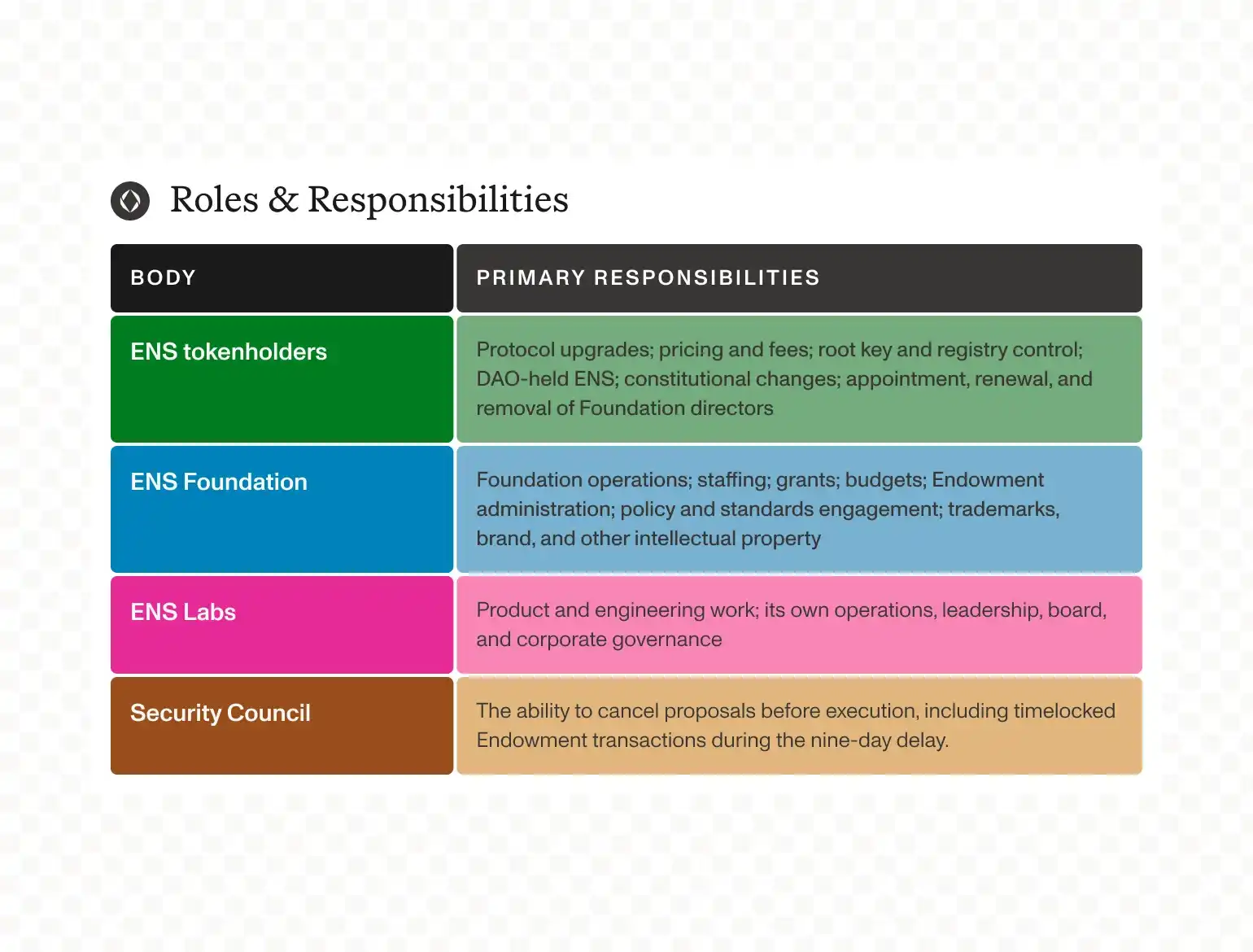
The change also narrows ENS Labs’ responsibilities. Before this, ENS Labs had been handling parts of the institutional workload by default while also developing the protocol and applications and supporting ENS standards integrations across the broader crypto ecosystem. With the foundation now active, ENS Labs can focus on product and engineering work, including ENSv2 and the infrastructure that supports the protocol.
Three entities, one protocol
The vote creates a structure in which ENS Labs, the ENS Foundation, and the broader community and token holders acting through ENS DAO all operate in parallel. According to ENS Foundation, they are aligned around one objective: protecting and expanding the ENS protocol over the coming decades.
The proposal also spells out how control and funding remain divided. The endowment funded by .eth registration revenue keeps its assets where they are today. Transactions tied to that endowment are now subject to a nine-day timelock, during which the ENS Security Council can cancel any transaction that falls outside the foundation’s responsibilities. The foundation may spend only under public budgets approved by its board, and it is expected to report publicly through annual audited financial statements and quarterly grant updates.
ENS tokens held by the DAO remain with the DAO and continue to stay fully under token-holder control. The proposal puts that share at 54.6% of total ENS supply. There is one approved exception: a one-time transfer of 1 million ENS to the foundation, limited to employee compensation under a public framework.
The ENS Foundation and ENS Labs are separate legal and operational entities, each with its own management team and board. The foundation does not own ENS Labs. ENS Labs has no governance authority over the foundation, the endowment, the ENS tokens held by the DAO, or the protocol. Its only role in foundation governance is the founder seat on the five-member board, and that seat must recuse itself from decisions involving funding support for ENS Labs.
Under the new division of labor, ENS Labs remains the lead on core protocol development, while the protocol itself continues to be governed by token holders. Token holders also retain oversight over the institutions acting on their behalf, including the power to appoint or remove foundation directors. The foundation is responsible for offchain work needed to support the protocol, and its board is tasked with overseeing operations and making sure ecosystem contributors, including ENS Labs, can receive sustainable funding.
Initial board members
ENS Foundation named the following people to its first five-member board:
- Alexander Urbelis, executive director. ENS Foundation described his background as spanning cybersecurity law, DNS threat intelligence, and policy. He previously served as general counsel and chief information security officer at ENS Labs, chief information security officer at the NFL, and chief compliance officer at Richemont.
- Nick Johnson, director. He is the founder of ENS and chief executive officer of ENS Labs, and previously worked at the Ethereum Foundation and Google.
- Kartik Talwar, independent director. He is a general partner at A.Capital Ventures and a co-founder of ETHGlobal.
- Brett Sun, independent director. He is a co-founder of Prelude and previously led technical work at Aragon, including the early ENS integration AragonID.
- Anthony Leutenegger, independent director. He is chief executive officer of Aragon, described as a major ENS integrator, and also serves as a delegate for Lido and Morpho.
Independent directors will serve two-year terms and can be renewed by token holders. ENS Foundation said each board member brings a different set of experience needed for the foundation’s first term.
What happens next
Existing commitments will continue under their agreed timelines, according to ENS Foundation. That includes administrators, active funding streams, grants, and commitments already in term. The foundation said it will work with relevant parties on transition plans for the grants program, SPP3, and the current working group structure. Foundation roles will be posted publicly as staffing needs become clear.
With execution complete, the foundation can begin carrying out the operating, financial, policy, and institutional duties approved under the proposal. ENS Labs will continue operating under its own management and governance while building ENSv2 and the products and infrastructure that support the ENS protocol. Token holders will continue to control protocol decisions and retain oversight over foundation directors.
ENS Foundation said the project’s goal is to show that critical internet infrastructure can be credibly neutral, publicly governed, and able to outlast any single company. It added that the full governance record can be reviewed in the executable proposal, the onchain vote, and the execution transactions.