
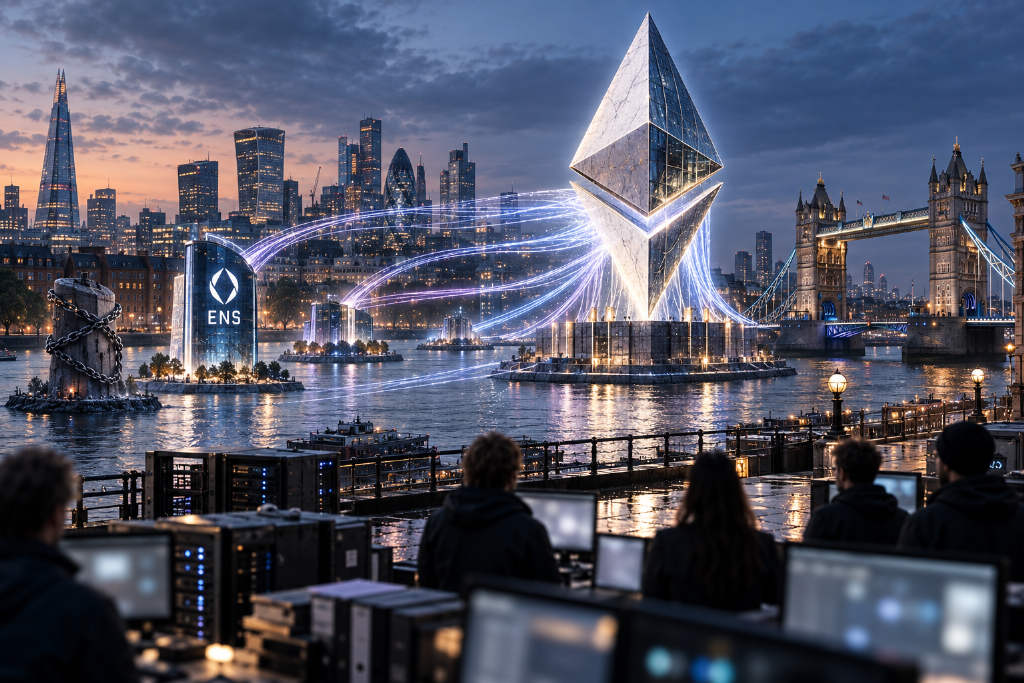
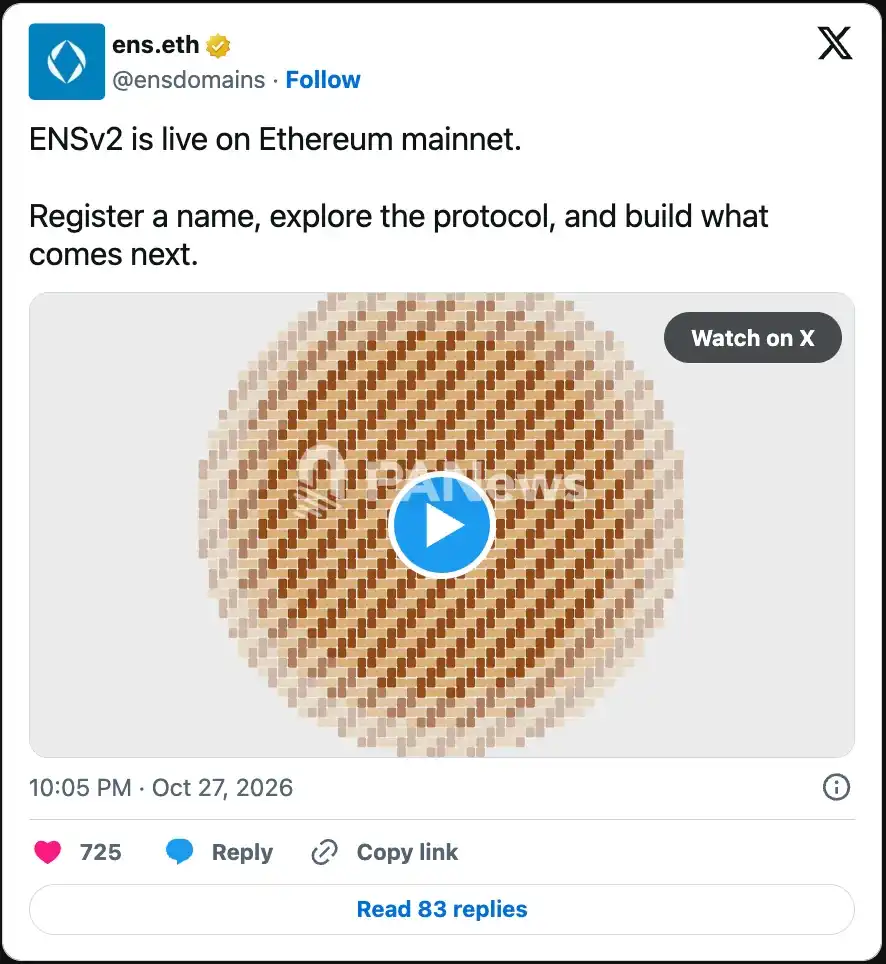
Ethereum Name Service has shipped its biggest upgrade to date, and it chose Ethereum mainnet rather than the Layer 2 route it had been preparing for years. ENS v2 went live on L1 on Tuesday, Oct. 27. Nine months earlier, ENS had already dropped Namechain, the dedicated rollup that was supposed to carry the upgrade.
According to the source article by William M. Peaster for Bankless, translated by Saoirse for Foresight News and published by MarsBit, ENS is not an outlier. Over the past year, more projects have exited Layer 2 networks, paused plans to launch their own L2s, or shut down live app-specific chains and moved core contracts back to Ethereum L1.
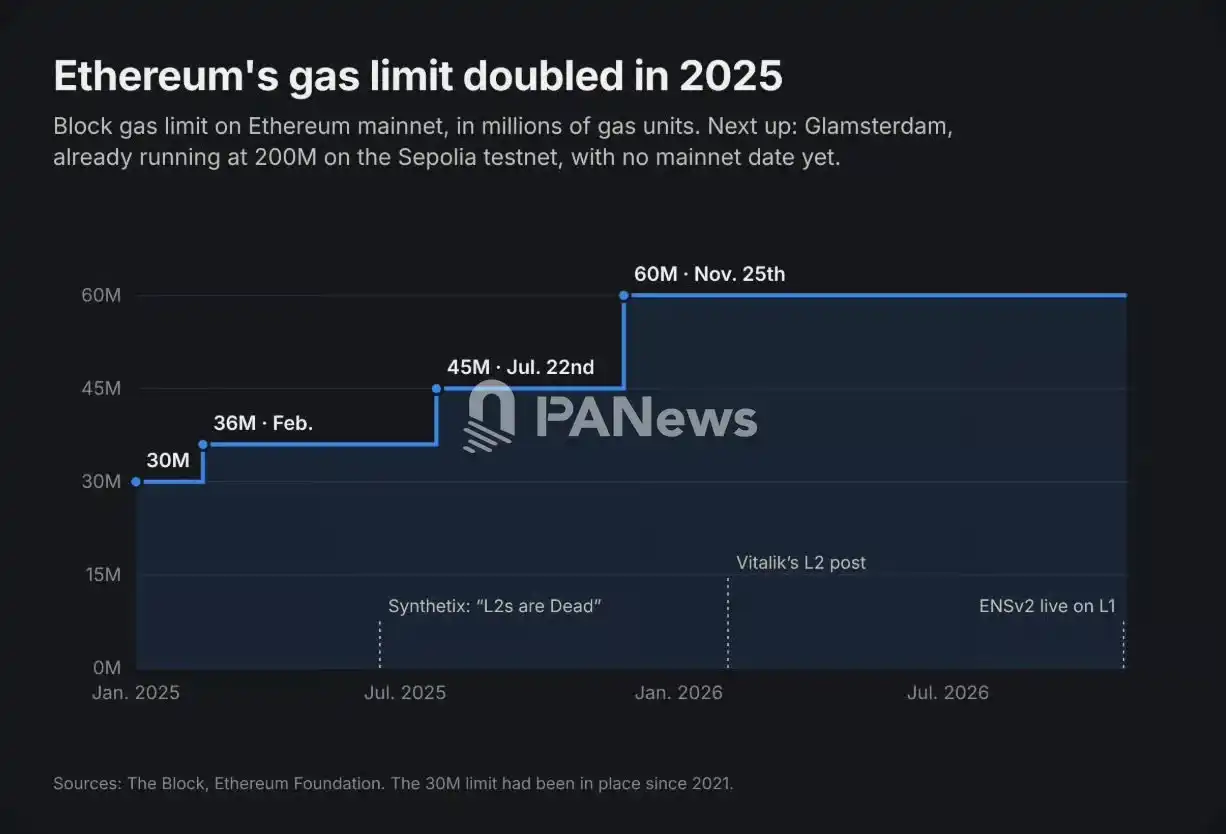
The backdrop is Ethereum’s higher gas capacity. In 2025, Ethereum raised the block gas limit in stages from 30 million to 60 million, and L1 transaction fees fell sharply. At the same time, the cost of running a standalone chain has proved expensive. This month alone, Blast and Abstract announced shutdowns within four days of each other.
Why ENS kept v2 on Ethereum mainnet
ENS, or Ethereum Name Service, turns long wallet addresses into readable names such as 「william.eth」.
ENS v2 is described in the article as a full rebuild of the protocol. Each ENS name can now run its own registration system for subdomains. Name holders also get more granular permission controls, and the system supports fee payments in stablecoins including USDC.
The more consequential part of the upgrade was where it landed. Back in May 2024, ENS Labs was still working on a plan to move the protocol to Layer 2, a path that later took shape as the dedicated rollup Namechain. The author wrote at the time that the upgrade could open a new phase for ENS adoption.
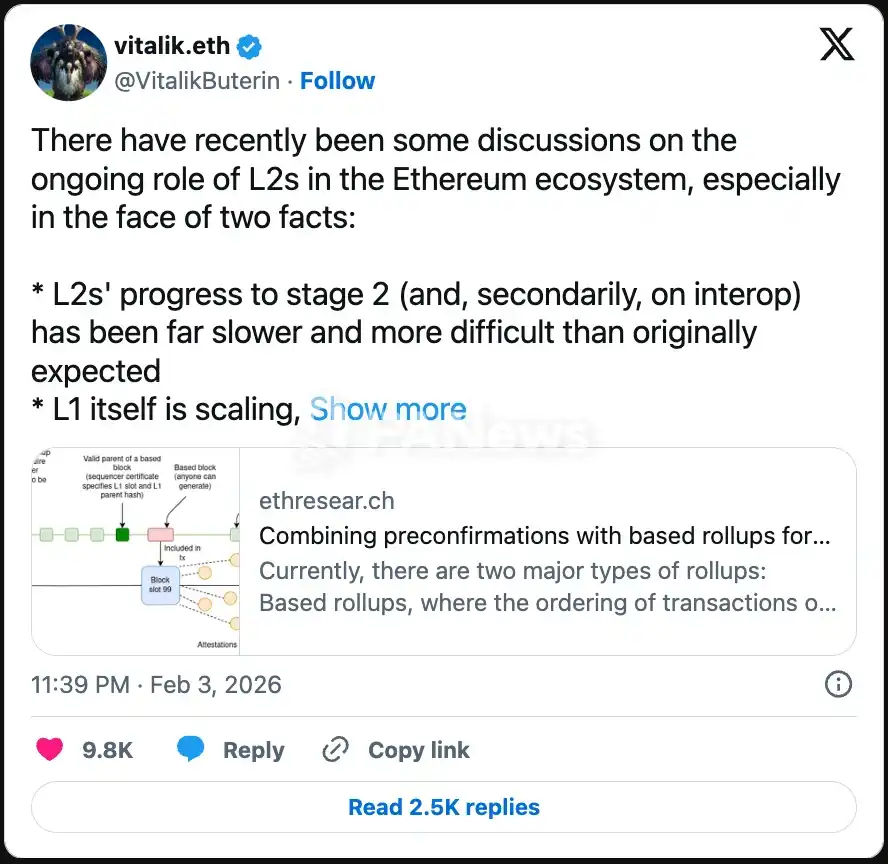
That new phase arrived, but not on L2. On Feb. 6, ENS founder Nick Johnson explained the change in direction: 「Ethereum L1 is scaling, and it’s scaling much faster than almost everyone expected two years ago.」
The article says ENS domain registration gas costs fell 99% over the past year as Ethereum scaled. Johnson also argued that Layer 2 networks introduce extra trust assumptions that do not exist on L1 itself.
Vitalik Buterin publicly backed the decision the same day, saying: 「This is a wise decision!」
A longer list of projects is moving back
ENS is the latest name on that list, not the first. The article compiles projects that moved from Layer 2 networks, or from planned in-house L2 efforts, back to Ethereum mainnet during 2026, and notes their former platform, timing, and migration status.
Synthetix was one of the earlier movers. It had launched on an Ethereum rollup in 2021, but in June 2025 it published a post titled 「Layer 2 is dead, long live Ethereum」, pointing directly to issues such as liquidity fragmentation.
Synthetix then wound down its L2 deployments over the summer of that year, and its new perpetual futures exchange launched on L1 in December. Founder Kain Warwick later said: 「I spent two years pushing the L2 narrative, but that path did not work for Synthetix, so we chose to return to mainnet.」
In February, Buterin published a separate argument. As L1 keeps scaling, he wrote, the path for Layer 2 networks to become fully decentralized has been slower and harder than first imagined. His conclusion, as cited in the article, was that the original vision for Layer 2 and its place in the Ethereum ecosystem no longer holds.
ENS halted the Namechain project three days later.
Superseed became another example this summer. Its core mechanism had relied on fees from its own Layer 2 chain to offset user loans. On Aug. 15, the project formally abandoned that chain and is now moving its ecosystem back to Ethereum mainnet, replacing the old fee-based model with an application-layer yield strategy.
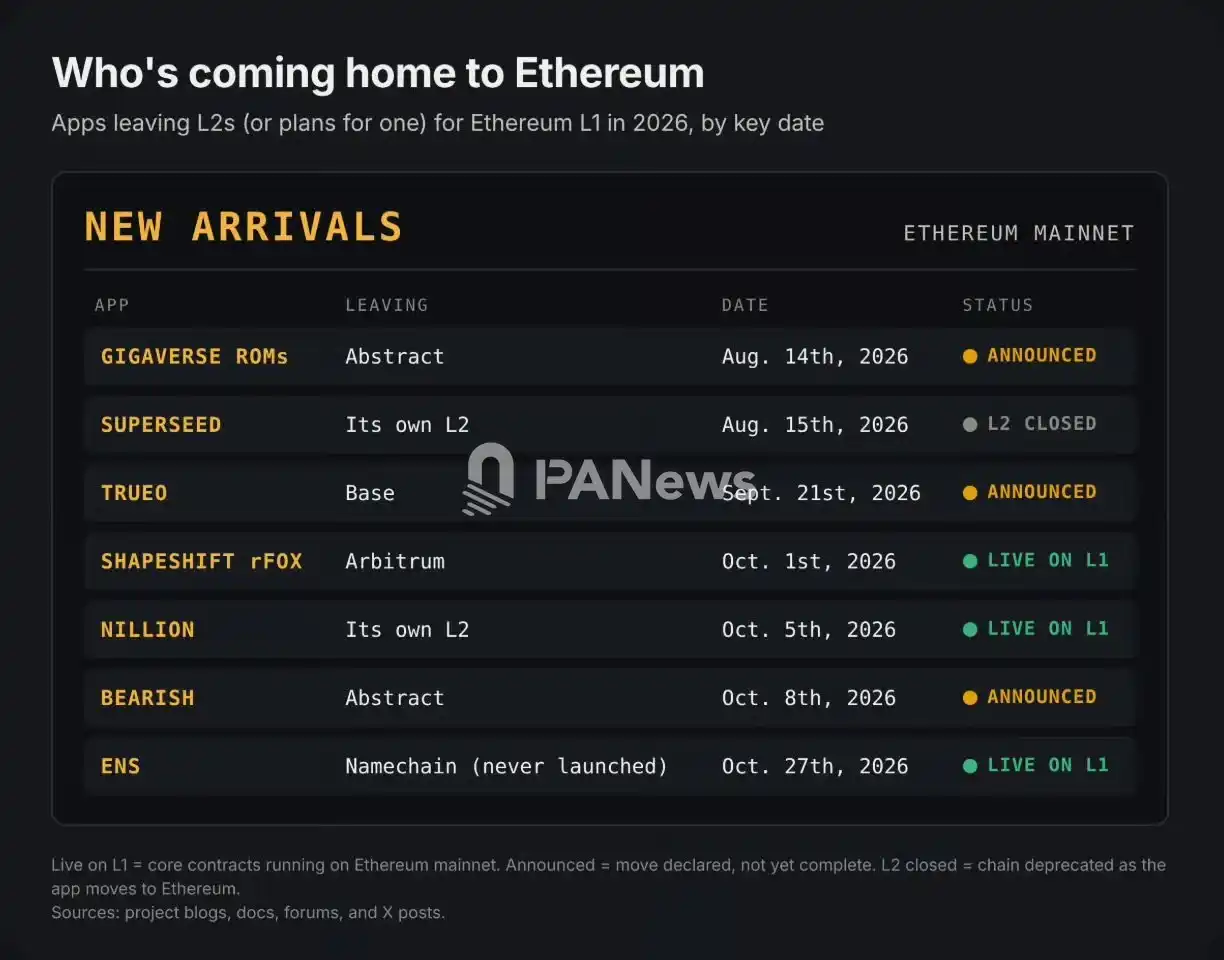
In September, Trueo, the prediction market protocol behind the DefiLlama market, said it would 「return to Ethereum」 from Base. Buterin supported that plan as well.
October brought a cluster of similar announcements:
- ShapeShift moved its rFOX staking program from Arbitrum to L1 on Oct. 1, saying most FOX tokens were already custodied on mainnet.
- Blast said on Oct. 2 that it would wind down in stages because on-chain revenue could not cover operating costs.
- Nillion launched the Blacklight network on L1 on Oct. 5, and its roadmap shows a gradual phaseout of its own L2.
- Abstract announced on Oct. 6 that it would shut down on Dec. 15, arguing that a standalone chain model aimed only at mainstream users was not sustainable.
Some NFT projects in the Abstract ecosystem, including Gigaverse's ROMs and BEARISH, have also announced moves to L1.
Back to L1 for core state, not for every computation
The article argues that a deeper architectural shift sits behind these migrations: projects are separating state storage from execution.
Take Synthetix’s new perpetuals exchange. Orders are matched off-chain, while user funds remain on Ethereum L1 and final settlement also happens on L1.
Derive V3 follows a similar pattern. The article says order matching runs off-chain for speed, risk calculations are verified with zero-knowledge proofs, and user funds are held in Ethereum L1 contracts.
ENS v2 uses the same broad logic. The domain NFT itself lives on L1, while subdomains can use the CCIP-Read standard for zero-gas resolution on L2 or off-chain, cutting usage costs. CCIP-Read lets a name point to data stored elsewhere.
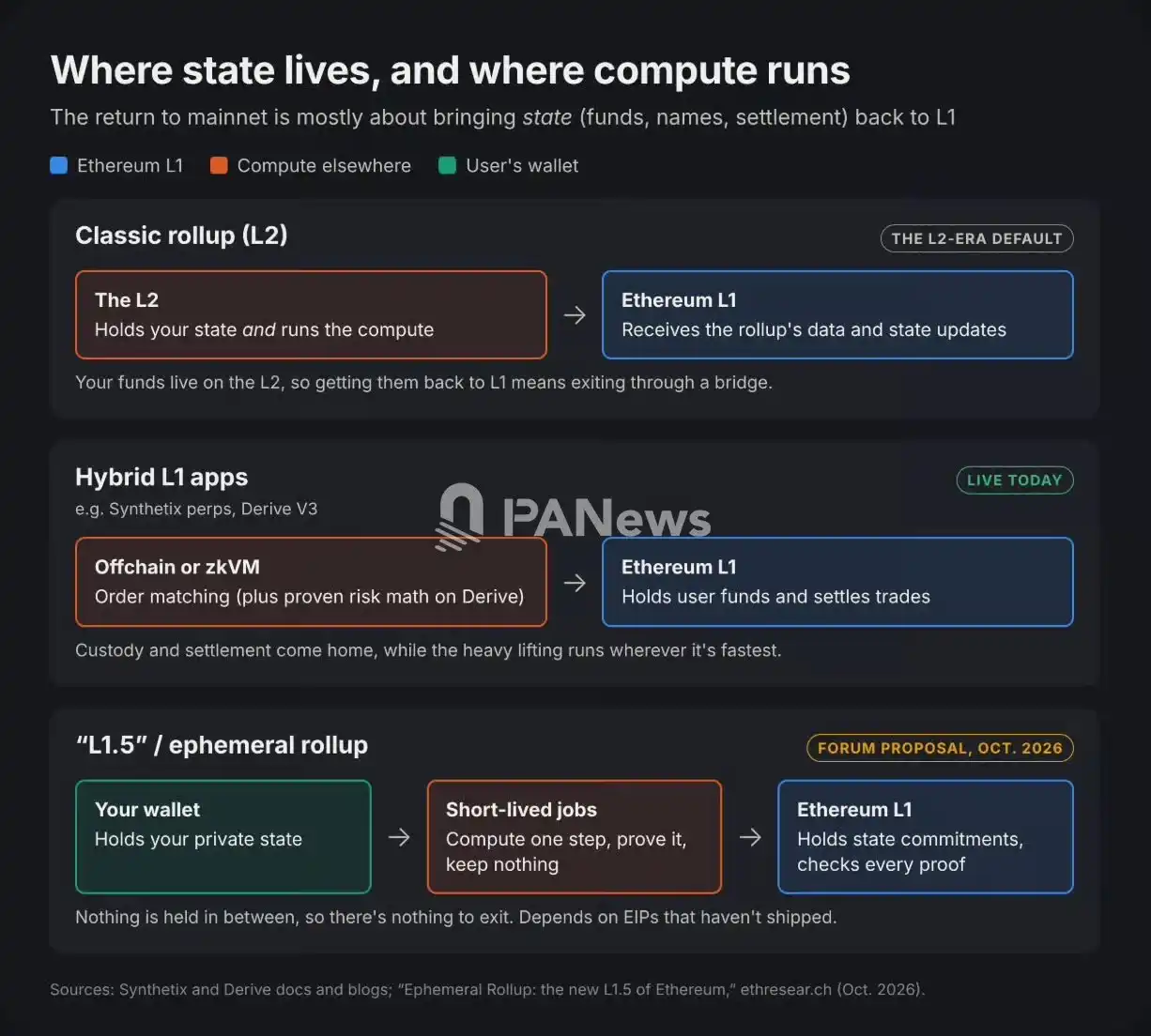
In practical terms, high-value functions such as custody, ownership, and settlement are moving back to L1, while compute-heavy work is pushed into the cheapest and fastest environment available.
The article contrasts that with the traditional rollup model, where state and execution sit together on L2 and users must go through an exit process to withdraw assets. It also compares three architectures: a traditional rollup that stores state and executes on L2; a hybrid application that keeps funds and settlement on Ethereum L1 while moving complex computation off-chain; and an L1.5 ephemeral rollup where users keep private state in their wallets and L1 stores only state commitments and verification proofs, without persistent intermediate storage.
EEZ and ephemeral rollups are also reshaping the boundary
The article also points to technical paths that aim to narrow the gap between L1 and other execution environments.
One example is the Ethereum Economic Zone, or EEZ, which the author wrote about in March. Its goal is synchronous composability between Ethereum and its rollups, meaning contracts on different chains could interact directly within the same transaction.
EEZ is not about pulling applications off L2. The idea is to make rollups feel like part of L1 from a user experience standpoint. That plan is already moving ahead. In August, GnosisDAO voted to convert Gnosis Chain from an independent L1 into a rollup built around the EEZ architecture.
Another idea is still early. This week, researcher namnc proposed the concept of an ephemeral rollup, also called L1.5, on the Ethereum research forum.
Under that design, L1 stores only user state commitments and verifies all proofs. Users keep private state in their own wallets, and computation runs as short-lived tasks that leave no persistent state behind once execution ends. Because L1.5 does not keep persistent state, there is no asset exit step.
The trend depends on Ethereum continuing to scale
The article adds one condition to this return-to-mainnet wave: Ethereum L1 needs to keep enough blockspace available. If projects move in faster than L1 expands, gas fees could rise again and the pattern could reverse.
Glamsterdam, a major Ethereum scaling upgrade, had its testnet launch plan delayed last week. The Ethereum Foundation said the timing for mainnet activation has not been set.
Still, Glamsterdam has already pushed the gas limit to 200 million on testnet, more than triple the current 60 million cap. The article notes that if the same kind of fee relief seen after the previous gas-limit doubling carries over to mainnet, L1 capacity could expand materially.
Whatever comes next, the direction described in the article is clear: more projects are putting their most important state back on Ethereum L1, and ENS is simply the latest case.
Written by William M. Peaster, Bankless
Translated by Saoirse, Foresight News



