



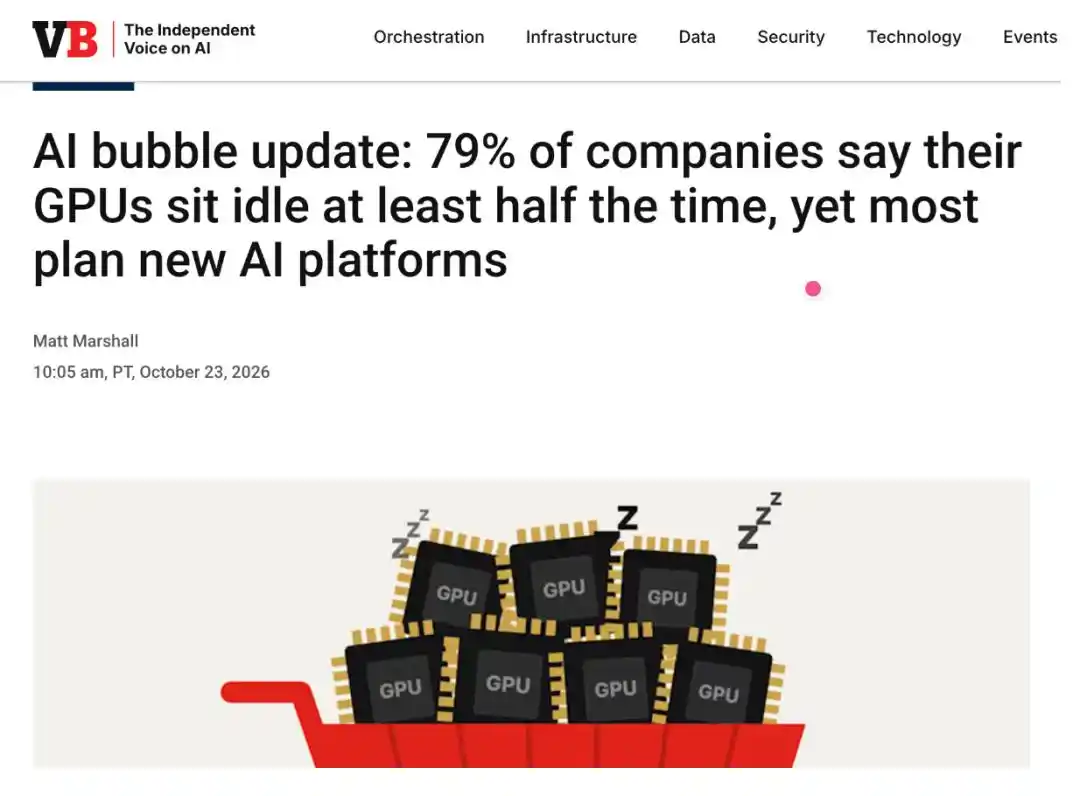
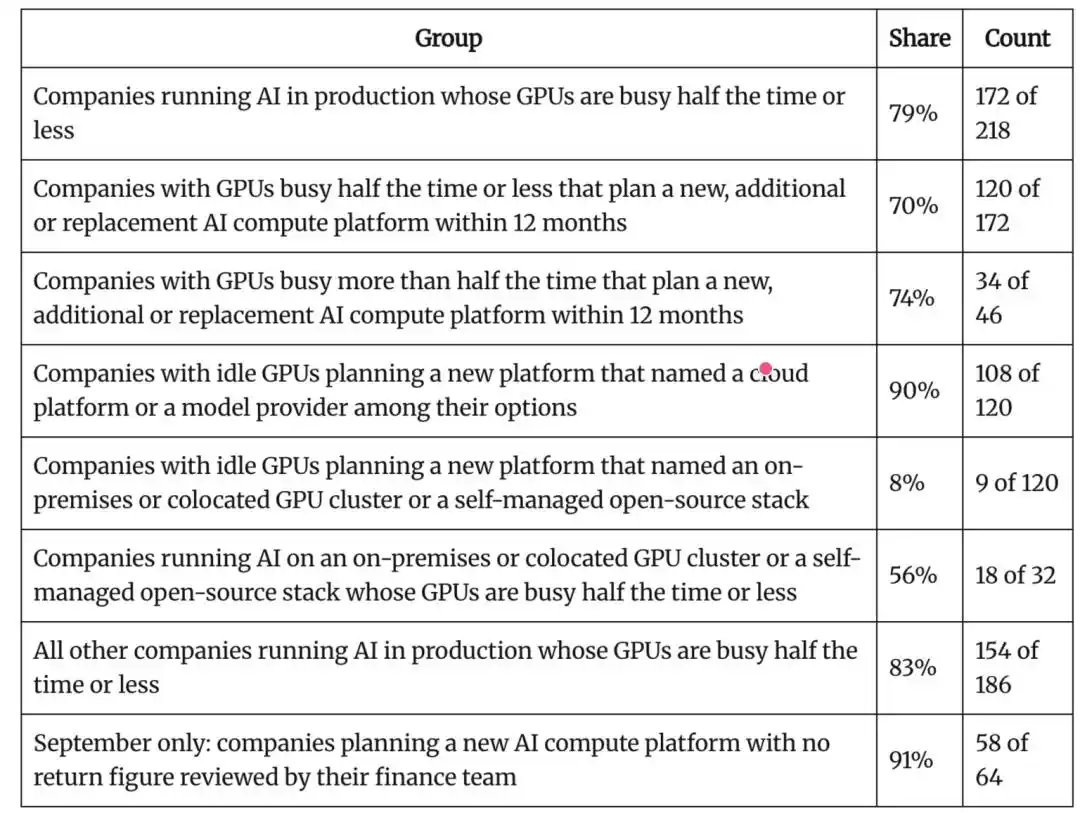
Enterprise AI spending is showing a sharp internal mismatch: 79% of respondents in a new VentureBeat Intelligence compilation said their GPU capacity sits completely idle at least half the time, yet 70% of companies with average GPU utilization below 50% still plan to introduce, expand, or replace AI computing platforms over the next 12 months.
The figures come from three VB Pulse surveys on AI infrastructure and compute conducted in July, August, and September 2026. Across the three rounds, VentureBeat Intelligence counted 385 qualified respondents from organizations with at least 100 employees, including consulting advisers responding on behalf of major clients.
The share of respondents reporting that at least half of their GPU capacity was idle stayed high throughout the quarter, ranging from 77% to 81%. In other words, underused GPU infrastructure was not a one-off reading. It persisted across all three months.
That raises a basic question. If existing resources are not being fully used, why are companies still looking for new AI platforms?
ROI checks are lagging behind infrastructure spending
VentureBeat’s September survey offered one answer on the financial side. Among 64 respondents planning to adopt a new AI platform, 58 said they did not have return-on-investment data reviewed by their finance departments. That works out to 91%.
The finding does not mean those projects generate no value. VentureBeat noted that respondents without plans to adopt a new platform also often lacked that kind of reviewed ROI data. Still, the result suggests financial evaluation has not kept pace with infrastructure spending. AI capabilities are moving into production, but many companies still do not have a clear, finance-reviewed picture of what they spent and what value they created.
Those numbers matter because Wall Street has been debating whether AI has already entered bubble territory. Based on the survey, VentureBeat put forward a more specific argument: the risk of an AI bubble may already be showing up inside enterprises.
Two bills, moving in different directions
On the surface, the pattern looks irrational. Hardware sits idle in the data center while AI budgets keep climbing. VentureBeat said some technology leaders told the outlet they were under heavy pressure to cut AI bills during this autumn’s budgeting cycle.
But the report argues that enterprise AI demand has not disappeared. It has shifted to places current hardware often cannot serve well.
Professionals and consumers are using more AI tools, and much of that work depends on frontier models from Anthropic and OpenAI. VentureBeat said that demand is likely to keep supporting compute spending by those companies for some time.
The deeper mismatch sits inside enterprises themselves. Many companies are paying for two very different categories of AI spending at once.
- First, there is panic-driven compute stockpiling. During the global compute shortage of the past two years, many companies locked in GPU clusters early out of fear of missing out. Once the hardware arrived, they often lacked mature internal use cases and engineering capacity to keep those systems busy.
- Second, there is dependence on closed-source frontier models. Business teams and engineers often prefer to call the strongest models from OpenAI, Anthropic, and Google directly. They pay by token through APIs, through monthly subscriptions, or through large cloud providers. Those workloads cannot simply be moved onto the local or hosted GPU capacity the company already controls.
The result is a costly split: self-built compute becomes a sunk asset, while closed-model API bills eat through budgets at speed.
VentureBeat pointed to an August report from Fortune on Uber. According to that report, Uber’s chief technology officer said the company encouraged employees to use AI tools as much as possible and even created a leaderboard ranking software engineers by their use of those tools. Within a few months, the company had exhausted its entire 2026 AI budget and later declared the end of the “Tokenmaxxing” era.
The survey data lines up with that divide. Among companies planning to buy new compute platforms while also leaving GPUs idle, 90% were looking at public cloud and model API providers, while only 8% were considering expansion of local private clusters. At the same time, 91% of companies planning to bring in a new platform could not produce a finance-reviewed ROI assessment.
VentureBeat also noted that some idle capacity may be intentional, such as reserving GPUs for peak demand, and some new platform plans may reflect replacement of older systems.
From the compute arms race to inference economics
If idle GPUs expose an infrastructure efficiency problem, the spread of AI agents may make the cost side even harder to manage.
VentureBeat expects model invocation to take up a growing share of enterprise AI spending. As companies move from simple generative chat toward multi-step autonomous AI agents, the tension around compute and cost may intensify.
Gartner has forecast that by 2028, inference costs for a single agent workflow will rise by more than 5x.
That does not mean token prices themselves will keep rising. The report said unit token prices may continue to fall as inference infrastructure improves and models become more efficient. The problem is that the number of tokens consumed to complete a task may grow faster than the price per token falls.
One cost driver that is easy to miss is context. In AI coding, for example, a model has to process not only the immediate prompt but also project code, system instructions, and prior execution records. As the task progresses, those context blocks may reappear across multiple requests. If they are reprocessed each time, costs can build quickly. That is one reason context caching is drawing more attention.
NVIDIA engineers wrote in a technical guide that in the Claude Code session scenarios they studied, about 85% to 97% of context in follow-up requests could be reused through caching after the first call. Anthropic’s cache-read pricing, depending on model and pricing terms, can be as low as one-fortieth to one-tenth of the price of standard input tokens.
For agents that run continuously, that kind of optimization can produce meaningful savings.

Another variable is the number of agents. In a coding-task test by evaluation firm Vals AI, a setup using one main agent to orchestrate multiple sub-agents cost 1.8x to 5.1x as much as a single-agent setup.
Yet only one of four tested configurations delivered a statistically significant performance gain. Adding more agents may improve capability in some cases. It may also just mean more models consuming more tokens at the same time.
How companies are being pushed toward a more practical approach
With high idle rates and model-call bills climbing, the report argues that broad, undisciplined expansion is becoming harder to justify. Before signing the next compute contract, companies may need to squeeze more output from assets they have already paid for, both in GPU time and in token spend.
It listed several practical steps:
- Measure the cost of each completed task, including both GPU resources and API spending.
- Test different models and inference settings, then choose defaults based on cost per completed task rather than token price alone. A cheaper model may consume more tokens and end up costing more per task.
- Give agents only the context they actually need and cache reusable content, whether the workload runs through a model provider API or on internal infrastructure.
- Add a second agent only when the task can be split into parts that truly run in parallel.
- Move routine, high-frequency work from frontier-model APIs to open models running on idle compute, including classification, information extraction, and text summarization.
- Use leftover idle GPU time for delay-tolerant workloads such as batch inference, model evaluation, and fine-tuning.
The goal, as framed in the report, is simple: pay a more reasonable cost for each unit of work actually completed.
That also changes how the headline numbers should be read. A 79% rate of low GPU utilization and a 70% intention to adopt new platforms do not by themselves prove that an AI bubble has formed, and they do not show that the entire industry is heading into overcapacity. They do suggest that many enterprises need to reexamine the gap between resource commitments and real demand.
For years, AI progress was often measured through parameter counts, training compute, and capital expenditure. As the technology moves deeper into real business operations, companies may need a different scorecard: how much work AI actually completed, how often it succeeded, how much time it saved, and what it cost.
For model vendors, that would widen competition beyond raw model capability into inference efficiency, deployment flexibility, and total task cost. For enterprises, the more urgent job may not be stockpiling more compute, but using the GPUs and tokens they already have more effectively.
References:
- https://venturebeat.com/infrastructure/ai-bubble-update-79-of-companies-say-their-gpus-sit-idle-at-least-half-the-time-yet-most-plan-new-ai-platforms
- https://fortune.com/2026/08/07/uber-ai-spending-tokenmaxxing-is-over-cto/
This article cites a post from the WeChat public account Jiqizhixin (ID: almosthuman2014), by an author identified as “关注AI的”.