

What should an ETH holder do after buying and holding the asset?
A few years ago, the answer was almost boring in its simplicity: move it into cold storage, sit tight, and wait for the next bull market.
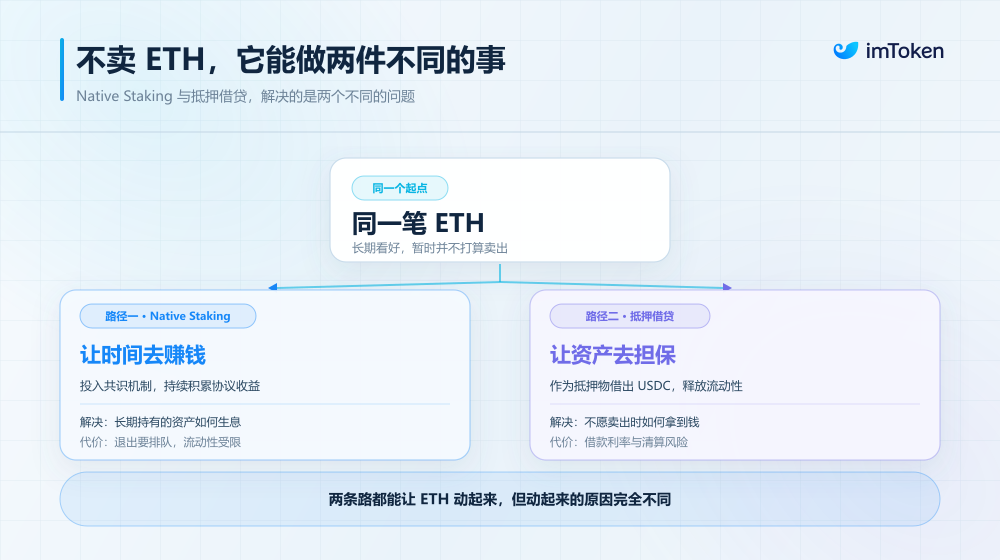
That is no longer the only obvious path. After Ethereum’s transition to proof-of-stake and the maturation of on-chain lending markets, ETH can be put to work in two common ways. One is native staking, where holders earn protocol rewards. The other is to post ETH as collateral in a lending market and borrow stablecoins without selling the underlying position.
On the surface, both approaches make idle ETH productive. But Odaily argues that comparing them only by APR misses the core distinction. Native staking is built for long-term yield generation on assets that are meant to stay in place. Borrowing is built for liquidity and capital efficiency when the holder does not want to sell.
Native staking turns holding time into a productive asset
The article starts with the cleanest version of the long-term holder case.
If someone has 32 ETH or more and is almost certain that the position will not be touched for the next two or three years, then short-term price swings are already part of the deal. In that setup, the main variable left to optimize is time itself. Native staking is a way to capitalize that holding period.
Under Ethereum’s proof-of-stake system, validators stake ETH, participate in consensus, handle attestations and block proposals, and receive rewards under protocol rules. Those rewards do not come from a borrower paying interest, and they are not extra tokens distributed by a DeFi platform. They come directly from Ethereum as compensation for helping secure the network.
For a long-term holder, the logic is straightforward. If the ETH was not going to be sold or actively deployed anyway, it can be used to participate in network operations and accumulate more ETH over time.
Odaily says the Pectra upgrade changed this path again. The new 0x02 Compounding Validator raises the maximum effective balance for a single validator from 32 ETH to 2048 ETH. Rewards above 32 ETH can now be added back into the effective balance in 1 ETH increments and included in future reward calculations, giving native staking a more complete compounding structure.
Even so, native staking has a clear limitation. It addresses yield, not immediate liquidity.
Once ETH enters the validator system, it takes on the role of security capital for the network. New validators must pass through an activation queue, and full exits also depend on network conditions and withdrawal processing. That makes staked ETH very different from a wallet balance that can be spent, traded, or redeployed at any moment.
Liquid staking partly eases that constraint. Odaily uses Lido as an example: users stake ETH and receive stETH, which can still be transferred, borrowed against, or used in other DeFi activity. But from an asset-structure perspective, that adds another layer on top of the simplest native staking setup in the form of an LST protocol and token.
In that sense, native staking is best suited to one specific question: if a holder already knows a portion of ETH is meant to stay untouched for the long run, how can that holding period itself produce value?
Borrowing keeps the position while pulling liquidity forward
Lending solves a different problem.
A holder may still be highly bullish on ETH and unwilling to sell, yet suddenly need cash for turnover or see an attractive on-chain opportunity. Selling spot is the easiest way to raise funds, but it also means giving up the position. If ETH then enters a major rally, rebuilding that exposure at a low cost may be difficult.
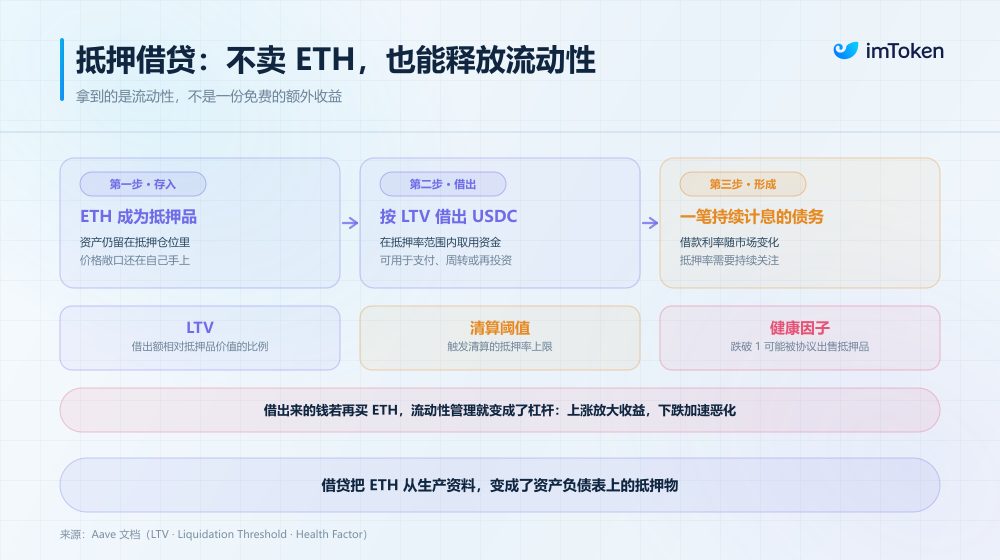
DeFi lending offers another route: keep the ETH, post it as collateral, overcollateralize the position, and borrow stablecoins.
Odaily points to protocols such as Aave. Users can deposit eligible assets as collateral and borrow other assets within a certain loan-to-value range. The borrowed funds can be used for payments, investments, or other financing needs, while the original ETH remains in the collateral position.
That changes the role of ETH completely.
In native staking, ETH functions like productive capital, generating protocol income through participation in consensus. In lending, ETH looks more like collateral on a balance sheet. Its main value is that it helps the holder obtain fresh liquidity.
That is why borrowing is not a free source of extra return.
Once assets are borrowed, the user takes on debt and must pay a borrowing rate that can change over time. At the same time, if ETH falls sharply, the position’s Health Factor declines. If liquidation conditions are met, part of the collateral may be sold by the protocol.
Odaily notes that Aave requires borrowers to keep track of LTV, liquidation threshold, and Health Factor. If the borrowed stablecoins are then used to buy more ETH, the setup moves beyond liquidity management and into leverage. A rising ETH price amplifies gains. A falling ETH price speeds up collateral deterioration as well.
This marks an important risk boundary between borrowing and native staking. The core risks in staking come from validator operations, slashing, and exit liquidity. Collateralized borrowing adds debt, interest-rate exposure, and liquidation risk driven by market prices.
For long-term holders, the real question borrowing answers is simple: if they do not want to sell ETH but still need funds, can the liquidity embedded in that asset be released?
Odaily’s answer is yes.
But that liquidity comes at a cost.
One earns from time, the other trades for liquidity
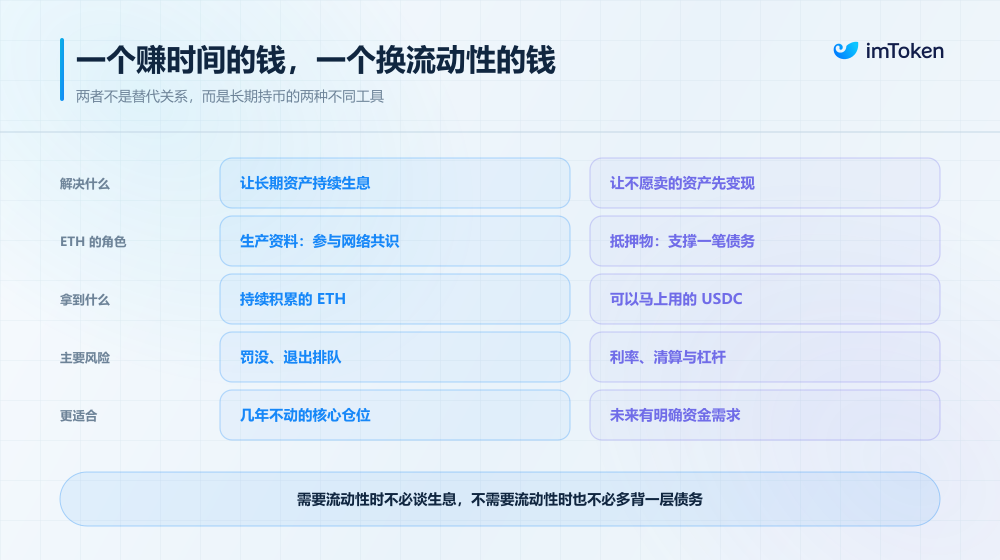
Viewed this way, native staking and borrowing are not strict substitutes. In actual portfolio management, the article describes them as complementary tools for different needs at different stages.
- Core long-term holdings: for the large spot position that is not expected to be sold for years, native staking is the more natural destination. It does not introduce outside debt, does not expose the holder to market liquidation, and captures Ethereum’s own network rewards.
- Tactical liquidity: for the portion tied to short-term cash-flow needs, and for users willing to monitor positions closely, borrowing creates a buffer without forcing a spot sale.
Put simply, when liquidity is not needed, ETH can be sent into validator work. When liquidity is needed, ETH can be pulled into service as collateral. The first route improves yield efficiency during a long holding period. The second improves capital efficiency on the balance sheet.
The article also mentions more aggressive DeFi structures that combine both ideas, such as converting ETH into stETH and then using it in recursive staking-and-borrowing loops to capture benefits from both sides. But it warns that the tighter capital efficiency is pushed, the longer the chain of risk exposure and transmission becomes.
For investors planning to hold for the long term, Odaily says that having one less layer of smart-contract risk can often matter more than gaining a couple of extra percentage points on paper.

Wallet tools are trying to lower the barrier to native staking
In practice, many users do not avoid native staking because they reject the strategy itself. The problem is operational complexity.
Running a validator independently remains a high bar for most users. Hardware setup, client deployment, avoiding downtime, and managing slashing risk all require work. Odaily says those maintenance costs still exist even in the Pectra era. Handing coins to a centralized exchange may be easier, but it also cuts against the non-custodial premise.
The article says this is where mature wallet tools are trying to fill the gap by productizing validator operations that used to be cumbersome.
It cites imToken’s non-custodial native staking service as an example. Starting from 32 ETH, users can launch an independent validator directly, with support for both the compounding 0x02 model and automatic withdrawal mode. The underlying hardware deployment, node operations, and around-the-clock monitoring are handled by professional infrastructure providers, while ownership of the private key and the withdrawal credentials remains with the user.
In Odaily’s framing, that compresses what used to be a highly technical and cumbersome validator-management process into a more direct and controllable native product experience.
The key question is what role ETH should play
The article closes by reframing the issue for long-term holders.
In the past, the main question was whether ETH should still be held at all. As staking, borrowing, and other on-chain financial tools have matured, the question has shifted. If the plan is to keep holding ETH, what role should that ETH actually play?
Should it function as a long-term asset that continuously earns protocol rewards, or as collateral that can be mobilized whenever funding is needed?
Odaily argues that answering that may matter more than comparing a few percentage points of APR.