

Once 32 ETH is deposited into a validator, is that money still really yours?
That is the question Odaily puts at the center of its market analysis. The piece says users have long compared staking products by looking at APR, fee splits, auto-compounding features, and withdrawal timing. But with network-wide benchmark staking yield now below 3%, those marginal return differences no longer carry the same weight. The more consequential issue sits underneath the interface: after ETH is staked, who actually controls it?
Ethereum splits validator powers into work rights and money rights
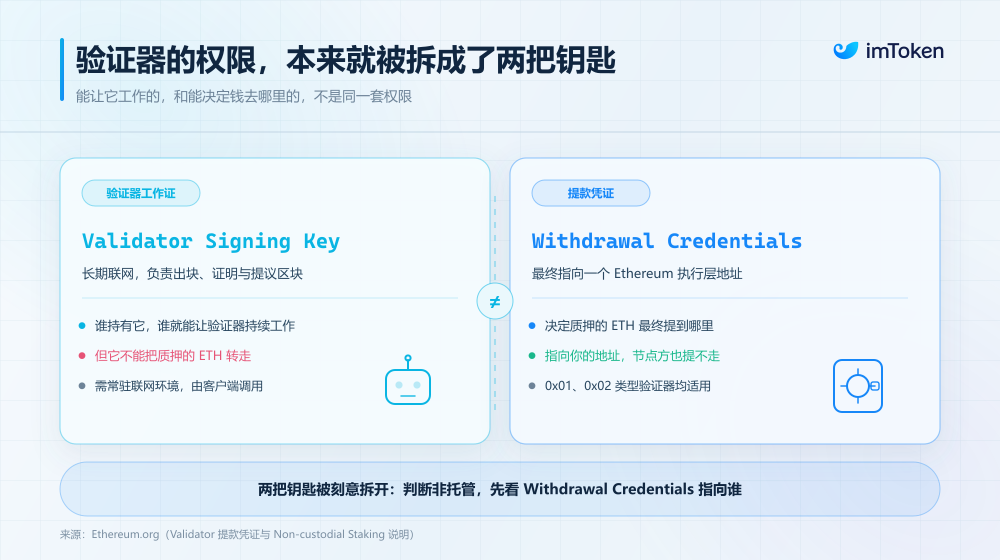
According to the article, the key to understanding non-custodial staking is Ethereum’s validator design at the consensus layer. A validator is not controlled by a single key. Protocol-level permissions are divided into two separate parts.
One is the Signing Key. This is the validator signing private key used to do the operational work: staying online around the clock, participating in attestations, proposing blocks, and carrying out other consensus tasks. Because of that role, it has to remain on an internet-connected server. Whoever holds this key is responsible for running the machine.
But Odaily stresses that the Signing Key is only for doing the job. Even if it is used to sign repeatedly, it cannot move the principal. If the machine goes offline or commits misconduct such as double-signing, Ethereum can penalize the validator’s rewards or principal, but that does not mean the operator can withdraw the stake to its own account.
The other part is the Withdrawal Credentials, which point to the withdrawal control for the validator. The article describes this as the real withdrawal password. It is fixed on the Beacon Chain when staking takes effect and determines where the deposited ETH and the rewards can ultimately be sent. This key can remain offline in a cold wallet or be secured through a mnemonic phrase.
In the article’s framing, Ethereum is clear about the distinction: the Signing Key is a hot permission that must stay online, while Withdrawal Credentials represent cold control at the ownership layer. That separation makes it possible for a third party to run a validator on behalf of a user without owning the user’s ETH.
Odaily cites imToken as an example of how this works in practice. A node service provider such as InfStones can hold the Signing Key and take care of data-center operations, network defense, and 24/7 uptime. That provider affects how smoothly the node runs and how much block reward it may earn, but it does not gain the ability to withdraw the staked assets for itself.
EIP-7002 pushes exit control closer to the withdrawal holder
The article says this control model became even tighter after Ethereum introduced EIP-7002, which enables exits to be triggered from the execution layer.
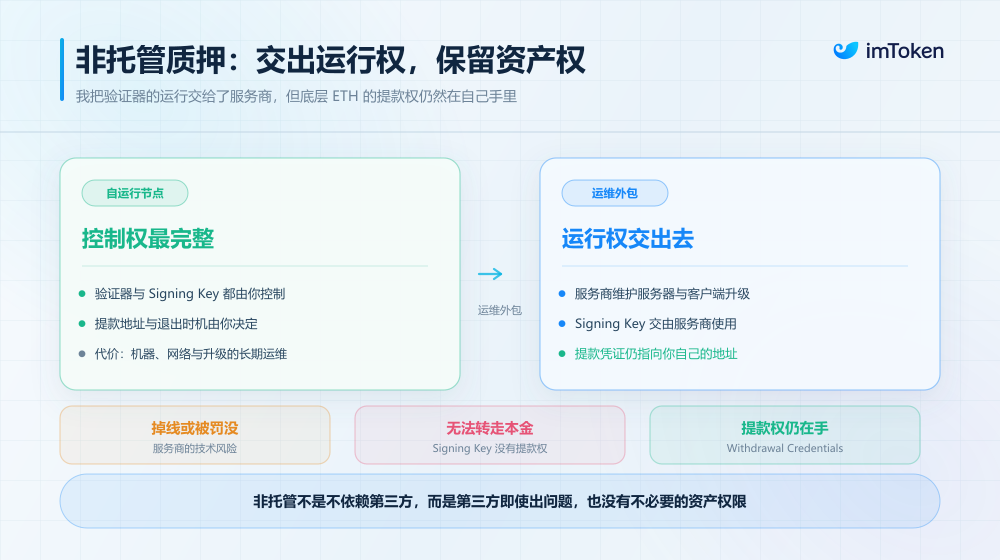
Before that change, if a node operator disappeared or refused to cooperate, the operator still could not take the user’s funds, but the user often had to wait for that operator to broadcast the exit message with the Signing Key. That left the user in a weaker position. With EIP-7002, if the 0x01 or 0x02 withdrawal credential remains in the user’s hands, the user can use an imToken wallet to send an instruction from the execution layer and force the validator to stop and enter the withdrawal queue.
Odaily’s point is straightforward: even if a node service provider vanishes entirely, the funds do not have to remain trapped on-chain. In this model, the real test of non-custodial staking is not whether a third party is involved. It is whether the party doing the operational work also has the power to take the money.
Users, wallets, node providers, and Ethereum each control different things
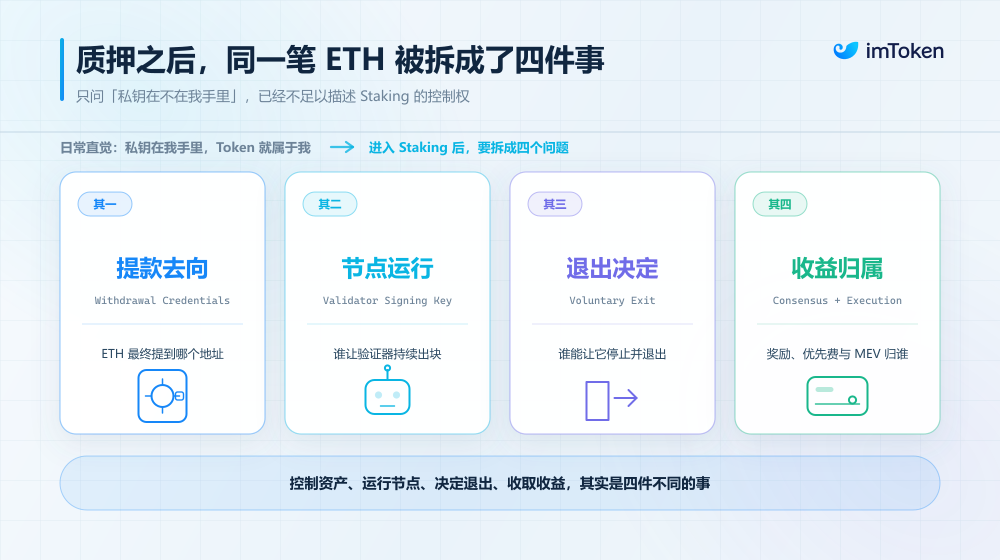
Odaily then breaks a single ETH staking action into four roles: the user, the wallet, the node service provider, and the Ethereum protocol itself. They all participate, but they do not hold the same authority.
User: retains the critical funding control
In a true non-custodial architecture, the user keeps the withdrawal-related authority. Using imToken’s non-custodial ETH staking as the example, the article says the service provider cannot move the staked assets into its own account, while validator status can be checked directly on-chain.
That is different from the common idea of handing coins to someone else for management. The ETH is no longer sitting in a wallet balance after being sent into Ethereum’s Deposit Contract and becoming validator balance, but it does not become the node operator’s asset. The operator maintains the validator and controls its work permissions, not the withdrawal right over the assets.
Wallet: an interface for managing permissions, not the owner of the stake
The wallet, in this structure, is described as an entry point for managing permissions rather than the owner of the staked ETH. It helps the user initiate staking, manage addresses, sign actions, and view validator status and rewards. But if the underlying setup remains non-custodial, the wallet provider does not automatically acquire withdrawal authority simply by providing the interface.
That is why staking through a wallet is not the same thing as handing custody of ETH to that wallet. The article says the defining factor remains how the underlying keys and Withdrawal Credentials are configured.
Node service provider: operational risk remains, but that is not the same as principal theft risk
This is the part of non-custodial staking that Odaily says users most often misunderstand. A user does not need to run a machine 24 hours a day, but someone still has to maintain the validator. The node provider handles client operations, uptime, validation duties, and the Signing Key used for that work.
That still makes the provider important. If it goes down repeatedly, the user can lose part of the rewards that would otherwise have been earned. If it commits serious violations, slashing risk exists. Non-custodial staking does not mean there is no service-provider risk. It means the risk is mostly limited to validator performance and return quality, rather than whether the provider can transfer away the user’s 32 ETH.
Ethereum protocol: activation, exits, queues, and withdrawals follow protocol rules
The final layer is Ethereum itself. Once ETH enters a validator, no party can move it as freely as a normal wallet balance. Activation timing, exit conditions, whether exits must queue, what kinds of validator behavior are penalized, and when withdrawals are finalized are all governed by protocol rules.
Odaily says the same logic applies to the 0x02 Compounding Validator introduced after Pectra. That design can raise a validator’s effective balance from the traditional 32 ETH cap to as much as 2048 ETH so rewards can continue compounding, but withdrawals and exits still follow protocol-defined procedures.
Lido offers liquidity, but the control structure changes underneath
With that framework in place, the article turns to liquid staking through Lido.
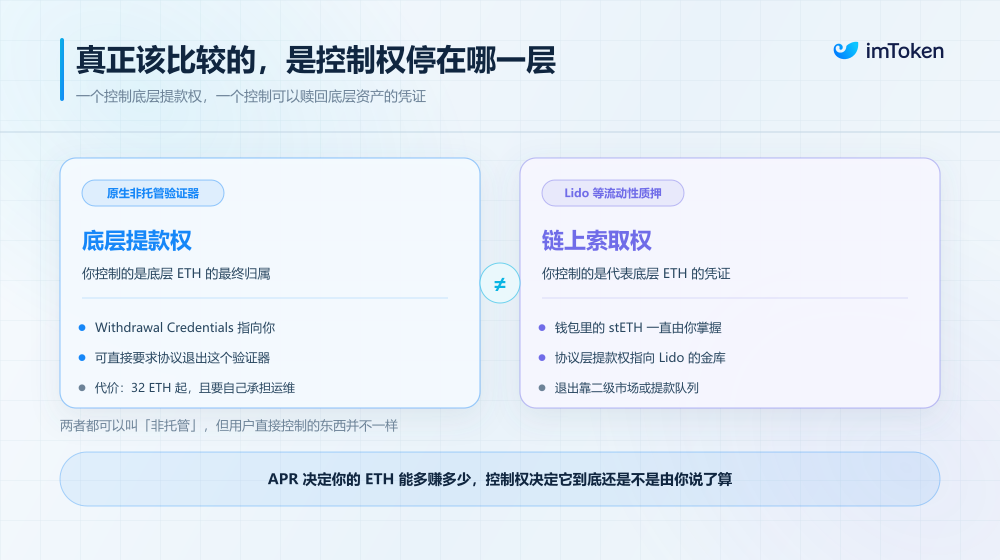
After users deposit ETH into Lido, they receive stETH. Odaily notes that stETH remains fully owned by the user and can be transferred, traded, or used in DeFi. That is the core value of liquid staking: it releases liquidity that would otherwise remain locked in validators.
At the same time, the control structure over the underlying ETH changes. Lido aggregates ETH from many users and allocates it through the protocol to different node operators that create and run validators. The Withdrawal Credentials for those validators are not each stETH holder’s own Ethereum address. They are set by the Lido protocol, and the underlying withdrawal process is handled through a combination of smart contracts, oracles, and node operators.
In other words, the user holds a staking claim represented by stETH, not the Withdrawal Credentials for a validator that belongs to that user alone.
When a user wants to redeem ETH from the protocol, the user must submit stETH into Lido’s Withdrawal Queue and wait for the protocol to complete the relevant exits and prepare funds. The article says Lido generates an NFT representing the withdrawal right for that request, and the user can claim the underlying ETH only after the request is completed.
Odaily adds that users still hold their own stETH, and the protocol runs through smart contracts rather than a centralized institution that can arbitrarily seize user assets. Even so, this setup has a different trust boundary from native non-custodial staking where one validator belongs to one user and the withdrawal address belongs directly to that user.
Native non-custodial staking and liquid staking solve for different priorities
The article does not argue that one model is always better than the other.
Liquid staking brings a lower entry threshold, stronger liquidity, and broad DeFi composability through stETH. Native non-custodial staking gives up some liquidity and requires at least 32 ETH, but it makes the control relationship over validator funds more direct.
Odaily describes liquid staking as something closer to holding a freely transferable certificate of staked assets. Native non-custodial staking, by contrast, is closer to owning a validator that truly belongs to the user while outsourcing day-to-day maintenance. The trade-off is structural rather than absolute.
For users with only a few ETH, users who need to trade at any time, or users who want to keep participating in DeFi, assets such as stETH are clearly more convenient. But if a user plans to hold 32 ETH, 64 ETH, or more for the long term and does not have strong liquidity needs, the article says the yield gap is no longer large enough to decide the choice on its own. Under those conditions, the question of who controls the assets becomes more important.
Staking returns change every day. APR can move up or down as more or less ETH is staked across the network, and fee rates can also change. By contrast, where the Withdrawal Credentials point, who can withdraw the principal, and whether an extreme situation still requires third-party cooperation determine the trust structure at the bottom of the product.
As returns converge, control becomes the dividing line
Odaily closes by saying the choice is not a matter of absolute right or wrong.
If a user holds only 2 ETH or 3 ETH, or prefers to use DeFi strategies such as looped borrowing, then liquid staking tokens such as stETH are the more practical option in terms of capital efficiency and accessibility. But if the goal is to build a long-term core ETH position inside the Ethereum network, whether the amount is 32 ETH or more, the equation changes. When net yield differences between products shrink to a few tenths of a percent or even just a few basis points, taking on lengthy contract interactions and governance risk for that incremental return may not be worth it.
The article ends by extending a familiar industry phrase. In crypto, people often say, 「Not your keys, not your coins.」 In staking, Odaily argues, the sentence may need an extra clause: 「Not your withdrawal credentials, not your native stake.」