
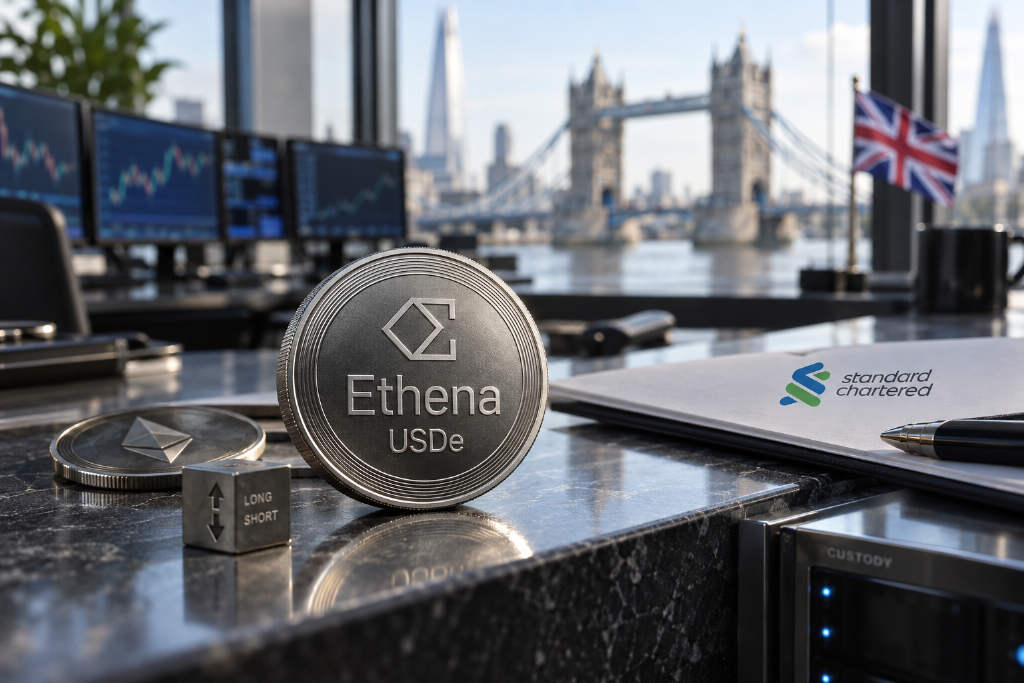
Ethena is trying to scale a dollar product that does not rely on bank deposits or Treasury-backed reserves. Its core stablecoin, USDe, is structured as a synthetic dollar: the protocol holds crypto collateral and offsets price exposure with hedge positions rather than keeping matching dollars in a bank. Users who stake USDe into sUSDe are currently earning about 4.8% annually.
That model is now getting attention from traditional finance. Standard Chartered has started publishing research on Ethena and projects that USDe supply could grow about eightfold, from roughly $5 billion today to $40 billion by the end of 2028. At the same time, Ethena has revised ENA tokenomics and plans to direct part of protocol revenue to ENA buybacks once USDe supply passes $7.5 billion.
How USDe works
Most large stablecoins, including USD Coin (USDC) and Tether (USDT), issue tokens against matching reserves held somewhere in traditional finance, usually cash or U.S. Treasuries. USDe works differently. Ethena holds crypto assets and pairs them with hedges designed to neutralize price swings, which is why the product is described as a synthetic dollar.
Ethena launched on Ethereum in February 2024. It was founded by Guy Young, and early backers included Dragonfly, Galaxy Digital, BitMEX co-founder Arthur Hayes, and Franklin Templeton.
The article gives a simple example. If a user deposits $100 worth of ETH to mint $100 of USDe, Ethena immediately opens an equal-sized perpetual futures position that benefits if ETH falls. If ETH drops by half, the spot collateral falls from $100 to $50, but the short hedge gains $50. If ETH doubles, the reverse happens. In either case, the combined value stays near $100 in dollar terms.
Where the yield comes from
One of the biggest differences between USDe and reserve-backed stablecoins is that Ethena can pay yield. Users who stake USDe receive sUSDe, which is currently yielding about 4.8% on an annualized basis.
According to the article, that yield comes from two sources:
- staking rewards generated by ETH held as backing collateral;
- funding-rate income from perpetual futures markets.
In perpetuals, when most traders are positioned for upside, they typically pay a recurring fee to the other side. Ethena sits on that other side as part of its hedge, so it can collect funding in bullish markets. The article says average annualized funding rates were about 11% in 2024 and are now around 5%, which helps explain why sUSDe yields have fallen from double digits in the first year.
Ethena describes this as real income generated by trading activity, with real on-chain collateral backing USDe. The article says users can verify that directly on the project’s website. About 60% of USDe supply is currently staked and earning yield.
For users, the staking flow is straightforward. On app.ethena.fi, the “Savings” tab shows Stake and Unstake options that let users move between USDe and sUSDe.
Standard Chartered starts coverage
A major point in the piece is that Standard Chartered has begun publishing research on Ethena. Large banks routinely assign analysts to write reports and price forecasts on companies and assets their clients may invest in, so the fact that the bank is now doing that for a DeFi project is presented as a notable development.
Standard Chartered expects USDe supply to rise from about $5 billion today to $40 billion by the end of 2028, an increase of roughly 8x. The article places that forecast within the broader expansion of stablecoins and the growing overlap between traditional finance and crypto.
ENA tokenomics overhaul
ENA is Ethena’s governance token. Total supply is 15 billion tokens, and the article says it is currently trading around $0.25.
For a period, ENA faced a familiar problem in crypto markets: early investors were selling, monthly unlocks added fresh supply, and token holders had little visibility into how protocol revenue might flow back to them.
In August, the Ethena Foundation announced a broader restructuring aimed at changing that:
- the foundation bought out all locked tokens held by a major seed investor that had been selling ENA since the October 2025 peak;
- ownership of the protocol and the value it generates was shifted to the ENA-governed foundation rather than Ethena Labs shareholders;
- a “fee switch” will turn on once USDe supply exceeds $7.5 billion, with part of Ethena revenue used to buy back ENA, starting at 5% and rising gradually to 25% once supply moves past $25 billion;
- monthly investor unlocks will end, with all remaining investor tokens released in a single event on Oct. 5, after which only about 12% of supply remains locked across team, ecosystem, and foundation allocations.
Ethena’s own estimates, using a 6% yield assumption, put annual buybacks at about $22.5 million when supply reaches $7.5 billion and about $135 million when supply reaches $15 billion. The article notes that $15 billion is roughly where USDe peaked last year. Ethena says the plan is meant to support a return to that peak and that its five-year goal is to push USDe supply above $100 billion.
Infrastructure business and ENA price targets
USDe is Ethena’s core product, but the company also lets other institutions use its infrastructure to issue their own stablecoins. This week, EtherFi announced a stablecoin powered by Ethena. The article says EtherFi has more than $300 million in stablecoin deposits and more than 100,000 active crypto cards.
Jupiter, MegaETH, and Sui had already taken the same route earlier. Once the fee switch is active, revenue from those additional stablecoins will also be included in the ENA buyback pool.
That is why Standard Chartered’s ENA price targets depend so heavily on renewed USDe growth. The bank expects ENA to reach $0.42 by the end of this year, $1.10 in 2027, and $2 by the end of 2028.
There is a catch. Buybacks have not started yet. USDe supply is still around $5 billion, so it needs to grow by about half before the fee switch turns on. Ethena also stopped paying ENA incentives to USDe holders on Sept. 30, meaning future supply growth will need to come from yield itself rather than token rewards.
Key risks in the model
The article argues that Ethena’s biggest risk is embedded in the same mechanism that generates yield. Returns depend on a market where traders are mostly positioned for upside. In a prolonged bear market, funding rates can turn negative. When that happens, Ethena would have to pay funding instead of collecting it. The project maintains a reserve fund for those periods.
There is also exchange risk. Ethena relies on centralized exchanges because that is where its hedge positions sit. If a major exchange were to fail or freeze withdrawals, part of those hedges could become trapped.
Lower yields can create another problem: capital leaves, supply contracts, and the narrative around ENA weakens with it.
The Binance dislocation last October
The biggest hit to USDe’s reputation came during the crash on Oct. 10 last year. The article says USDe fell to $0.65 on Binance while trading close to $1 on other exchanges.
It attributes the issue entirely to Binance’s internal pricing setup. Binance was using its own shallow order book to price USDe rather than deeper markets elsewhere, and because users on the platform could post USDe as collateral, that artificially depressed price triggered liquidations.
Two other tokens, BNSOL and Binance’s own WBETH, reportedly saw the same kind of dislocation on the exchange. Binance later rolled out a fix to the pricing system ahead of schedule and paid $283 million in compensation to affected users. Throughout the episode, the article says, Ethena continued to operate as designed, remained overcollateralized, and honored every USDe redemption at $1.
The damage to confidence was still severe. Seeing a synthetic dollar print at $0.65 was enough to shake the market, and about $3 billion was redeemed afterward. Weaker market conditions after the crash pushed funding rates and yields lower, while leveraged sUSDe positions in DeFi were unwound. USDe supply has since fallen from a peak of $14.8 billion to about $5 billion today.
Regulatory position under the GENIUS Act
The article also links Ethena’s outlook to U.S. stablecoin regulation. It describes the GENIUS Act as a U.S. stablecoin law passed last year that bars regulated stablecoin issuers from paying interest to holders. That forced Circle and Coinbase to restructure USDC rewards.
Stablecoin yield was also a flashpoint in recent CLARITY negotiations because banks do not want crypto firms competing for deposits. The article says that was one reason those talks failed.
USDe, however, is described as falling outside the GENIUS stablecoin framework because it is a synthetic dollar rather than a regulated reserve-backed stablecoin. Under the current rules, that means it can continue paying yield. The same point cuts both ways: it is an advantage if the rules stay as they are, and a real risk if lawmakers later decide to close that gap.
The author’s conclusion
The original author’s view is explicit. Ethena, in that telling, has already survived the stress test that critics expected would break it. A dollar product that pays market-based yield is something regulated stablecoins cannot legally offer, and the author argues that yield-bearing dollars may become an important part of on-chain money.
The piece ends on that note: with tokenomics revised and a major bank now backing a renewed growth case, the author says he would not bet on Ethena failing.