
Ethereum looks unusually quiet on the surface. The market underneath is not.
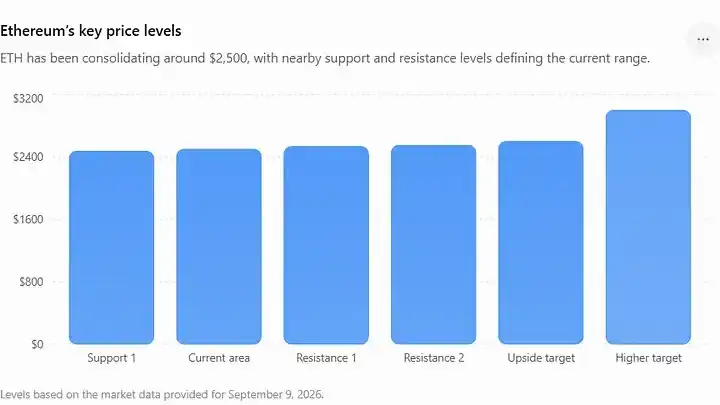
After rising more than 30% in August, ETH has spent early September moving in a narrow band, repeatedly testing the $2,500 level without producing a clean breakout. Price action has stalled, but treasury accumulation, exchange balances, ETF demand and protocol development are all still moving.
$2,500 remains the line both sides are fighting over
ETH has recently traded mostly between $2,480 and $2,520. Repeated attempts to reclaim $2,500 suggest buyers are still defending that psychological level, but resistance in the $2,525 to $2,535 zone has capped upside so far. Beyond that, $2,550 stands out as the more important barrier.
A decisive break above $2,550 could bring $2,600 back into focus. If momentum returns, the path toward the $3,000 area may reopen. The downside is also clearly mapped. Initial support sits around $2,475 to $2,485, and a failure there could expose $2,430 to $2,445.
Some technical charts have printed a golden cross, which is often read as a longer-term bullish signal. Still, the source article noted that technical indicators alone are not enough to reverse weak participation. That matters now as investors watch the Federal Reserve policy meeting scheduled for Sept. 15 to 16.
Over a longer horizon, the current Ethereum price setup depends heavily on whether this consolidation can turn into a sustained breakout rather than a short-lived bounce.
Holder behavior is splitting by wallet size
One of the clearest features in the current market is the divergence between different classes of holders.
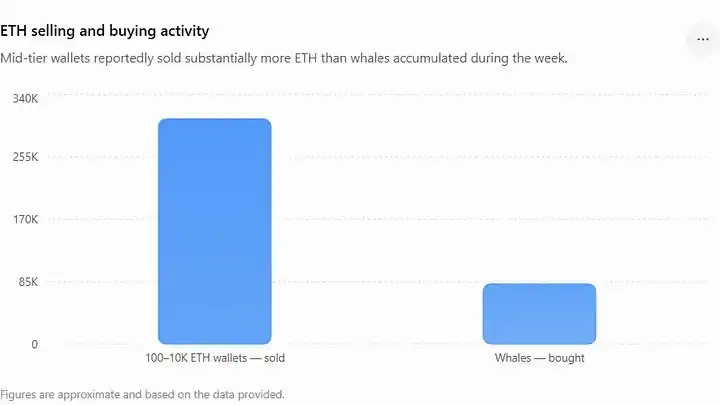
Wallets holding 100 to 10,000 ETH reportedly sold about 307,000 ETH last week. Whale addresses, by contrast, bought roughly 82,000 ETH over the same period.
That does not automatically mean the market is turning bearish. In the framing of the source article, the move may simply show that some investors are taking profits after August's rally while larger pools of capital are building positions with a longer time horizon.
BitMine Immersion Technologies is the most prominent example cited. The company bought another roughly 28,086 ETH, valued at about $69 million to $70 million, lifting its total holdings to a reported 5.93 million ETH. That amounts to nearly 4.9% of Ethereum's total supply.
The size of that position is difficult for the market to ignore. Even though the mark-to-market value remains below its average entry cost, BitMine has kept buying, according to the report, and a large share of its ETH is staked. That is a very different posture from short-term trading.
Abraxas Capital bought spot ETH while hedging a large short
Abraxas Capital has also been active. The firm reportedly bought about 13,000 ETH in spot markets, worth roughly $32 million.
The motivation attached to that trade is what makes it notable. According to the source article, part of the spot purchase was intended to hedge a short position of about 141,000 ETH on Hyperliquid. In other words, not every large spot buy should be read as a clean directional bullish bet.
Other whale-related flows pointed in different directions as well. An early Ethereum holder reportedly sold about 11,023 ETH through Wintermute, while Justin Sun continued moving ETH after withdrawing additional funds from Lido.
The picture is straightforward: whale activity is increasing, but it is not aligned. Some large holders are distributing, some are accumulating, and some are hedging.
ETF inflows slowed sharply, but exchange supply also dropped
Spot Ethereum ETFs showed a similar split. Weekly inflows reportedly fell to about $218 million from roughly $824 million the week before, and some single trading days even posted net outflows.
The slowdown is clear. Even so, the article argued it is too early to treat weaker ETF flows as evidence that institutional interest has disappeared, because another supply-side signal has been moving in a more supportive direction.
More than 116,000 ETH left trading platforms within 48 hours. Lower liquid supply on exchanges can reduce immediate sell pressure, though the report explicitly noted that this does not guarantee a price increase.
Institutional market structure is also still expanding. Standard Chartered has reportedly broadened its physically settled spot ETH trading service for institutional clients in the United Arab Emirates. The result is a market where localized demand is cooling while the wider institutional infrastructure continues to build.
Ethereum's most important story may not be the price chart
If price action has turned dull, the development roadmap has not.
The Ethereum Foundation's protocol teams recently published a unified priority ranking for 62 proposed EIPs tied to the planned Hegotá upgrade. Two proposals were placed in the top-priority tier.
The first is EIP-7805, also known as FOCIL, which is designed to strengthen censorship resistance through enforced transaction inclusion. The second is EIP-8141, or Frame Transactions, which targets one of Ethereum's long-running usability issues: users generally need native ETH to pay gas fees.
The proposal could eventually allow users to pay gas directly with stablecoins such as USDC or USDT, while also supporting native account abstraction and new validation methods. If implemented, that would lower the barrier for mainstream users interacting with Ethereum.
The roadmap also carries a longer-dated objective: building quantum resistance for Ethereum Layer 1. For now, December 2029 is being treated as an important milestone target.
Glamsterdam is shaping up as the next major test
Hegotá remains a longer-range plan. Before that arrives, Ethereum is expected to face its next major upgrade, Glamsterdam, with a current target of the fourth quarter of 2026.
That upgrade is tightly focused on Layer 1 performance. Developers are working through enshrined proposer-builder separation, or ePBS, block-level access lists, gas repricing and a higher gas limit.
One key goal is to lift the baseline gas limit to around 200 million. If that is achieved, Ethereum's throughput capacity would rise materially.
A Sepolia testnet fork is expected on Sept. 28 or in early October. That makes the next several weeks important not only for short-term traders but also for judging whether Ethereum's underlying roadmap is advancing toward mainnet as planned.
The ecosystem is evolving in different directions
Changes are not limited to the base layer.
Lido has launched the 0x02 community staking module testnet, designed to support compounding validator nodes with balances of up to 2,048 ETH. If the feature reaches mainnet, the report said, it could significantly improve capital efficiency for staking operators.
Scroll is moving in a very different direction. The Ethereum Layer 2 project said it plans to shift gradually from a general-purpose chain toward an application-specific network built around its Compass AI ecosystem. The transition is expected to take about nine months. Scroll also plans to migrate the SCR token to Ethereum mainnet while keeping its existing supply and tokenomics unchanged.
Trezor, for its part, has added support for ERC-7730 clear signing in an effort to help users better understand what they are approving before confirming blockchain transactions.
What the market is still waiting for
Ethereum currently lacks one dominant catalyst capable of deciding the next directional move on its own. Instead, several smaller forces are pulling at the market at the same time:
- Retail holders are selling.
- Treasury companies are accumulating.
- ETF net inflows are slowing.
- Exchange ETH balances are declining.
- ETH remains pinned near $2,500.
- Core developers are preparing some of the network's most important base-layer changes in years.
That leaves traders with a simple near-term map. A sustained move above $2,550 would strengthen the bullish case considerably. A break below $2,475 could shift attention to the $2,430 to $2,445 zone. Until one of those levels gives way, Ethereum may remain range-bound.
Calm price action should not be mistaken for a dormant ecosystem. The article's central point is that ETH's next major move may depend less on one headline event than on which of these competing trends ultimately takes control.