

Ethereum’s base-layer roadmap still runs through the slow gears of All Core Developers governance and hard-fork scheduling. But a new analysis from Bankless senior analyst William M. Peaster says some of the biggest changes are now forming somewhere else entirely.
In the article, which TechFlow translated into Chinese and MarsBit published, Peaster highlights four things that moved forward over the past week: Paradigm’s new Solidity compiler Solar, the Ethereum Economic Zone’s Rollup X testnet, a public test release of Fast Confirmation Rule, or FCR, and the evm.fast challenge focused on formal worst-case bounds for Ethereum block proving. His point is pretty direct: put these pieces together, and Ethereum might be able to remake parts of DeFi without sitting around for a hard fork.
Four pieces moving outside the protocol layer
The piece starts with a hypothetical lending market built fully on an Ethereum rollup. When liquidations hit, collateral would be sold straight into Ethereum L1’s deep spot liquidity. Cheaper deployment. Lower user costs. Deposits landing within seconds. And the rollup underneath could still post a state proof to mainnet every 12 seconds even during heavy congestion.
Peaster says that exact system does not fully exist yet. Still, he argues it is far closer than it was a month ago. And the striking part is where the ingredients came from: not a hard fork, but coordinated work across Ethereum’s surrounding infrastructure.
The four components he points to are:
- Solar, Paradigm’s new Rust-based Solidity compiler
- Rollup X, the first experimental network built on the Ethereum Economic Zone, or EEZ
- Fast Confirmation Rule, which has entered a new public testing phase
- evm.fast, an open challenge aimed at formal upper bounds for Ethereum block proofs
Solar cuts contract costs without an EIP
First up is Solar. Peaster calls it a tool that can meaningfully cut smart-contract deployment and execution costs without any Ethereum Improvement Proposal, or EIP.
On Nov. 2, Paradigm shipped Solar v0.3. This release is a full Rust rewrite of a Solidity compiler and, the article says, the first milestone version that can produce production-grade bytecode from end to end. Developers can already invoke it directly from the Foundry toolchain with command-line parameters.
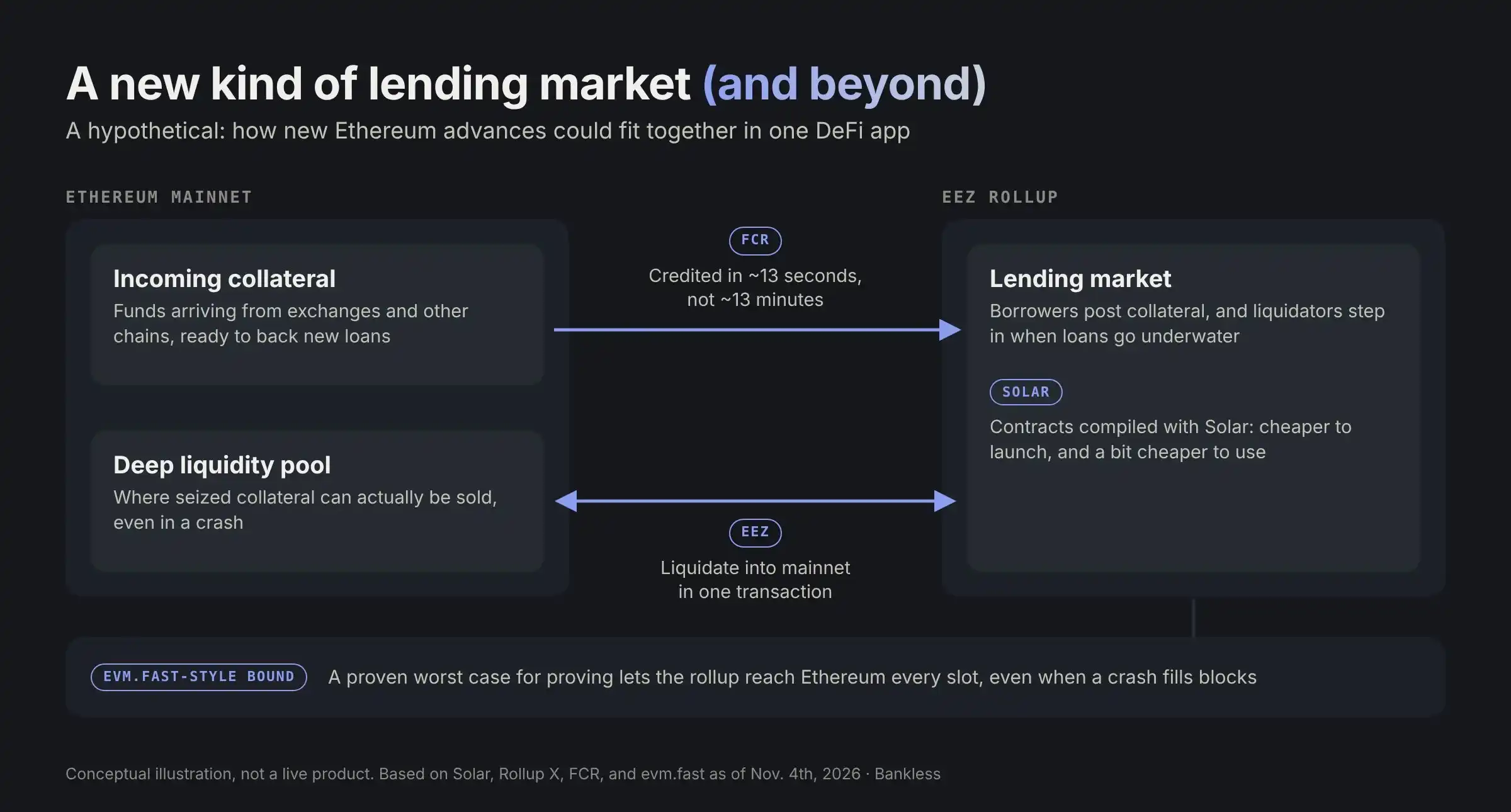
By Paradigm’s own numbers, contracts compiled with Solar show average deployment cost cuts of about 26% versus the long-entrenched solc compiler, while runtime gas consumption drops by about 5%.
The article says those gains also appeared in early tests on live DeFi codebases. In Origin’s stablecoin protocol repository, with business logic left untouched, deployment costs fell 35% and average gas per call declined about 4%.
There are caveats. Solar’s documentation says the project is still moving fast and is not yet recommended for mainnet production settings that hold large amounts of capital. Results differ by project too. Peaster points out that when decentralized exchange Ekubo moved a development branch to Solar, 166 gas test metrics improved, while 12 increased slightly.
Rollup X shows synchronous composability across layers
The second piece is Rollup X. The article treats it as a fresh benchmark for cross-layer interaction.
EEZ is led by Gnosis and ZisK with support from the Ethereum Foundation. The goal is to give Ethereum mainnet and rollups what the article describes as synchronous composability. In plain terms, a contract on one chain can call logic on another chain and use the returned data inside the same atomic transaction. If one branch breaks, the entire transaction rewinds.
During this year’s Devcon, EEZ launched its first public testnet, Rollup X, and showed off two examples.
In one example, aggregator CoW Swap took a swap order signed by a user on Rollup X, routed it into Ethereum L1 spot liquidity for execution, and sent the purchased assets back to Rollup X in that same atomic transaction.
In another, Rollup X rapidly verified a post-quantum signature scheme offchain, letting a contract on Ethereum mainnet act directly on the result.
Peaster is not pretending the system is finished. Real-time ZK proofs are expected to fully mature in 2027, and Gnosis has warned that the testnet is not appropriate at this stage for large amounts of real assets. Even so, the article says Rollup X gives a glimpse of where this tech may end up.
FCR reduces deposit confirmation to about 13 seconds
The third development is Fast Confirmation Rule. The article says it can shrink delays in cross-chain deposits and similar flows from more than 10 minutes down to seconds.
Right now, most L2 networks and bridges wait for Ethereum finality before crediting deposits from mainnet, and that usually takes about 13 minutes. Drawing on Ethereum Foundation educational material cited in the piece, FCR works by counting validator attestations and can tag a block as quickly confirmed within a single slot, roughly 13 seconds.
And this is not framed as theory only. Gnosis Bridge has used it for Ethereum-originated transfers since Oct. 8. The bigger turn came on Nov. 4, when node provider QuickNode launched a public beta for FCR and folded it into the existing safe-block tagging interface many applications already use.
Ethereum researcher Julian Ma is quoted as saying, “The technical barriers to industry-wide adoption of FCR have now been completely removed.”
The article also lays out the security assumption. FCR relies on at least 75% of staked validators being honest, online, and submitting attestations on time. If the network turns unstable, the system drops back to the standard finality path to avoid the rare risk of a reorganization in a quickly confirmed block.
evm.fast targets the worst-case proving problem
The fourth piece is evm.fast, which Peaster presents as an effort to solve the worst-case side of block proving at the mathematical layer.
The dream of proving Ethereum in real time depends on whether a prover can keep pace with block production. Under normal conditions, the article says, that is already getting close. Gnosis disclosed that ZisK can now prove 99.9% of Ethereum blocks in under 10 seconds.
But the unresolved problem sits in the tail. According to the article, nobody has yet produced a strict mathematical upper bound on the maximum computational load of a maliciously constructed block. So, in theory, an extremely complex block could still stall a prover.
To tackle that, the Ethereum Foundation, zkSecurity, and Verity Labs launched the evm.fast challenge on the Yukon research platform on Nov. 2. Teams are being asked to use the Lean formal theorem-proving tool to derive and prove an absolute upper bound on the number of RISC-V machine instruction steps needed to verify any Ethereum block.
At launch, the leaderboard’s theoretical upper bound was infinity. Pretty stark. In practical terms, the first team to produce a finite constant that holds up under mathematical scrutiny would jump straight to the top.
How the four parts fit together in a lending market
Peaster’s real argument is not just that each piece matters by itself, though he says they do. It is that, together, they could open the door to a different kind of onchain financial system.
Solar would cut the cost of launching and expanding lending markets. Many lending protocols deploy a new contract instance when they open a new market, so lower compile and deployment costs stack up as the protocol grows. Interest accrual and liquidation checks also run constantly across borrowing, repayment, and liquidation flows, so even modest runtime gas savings can accumulate over time.
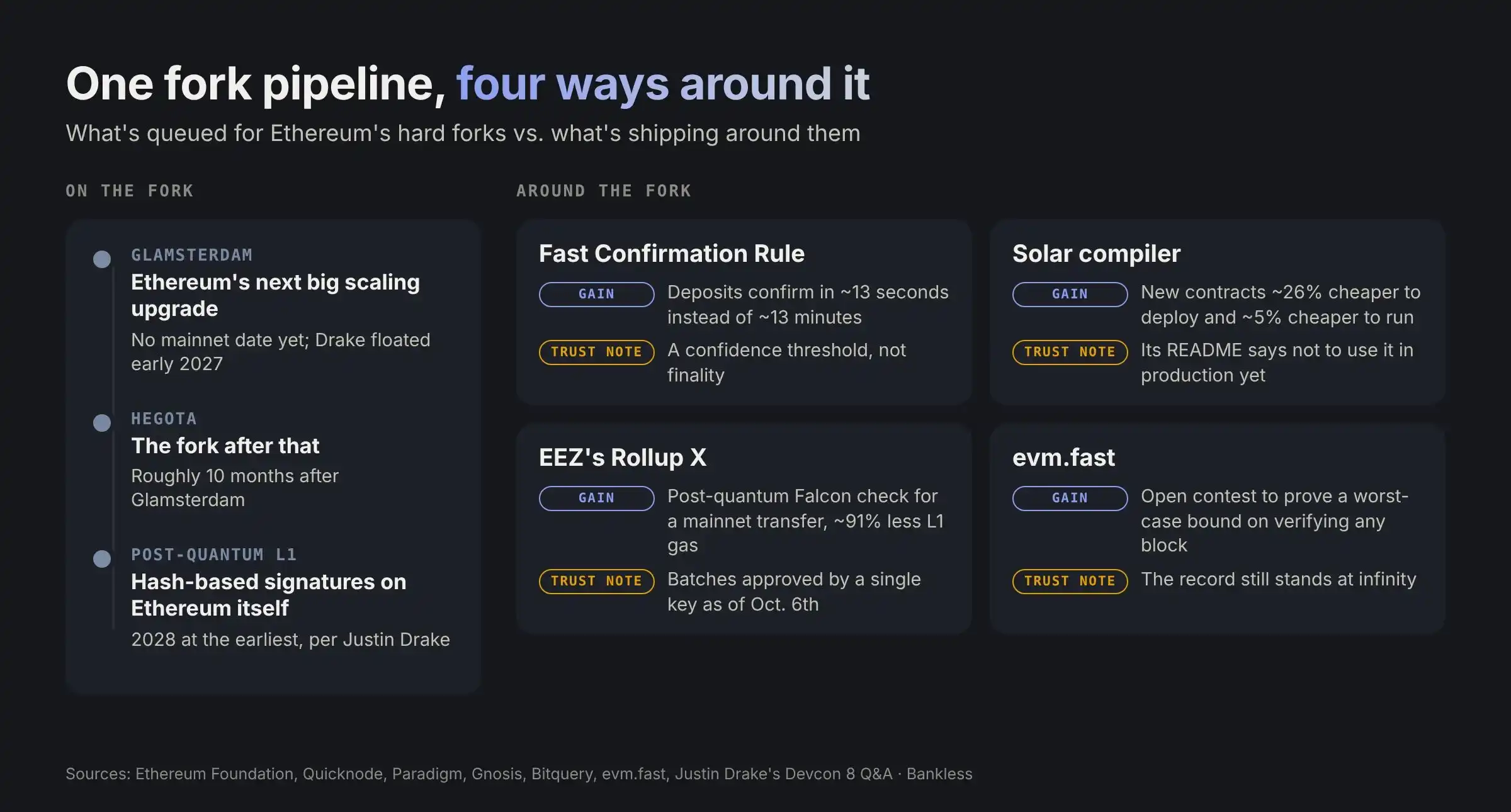
EEZ would tackle the liquidation problem that often weakens newer chains. In a violent market move, local spot liquidity may not be deep enough to absorb seized collateral. With EEZ, liquidators could sell that collateral directly into Ethereum L1 spot liquidity and settle the L2 debt in the same atomic transaction. If any step fails, the whole thing reverts. The article says that would let rollups list assets whose real liquidity lives on mainnet, while arbitrageurs keep prices aligned without taking bridge depeg risk.
FCR would strip out waiting friction on deposits. Not every collateral asset arrives through synchronous calls; a big share still comes in from centralized exchanges and other multichain venues. With FCR, a lending market could credit collateral in about 13 seconds, cutting idle capital and letting outside liquidity move in faster when borrowing rates spike. The article adds that protocols could apply dynamic risk haircuts to quickly confirmed collateral before finality arrives, limiting bad-debt risk from occasional reorganizations.
evm.fast would draw a hard safety boundary for the proving side. During panic conditions, blocks get crowded, and the article says attackers could try to build blocks that delay proofs and cut the rollup off from mainnet. If an absolute upper bound on proving cost is formally established, operators could provision enough compute headroom to guarantee validity proofs arrive on time in every slot, even under the harshest conditions. Peaster describes that shift as moving from “usually fast enough” to “mathematically always fast enough.”
For users, the article says, the outcome would be easier to spot: lending backed by mainnet-grade liquidity, near-instant collateral deposits, tighter spreads and slippage, and lower gas costs, all without waiting for Ethereum to push through a new hard fork.
Beyond lending: DAO treasuries and post-quantum signatures
The article says the same setup can be used for more than lending.
One example is a post-quantum treasury design for a decentralized autonomous organization, or DAO. Treasury multisig signers could approve grants with the Falcon signature scheme, which is designed to resist quantum attacks. A rollup would do the expensive signature verification work, and the Ethereum mainnet treasury would execute the transfer in the same atomic transaction, echoing the liquidation flow demonstrated in Rollup X.
Under that arrangement, Ethereum mainnet would only need to carry a small slice of Falcon’s full verification cost of 5.5 million gas. In Gnosis’ demonstration cited by the article, the mainnet side used about 495,000 gas. Solar could push verification contract costs lower, FCR could speed incoming donations and outside funding, and a formally proven compute ceiling would help make sure the system does not jam.
Peaster extends the same reasoning to decentralized exchanges, cross-border payment networks, and fully onchain games. The list of what can be built at Ethereum’s application layer, he argues, has gotten longer even though none of the existing protocol rules changed.
An alternate path around protocol bottlenecks
The article closes by circling back to Ethereum governance. The slow pace of All Core Developers coordination and hard-fork delivery is nothing new, and Peaster does not cast caution itself as a flaw. For consensus rules securing an economy worth hundreds of billions of dollars, he says, change should be deliberate.
Still, he argues that Ethereum’s ecosystem can push the technical frontier outward through self-organized work outside the protocol layer, and the past week’s developments show that bottom-up engineering path in action.
He says the implications may run especially deep in post-quantum security. Ethereum core researcher Justin Drake has said publicly that the main obstacle to quantum-resistant changes is no longer cryptography itself, but the ordering of priorities inside the All Core Developers process.
According to the article, Drake said that if all client teams treated quantum safety as the top priority, the relevant features could reach mainnet within months. At the current pace, though, the timeline may not land until the end of 2028 at the earliest. In Peaster’s view, Rollup X’s Falcon signature work shows developers do not need to wait for mainnet to make the first move.
The hard-fork pace on Ethereum is unlikely to suddenly accelerate, the article says. So the more interesting question is how many side-path solutions the wider ecosystem can produce between protocol upgrades, and whether decentralized oversight and evaluation can keep up.



