

Author: 0xJaehaerys, Plain Blockchain

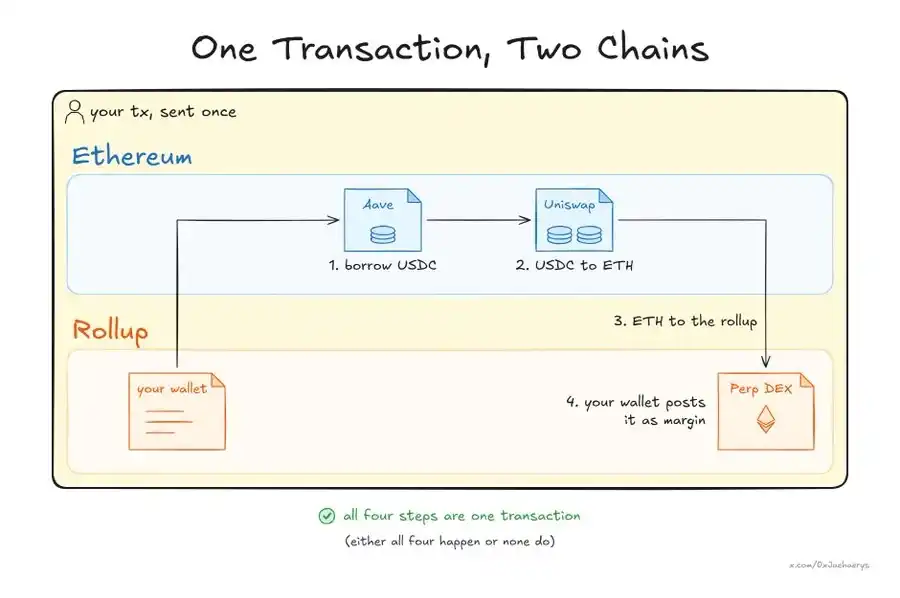
Liquidity across Ethereum is spread between mainnet and dozens of Layer 2 networks. A user who wants to borrow USDC from Aave on mainnet, swap it for ETH on Uniswap and post that ETH as collateral on a perpetuals DEX cannot normally complete the sequence in one transaction on a Rollup. The process requires bridges, transfers and separate approvals.
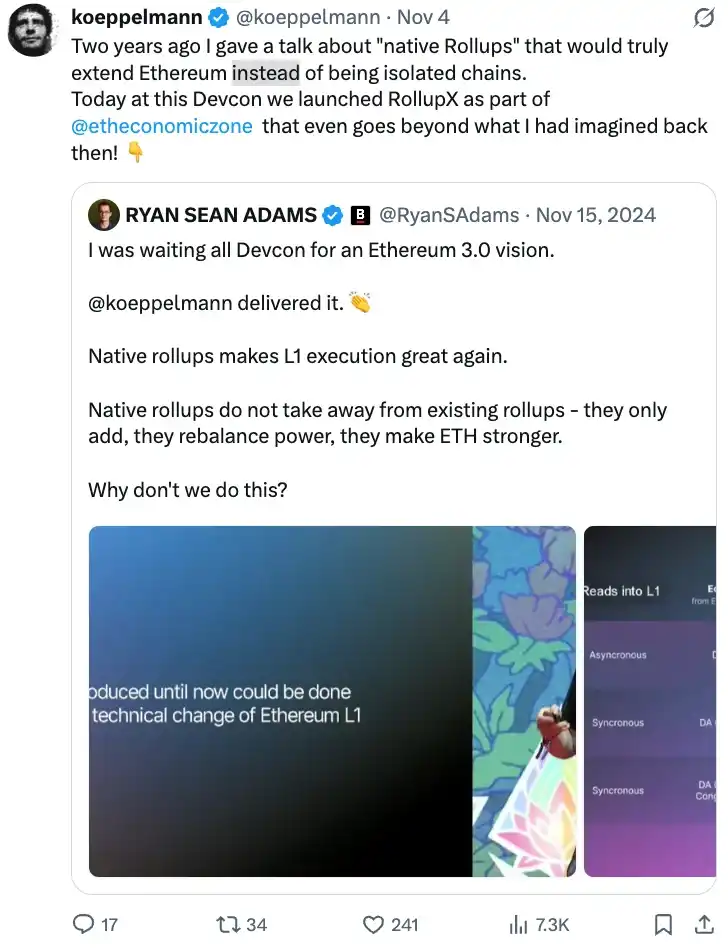
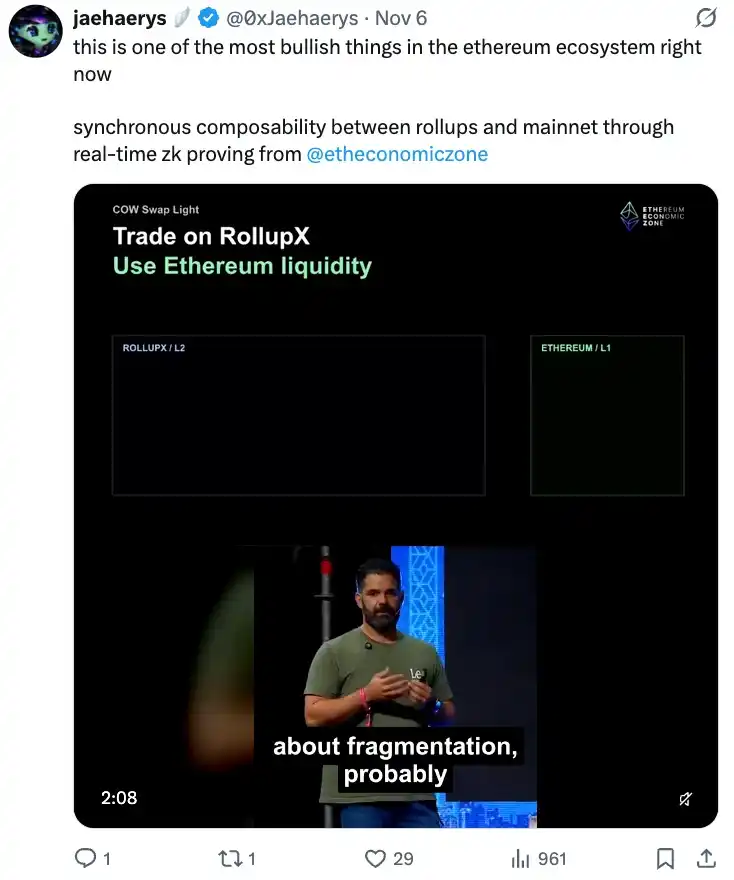
The Ethereum Economic Zone, or EEZ, is designed to change that workflow. Connected Rollups can use resources on Ethereum and on other connected Rollups as if they were on the same chain, enabling synchronous composability within a single block.
What the EEZ is
EEZ consists of contracts on Ethereum and rules that connect individual chains to those contracts. It is not a new chain and not a new stack. Each connected chain keeps its preferred virtual machine and transaction ordering, and decides who may join and which proof systems it trusts.
The chains share Ethereum blocks. Each can use mainnet liquidity, contracts and keys in the same block. The “economic zone” label reflects a shared market with independent rules for each chain.
The design assumes that the number of chains around Layer 1 will not decline. Ethereum does not have enough bandwidth to host the global economy, and not every participant fits the mainnet model. Banks and trading platforms may need different rules. The connected environment may include EVM and non-EVM chains, as well as public, private and permissioned networks.
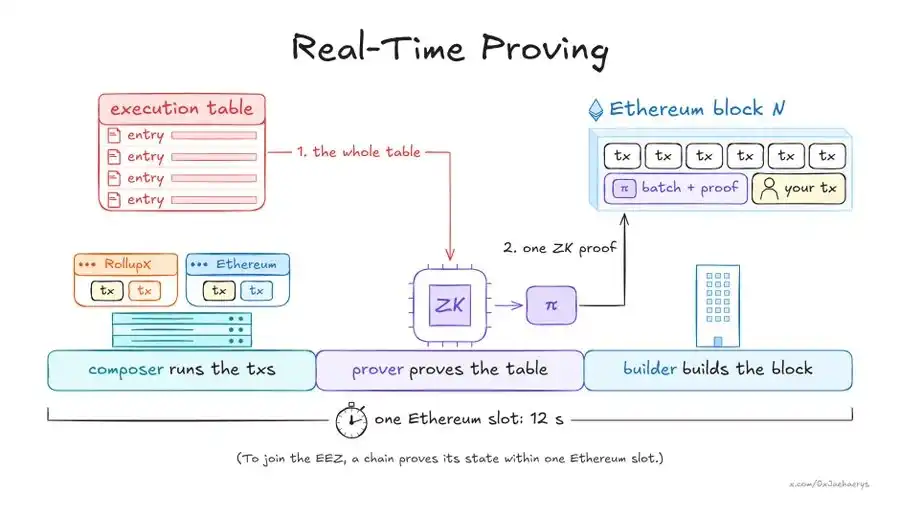
A chain joining the EEZ must meet at least two conditions: it must prove its state within one slot, and it must roll back with Ethereum if Ethereum reorganizes. The second condition prevents a Rollup from remaining on a discarded historical state after a reorganization. The first depends on real-time proving.
Real-time proofs make synchronous calls possible
A validity proof shows that a chain followed its rules and reached a new state. An Ethereum contract can verify the state transition without re-executing the chain’s block.
EEZ requires the proof to be generated within one Ethereum slot, which lasts 12 seconds. RISC Zero and SP1 can currently prove a block within 12 seconds using eight to 16 GPUs, at a cost of $0.01 to $0.05. A shorter block time could accelerate the process.
The article cites data from Ethproofs showing that ZisK needed 24 RTX 5090 GPUs a year ago but now needs four.
Ethereum does not execute Rollup code directly. It accepts a Rollup response only when that response comes with a proof. In the past, proof generation could take minutes or hours, preventing the response from arriving in the same block as the original call. A proof generated within one slot makes synchronous execution possible.
Under the EEZ design, the Rollup’s response to a cross-chain call is prepared before block production. A composer calculates the result, a prover proves it, and a builder places the proof and the transactions that need the response into an Ethereum block. The calculation, proving and packaging must all happen within the same 12-second slot.
Proxy contracts and the execution table
The simplest example is a call from Ethereum to a Rollup. Calls between two Rollups follow the same route.
Precomputed proxy addresses
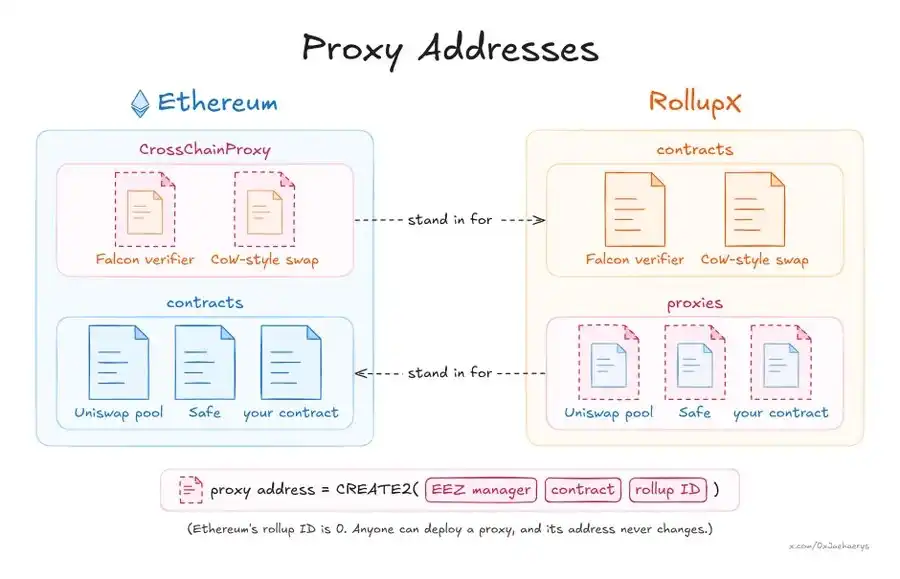
Calls to another chain go through a proxy. Every contract on a Rollup has a known proxy address on Ethereum, and Ethereum contracts have corresponding addresses on the Rollup.
The address is calculated with CREATE2 from the EEZ contract address, the original contract address and the chain ID. An Ethereum contract that needs to call a Rollup contract can call the contract’s Ethereum-side proxy.
The composer and execution table
The composer runs the transaction on every chain involved and records each cross-chain call in an execution table. The table contains precomputed answers. Each execution entry includes the call result, the Rollup state roots before and after the call, the list of calls the Rollup will make back to Ethereum, and a rolling hash of those calls and results. One proof can cover the full table.
The composer sends a transaction bundle to the builder. The builder must include the bundle in full and in order, or exclude it entirely.
The first transaction is postAndVerifyBatch, which submits the execution table and verifies its proof. Later transactions call Rollup proxies, which read their answers from the verified table.
Batch verification and proxy responses
The postAndVerifyBatch transaction verifies the batch proof. The Rollup’s onboarding rules determine which proof system it trusts and how many proofs each batch requires. The choices can include zero-knowledge proofs, trusted execution environments, multisignatures or a combination.
After execution, the batch’s entries become available to proxies on Ethereum. When a user transaction calls a proxy, the proxy looks up the matching entry in the EEZ contract. It returns an answer only if the call exactly matches the composer’s simulation, the entry arrives with the batch in the same block, and the rolling hash generated by the Rollup’s callback to Ethereum matches.
Callbacks to Ethereum
Calls from a Rollup back to Ethereum are executed directly by Ethereum, while the Rollup obtains the answers from the composer’s simulation. Calls can be nested. An Ethereum contract reached through this process can call a Rollup contract through another proxy, with the nested answer already present in the execution table.
One transaction for borrowing, swapping and collateral
The opening example runs in the opposite direction, from a Rollup to Ethereum. Before block production, the composer runs the transaction on both chains and records everything the user’s wallet will receive in the execution table. The builder places the batch, table and proof into an Ethereum block, completing the sequence within one block.
A single transaction initiated on a Rollup can therefore borrow USDC, swap it for ETH and deposit the ETH into a margin vault. If the composer finds a failed step during simulation, it does not send the bundle. If actual Ethereum execution differs from the simulation, every operation on Ethereum and the Rollup is reverted.
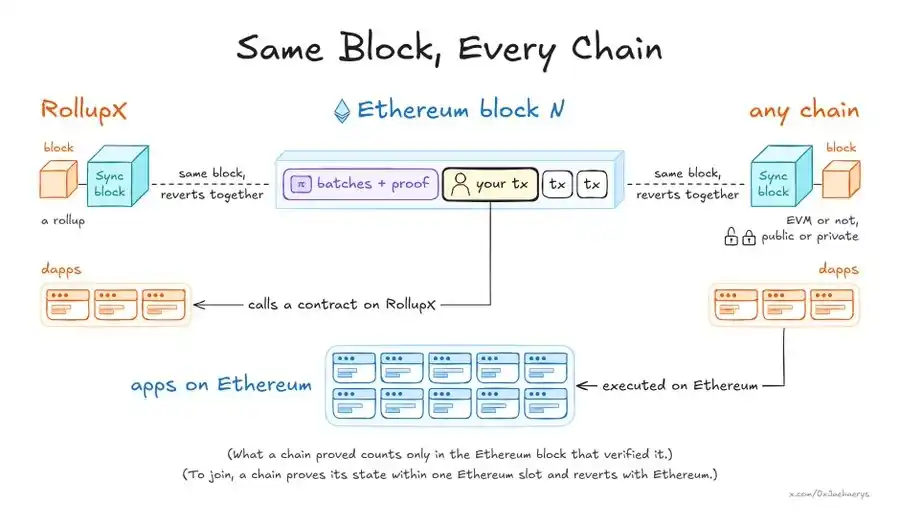
The mechanism supports all three directions: L1 to L2, L2 to L1 and L2 to L2.
Connected Rollups can access mainnet liquidity
A new EEZ chain would not need token incentives to bootstrap liquidity. It could use liquidity and applications already available on Ethereum.
On RollupX, an EEZ test Rollup located on mainnet, a user bought CRV from an Ethereum Uniswap pool. CRV did not exist on the Rollup at the time, but the bridge minted a wrapped version of CRV during the same swap transaction.
If every EEZ chain worked this way, trading volume would flow into one L1 liquidity pool instead of being split across chains. Ethereum protocols would not need to be deployed repeatedly on every network. The calls pay gas on L1, so more activity across EEZ chains would also create greater demand for Ethereum block space.
Applications launch Rollups partly to control transaction ordering and retain MEV. Trading platforms may also want custom matching engines. Previously, that independence came at the cost of Ethereum composability because L1 contracts and liquidity were available to Rollups only asynchronously.
With EEZ, a trading platform can keep its own matching engine. Orders that cannot be filled in its order book can be executed directly against Ethereum liquidity in a synchronous block.
L1 key management, private chains and permissioned networks
Keys and permissions can remain on L1 because a Rollup contract can read Ethereum state in the same transaction. Safe already runs on RollupX in this form. The Safe on the Rollup is only a proxy; its signers and permissions remain in the Safe contract on mainnet.
Each transaction checks L1 state immediately before execution to verify the multisignature. A change to the mainnet multisig can take effect across all Rollups immediately, without synchronization or delay. Ethereum identity contracts can similarly prove credentials directly to any Rollup within the same block.
EEZ chains do not have to be public. A privacy chain such as Aztec, or a government-operated permissioned chain, could join the EEZ and use L1 liquidity. The closest current example is Bermuda Bay, a privacy pool on RollupX. It hides trader identities while the swap executes on Uniswap V3 on L1 in the same transaction.
Rollups as Ethereum coprocessors
A Rollup can also serve as an Ethereum coprocessor. Tasks that are too expensive to compute on L1 can run on a Rollup, while an Ethereum contract acts on the result within the same block.
Verifying a post-quantum Falcon signature on Ethereum costs 5.5 million gas. In an EEZ demonstration, the signature was verified on a Rollup, and the result directly authorized a payment from Safe on L1 without a precompile or hard fork. If a new cryptographic system or virtual machine exists on a chain inside the economic zone, Ethereum can use it.
The limits of synchronous execution
EEZ chains cannot have all three of fast block production, synchronous Ethereum calls and decentralized sequencing. The article cites a Gnosis forum discussion describing this as a choice of two out of three.
A fast chain producing a block every 200 milliseconds, for example, needs a centralized sequencer to support synchronous calls with Ethereum. If only one of every 60 blocks is synchronous, applications on that chain can reach Ethereum once every 12 seconds. The chain remains usable, but its cross-chain activity runs at L1 speed and depends on L1 block space.
Every cross-chain call passes through the composer. Because the composer must see unencrypted transactions before block production, the composer and builder gain priority access to the resulting MEV.
At present, validators build 7% of Ethereum blocks themselves rather than using an external builder. Synchronous calls do not occur in those slots.
During the first month after launch, every EEZ batch landed in a block built by an external MEV-Boost builder. Titan built 56% of those batches, compared with a normal block share of 48% for Titan. Titan can now capture cross-chain MEV as well.
EEZ is intended to remove the need for Rollups to choose between operating as independent chains and staying fully on Ethereum. A Rollup can retain control over transaction ordering and its own rules while using Ethereum liquidity and applications within the same block.



