

Ethereum is locked in a fresh argument over EIP-8363, a draft proposal that would make staking rewards much less attractive as the network’s staking ratio rises. Filed on Aug. 4 by six researchers including EthCC founder Jérôme de Tychey and Ethereum Foundation researcher Justin Drake, the proposal introduces what its authors call a tapered issuance burn. If effective stake gets close to 50% of ETH’s total supply, validators’ consensus-layer issuance rewards would be fully offset.
The proposal first appeared under the number EIP-8361, then switched to EIP-8363 after the original number was found to have already been assigned elsewhere. Even in draft form, it has quickly become one of the most divisive topics in the Ethereum community.
Why the authors think Ethereum has a staking problem
At a basic level, more ETH staked means a higher economic cost to attack the network. The authors do not dispute that. Their point is narrower: more stake does not always produce the same incremental gain in security, especially if fresh deposits continue to flow to a small set of large service providers.
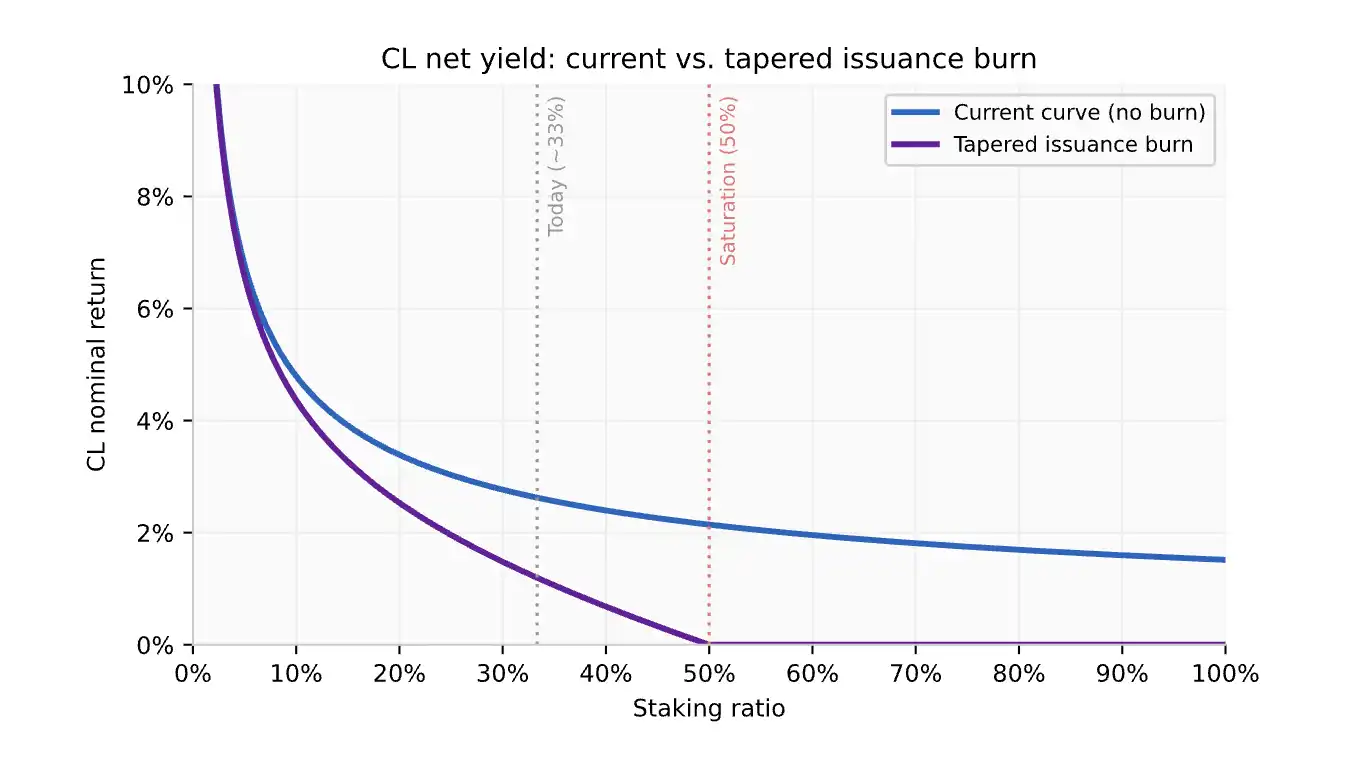
Today, Ethereum’s consensus-layer rewards decline as total stake increases. But even if all ETH were staked, the nominal consensus yield for an individual validator would still have a theoretical floor of about 1.5%. The EIP-8363 authors argue that this leaves the protocol with no real stop signal. In their view, Ethereum keeps paying to encourage more staking, which can pull ETH toward large custodians, exchanges, and staking derivatives.
They also argue that unstaked ETH holders are continuously diluted by new issuance. Liquid staking tokens, or LSTs, come with built-in yield and can become more attractive than native ETH as DeFi collateral or savings instruments. The proposal is designed to reduce that dilution pressure and make native ETH more competitive again as a neutral asset.
How EIP-8363 would work
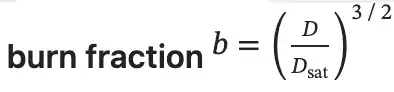
The draft does not ban new validators and does not impose a hard 50% staking cap. Instead, it would calculate validator rewards as usual, then deduct and burn part of that issuance. The burn ratio would depend on the network’s effective stake balance, using the effective stake balance divided by 60.25 million ETH, raised to the power of 1.5, with the result capped at 100%.
The 60.25 million ETH figure is roughly equal to half of current ETH supply. As total stake approaches that level, validators’ net consensus-layer issuance would trend toward zero. At or above that threshold, the normal consensus issuance earned by fully performing validators would be entirely canceled out by the added burn.
The proposal notes that 60.25 million ETH would be a fixed value written into the protocol at the time of a hard fork.
The authors also try to head off two common misunderstandings. First, 50% is neither a staking limit nor a target staking ratio. Validators could still join. The idea is to let market incentives stop growth before yields no longer cover liquidity, operating, slashing, and regulatory risks. Second, “zero rewards” refers only to net consensus-layer issuance. Execution-layer income such as priority fees and MEV would not be affected.
What the numbers look like at today’s staking level
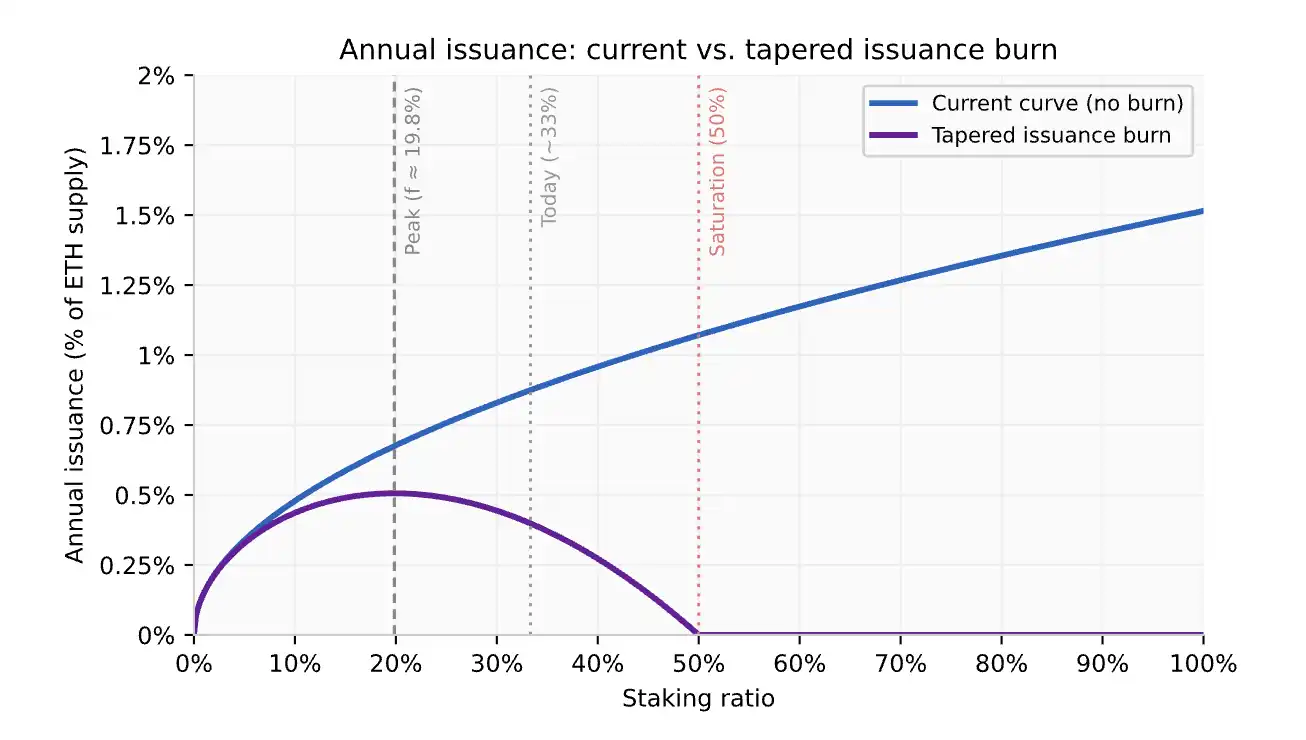
Under the proposed curve, annual consensus-layer issuance would peak at a staking ratio of around 19.8%, then decline as the staking ratio moves higher. At the current staking ratio of about 33%, the authors estimate that a full implementation at fork activation would cut consensus-layer yield from roughly 2.6% to about 1.2%.
To avoid an immediate collapse in returns, the draft includes an 18-month transition period. At activation, the base reward factor would be temporarily raised from 64 to 128, then stepped back down to 64 across 65 intervals, with each step lasting about 8.6 days. That would keep net rewards close to current levels at first, then lower them gradually over time.
Still, the rule that removes consensus-layer issuance incentives beyond the 50% area would apply from day one of activation. It would not wait for the 18-month transition to end.
Where the proposal stands now
EIP-8363 remains an unmerged Core EIP draft and is still in editorial review and consensus evaluation. The authors also submitted PR #12087 in an effort to have it listed as Proposed for Inclusion in the Hegotá upgrade discussion process. That pull request has not been merged either, and the proposal does not appear in the current formal Hegotá Meta EIP.
Ethereum core developers plan to discuss Hegotá proposal deadlines at the 184th ACDC meeting on Aug. 6. Even if the draft reaches Proposed for Inclusion status, that would not mean implementation is locked in. It would still need developer review, client work, testing, and later progression through steps such as Scheduled for Inclusion.
The case from supporters
Jérôme de Tychey described the draft as a “minimal, market-driven” change. In a forum response, he said the issuance debate has been active since 2023 and that the proposal is only meant to open a formal feedback window, not guarantee inclusion.
He also warned that if validator entry stays saturated and exits remain limited, total staked ETH could top 70 million by early 2028, representing more than 55% of supply. In that scenario, he argued, any later reversal could trigger larger exits and greater market disruption.
Supporters of lower issuance generally make three points. Ethereum may be paying too much for economic security that is already abundant. Unstaked holders keep absorbing dilution and are forced to choose between accepting it and taking staking risk. And as LSTs, ETFs, and custodial services continue to reduce friction, a small group of intermediaries could end up controlling both large ETH balances and validator power.
Why critics are pushing back
Public reactions so far have skewed negative.
Aave founder Stani Kulechov said consensus-layer staking rewards that vary with the staking ratio and eventually approach zero would weaken the predictable cash-flow profile institutions often want from ETH. He also said the change would compress positive spread strategies tied to ETH borrowing and LST looping.
Obol co-founder Oisín Kyne argued that Ethereum’s real security depends not only on how much ETH is staked but also on whether validator power stays sufficiently distributed. If yields fall to very low levels, large institutions with lower capital costs and less sensitivity to returns may be better positioned to remain, pushing out higher-cost independent operators.
ether.fi CEO Mike Silagadze criticized the timing of the submission, saying it arrived too close to the Hegotá deadline and left too little room for prior discussion across the ecosystem. He said lower rewards could hurt staking-related protocols and weaken institutional confidence in Ethereum’s governance stability.
Community member Ryan Berckmans said the opposition includes at least four camps: people worried about who would run validators at near-zero rewards, people who do not want staking yields reduced, people opposed to another change in ETH monetary policy, and people who want to avoid a divisive fight that could distract from ecosystem growth. Berckmans said he supports a moderate issuance reduction, but not a path that drives rewards all the way toward zero, and he sees the current draft as too polarizing.
A more middle-ground view came from Lorenzo Valente, head of research at ARK Invest. He framed the issue around ETH’s identity as an asset. If ETH is valued more as an “internet bond,” then weaker staking rewards could damage lending markets and the yield curve. If ETH is valued more as neutral money and a store of value, then the base yield earned through recursive staking comes largely from new protocol issuance, with unstaked holders paying the cost through dilution. Lower issuance, in that framing, reduces a transfer of value from unstaked holders to stakers and leveraged yield strategies.
Who would feel it first
If EIP-8363 were adopted, solo stakers would be among the first groups hit.
The 18-month transition spreads out the decline in rewards, but it does nothing to reduce fixed costs such as hardware, electricity, and operations. The draft keeps current offline penalty intensity in place while lowering net rewards, which means a single outage would take longer to recover through future earnings. By the proposal’s own estimate, at the current staking ratio of about 33%, the time needed to make up for downtime losses could rise to about 3.8 times the current level.
That is easier for large operators with backup power, geographic redundancy, and around-the-clock operations. For home validators, a few internet outages or equipment failures could eat meaningfully into annual returns.
Tax treatment could widen the gap. The proposal says there is no clear answer in some jurisdictions on whether tax authorities would recognize income based on gross rewards before the burn deduction. If the burned portion is treated only as a capital loss, solo stakers’ after-tax income could come in below the headline net yield.
The effect would likely spread to LSTs. Products such as stETH and rETH derive base yield from underlying validators. As consensus issuance falls, the yield gap between LSTs and native ETH would narrow. That raises a new pricing question: would users still be willing to take on smart contract, governance, custody, and depeg risk for an extra one or two percentage points of return?
Recursive strategies that rely on LST yield would feel the pressure sooner. A common structure is to borrow ETH, buy or mint an LST, then post that LST as collateral to borrow more ETH. As staking yield moves closer to borrowing costs, the positive spread on those trades would shrink and leveraged positions could unwind on their own. Aave, Morpho, Pendle, and other products built around LST yields could face lower ETH borrowing demand, weaker capital utilization, and reduced liquidity.
The impact would eventually reach DeFi’s broader rate structure. Staking yield is a key base rate in ETH-denominated markets, and LST lending, fixed-income products, yield splitting, and recursive leverage are all priced around it.
That does not mean LSTs would lose all utility. What could change is their relative advantage over native ETH.
Institutions and regular ETH holders would not see the same outcome
Further up the stack, ETFs, exchanges, custodians, and ETH treasury companies would also see staking income fall. For institutions that use staking returns to improve asset-level yield, ETH would offer less predictable cash flow, which could affect new allocation decisions. Kulechov said that would make ETH income harder to evaluate and reduce its competitiveness against other yield-bearing assets.
But the effect on institutions would not be uniform. As base yield falls, higher-cost participants may leave first, while large institutions that rely least on staking income may be best positioned to stay. That is one reason critics worry the validator set could become even more concentrated.
For regular ETH holders, the direction of the impact is clearer. Issuance that is burned would not go to a protocol or a fund. The benefit would be shared across all ETH holders through lower dilution.
Even so, lower issuance does not guarantee that ETH becomes deflationary, and it does not prove price must rise. Supply outcomes would still depend on EIP-1559 fee burn, network usage, validator issuance, and market conditions. If lower yields also weaken institutional allocation, LST demand, and on-chain borrowing activity, changes on the demand side could offset part of the supply-side benefit.