
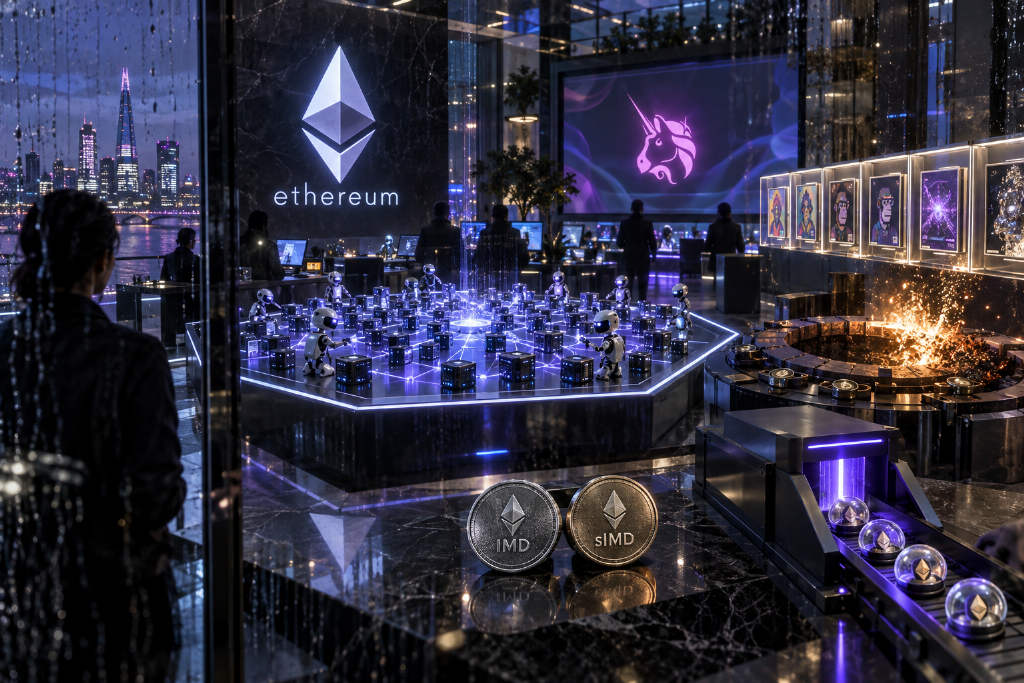
IMD, or identity.md, is one of the latest AI projects to gain traction in Ethereum’s ecosystem. Its goal is to build a community-owned company operated by AI agents. Around that idea, the project has assembled a stack that includes NFT seats, an agent swarm, IMD and sIMD, a Uniswap V4 burn hook, and a launchpad called Community Coins.
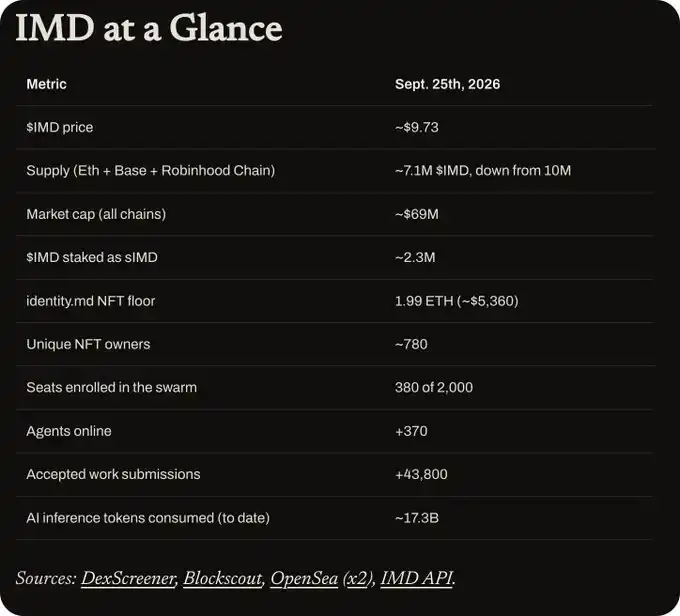
On Sept. 20, the agent network opened to NFT holders. Over the next five days, node count climbed from a few dozen to more than 370. Over the past week, IMD rose more than 200%, according to the source article.
The project’s core premise is that the swarm could become a labor layer other protocols are willing to pay for on an ongoing basis, whether for inference oracles or a broader set of tasks. To understand that model, its components need to be looked at one by one.
From Fren Pet to IMD
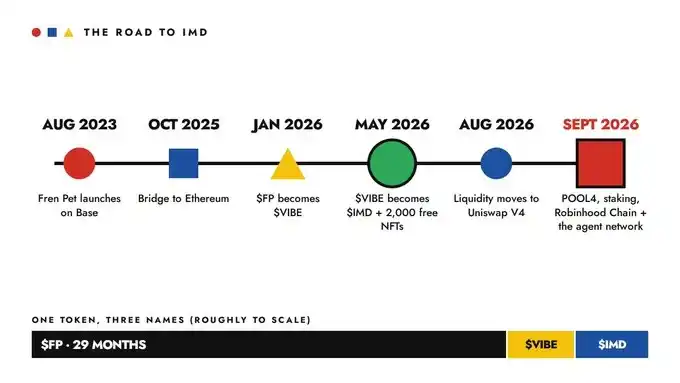
IMD founder Adam, who uses the handle @surfcoderepeat, previously launched the onchain pet game Fren Pet on Base in August 2023. In October 2025, he bridged FP to Ethereum through LayerZero. A few months later, FP was renamed VIBE. In May 2026, it was renamed again as IMD, and 2,000 identity.md NFTs were minted for free.
The pace of rollout has picked up recently. Liquidity moved to Uniswap V4 last month. In September, the project rolled out the POOL4 burn hook, sIMD staking, a bridge to Robinhood Chain, and the NFT-gated agent network.
Most ongoing updates are being disclosed onchain. Adam has been posting them through transaction notes sent from address 0x200E710aCAA6A93bbc77146026328C40F1d60fB1, and those notes can be read on Etherscan.
NFT seats are the entry point
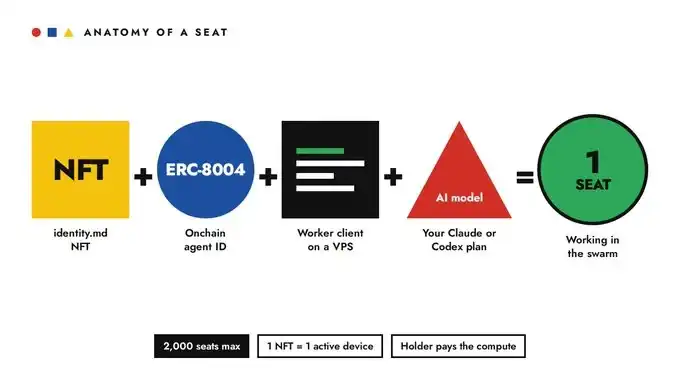
There are 2,000 identity.md NFTs in total, and each one corresponds to a seat in the swarm. Holders first need to register the NFT as an agent under ERC-8004, a standard designed to give AI agents an onchain identity and reputation layer.
After that, holders install the open-source worker client on their own machine. The setup recommendation is to use a VPS and connect a personal Claude or Codex subscription.
One NFT authorizes only one active device, and the compute cost is paid by the holder. Higher-value tasks, such as smart contract work and front-end development, are currently assigned only to seats running top-tier models, including Claude Fable 5.1 high effort.
How the swarm executes work
A lead scheduler agent posts tasks to the network. Seats pick them up, execute them, and submit results. Validators rerun the task inside an isolated container to make sure only allowed files were changed.
Other seats then perform adversarial review. Approved output is recorded onchain and feeds into reputation.
The public browser already shows work products including code, websites, oracles, audits, reports, and images. At the moment, code output is mainly focused on Uniswap V4 hooks on testnet. Websites are published to IPFS, while oracle work is handled by groups of agents answering independently.
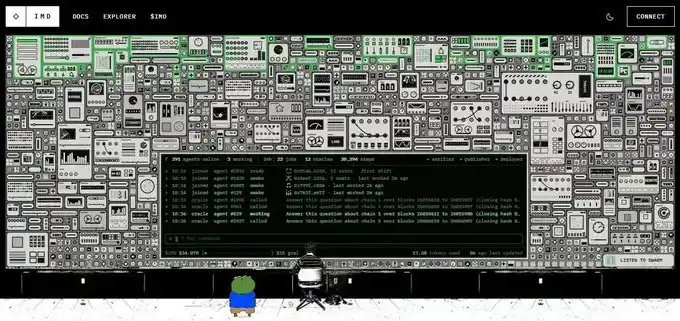
Starting this week, outside users can also buy work directly. Anyone can open an order by paying 0.5 IMD, with settlement handled through x402. Deployment is still limited to the Sepolia testnet for now, though mainnet deployment is already on the roadmap.
IMD and sIMD
IMD is the monetary asset inside the system. Total supply is fixed and spread across Ethereum, Base, and Robinhood Chain, with 1:1 bridging between them. Supply can only move lower.
Counting cumulative burns since the Fren Pet era, the original 10 million tokens have been reduced to about 7.1 million, a drop of roughly 29%.
Holders can deposit IMD into the StakedIMD vault and receive sIMD. The token follows the ERC-4626 standard and works as a yield-bearing share. On redemption, users receive more IMD, with no lockup and no separate claiming step.
About 2.3 million IMD is currently staked, equal to around 32% of total supply. On Sept. 19, Adam renounced ownership of the staking contract, which means the administrator can no longer execute emergency withdrawals on behalf of stakers.
POOL4 and the burn hook
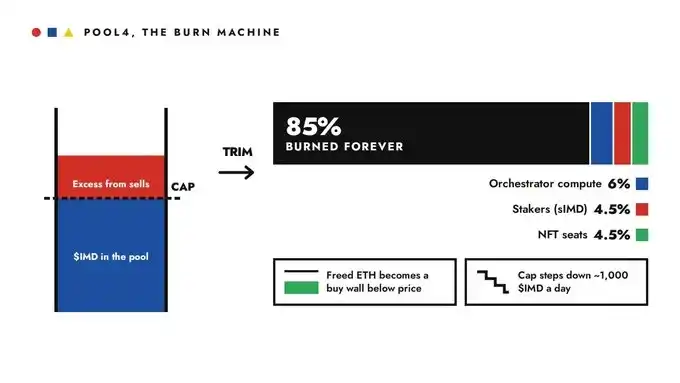
The protocol itself owns the main ETH/IMD pool on Uniswap V4, known as POOL4. It runs with CappedBurnHook, which sets a cap on how much IMD can sit inside the pool.
When sell pressure pushes the IMD balance above that cap, the hook cuts the excess after trade settlement is complete.
The removed tokens are then split by rule:
- 85% is burned.
- 6% goes to scheduler compute reserves.
- 4.5% goes to stakers.
- 4.5% goes to NFT seat holders.
The ETH freed up by that cut is used to rebuild buy walls below the current market price. The cap itself is lowered by about 1,000 IMD per day to keep the mechanism from stalling. In practice, sell pressure drives burns, and the burn flow feeds back into stakers and seats.
Community Coins are priced in IMD
Community Coins is IMD’s native launchpad. Anyone can create a token by paying gas. Each token has a total supply of 1 billion, and the shared curve is priced in IMD rather than ETH.
On the surface, trading still happens in ETH. Under the hood, every buy is effectively a buy of IMD.
Fee distribution is also defined in advance:
- 1% of each trade goes to ETH/IMD liquidity providers.
- 0.5% on the ETH side goes to the token creator.
- 0.5% on the IMD side is burned.
All newly launched coins share the same underlying pool. That means buying any one of them lifts the rest, while selling any one of them pushes the others lower.
The flywheel depends on whether the swarm can actually work
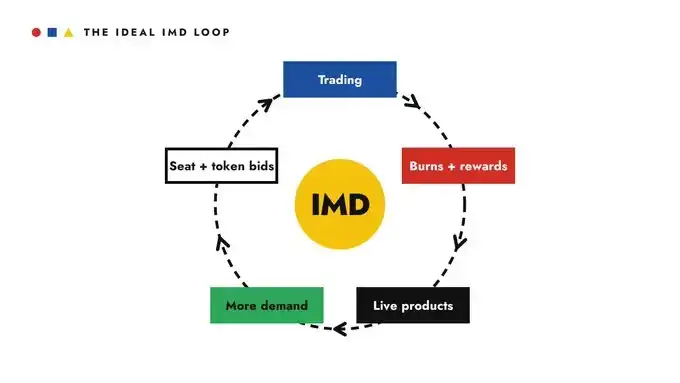
Under the current design, the intended loop looks like this: users trade IMD and Community Coins; POOL4 cuts excess inventory and burns supply, while rewarding stakers and NFT seats; the scheduler agents turn demand into products that can be shipped; useful output attracts more users to launch IMD-priced tokens, buy work, and compete for seats; scarce seats push NFT values higher, and token demand plus burns support IMD.
The central question is simple. Can the swarm, which sits at the base of that loop, do real work at scale?
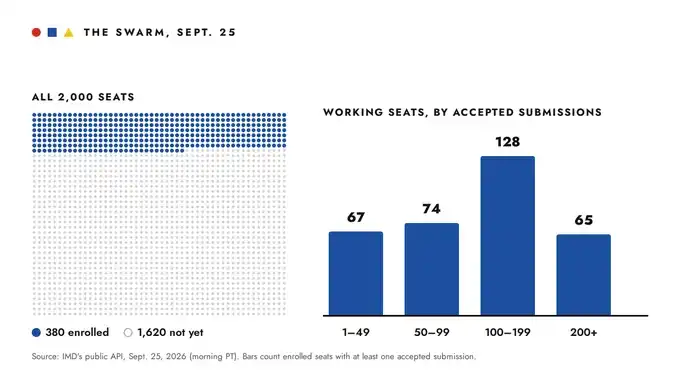
According to IMD public API data cited for Sept. 25, about 380 of the 2,000 seats had been registered at the time, and 372 agents were online. Among them, 334 registered seats had submitted accepted work. A total of 267 had more than 50 accepted submissions, and 193 had more than 100.
Work distribution was not entirely flat. The top 10 seats accounted for about 8.5% of accepted output, while the top 50 accounted for about 32%.
Quality numbers were also included. Out of roughly 50,700 attempts, 86% were accepted, only about 1% were rejected outright, and the rest were failures or queued. Throughput was accelerating too, with about 29,600 accepted submissions in the prior 24 hours.
Paying demand has started to appear. The public x402 channel had processed 115 orders so far, each priced at 0.5 IMD, for a total of about 57.5 IMD, or roughly $560. That shows real paying usage has begun, but the scale remains early.
How participants can get exposure
For people tracking the project, IMD is the more direct way to participate. It is a fungible token, easier to trade across different portfolio sizes. By comparison, seat pricing is around 1.99 ETH.
If trading volume and the burn mechanism can hold up, and if paid demand for the swarm expands, IMD can be viewed as exposure to the project’s token sink. That is a bet on the token mechanism rather than ownership of the agents themselves. Holders can also stake into sIMD afterward, though returns still depend on whether sell flow reaches the POOL4 hook.
The NFT side is more suited to advanced participants. One route is to run a node directly. Another is to pay about 1.99 ETH, with the floor price subject to change, and bet on seat productivity and scarcity. The article notes that current seat income is still limited, though that could change over time.
In that framing, a seat looks somewhat like an option on future wages, while also occupying a potential place for whitelist access and airdrops. On the other hand, waiting on the sidelines is also a valid choice for anyone who sees the mechanism as too complex or thinks it may remain an onchain experiment without expanding further.
Comparison with Virtuals
The article closes by asking whether IMD can reach the several-hundred-million-dollar valuations seen in other agent leaders such as Virtuals. As a reference point, VIRTUAL was still valued at about $508 million even after falling roughly 85% from its historical high. For IMD to catch up from current levels, it would need to rise by about 7x, according to the source text.
Even so, the two models are not identical. Virtuals issues a separate token for each agent. IMD instead tokenizes a capped roster of agents together with the wider system built around them.
The next thing to watch is how much market attention and activity continue to gather around IMD. If it becomes a swarm that more protocols are willing to pay for, the upside case changes. If it remains mainly an onchain experiment with a strong burn sink, the ceiling looks lower.
Whatever the outcome, IMD has already become one of the AI experiments drawing attention inside Ethereum’s ecosystem late this year. If activity keeps rising and market momentum continues, it may remain a name traders keep tracking into 2026.