

In a research report written by ShirleyLi of Web3Caff Research, Ethereum is presented as a network that has travelled almost twelve years since Vitalik Buterin and his team formally introduced it to global users at international conferences in 2014. The report frames Ethereum’s rise as a move from a niche experiment to one of the most influential base-layer platforms in Web3, while also stressing that a larger ecosystem has made the network heavier to coordinate. Ethereum now faces not only its own operational pressure, but also the challenge of later entrants competing under what the report describes as a harsh jungle rule.
The report describes Ethereum’s long-term tension as a balance between “stability maintenance” and “change seeking.” From 2014 to 2016, Ethereum formed its early four-stage roadmap: Frontier, Homestead, Metropolis and Serenity. The first three are usually viewed as Ethereum 1.0, focused on basic functions and network stability, while Serenity represented the longer-term goal of rebuilding consensus and the base architecture. In 2020, Ethereum clarified its transition toward proof of stake and introduced sharding logic. In 2022, its medium- and long-term roadmap established a Rollup-centric scaling path, moving execution expansion to Layer2 while positioning the main chain around security and data availability. In February 2026, the Ethereum Foundation released a ten-year “Strawmap” draft, further specifying optimization goals for the consensus layer, data layer and execution layer.
Foundation restructuring and a narrower funding model
The report follows up on questions raised in the author’s late-2024 report, “Ethereum’s Future Path: Development Amid Controversy, Can the Ecosystem Giant Resist a Crisis?” In early 2025, as the overall market environment recovered and new narratives emerged, Ethereum’s development rhythm still appeared slow to parts of the community. Criticism focused on the Ethereum Foundation and core developers in areas including execution efficiency, market communication and ecosystem expansion. The Foundation responded with a series of changes. In February 2025, Aya Miyaguchi, who had served as executive director since 2018, moved into the newly created President role, shifting from daily operations and executive management toward external cooperation, institutional relations and cultural communication. Nethermind founder Tomasz Stańczak and Hsiao-Wei Wang became co-executive directors.

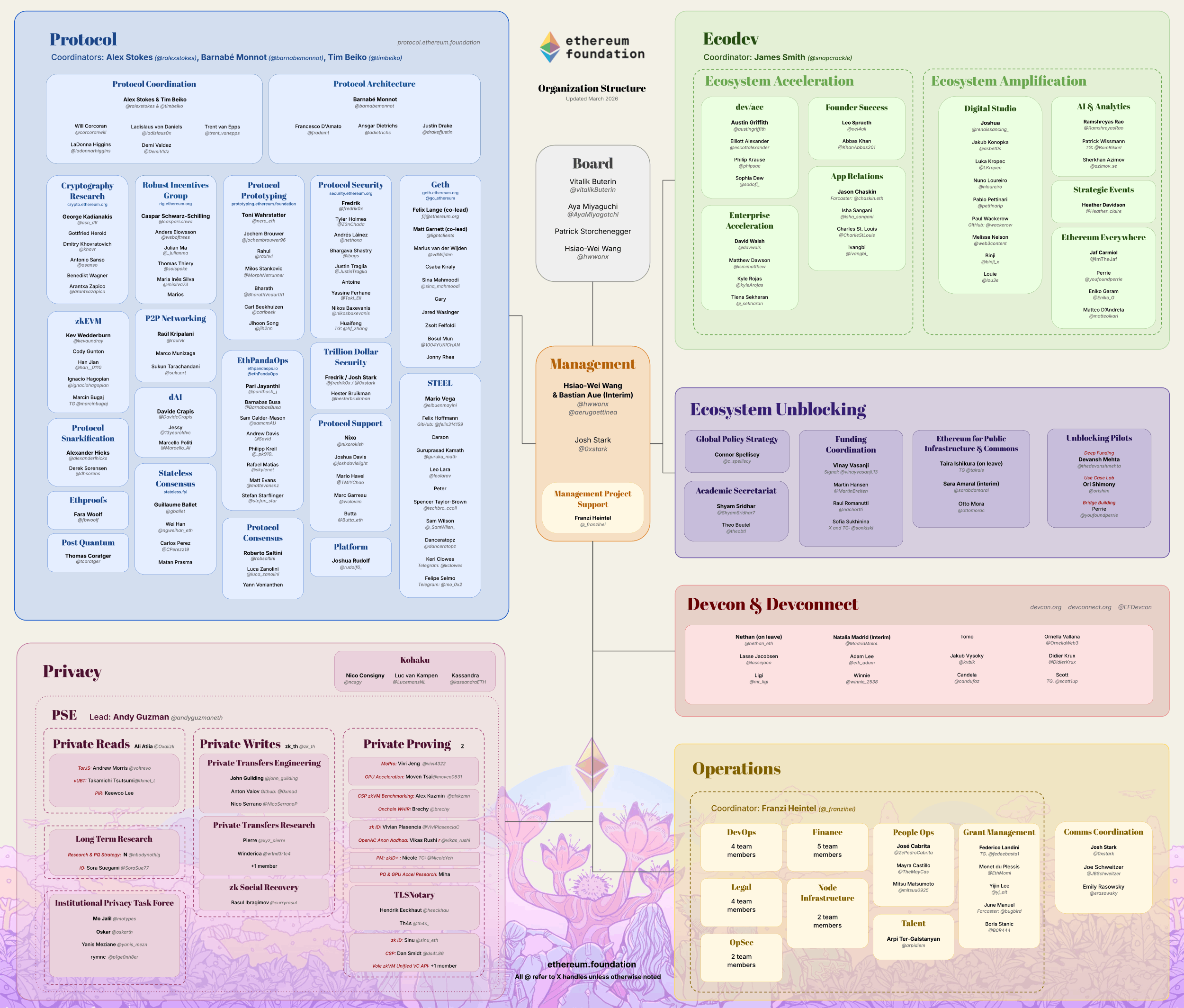
Under the new management structure, the Foundation streamlined its organization, cut 19 employees, and moved its strategic focus back from Layer2 to Layer1 itself. In June 2025, it also reorganized its internal research and development system. The former “Protocol Research & Development,” or PR&D, was renamed “Protocol,” with short-term goals of scaling L1 performance, scaling Blobs and improving user experience. In February 2026, Tomasz Stańczak stepped down as co-executive director, with Bastian Aue and Hsiao-Wei Wang taking over. During his term, Stańczak advanced explorations including privacy protection, quantum computing security, and the integration of AI with Ethereum. After leaving, he shifted more attention to products and infrastructure related to the convergence of AI and blockchain.
The latest internal structure cited in the report lists Vitalik Buterin, Aya Miyaguchi, Patrick Storchenegger and Hsiao-Wei Wang as Ethereum Foundation board members, responsible for governance and strategic direction, while management and functional teams handle execution and operations. In August 2025, the Foundation suspended the open grant program that had been running since 2018, and in November restarted the Ecosystem Support Program, or ESP. The funding model changed from passively receiving applications to actively guiding capital allocation. The first funding directions covered cryptography, privacy, the application layer, security and community growth. The Foundation also reduced its annual spending ratio from around 15% to 5% to slow the consumption of ETH reserves. In May 2026, researchers Carl Beek and Julian Ma announced departures, while former Foundation researcher Dankrad Feist publicly said the Ethereum ecosystem needed a new organization more aligned with Ethereum’s economic interests to “save” Ethereum. Vitalik Buterin and co-founder Joe Lubin responded that the disputes reflected friction between long-term technical building and commercialization, a stage they described as part of Ethereum’s development process.
PoS, Pectra and the scaling of Blob capacity
Ethereum’s move to proof of stake ended the high-energy consensus model, but the 32 ETH staking threshold also raised the entry barrier for validators and introduced risks around validator concentration. Vitalik Buterin previously proposed raising the participation ratio required for block finality, for example from the current roughly two-thirds threshold signature level to 75% or above, in order to strengthen network security. In May 2025, the Pectra upgrade was activated on Ethereum mainnet. EIP-7251 raised the maximum effective validator balance from 32 ETH to 2048 ETH. The minimum threshold to become a validator remains 32 ETH, but large stakers no longer need to split funds across many validator nodes to obtain corresponding rewards, which helps reduce communication and coordination overhead in consensus. EIP-7002 optimized the staking withdrawal mechanism by introducing execution-layer-triggered withdrawals, allowing withdrawals under specific conditions without an active validator signature.
The Foundation also explored the use of Distributed Validator Technology, or DVT, to improve the staking structure. DVT splits a single validator’s private key and signing capability across multiple nodes, reducing single points of failure. Lightweight implementations such as DVT-lite are being tested to simplify deployment and operations. According to information disclosed by the Foundation in March 2026, 72,000 ETH participated in staking through related mechanisms. On data availability, EIP-4844 in the Dencun upgrade introduced Blob space, a low-cost temporary data availability layer. Layer2 networks can submit batched transaction data to Blobs. The original design set a target of 3 Blobs per block and a maximum of 6, with a floating fee mechanism that raises base fees when use is above the target and lowers them when use is below it.
As Layer2 demand for Blob space grew, actual usage approached or repeatedly reached the 3-Blob target, triggering fee increases and raising Blob costs at certain stages. Pectra therefore included two related proposals. EIP-7691 raised the target number of Blobs per block from 3 to 6 and the maximum from 6 to 9, while EIP-7623 increased the cost of Calldata to guide Layer2 networks toward greater Blob use and reduce pressure on mainnet data publishing. With the Fusaka upgrade advancing in December 2025, Ethereum introduced additional key mechanisms at the data availability layer. The report places Blob within Ethereum’s broader shift from execution sharding to data sharding: rather than splitting execution across many shards, Ethereum prioritizes expanding data availability, with Blob as a transitional implementation and PeerDAS improving verification through data availability sampling. On December 11, 2025, the Foundation stated that Blob capacity per block had increased to 15.
Rollup fragmentation and the Ethereum Economic Zone
The report argues that the relationship between Rollups and Ethereum mainnet is changing as the number of Rollup solutions grows. Rollups reduce mainnet execution load by moving transaction execution to Layer2, but they also change fee distribution. More user-paid transaction fees flow to Layer2, while the main chain mainly handles data publishing and settlement. At the same time, different Rollups are relatively independent in architecture and ecosystem, forming parallel sub-ecosystems and increasing the complexity of cross-Rollup interaction. LayerZero and Hyperlane attempt to standardize message transmission across Rollups, while Astria and Espresso explore shared sequencers from the transaction-ordering layer. The report notes that this “Rollup — third-party infrastructure — Rollup” model is still a non-native Ethereum extension path, bringing additional trust assumptions and changes to Layer1 MEV allocation.

Different Rollup stacks are also accelerating their own ecosystems. Arbitrum uses the Nitro / Orbit stack to promote Orbit chains, with Plume Network and ApeChain listed as examples. zkSync uses the Elastic Chain architecture for multi-chain expansion, with Abstract and ZERO Network as representatives. Optimism has built the Superchain around OP Stack, with members including OP Mainnet, Base, BOB and Soneium. In mid-to-late February 2026, the Base team announced a gradual move away from Optimism’s OP Stack architecture toward its own maintained Base Stack unified technical stack. Because Base was originally built with OP Stack, the report characterizes the shift as customization based on an open-source framework rather than a full break from Optimism. Base also said it would continue cooperating with the Optimism ecosystem and follow relevant open-source norms.
The Ethereum Foundation has started addressing this structural issue more directly. Within the Protocol framework, it established a Platform Team to coordinate protocol research and ecosystem development, aiming to reshape the relationship between mainnet and Layer2 from a delicate alliance into a more unified platform. On March 23, 2026, the Foundation published another systematic explanation of the evolving roles of Layer1 and Layer2. In the updated definition, Layer2 is no longer limited to scaling. It also serves differentiated needs that Layer1 cannot provide, such as stronger privacy protection, lower latency, and compliance adaptation for specific scenarios. Mainnet, meanwhile, is positioned as the core settlement and liquidity layer for a multi-chain ecosystem.
To move in that direction, Ethereum is pursuing two tracks. The first is stronger connectivity between Rollups and the main chain. With Ethereum Foundation co-funding, Gnosis co-founder Friederike Ernst and Zisk founder Jordi Baylina recently announced the Ethereum Economic Zone, or EEZ. The plan attempts to build an L1<>L2 framework in which interactions between Rollups and mainnet, and between Rollups themselves, are brought into a unified execution framework. Instead of relying completely on traditional asynchronous messaging, EEZ aims for stronger composability. Contract calls across different execution environments could be completed within the same execution flow and with atomicity, meaning the operations either all succeed or all roll back, reducing the risk of inconsistent cross-chain states. The report notes that EEZ’s concrete implementation path still needs further clarification.
The second track is Native Rollup. Ethereum ecosystem developers recently released a proof-of-concept prototype for Native Rollup, proposed in EIP-8079, in an attempt to reshape how Rollups are verified. Today, both Optimistic Rollups and ZK Rollups execute transactions and generate state, then use extra mechanisms such as fraud proofs or zero-knowledge proofs to prove correctness to Ethereum mainnet. EIP-8079 tries to expose Ethereum’s state transition function as an open interface that Rollups can call. In this model, a Rollup can submit transactions to mainnet and let mainnet complete state calculation under unified rules, reducing reliance on independent proof systems and lowering Rollup maintenance costs. The report compares the difference to a teacher-student process: in the traditional model, the student solves the problem and submits proof that the solution is correct; in the Native Rollup model, the student submits the organized problem information and the teacher performs the calculation under a unified rule set.
MEV, Glamsterdam, ePBS and faster confirmation
After Ethereum’s move to proof of stake, the network randomly selects block proposers from validators staking ETH. A proposer is responsible for final publication of the block and can extract value beyond standard block rewards and gas fees by changing transaction order, which is MEV. To reduce a single validator’s control over transaction ordering and value extraction, Ethereum previously proposed proposer-builder separation, or PBS. The idea is to separate block construction from final confirmation. Builders collect transactions, order them and package candidate blocks, while proposers choose from candidate blocks and submit the final block. This improves block-building efficiency and lowers the complexity for validators participating in block production.

However, the report also describes a structural problem: as specialization increases, block-building capacity can concentrate among a smaller number of builders, increasing their influence over transaction ordering and MEV distribution. In past implementation, PBS was not directly written into the protocol. It was implemented through off-chain middleware such as MEV-Boost, which allows validators to outsource block construction to third-party builders and use relays for information transmission. Although this improved block-building efficiency in practice, it remained an off-chain market that depended on trusted relays, carried centralization risks, and lacked full on-chain transparency and constraint for MEV distribution.
Glamsterdam is planned around reconstructing the division of responsibilities among network participants. Its core directions include introducing parallel processing capacity to prepare for faster transaction execution; redefining the workflow for creating and verifying blocks so the network has more time for data propagation and can support larger data loads; and adjusting fee mechanisms so the storage cost of on-chain data more accurately reflects long-term node resource use, including bandwidth and storage. One of Glamsterdam’s key changes is EIP-7732, Enshrined Proposer-Builder Separation, or ePBS. This proposal writes proposer-builder separation directly into Ethereum’s protocol, introduces builders as formal participants, requires them to stake first, and asks them to submit block commitments to the network.
EIP-7732 also decouples consensus verification from execution verification. During the critical block propagation stage, the network can prioritize consensus-layer verification while delaying full execution-layer verification, including transaction execution and state updates, to a later stage. The report explains this with the image of a teacher first confirming that students have submitted their papers, then taking the papers back to the office for detailed marking. In this way, ePBS reduces reliance on relays and gives nodes more time to propagate block data, allowing Ethereum to support larger data volumes, especially Blob writes, while maintaining network stability. The report treats this as both a structural optimization of MEV and a foundation for Ethereum’s data availability expansion.

The report also compares Ethereum with high-performance Layer1 networks. Solana improves throughput through parallel execution and local fee markets, while Sui uses an object model and DAG architecture for more efficient concurrent processing in certain scenarios. These designs can serve use cases such as high-frequency trading and on-chain games. Ethereum’s own long-term idea for improving confirmation experience is Single Slot Finality, or SSF. In Ethereum, validators reach consensus roughly every 12 seconds on a slot, and 32 slots, about 6.4 minutes, form an epoch. Under the current mechanism, a block needs at least two-thirds of validators to complete two rounds of voting, or two epochs, before it is finalized. This means finality usually takes around 12 to 15 minutes. SSF aims to compress finality logic that currently spans two epochs into a single slot.
Before SSF is fully implemented, the Ethereum Foundation has proposed Fast Confirmation Rule, or FCR, as an interim optimization. FCR aims to reduce deposit confirmation time from Ethereum L1 to L2s and centralized trading platforms from several minutes to around 13 seconds. It does not change the existing finality mechanism. Instead, it uses the first round of voting to judge safety earlier. If the first vote already shows a high level of support, clearly above two-thirds in the report’s example, the system can treat the block as basically confirmed ahead of finality. FCR is not true finality, and its safety depends on most validators acting honestly and network communication remaining stable and low-latency. If the network becomes congested or is attacked, a fast-confirmed block can still be reorganized and fall back to the original rule set. The report ends with Web3Caff Research’s disclaimer that the information is for reference only and does not constitute a prediction, investment advice, proposal or offer, and that readers should comply with the laws and regulations of their own jurisdictions.