

Ethereum separates foundation stewardship, technical development, and business expansion
On July 1, Ethereum Institutional was formally launched to consolidate Ethereum Foundation marketing and outreach efforts into a dedicated team focused on pitching Ethereum’s tokenization and stablecoin use cases to banks and asset managers. A few days earlier, Ethlabs emerged as a separate initiative founded by five former senior Ethereum Foundation researchers. Its mandate is centered on two areas: improving onchain settlement efficiency and strengthening the narrative of ETH as a monetary asset.
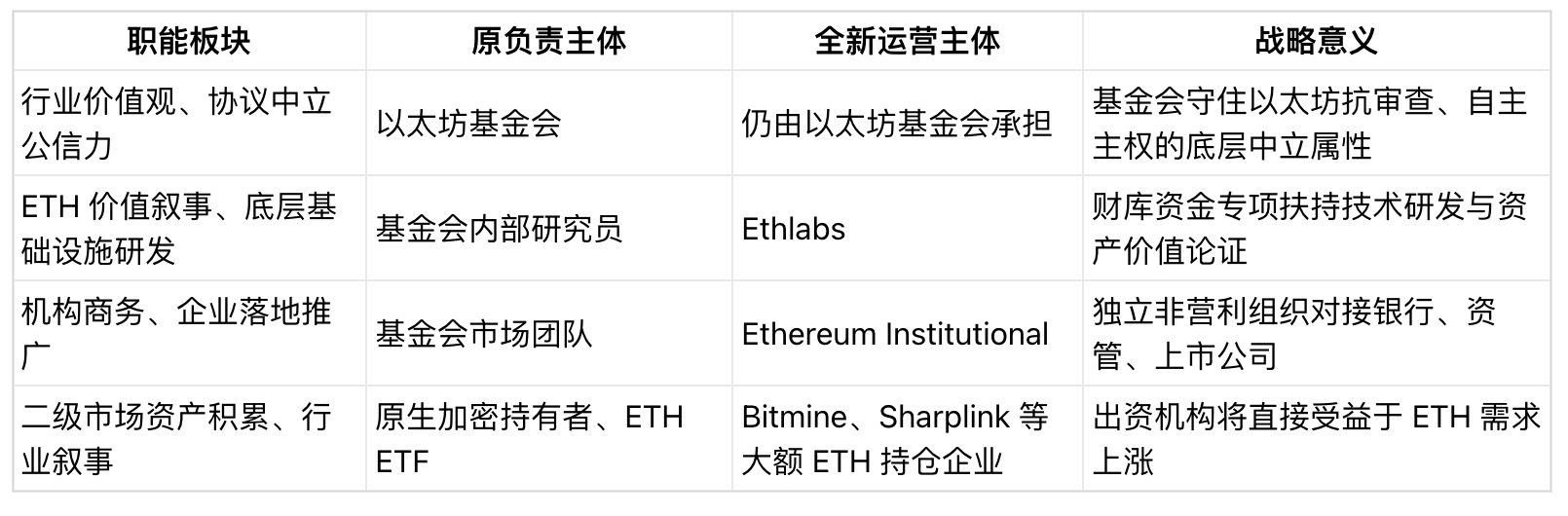
Both organizations are funded by Bitmine, Sharplink, and Ethereum co-founder Joe Lubin. Their launch comes at a moment of visible transition inside the Ethereum Foundation itself. On June 18, co-executive director Hsiao-Wei Wang announced her departure. Tomasz Stańczak had already submitted his resignation earlier. According to the source article, at least eight executives have left the Ethereum Foundation over the past five months, indicating that organizational turnover and strategic repositioning are unfolding at the same time.
The backdrop is a broader redefinition of the Foundation’s role. As described in the source material, the Ethereum Foundation published a new functional charter in March 2026, clarifying that it is not the parent company of Ethereum and does not hold final decision-making power over the protocol. Instead, it positions itself as a steward of sovereign participation, censorship resistance, open-source code, privacy, and security. That narrower definition leaves a deliberate operational gap, particularly in business development and institutional commercialization, which external organizations are now expected to fill.
Under this model, Ethereum is no longer trying to house all strategic functions under one umbrella. The Foundation preserves legitimacy and long-term protocol values. Ethlabs works on infrastructure and ETH value capture logic. Ethereum Institutional handles commercial conversion, institutional relationships, and strategic sales. This is a structural redesign of influence within Ethereum rather than a simple expansion of headcount.
Three power centers have taken shape inside the Ethereum ecosystem
The emerging arrangement creates three distinct centers of power. First, the Ethereum Foundation remains responsible for normative legitimacy and the long-horizon value of the protocol. Second, Ethlabs takes on technical R&D and the work of turning Ethereum’s infrastructure roadmap into a coherent value proposition for ETH itself. Third, Ethereum Institutional becomes the business-facing arm, responsible for translating financial industry interest into capital commitments, enterprise deployments, and ecosystem relationships.
Ethlabs is expected to address the technical and conceptual issues that still make some institutions hesitant to commit to Ethereum at scale. That includes improving core infrastructure and articulating a more complete framework for ETH as a monetary asset. Meanwhile, Ethereum Institutional is positioned as a purpose-built institutional engagement platform. Its role includes hosting industry forums, maintaining ties with major financial institutions, and tailoring pitches in ways that can convert exploratory conversations into real-world adoption.
The logic behind keeping both organizations independent from the Foundation is straightforward. A neutral standards-and-values steward cannot easily function at the same time as a promotional arm for ETH or as a direct enterprise sales team without compromising credibility. Ethereum’s new setup is therefore designed to solve a long-standing contradiction: the ecosystem needs both neutrality and aggressive commercialization, but those functions do not sit comfortably inside the same institution.
In that sense, Ethereum is opting for execution efficiency over a more purist version of institutional independence. The trade-off is not hidden. Commercial progress may accelerate, but the channels through which Ethereum is marketed to Wall Street are now more directly shaped by the actors financing that effort.

Institutional reach is growing, but influence is concentrating among large ETH holders
Ethereum Institutional says it has already engaged with more than 500 first-tier banks, global asset managers, sovereign funds, custodians, and market infrastructure service providers. Its Ethereum institutional summit brought together more than 150 financial executives from organizations managing a combined $250 trillion in assets. Those numbers help explain why Ethereum chose to split these functions into independent entities rather than retaining them as subordinate internal programs of the Foundation.
At the same time, this design shifts considerable narrative and relationship power toward the balance-sheet-heavy sponsors behind the effort. According to the source article, by outsourcing business development and ETH value advocacy to external entities, Ethereum solves a practical execution problem but also hands the public-facing, Wall Street-oriented messaging channel to firms that already hold enormous ETH positions. The ecosystem has effectively prioritized convenience and operational effectiveness over stricter separation from capital interests.
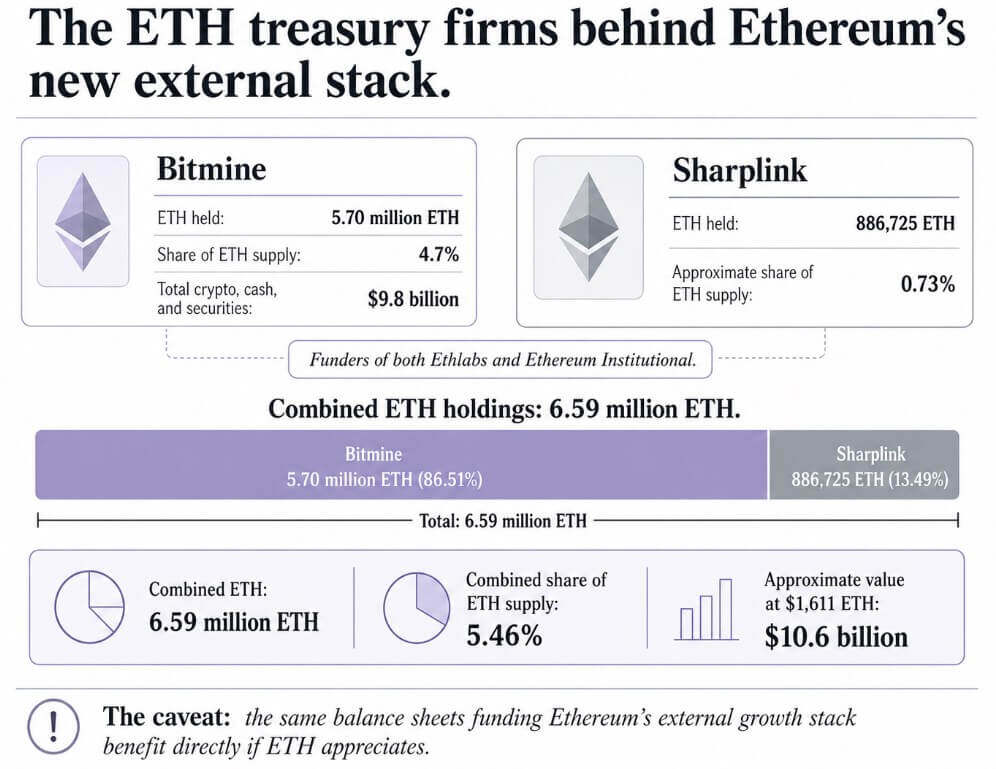
Bitmine currently holds 5.7 million ETH, equal to 4.7% of circulating ETH supply. Including cash and marketable securities, its total assets amount to $9.8 billion. Sharplink holds 886,725 ETH and added another 10,000 ETH on June 28 at an average price of $1,611. Combined, the two firms control 6.59 million ETH, representing 5.46% of the 120.7 million circulating supply. At prevailing prices, that combined position is worth nearly $10.6 billion. Bitmine’s own market capitalization stands at $6.55 billion, while Sharplink’s exceeds $1 billion.
If this operating model proves successful, those backers stand to benefit directly. Better infrastructure, stronger institutional relationships, and broader market acceptance could all support higher ETH demand. Given the size of their holdings, even modest ETH price moves can translate into balance-sheet swings worth hundreds of millions of dollars. Joe Lubin, who supports both nonprofit organizations, sits at the center of this incentive structure, while Bitmine and Sharplink are deeply financially tied to Ethereum’s commercial and ecosystem trajectory.
Scaling progress remains the real foundation of Ethereum’s institutional case
The institutional story cannot be sustained by marketing alone. It depends on whether Ethereum can offer sufficient throughput, predictable costs, and credible infrastructure for larger-scale financial settlement. The article notes that PeerDAS has already gone live and can raise data availability capacity for layer-2 networks by roughly 10x. The planned Glamsterdam upgrade, expected in the second half of 2026, is intended to improve base-layer scaling, enable parallel transaction processing, and support larger block payloads.
An academic report released in June 2026 found that transaction throughput across Ethereum mainnet and layer-2 networks had doubled. Median mainnet fees fell from above $2 to below $0.02, while layer-2 fees dropped by more than 95% to as low as $0.0015. These are meaningful improvements and suggest that Ethereum’s modular scaling roadmap is producing measurable operational gains.
Still, the long-term performance outlook remains restrained. The same report projected that Ethereum mainnet throughput would remain below 100 transactions per second even before 2034. It also suggested that layer-2 aggregate throughput would not surpass Solana until March 2029, although by then Ethereum’s layer-2 fees would be far lower than its competitor’s. In practical terms, Ethereum’s ability to attract institutional flows will depend less on raw mainnet throughput and more on whether layer-2 scaling and broader industry standards can mature fast enough to support real settlement demand. That is precisely the domain Ethlabs is expected to work on.

Why the bullish case remains credible
The bullish argument begins with scale. Ethereum already hosts $157 billion in stablecoin market capitalization, accounting for more than half of the global stablecoin market according to the source article. It also holds $37.2 billion in DeFi total value locked, equal to 62% of the industry total. Data from RWA.xyz shows that tokenized real-world assets on Ethereum amount to $15.8 billion, while the entire sector totals $31.52 billion. Ethereum therefore remains the leading public blockchain across stablecoins, DeFi, and tokenized real-world assets.
That base matters because institutional finance tends to gather where liquidity, standards, and developer gravity are already strongest. On top of that, Citibank projects that the global tokenized real-world asset market could expand from roughly $17 billion today to $5.5 trillion by 2030, with a lower bound of $2.7 trillion and an upper bound of $8.2 trillion. If Ethlabs keeps upgrading infrastructure and Ethereum Institutional successfully converts industry relationships into actual deployed capital, Ethereum could strengthen its position as the default settlement layer for compliant digital asset activity.
In that scenario, large ETH holders such as Bitmine and Sharplink would likely be among the earliest and largest beneficiaries. Their gains would not only come from price appreciation, but also from the compounding effect of Ethereum becoming more embedded in institutional-grade financial workflows. For the bullish thesis to hold, however, execution has to move from narrative to measurable adoption.
Why the bearish case cannot be ignored
The first weakness in the story is price. Citibank cut its 12-month ETH target from $3,175 to $2,240, citing soft ETF demand and negative inflows, and outlined a bear-case scenario of $1,094. Standard Chartered has taken the opposite view, maintaining that ETH could reach $4,000 by the end of 2026. The scale of disagreement between major institutions highlights how uncertain Ethereum’s short-term market outlook remains.

If ETH stays structurally weak, the funding foundation behind Ethereum’s new commercial architecture may become more fragile. Should Bitmine and Sharplink continue to trade at a discount to the value of the crypto assets on their balance sheets, their ability to sustain support for Ethlabs and Ethereum Institutional could diminish over time. Even if both nonprofits remain operational, the stability of their capital base would come into question.
A second issue is perception. As long as the new organizations are backed by firms with very large ETH holdings, critics may argue that their primary function is to support ETH price rather than to build genuinely useful institutional infrastructure. That suspicion could become louder if concrete adoption lags while promotional activity remains high.
The regulatory backdrop supports the broader bull case for digital asset infrastructure, but it does not guarantee upside for Ethereum specifically. The article points to the 2025 U.S. GENIUS Stablecoin Act, which established a federal regulatory framework for stablecoins. It also notes that a consortium involving Visa, Mastercard, and Coinbase subsequently launched the Open USD stablecoin. Greater regulatory clarity may increase institutional settlement activity across the sector, but that benefit is not exclusive to Ethereum.
There is also no consensus on how large the market will ultimately become. While Citi sees a multitrillion-dollar tokenization opportunity, McKinsey’s projection is much more conservative at roughly $2 trillion by 2030. That gap shows that even the size of the addressable market remains contested, which means Ethereum’s upside cannot be taken for granted simply because tokenization has become a favored narrative.

Ethereum has solved one contradiction, but introduced another
By creating Ethlabs and Ethereum Institutional, Ethereum has found a way to separate the Ethereum Foundation’s neutral stewardship role from the ecosystem’s need for aggressive business development and institutional lobbying. That is a meaningful structural solution to a problem that had become increasingly hard to ignore.
Yet the benefits and risks now coexist more openly than before. On the positive side, specialized organizations can focus on infrastructure, institutional relationships, and strategic execution in ways the Foundation cannot. That could make Ethereum more competitive as a base layer for tokenized finance, stablecoins, and regulated digital asset settlement. On the negative side, the entire expansion mechanism is now more tightly coupled to the financial health and incentives of major ETH-holding sponsors.
In practical terms, Ethereum’s commercial future is no longer just a question of technology or ideology. It is also a question of capital structure. If ETH performs well and institutional conversion accelerates, the model may look prescient. If ETH underperforms and funding weakens, the same structure may look overly dependent on whale-backed balance sheets. As framed by the source article, the next year of ETH price action may be the variable that determines which of those two interpretations becomes dominant.