
For several years, Ethereum’s standard scaling answer was to move applications, assets and users onto dedicated Layer 2 networks. Mainnet gas costs were high, while rollups offered a way to separate execution from Ethereum’s security, data availability and final settlement functions.
That division is being reconsidered in 2026. Synthetix brought its new perpetuals exchange back to Ethereum mainnet, ENS abandoned its long-planned Namechain, and projects including Trueo and Superseed chose to place more of their activity on L1. Some independent L2s are also shrinking their operations or preparing to shut down.
From the L2 migration wave to a mainnet return
High Ethereum gas costs made launching a dedicated L2, or moving a core product to another rollup, a common decision for major protocols. The recent changes do not show that every project is leaving L2s. They do show that teams are reassessing infrastructure costs alongside security, liquidity and integration with the wider Ethereum ecosystem.
ENS offers one of the clearest examples. In 2024, ENS Labs planned Namechain, a dedicated ZK Rollup for ENSv2 intended to reduce the cost of registering and managing names through a separate execution environment. In February 2026, ENS co-founder Nick Johnson announced that development would stop and that ENSv2 would be deployed directly on Ethereum mainnet.
Johnson said Ethereum L1 had scaled much faster than expected two years earlier. Data disclosed by ENS Labs showed that as Ethereum’s gas limit increased, the average gas cost for registering an ENS name fell by about 99% over the previous year, from close to $5 to less than $0.05.
Operating an independent L2 also creates costs beyond the initial deployment. A project must maintain nodes and infrastructure, handle cross-chain resolution and bridging, conduct security audits and manage ongoing operations. If the core business can already run on mainnet at a very low cost, keeping a separate rollup can add architectural complexity without delivering a clear benefit.
A similar reassessment has emerged in DeFi. In June 2025, Synthetix, which had actively supported Ethereum’s L2 ecosystem, published an essay titled “L2s are Dead, Long Live Ethereum.” It argued that the earlier L2 scaling path had created liquidity fragmentation and unstable infrastructure for applications. In December 2025, Synthetix launched its next-generation perpetuals exchange on Ethereum mainnet.
Several migration decisions followed in the second half of 2026:
- Trueo: In September, it said it would move its main deployment from Base back to Ethereum L1, citing mainnet’s stronger integration capabilities, network effects and neutrality as it builds a prediction market and outcome oracle.
- ShapeShift: On October 1, it moved the rFOX staking program from Arbitrum to Ethereum mainnet. Since most FOX tokens were already held on mainnet, requiring users to bridge merely to stake had limited practical value.
- Superseed: In August, it stopped its existing L2 and planned to move the ecosystem’s core products to Ethereum mainnet. The project would no longer rely on gas revenue from an independent chain to support lending repayments, instead using application-layer yield strategies to pursue the same product goals.
- Nillion: In October, it launched Blacklight L1, moved node operations that had run on Nillion L2 to Ethereum mainnet and planned to phase out the former L2 network.
These examples should not be read as proof that all protocols are abandoning L2s. They show that teams are choosing infrastructure according to the actual requirements of their products, including security, liquidity and execution efficiency.
Pressure on some independent L2 businesses is also becoming visible. On October 2, Blast announced that it would stop operating because the cost of maintaining the network had exceeded the revenue generated by the L2, and it could not see a reliable path to economic sustainability. Abstract later said it planned to close the network on December 15. Abstract had connected more than 144 applications and attracted over 400,000 users, but insufficient liquidity, a limited DeFi ecosystem and a lack of institutional participation made continued operation of an independent consumer chain difficult.
Owning a chain does not automatically create a sustainable business model. As Ethereum reduces the cost of publishing L2 data and improves mainnet performance, low gas fees and token incentives alone are becoming less effective as a durable competitive strategy.
From a general-purpose L2 to a hybrid architecture
The economic calculation is only part of the issue. When applications and liquidity are spread across multiple networks, Ethereum’s original promise of global composability also becomes harder to preserve.
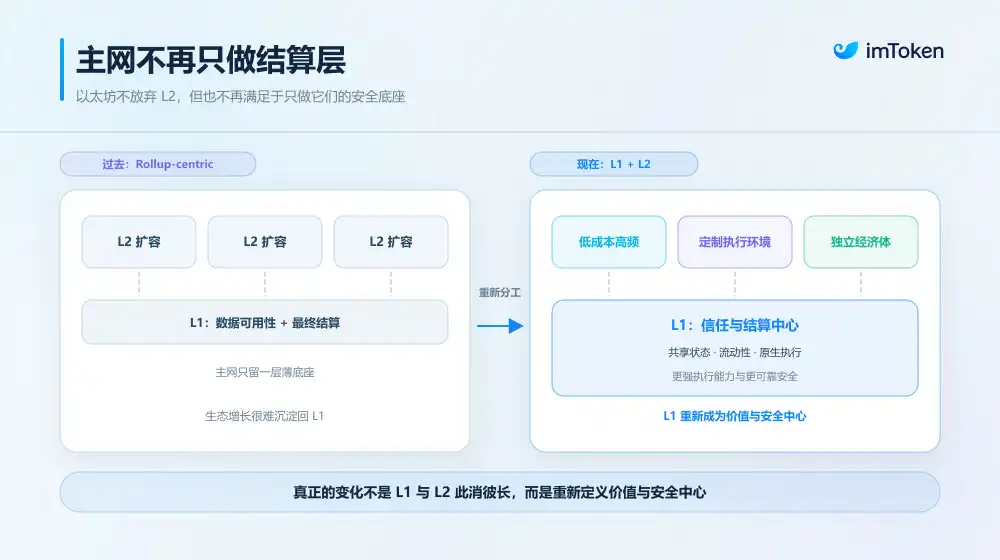
Under the early rollup-centric roadmap, the division of labor was straightforward. L1 provided security, data availability and final settlement, while L2 handled scaling and low-cost execution. At a time when a single mainnet transaction could cost tens of dollars, this looked like the only workable answer.
By November 2026, however, ETHBEAT, formerly known as L2BEAT, had listed dozens of different L2s. Only a single-digit number had reached Stage 2, and their asset base was almost negligible. Major rollups including Base, Arbitrum One and OP Mainnet remained at Stage 1.
L2 progress toward Stage 2 has been slower than expected, while Ethereum L1’s own scaling work has advanced. Vitalik Buterin has said that as mainnet scaling accelerates, the original vision of L2s and their role within Ethereum are no longer unchanged.
Some L2s may choose to remain at Stage 1 for regulatory, commercial or customer-control reasons. Retaining management and upgrade powers can be part of the design for institutional applications that must meet specific regulatory requirements. But a network whose key upgrade rights and state-resolution powers remain with a small number of entities should not automatically be treated as a fully decentralized shard of Ethereum mainnet.
A more durable compromise is to keep assets and critical state on L1 while sending high-frequency, complex computation to an offchain system or another execution environment. Synthetix’s new perpetuals exchange uses this hybrid approach. User assets remain held by Ethereum L1 contracts, order matching is handled by a high-performance offchain central limit order book, and completed trades are written back to mainnet through batch settlement.
Users do not need to bridge large amounts of capital to another chain to obtain faster trading, while the matching experience can approach that of a centralized exchange. The model does not remove every trust issue. Some of Synthetix’s margin management still depends on the offchain order book, and the matching system itself requires scrutiny. Asset custody and final withdrawals, however, remain protected by mainnet contracts, so users do not have to place all of their funds under the security assumptions of an independent L2 sequencer and bridge.
The structure points to another way to build onchain finance. Not every computation needs to be performed onchain. The key question is which steps require the non-substitutable trust guarantees of onchain rules.
Vitalik’s Native Rollup research could offer a longer-term direction. In simple terms, the idea is to use Ethereum’s native ZK-EVM verification mechanism so that mainnet can directly verify a rollup’s EVM execution results. That could reduce reliance on external security committees and create stronger conditions for interoperability and synchronous composability between rollups.
Proposals such as the Ethereum Economic Zone, or EEZ, are also exploring tighter synchronized interaction between different rollups and mainnet. These technologies remain at different stages of research and validation, but they share one objective: users should not be forced to accept disconnected asset, liquidity and trust systems simply because they use different execution environments.
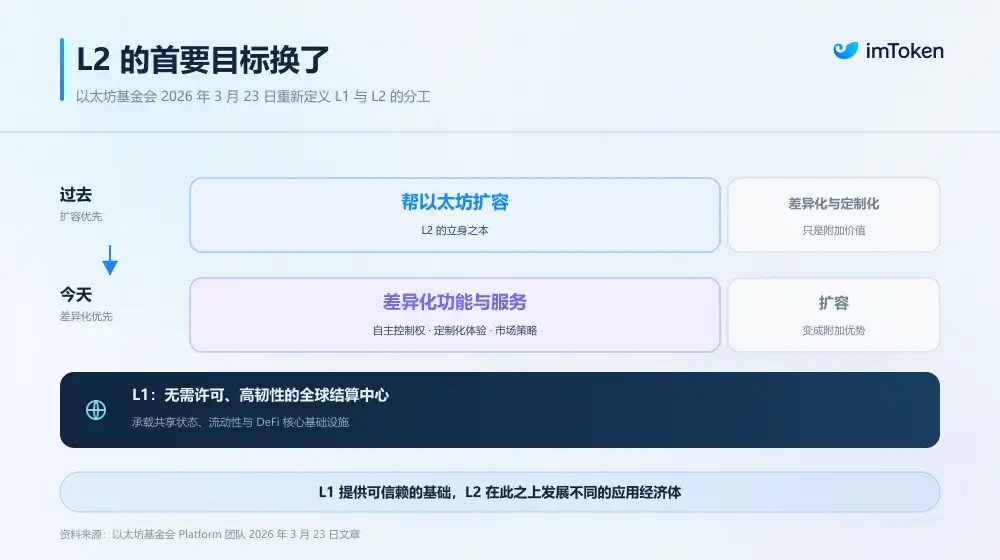
L2s are not disappearing. High-frequency trading, gaming, privacy computation and applications that need control over their own execution environments can still have strong reasons to use them. The idea that needs revision is the assumption that scaling is the only central mission of an L2.
What happens to ETH’s value capture when both L1 and L2 are cheaper?
The infrastructure question leads back to ETH. If Ethereum mainnet becomes stronger and more applications return to L1, will the asset’s value logic change as well?
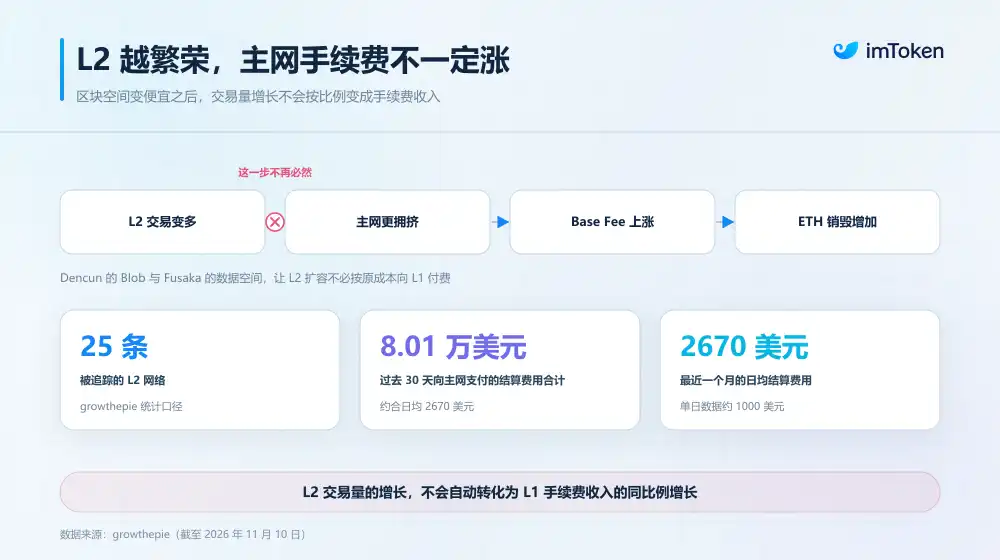
For much of the past several years, the market’s view of ETH relied heavily on the fee-burning mechanism introduced by EIP-1559. The base fee paid in a transaction is destroyed, while the priority fee goes to validators. When demand for block space is high, the base fee tends to rise and the amount of ETH burned increases.
That mechanism formed an important part of the “Ultrasound Money” narrative. If network activity kept growing, fee destruction could offset or exceed new ETH issuance, putting ETH into net deflation.
The same logic also creates a problem. Upgrades such as Dencun and Fusaka reduce the cost of publishing L2 data to mainnet, while Ethereum continues to raise its gas limit. The cost of an individual transaction and the fee revenue it generates may fall. Even if the ecosystem’s overall transaction volume expands, ETH burning does not necessarily grow at the same pace.
Trying to support ETH’s valuation by maintaining high gas fees could impose higher costs on ordinary users and real applications, weakening the network’s long-term competitiveness.
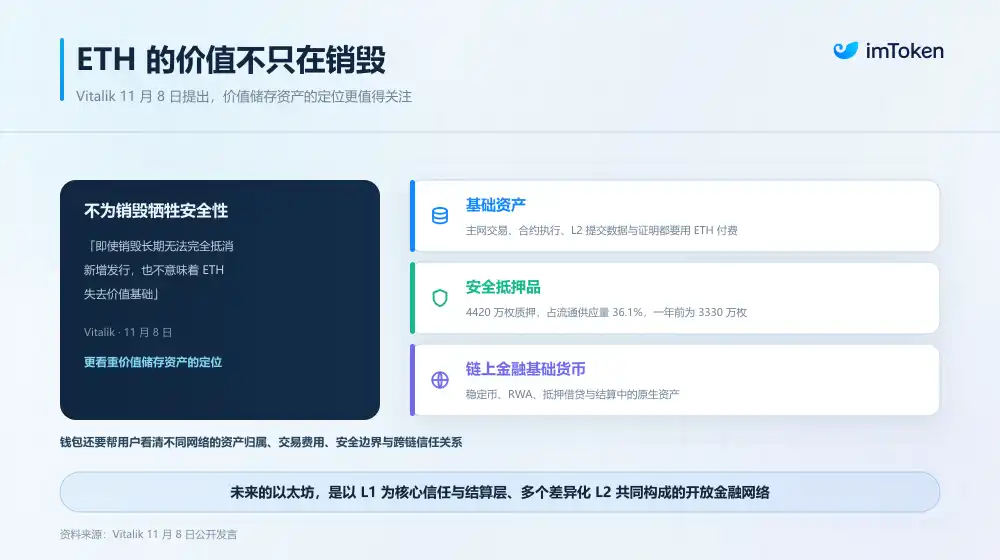
Vitalik Buterin has discussed ETH’s monetary position directly. His view is that Ethereum should invest more in ETH’s role as a store of value rather than treating it mainly as an asset whose value comes from fee destruction.
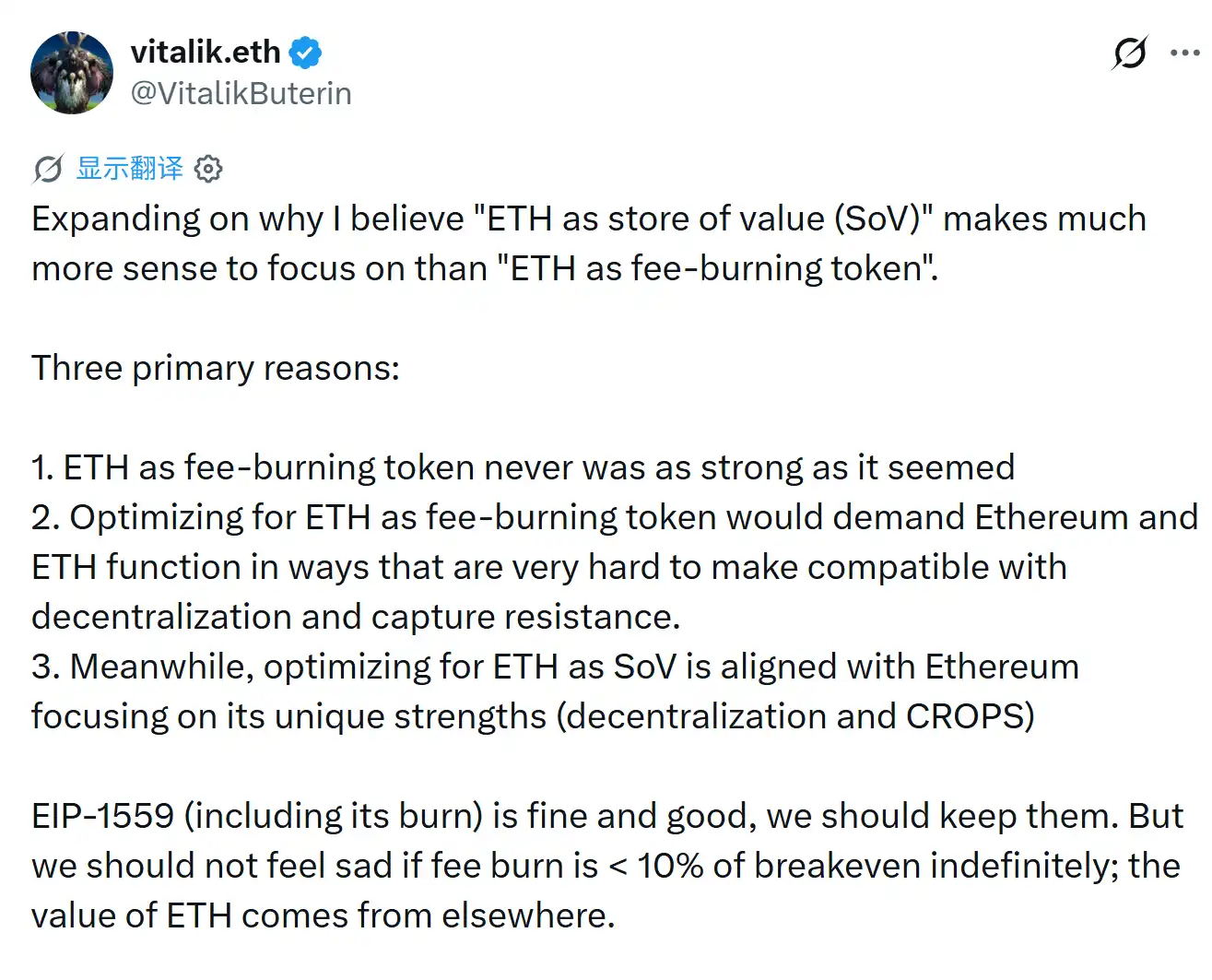
That position does not reject EIP-1559 or call for fee burning to end. Buterin has said the mechanism remains sound and should be retained. Even if fee burning in the future offsets less than 10% of the break-even issuance rate for an extended period, holders should not regard that outcome as a failure, because ETH’s value does not come from burning alone.
Some of the periods with the highest ETH burn were driven largely by speculation within the crypto industry. In 2022, Yuga Labs’ Otherdeed NFT mint generated about $180 million in fee burn in a single day. That activity did not represent external demand in the conventional sense. If the crypto market contracts and users have less capacity for speculation, those transactions and the fee revenue attached to them can disappear as well.
Historical burn data alone therefore cannot establish a reliable long-term valuation floor for ETH. If Ethereum had to generate persistently high fees to support an ETH market capitalization worth hundreds of billions of dollars, it could be pushed toward the behavior of a large commercial company: increasing research spending, changing product priorities and intervening more actively in governance. That would not fully align with the network’s long-standing goals of decentralization and resistance to control.
Keeping gas fees deliberately high to increase burn could also exclude the ordinary users who most need privacy, security and open financial services.
For Buterin, ETH’s long-term value should rest on Ethereum’s distinctive qualities: decentralization and what he describes as CROPS — censorship and capture resistance, open-source software, privacy and security. Those properties point to a practical form of value: stability, and the ability of the network to keep operating as external conditions change.
Three foundations for L1 and ETH
From that perspective, strengthening L1 supports ETH’s long-term position in three ways.
- Core state and settlement: A shared settlement layer can bring together assets, mature financial protocols and deep liquidity. Computation can become commoditized and execution environments can be replicated, but a settlement layer with those network effects is difficult to rebuild quickly. If core financial activity returns to mainnet, ETH could reinforce its position as the underlying gas asset, native collateral and settlement asset.
- Mainnet scaling: Ethereum has spent the past two years working on the tension between higher throughput and the hardware requirements imposed on nodes. If the relevant technologies mature, the network could move from a low-frequency, high-cost settlement layer toward a global financial infrastructure with higher throughput and lower usage costs. ETH’s value would no longer need to depend on expensive individual transactions.
- Staking and economic security: ETH is the native resource required for network operation, the economic collateral securing the proof-of-stake consensus and an important collateral and liquidity asset in DeFi and onchain finance. That demand base is broader than an explanation of ETH’s long-term value based only on fee burning.
Ethereum searches for a new L1-L2 balance
If the past several years represented an Ethereum scaling experiment, the changes in 2026 look more like a search for a new balance across the ecosystem.
L2s are not going away, nor should they. They remain important for expanding Ethereum’s application range, supporting specialized execution environments and serving more users. L1, however, cannot remain only a data-availability and final-settlement layer.
Ethereum is being pushed to strengthen its execution capacity, liquidity-center position, resistance to censorship and economic security, allowing important assets and financial state to settle in an environment that users can trust.
The Lean Ethereum philosophy argues for removing redundancy and friction while returning core security, censorship resistance and state consensus to the center of the protocol. If valuable state and liquidity gather on mainnet again, the relationship between L1 and L2 will be less about one replacing the other and more about assigning different responsibilities to different execution environments.



