
Ethereum and Solana are being squeezed by the same staking inflation dilemma. Keep validator yields where they are, and staking becomes even more attractive to large institutions and major service providers with scale. Cut those rewards, and smaller operators with fixed costs get hit first. In both cases, the likely outcome is a smaller validator set and a harder decentralization trade-off.
The article frames that tension through the idea of “Morton’s fork,” a historical reference to a tax logic attributed to John Morton under Henry VII. If a noble lived lavishly, he clearly had money to contribute. If he lived modestly, he must have been saving money and could also contribute. Different paths, same destination. The piece argues Ethereum and Solana now face a modern version of that setup.
Ethereum’s EIP-8363 would scale reward burning with total staked ETH
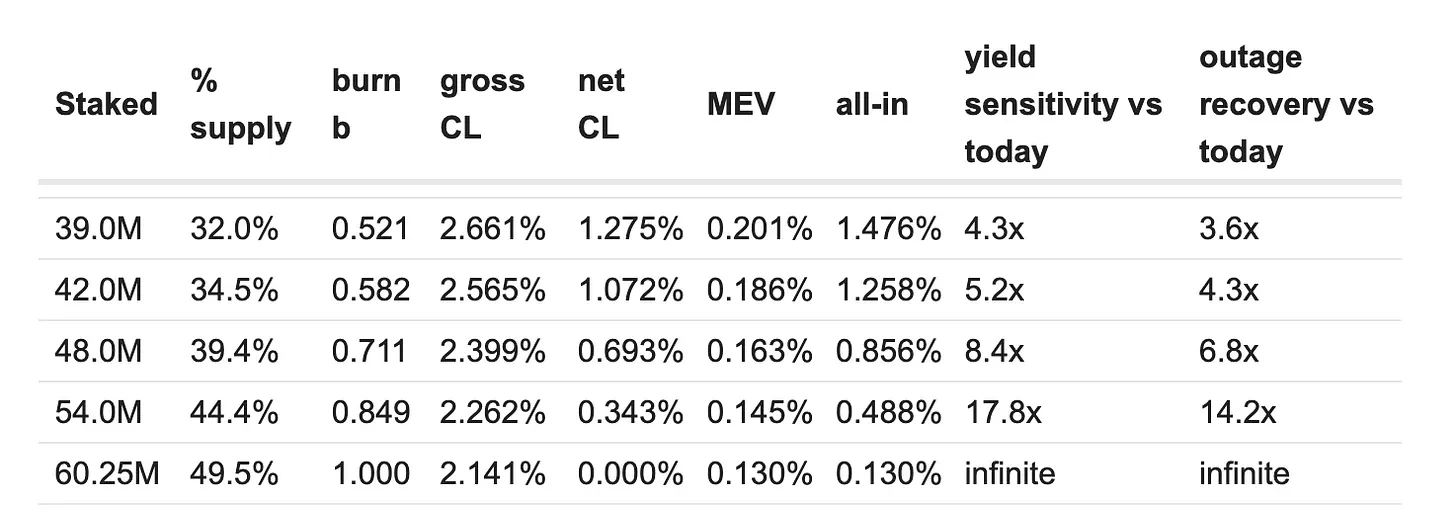
On Aug. 4, Ethereum researchers including Justin Drake and Jérôme de Tychey published a draft titled “progressive issuance burn,” or EIP-8363. The mechanism is straightforward: as more ETH is staked, the protocol would burn a larger share of validator rewards.
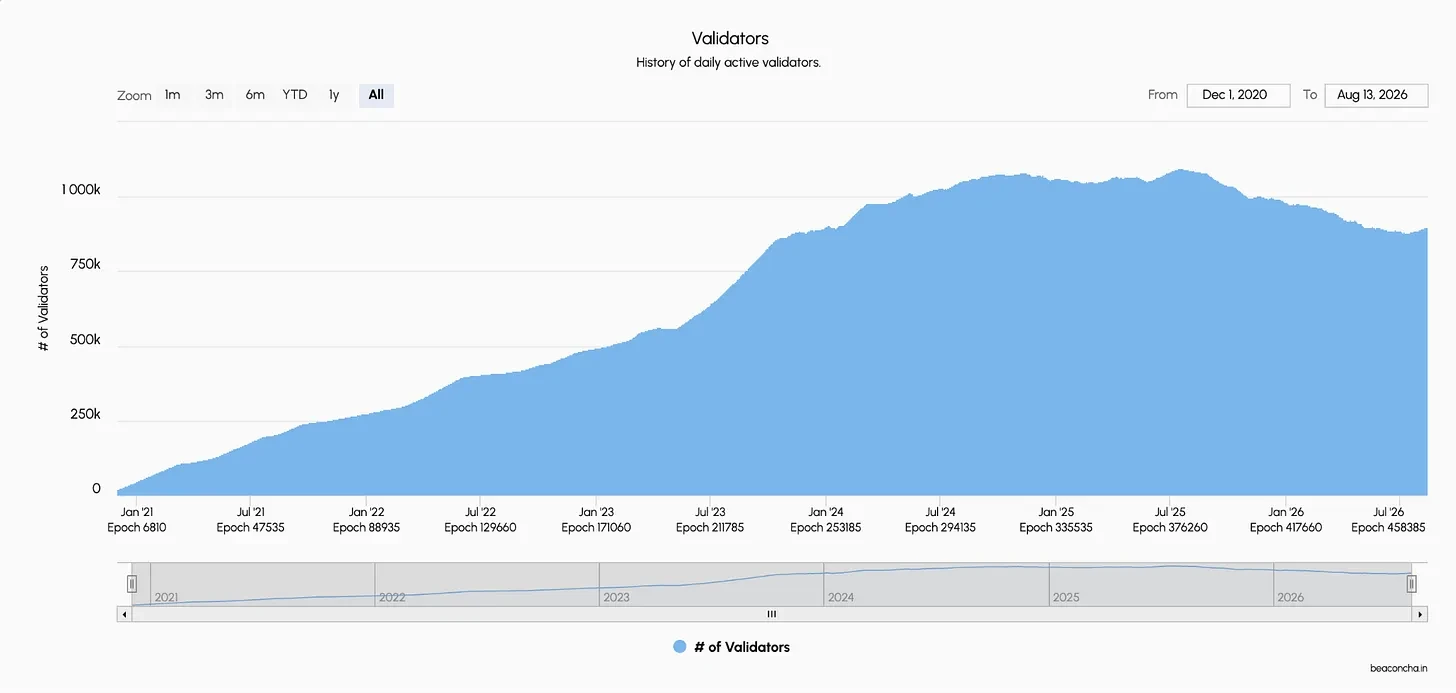
Once total staked ETH reaches 60.25 million, about half of total supply, the reward burn rate would rise to 100%, taking inflation-derived staking yield to zero. Ethereum currently has about 41.4 million ETH staked, equal to 34% of total supply, across roughly 890,000 validators, with an average staking yield of 2.67%. Based on the proposal, Aave founder Stani Kulechov said validator returns at current scale would fall from 2.862% to 1.476%.
Pushback came quickly. Within three days of publication, Kulechov, SharpLink CEO Joseph Chalom, and ether.fi’s Mike Silagadze had all voiced opposition. EIP-8363 remains an early draft under initial GitHub review. It is still far from finalization or implementation and did not make it into the upcoming Hegotá upgrade, though it could still surface in a later network upgrade discussion.
The scale of the money involved helps explain the reaction. Ethereum uses new issuance to pay participants for securing the network. The protocol mints about 1.1 million ETH a year for validators. Using the article’s reference price of $1,921 per ETH, that amounts to an annual compensation pool of roughly $2.1 billion.
Solana runs on a similar model, though the issuance burden is larger relative to its own economy. It mints about 19 million to 22 million SOL a year, worth about $1.5 billion at current prices cited in the article. Users pay 6,400 to 9,600 SOL per day in transaction fees and Jito tips, or about $225 million a year. That means fees cover only 13% of validator revenue, with the rest coming from token issuance. Chalom estimated Ethereum is not far off that structure: fees and tips account for about 15% of staking yield, while the remaining 85% comes from issuance.
The inflation gap is clear in the token numbers as well. Solana’s annual inflation rate stands at 3.7%, while Ethereum’s is 0.85%. For holders who do not stake, SOL dilution runs at more than four times the pace faced by ETH holders under the same conditions.
Security capital and yield-bearing capital are not the same thing
The article compares blockchain security spending with a traditional finance backstop. The National Securities Clearing Corporation, or NSCC, is involved in nearly all U.S. stock and bond trading. Its parent, DTCC, processed $4,700 trillion in securities transactions in 2025 and held $115 trillion in assets under custody. NSCC maintains a $19.7 billion member default fund, with only $130 million contributed by NSCC itself and the rest funded by members.
By contrast, attacking Ethereum would require control of 41.4 million staked ETH, a capital wall worth about $79.6 billion, roughly four times the size of that NSCC fund. The article adds two other constraints. A large attempt to buy ETH would likely drive the price higher, and an attacker would still need a global server footprint to deploy the stake. Ethereum’s slashing rules also mean malicious behavior can lead to the destruction of the attacker’s staked assets.
Still, the systems are built on different incentives. NSCC member capital is posted as a condition of access and does not earn a return. Members want that requirement to be as low as possible. On Ethereum, the same kind of security capital currently earns 2.67% annually, while Solana staking yields range from 5% to 8%.
Those yields now sit inside DeFi’s collateral stack
Years of relatively steady staking returns have created a full market around them. The article says about $35 billion in liquid staking tokens such as stETH is now used as collateral across crypto lending platforms. Traders loop these assets through Aave and Morpho, borrow WETH, then stake again. The strategy only works if staking yield stays above borrowing costs.
Pendle has built fixed-rate markets around staking returns. Curve runs pools tied to those exits. SharpLink, according to the article, holds $3 billion in ETH reserves, with most of that staked through Coinbase, Anchorage, Figment, and Galaxy. In that sense, staking yield is no longer just validator income. It has become a benchmark rate for a large part of DeFi.
If consensus-layer rewards were cut in half, looped strategies that depend on positive carry could flip from profitable to unprofitable. Pendle’s fixed-rate pricing would need to adjust, and lending markets would have to reassess the collateral value of liquid staking tokens across the board.
Why the post-Merge comparison to miners only goes so far
Before the Merge, Ethereum issued about 13,000 ETH per day to miners. After the Merge, that fell to about 1,700 ETH per day, an 88% reduction. Miners had spent billions of dollars on hardware and fought the change, eventually splitting off to create ETHW, which the article says is now worth less than 1% of ETH.
But miners and today’s stakers are not interchangeable. Miners sold computation for rewards. Their income did not sit at the center of a broad on-chain collateral system, and few complex financial products were built on top of mining yield. That meant the rest of the ecosystem could keep functioning without major structural changes even if mining revenue vanished.
Stakers play two roles at once. They secure the network, and the tokens they receive through staking are also used as base collateral in a large share of DeFi lending activity. Cutting staking returns therefore reaches beyond validator cash flow and into the wider financial structure built on top of it.
Who has the strongest incentive to fight reward cuts
The article draws on Mancur Olson’s 1965 theory that small groups with large per-member gains tend to organize more effectively than large groups whose losses are individually tiny.
That maps neatly onto Ethereum’s staking politics. Ordinary token holders make up the large group. New issuance dilutes them, but the annual loss per holder is small enough that many feel little urgency to mobilize. Large staking providers are the smaller group. A big share of newly issued tokens flows to them, the revenue can run into billions of dollars, and their business models depend heavily on that income.
Even solo operators face fixed costs that do not fall just because rewards do. Running a validator still requires spending on servers, electricity, and connectivity. With a 32 ETH stake, the article estimates current annual income at about 0.92 ETH, or roughly $1,760. Under the progressive proposal, that would drop to 0.47 ETH, about $900. If costs stay flat, an expense load that once accounted for 20% of revenue would move close to half. A slashing event would also consume a much larger share of annual earnings.
Supporters of issuance cuts argue that current staking returns remain too high, continue drawing in ETH, and mostly benefit large exchanges and major staking firms. The article says institutional money lifted total staked ETH by about 15% in the first half of 2026. In that view, raising the marginal cost of new staking could reduce the incentive for further concentration.
Opponents answer that direct reward cuts would first wipe out smaller, at-home node operators. Both sides say they want the same thing: to stop Ethereum from being controlled by a narrow set of capital-heavy players. Their disagreement is over which choice damages decentralization faster.
Solana is confronting the same structure
Solana validators have a clearly defined fixed cost base of their own. Each validator pays about 389 SOL a year in vote fees, whether the node is profitable or not, whether the market is up or down, and whether delegated stake arrives or not. With staking yields around 6.5%, the article puts validator break-even at roughly 200,000 delegated SOL.
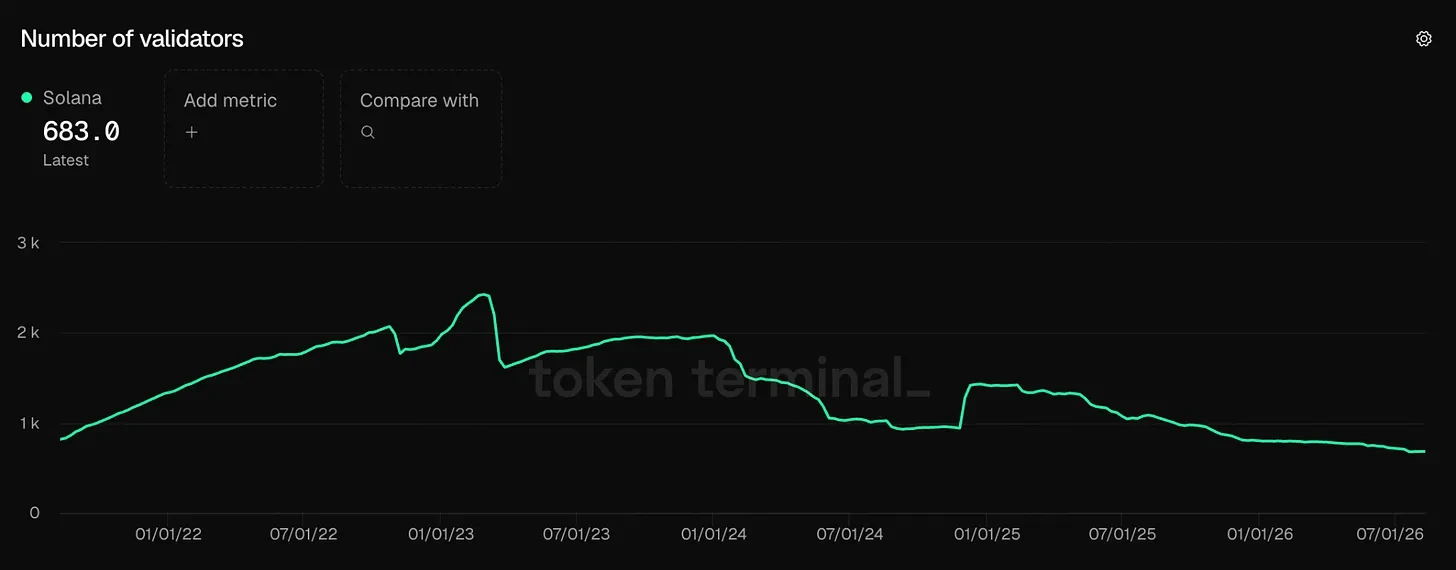
Active Solana validators have already fallen from a peak of 2,500 to 683, according to the article, even as total staked SOL has climbed to 430 million, close to 68% of stakeable supply.
Solana is now voting on reward reform. SIMD-0550 would increase the annual disinflation step from 15% to 30%, bringing forward the date for reaching the long-term 1.5% inflation target from 2032 to 2029. The article says that would reduce future issuance by an estimated 18.9 million SOL. SIMD-0553 would redesign fees around resource usage and raise the daily burn amount from 648 SOL to 7,500 to 9,000 SOL. Even at the top end of that range, daily burn would still sit well below the roughly 60,000 SOL distributed in rewards each day.
The vote runs through Aug. 18. Passage requires absolute majority support representing more than 66.67% of total staked SOL.
The fight is over who absorbs the cost of reform
The article closes on a broader point. Blockchain governance is often described as a self-directed process in which code and token-holder votes shape the future of a digital economy. Ethereum and Solana, however, are showing a similar pattern: once a chain’s native asset becomes a key source of global crypto liquidity, a target for institutions, and a building block for collateral markets, yield, leverage, and operating costs begin to exert more force than the original design vision.
For any chain that grows by paying users to lock capital, there is eventually a limit. The question for Ethereum and Solana is not whether they face that wall, but how soon they reach it and what form the trade-off takes when they do.