
About 42.4 million ETH, or roughly 34.7% of Ethereum’s total supply, had been staked across the network as of late August, setting a new high, according to an article written by imToken and published by Foresight. More than 2.2 million ETH was also waiting at the validator entry point, and at the current pace, newly staked funds would need close to 39 days before activation.
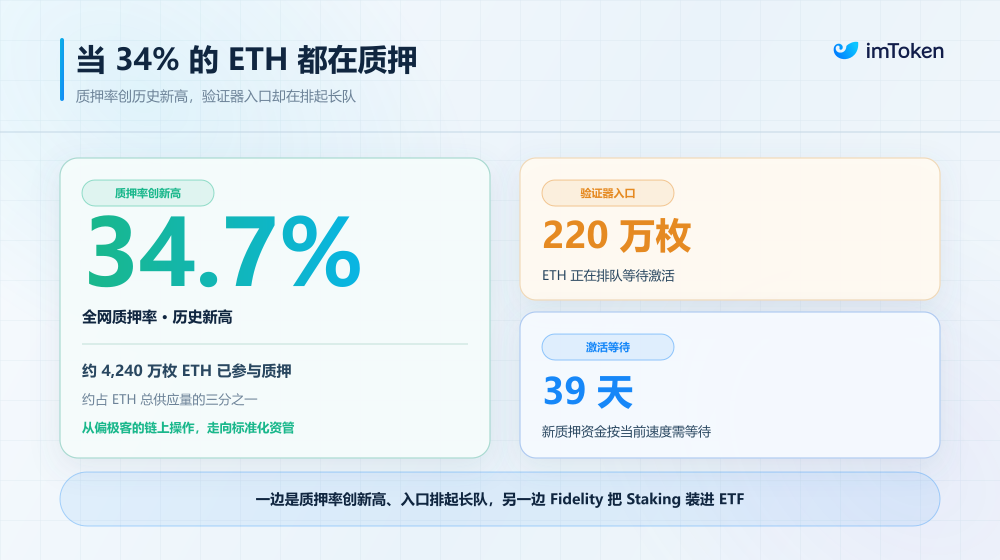
Another shift came from traditional finance. In August, Fidelity moved forward with staking arrangements for its Ethereum fund FETH. The firm had already signed custody-related agreements with Anchorage Digital and BitGo, and it also set out a mechanism for allocating staking rewards.
Taken together, the two developments point to the same pattern described in the article: over the past six months, Ethereum staking has been moving away from a niche, technically heavy on-chain activity and toward a more standardized asset management model. For ordinary ETH holders, the practical question is no longer just whether to stake, but whether to run a node, use native staking, choose Lido, or leave the process to an exchange.
Staking is no longer just about locking ETH for yield
After The Merge, Ethereum stopped relying on miners and computational power to secure the network. Validation and consensus are now handled by validators that stake ETH.
The minimum requirement to become an independent validator is 32 ETH. Validators that stay online, submit attestations correctly, and participate in block proposals can earn consensus-layer rewards from the protocol. Long periods of downtime can bring penalties, and more serious violations such as double signing can lead to slashing.
From that perspective, the article says staking income should not be viewed as interest that appears out of nowhere. It is a protocol reward paid to users who contribute economic security to Ethereum with their ETH.
For years, though, staking had a structural limitation: rewards did not compound natively. Under the traditional 0x01 validator model, even if a validator earned an extra 0.5 ETH or 1 ETH in consensus-layer rewards, any balance above 32 ETH would be periodically swept by the network to the withdrawal address instead of staying inside the validator to earn more. To put those funds back to work, the user had to assemble enough ETH again and redeploy.
Pectra changed that. Under the newer 0x02 validator model, the maximum effective balance rises to 2048 ETH, and balances above 32 ETH can continue to increase the effective staked amount over time under protocol rules. For long-term stakers, that means the old cycle of earning rewards, pulling them out, and redeploying can, for the first time, be handled automatically inside Ethereum’s native protocol.
Looking across the past six months, the article frames ETH staking as something that has moved beyond the earlier and simpler model of locking 32 ETH for yield. Fidelity’s plan to add staking rewards into an ETF addresses the question of who stakes on behalf of traditional finance users. Pectra addresses capital efficiency at the validator level. Liquid staking protocols such as Lido address liquidity. Professional node operators, meanwhile, are beginning to separate operations from control over the assets themselves.
That is why, in the article’s view, comparing staking options today means looking beyond APR alone.
How the main staking paths differ
The article groups the staking choices available to ordinary users into four common routes. On the surface, they all offer access to the same category of return. The real difference lies in which powers and which risks a user hands over to a third party.
Running your own node: the most native rewards and the fullest control
The purest form of ETH staking is to prepare 32 ETH, run both execution-layer and consensus-layer clients, and maintain a personal validator.
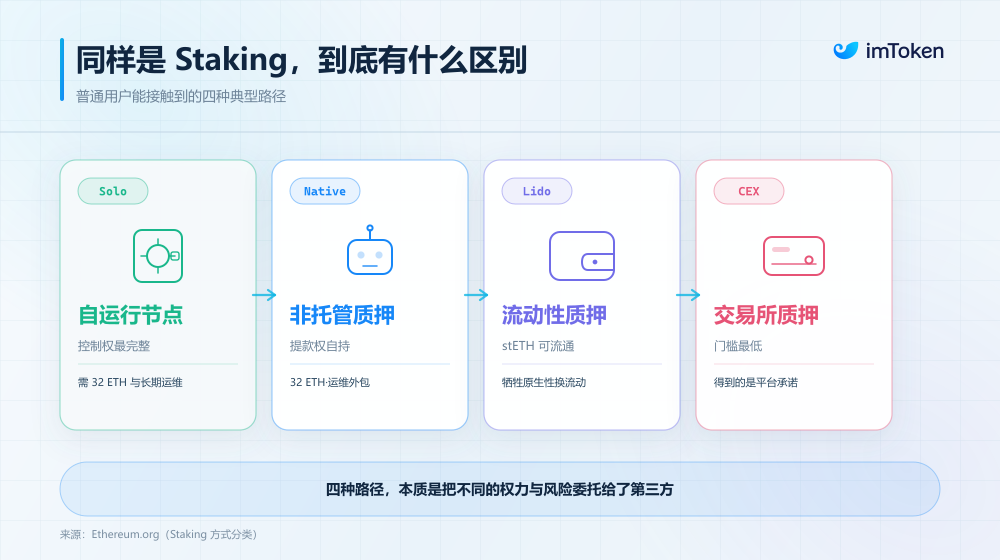
Under that setup, the user decides how the node is deployed, which client is used, and when to exit. The rewards generated by the protocol also do not need to be shared with a liquid staking protocol or an exchange platform.
The hurdle is high. A user needs at least 32 ETH, a stable device, reliable network conditions, and the ability to keep client versions, node status, and key security in order over time. The article sums it up as a trade: the highest degree of control and fuller rewards in exchange for higher technical and operational costs.
Native staking: keep control of assets, outsource operations
The second route sits between solo staking and full custody.
The user still commits 32 ETH to create an independent validator. The ETH still enters Ethereum’s native staking system, and it is not converted into another token. What changes is that node operations are handed to a professional service provider.
The article stresses one distinction above all: withdrawal rights can be separated from operational control of the node. Validators use different keys. The signing key, used for routine signing and block validation, can be managed by a professional node operator. The withdrawal credential, which determines where principal and rewards ultimately go, can remain in the user’s hands.
That separation is presented as a key dividing line between non-custodial native staking and custodial staking through an exchange. The article cites imToken’s current non-custodial ETH staking service as an example. Users with more than 32 ETH can create an independent validator, keep control of the withdrawal key, hand node operations to professional infrastructure providers, and choose between options such as compounding validators and auto-withdrawal validators.
This route is described as suitable for users with at least 32 ETH who want native staking rewards, care about self-custody, but do not want to maintain a validator on their own every day.
The article also makes clear that non-custodial does not mean risk-free. A node operator can still go offline, make configuration errors, or even trigger slashing. What is being outsourced here is not ownership of the assets, but operational risk around running the validator.
Lido: give up some native purity, gain liquidity
For users without 32 ETH, or for those unwilling to leave ETH tied up while waiting through a validator exit queue, liquid staking offers a different route.
Lido is the clearest example in the article. A user deposits ETH into Lido, the protocol allocates the funds to node operators for Ethereum staking, and the user receives stETH.
That turns staked ETH, which cannot otherwise be transferred directly, into an on-chain asset that can keep circulating. Users can transfer and trade stETH, and they can also use it in DeFi activities such as lending and liquidity provision.
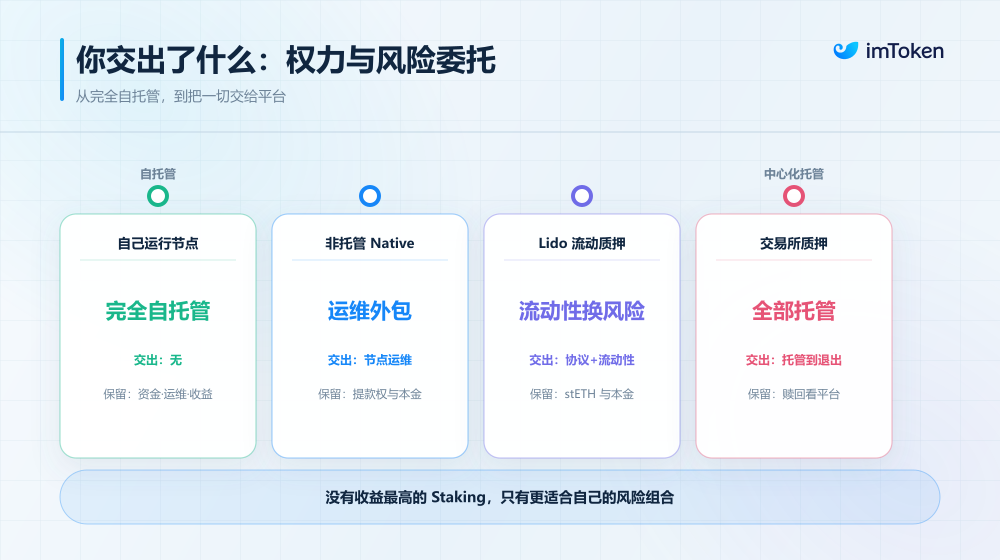
When it is time to exit, users can either follow Lido’s redemption process to get ETH back or sell stETH for ETH directly on a DEX. The second route does not require waiting for a validator to exit, but it does expose the user to market pricing and slippage at that moment.
At the same time, stETH reflects staking rewards through mechanisms such as rebasing, so users generally do not need to manage a separate process of claiming and restaking rewards on their own.
The convenience comes with extra layers of risk. The article says Lido currently charges a protocol fee that is distributed across parties including node operators and the DAO treasury, with users receiving the remainder. It also adds risks tied to Lido smart contracts, governance, node operators, and secondary-market liquidity for stETH.
The article specifically notes that stETH is not bound to ETH through a hard 1:1 redemption peg in the way some fiat-backed stablecoins are. If the market rushes to sell stETH over a short period, it can trade at a discount to ETH. If users keep deploying stETH into more DeFi protocols, they add more smart contract and liquidation risk on top.
According to the article, imToken’s ETH staking portal has also integrated Lido, allowing users to join liquid staking and hold stETH without owning 32 ETH.
Exchange staking: the lowest threshold, but based on platform promises
The last route is also the most familiar one for many newer users: deposit ETH on an exchange and click the staking button.
From a user-experience standpoint, this is the simplest option. There is no need to prepare 32 ETH, understand validator mechanics, manage signing keys or withdrawal keys, or worry about whether a server goes offline.
The exchange pools ETH from many users, runs validators, and credits part of the rewards back to customer accounts according to its own rules.
That simplicity also brings the heaviest reliance on trust. A user who sees “1 ETH staked” may, in many cases, first be looking at an internal ledger entry inside the exchange. How validators are deployed, how much of the underlying assets are actually staked, how rewards are reinvested, what share the platform keeps, and how redemptions are handled all depend on the product design of the specific platform.
More importantly, the assets themselves sit under centralized custody first. The article does not say exchange staking is necessarily a poor choice. For beginners who already keep ETH on an exchange for the long term and do not plan to manage an on-chain wallet themselves, it may still be the option with the lowest operational hurdle. But the convenience comes from handing custody, node operations, reward allocation, and the exit process over to the platform as a package.
No single staking route is best for everyone
Placed side by side, the four approaches show that the evolution of Ethereum staking products is not a story in which every solution converges on the same end state. Instead, each one separates and repackages the specific capabilities different users want.
- Running a node pushes control to the maximum.
- Native staking splits asset ownership from node operations.
- Lido recombines staking yield with liquidity.
- Exchanges hide more of the complexity and trade lower friction for centralized custody.
The article adds that Fidelity’s plan to wrap staking into an ETF goes one step further. An investor would not need to hold on-chain ETH or understand validator mechanics. A traditional financial product could handle custody, node operations, yield collection, and eventual distribution instead.
Seen through that lens, staking is starting to look more and more like a mature financial infrastructure service.
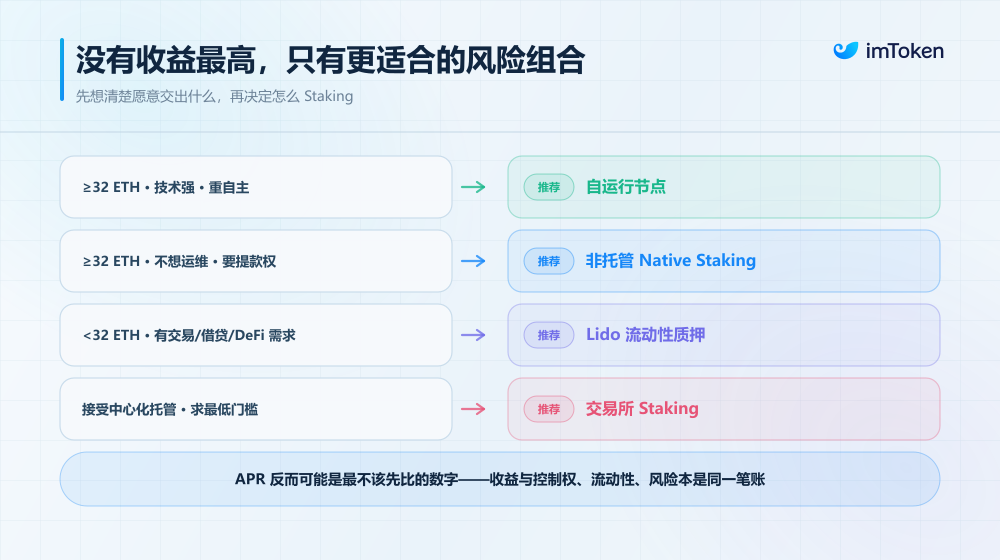
As for which route an ordinary user should choose, the article ties the answer to token holdings, technical ability, and risk preference.
Users with at least 32 ETH, some technical ability, and a strong preference for direct control and participation in Ethereum may still find running their own validator to be the fullest expression of control.
Users with the same 32 ETH minimum who do not want the long-term burden of node maintenance, but still want to keep a firm grip on withdrawal rights, may find non-custodial native staking the more natural compromise.
Users with less than 32 ETH, or those who regularly need their ETH for trading, lending, or other DeFi activity, may prefer liquid staking through Lido, accepting another protocol layer in exchange for greater capital flexibility.
Exchange staking, by contrast, fits users who are already comfortable with centralized custody and want the lowest possible barrier to entry, provided they understand that platform risk does not disappear just because there is a staking button.
The article closes with a broader point: APR may now be the least useful number to compare first. If two products differ by only a fraction of a percentage point in annualized return, but one requires full transfer of assets to a third party while another leaves withdrawal control with the user; if one requires waiting in the validator queue to exit while another can be sold through an LST in the market; if one compounds natively while another depends on how a platform handles rewards, those differences may matter more than the headline APR.
Staking yield does not exist in isolation. How much a user earns is tied to how much liquidity and control they give up, and how much additional risk they accept in return.
The source article includes a disclaimer stating that markets involve risk, investment requires caution, the piece does not constitute investment advice, and users should assess whether any opinions, views, or conclusions fit their own circumstances before acting on them.