

Why Ethereum is separating commercialization from the Foundation
On July 1, Ethereum Institutional was officially launched to consolidate the Ethereum Foundation’s market-facing efforts into a dedicated team focused on pitching Ethereum’s tokenization and stablecoin use cases to banks and asset managers. Just days earlier, Ethlabs had also emerged, founded by five former senior Ethereum Foundation researchers. Its mandate is centered on two priorities: improving onchain settlement efficiency and building a more complete monetary narrative around ETH.
The timing of these launches is significant. The Ethereum Foundation has been going through sustained leadership turnover. On June 18, co-executive director Hsiao-Wei Wang announced her departure, after Tomasz Stańczak had already submitted his resignation. Over the past five months, at least eight senior executives have left the Foundation. At the same time, the Foundation had already redefined its role in March 2026 through a new functional charter. It described itself not as Ethereum’s parent company and not as the final authority over protocol decisions, but as a steward of values such as sovereignty, censorship resistance, open-source code, privacy, and security.
That repositioning deliberately created a vacuum in the commercialization layer. The reasoning is straightforward: a body that claims neutrality in standards and protocol stewardship cannot simultaneously act as ETH’s promotional arm or as a sales organization for enterprises without undermining its own credibility. As a result, Ethereum’s ecosystem is now pushing commercialization into external, independently operated entities, while the Foundation remains focused on legitimacy, long-term protocol direction, and core ideological commitments.
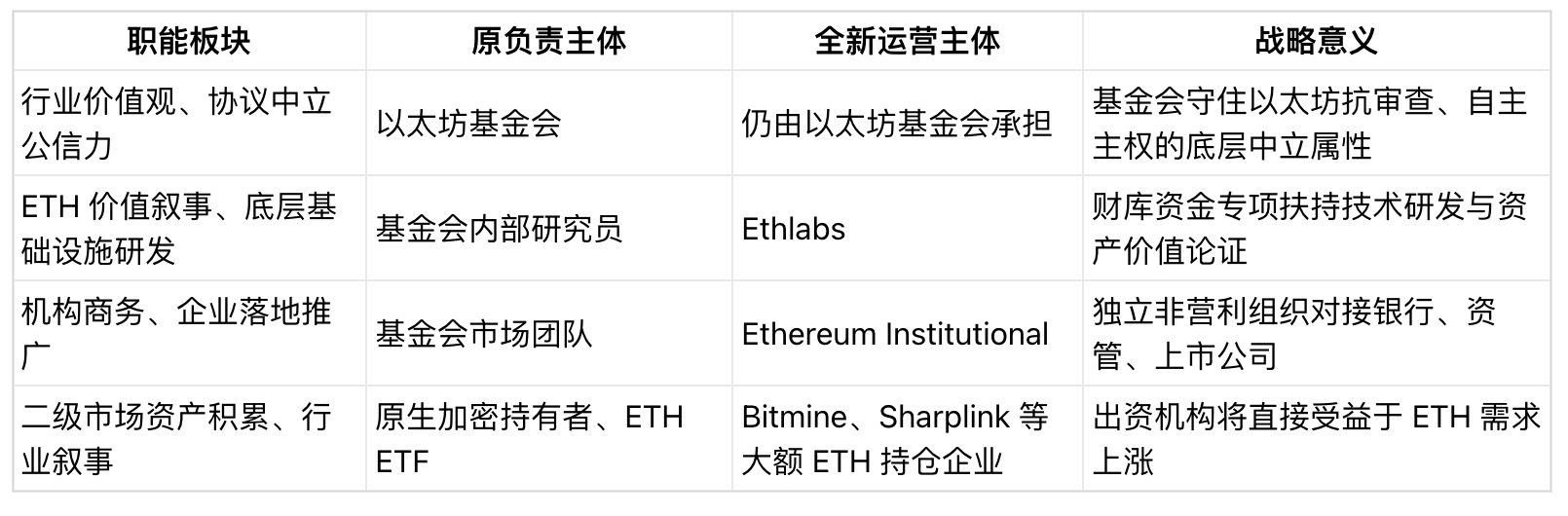
In practical terms, Ethlabs is taking responsibility for technical development and ETH value capture narratives, while Ethereum Institutional is handling direct business development. The arrangement is not just organizational housekeeping. It reflects a structural attempt to solve a governance problem that has existed for years: how to preserve neutrality at the protocol layer while still competing aggressively for institutional adoption in tokenization, stablecoin issuance, and digital asset settlement.
The emergence of three Ethereum power centers
With these changes, Ethereum now appears to have three distinct power centers. The first is the Ethereum Foundation, which retains moral legitimacy, long-horizon protocol stewardship, and responsibility for defending Ethereum’s ideological framework. The second is Ethlabs, which focuses on infrastructure, research, settlement performance, and the effort to present ETH as a coherent monetary asset. The third is Ethereum Institutional, which serves as the business-development front end for engagement with global financial institutions.
Ethereum Institutional has already disclosed the scale of its network. According to the organization, it is currently in contact with more than 500 institutions, including tier-one banks, global asset managers, sovereign wealth funds, custodians, and market infrastructure providers. It also said its Ethereum Institutional Summit brought together more than 150 senior financial executives, whose organizations collectively manage around $250 trillion in assets. That resource base helps explain why the ecosystem chose to externalize this function rather than keep it as a subordinate unit under the Foundation.
The benefit of this architecture is operational clarity. The Foundation no longer has to reconcile public neutrality with active ETH promotion. Ethlabs can focus on product, protocol-linked infrastructure, and strategic narrative formation. Ethereum Institutional can spend all of its time converting relationships into deployments, forums, partnerships, and capital commitments. The cost, however, is a shift in influence. The main channels used to speak to Wall Street are increasingly being controlled by actors whose balance sheets are deeply exposed to ETH itself.
That tradeoff can be framed as convenience versus independence. Ethereum has clearly chosen convenience and execution speed. From an institutional adoption standpoint, this may be rational. From a governance and incentive perspective, it introduces a more concentrated layer of influence than the ecosystem has historically been comfortable admitting.

Who funds the new structure: Bitmine, Sharplink, and Joe Lubin
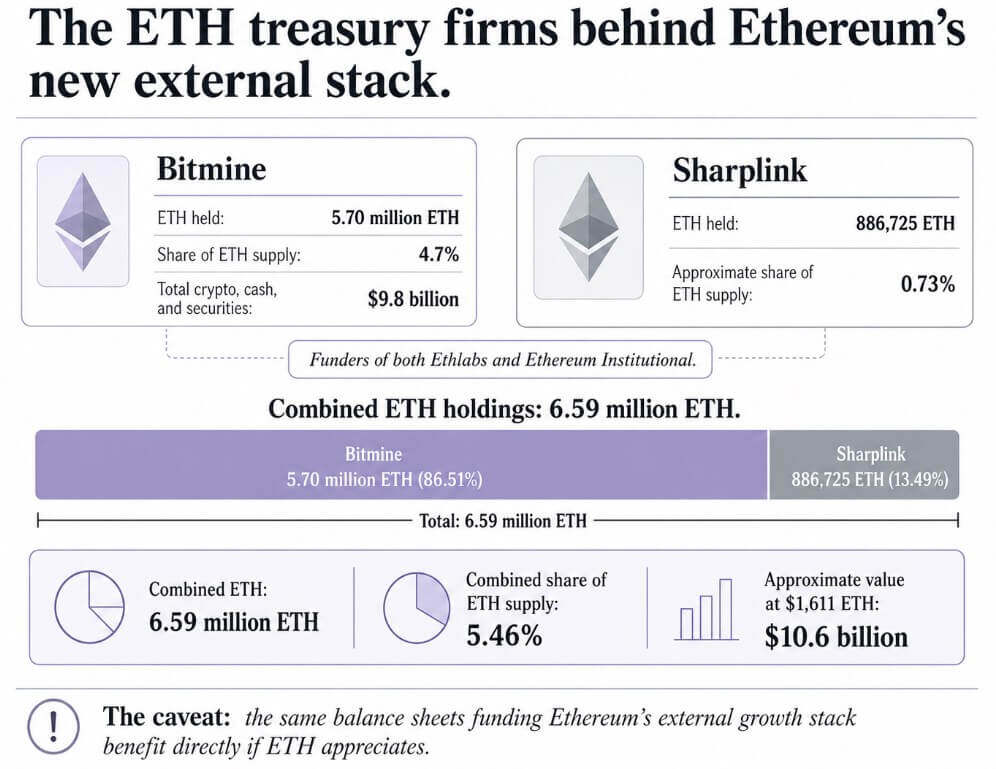
The financial backbone behind both Ethlabs and Ethereum Institutional comes from Bitmine, Sharplink, and Ethereum co-founder Joe Lubin. Their role matters because these are not neutral donors with no market exposure. They are deeply aligned with ETH’s market value and with Ethereum’s ability to become the preferred institutional settlement network.
Bitmine currently holds 5.7 million ETH, representing about 4.7% of total ETH supply. Including cash and marketable securities, its total asset base stands at $9.8 billion. Sharplink holds 886,725 ETH and added another 10,000 ETH on June 28 at an average price of $1,611. Combined, the two firms control 6.59 million ETH, or 5.46% of the 120.7 million ETH circulating supply. At current market prices, that position is worth close to $10.6 billion.
The equity side is meaningful as well. Bitmine’s market capitalization is listed at $6.55 billion, while Sharplink’s market value exceeds $1 billion. At this scale, even relatively modest ETH price moves can create hundreds of millions of dollars in mark-to-market changes. That means any improvement in Ethereum’s infrastructure, institutional traction, or settlement relevance can directly affect the financial position of the entities funding the ecosystem’s expansion.
If the new organizational model works, these backers stand to benefit first. Better infrastructure, a clearer ETH monetary thesis, and a more effective business-development pipeline could all support greater ETH demand. Joe Lubin, by backing both nonprofit entities at once, sits near the center of this incentive structure. Meanwhile, Bitmine and Sharplink are not merely aligned with Ethereum in principle; their financial outcomes are tightly intertwined with Ethereum’s commercial success.

That is precisely why the new architecture is both powerful and controversial. It creates a more professional institutional outreach system, but one financed by some of the largest ETH holders in the market. The upside is stronger execution. The downside is that the ecosystem’s promotional and adoption machinery becomes inseparable from the wealth effects of ETH price appreciation.
Infrastructure progress and the real basis for institutional adoption
Ethlabs’ importance ultimately depends on whether Ethereum can continue improving performance where institutional users actually care: settlement efficiency, cost predictability, and scaling capacity. On that front, there are already concrete developments. PeerDAS has gone live and is expected to increase data availability capacity for layer-2 networks by roughly 10x. The planned Glamsterdam upgrade, targeted for the second half of 2026, is aimed at base-layer scaling, parallel transaction processing, and larger block payloads.
A June 2026 academic report suggested that aggregate transaction throughput across Ethereum mainnet and layer-2 networks had already doubled. Cost improvements were even more striking. Mainnet median fees fell from above $2 to below $0.02, while layer-2 fees declined by more than 95%, reaching as low as $0.0015. These are not marginal changes. For tokenization, stablecoin settlement, and enterprise transaction flows, fees and performance determine whether Ethereum is economically viable at scale.

Even so, the long-term projections remain measured. The same report indicated that Ethereum mainnet is still expected to remain below 100 transactions per second before 2034. It also projected that layer-2 throughput would not surpass Solana until March 2029, although by then Ethereum’s L2 transaction fees would likely be much lower. This is a crucial distinction. Ethereum’s institutional case is not built on claiming the highest raw TPS on mainnet. It is built on the idea that a layered architecture, combined with standards, compliance alignment, and lower effective settlement cost, can still win institutional deployment.
That is why Ethlabs matters. Its job is not simply to improve code. It has to reduce the practical objections that large financial institutions still have when deciding where to launch tokenized assets, stablecoins, or onchain settlement products. In Ethereum’s current structure, that technical and narrative work is inseparable from the broader commercialization effort.
The bullish case: scale advantages in stablecoins, DeFi, and tokenized assets
The strongest argument in Ethereum’s favor is that it already operates from a position of substantial scale. Ethereum currently hosts $157 billion in stablecoin market value, accounting for more than half of the global stablecoin market. It also holds $37.2 billion in DeFi total value locked, equivalent to 62% of the sector. According to RWA.xyz, Ethereum’s tokenized real-world assets total $15.8 billion, compared with $31.52 billion across the entire category, keeping Ethereum firmly in first place among public blockchains.
This existing scale matters because institutional adoption tends to reinforce incumbency. Deep stablecoin liquidity, mature DeFi rails, established custodial integrations, and proven issuance patterns make it easier for banks and asset managers to choose Ethereum or Ethereum-linked layer-2 environments over less established alternatives. If Ethereum Institutional is successful at turning relationships into deployments, it will be building on top of a foundation that already has measurable dominance in the most commercially relevant sectors of crypto finance.

Citi’s projections illustrate why this matters. The bank estimates that the global tokenized real-world asset market could expand from roughly $17 billion today to $5.5 trillion by 2030, with a low-end scenario of $2.7 trillion and a high-end scenario of $8.2 trillion. If Ethlabs continues to improve infrastructure and Ethereum Institutional can convert institutional networks into real capital and issuance activity, then large ETH holders such as Bitmine and Sharplink could become early beneficiaries of an expanding settlement economy. In that scenario, Ethereum’s role as the default compliant settlement layer for digital assets would strengthen, and ETH’s asset value could rise in tandem.
The point is not simply that Ethereum is large today. It is that the ecosystem is trying to professionalize the machinery that translates technical leadership and market share into actual institutional capture. The new organizational design is intended to do exactly that.
The bearish case: price sensitivity, funding dependence, and uneven regulatory upside
The first major risk is ETH price itself. Citi recently cut its 12-month ETH target from $3,175 to $2,240, citing weak ETF demand and negative fund flows. It also set a bear-case scenario at $1,094. Standard Chartered, by contrast, remains much more constructive and continues to argue that ETH could reach $4,000 by the end of 2026. Such a wide gap between major institutional forecasts underscores how uncertain the short-term market outlook remains.
If ETH stays weak for a prolonged period, the implications go beyond token holders. Bitmine and Sharplink could face continued equity discounts relative to the value of their ETH holdings, which would reduce their flexibility and capacity to keep funding Ethlabs and Ethereum Institutional at the same pace. Even if both nonprofit entities remain operational, their funding stability would likely deteriorate. Markets could then increasingly question whether these organizations exist to build real institutional-grade infrastructure or primarily to support the ETH investment case.

The regulatory backdrop also supports the strategic thesis without guaranteeing price appreciation. In 2025, the U.S. GENIUS Stablecoin Act established a federal regulatory framework for stablecoins. Visa, Mastercard, and a Coinbase-led consortium subsequently launched the Open USD stablecoin. This is clearly supportive for institutional settlement growth, but it is not an Ethereum-exclusive tailwind. A better-regulated stablecoin market can increase activity across multiple chains, not just Ethereum.
There is also disagreement over the total addressable market. McKinsey has offered a far more conservative forecast, estimating the tokenization market at around $2 trillion by 2030, far below Citi’s upper-range expectations. That spread shows that even if Ethereum executes well, the overall size of the opportunity remains contested. In other words, Ethereum faces both execution risk and market-size uncertainty at the same time.
Ultimately, Ethereum’s decision to split business functions away from the Foundation addresses a genuine structural contradiction between neutrality and commercialization. But the resulting model is double-edged. On the positive side, specialized organizations can focus on infrastructure, enterprise relations, and Wall Street connectivity. On the negative side, the entire expansion system is now closely tied to the balance sheets of major ETH holders, making capital availability sensitive to ETH’s own market performance. Over the next year, ETH price action may determine whether this architecture is viewed as a breakthrough in institutional strategy or as a fragile arrangement built on concentrated incentives.