
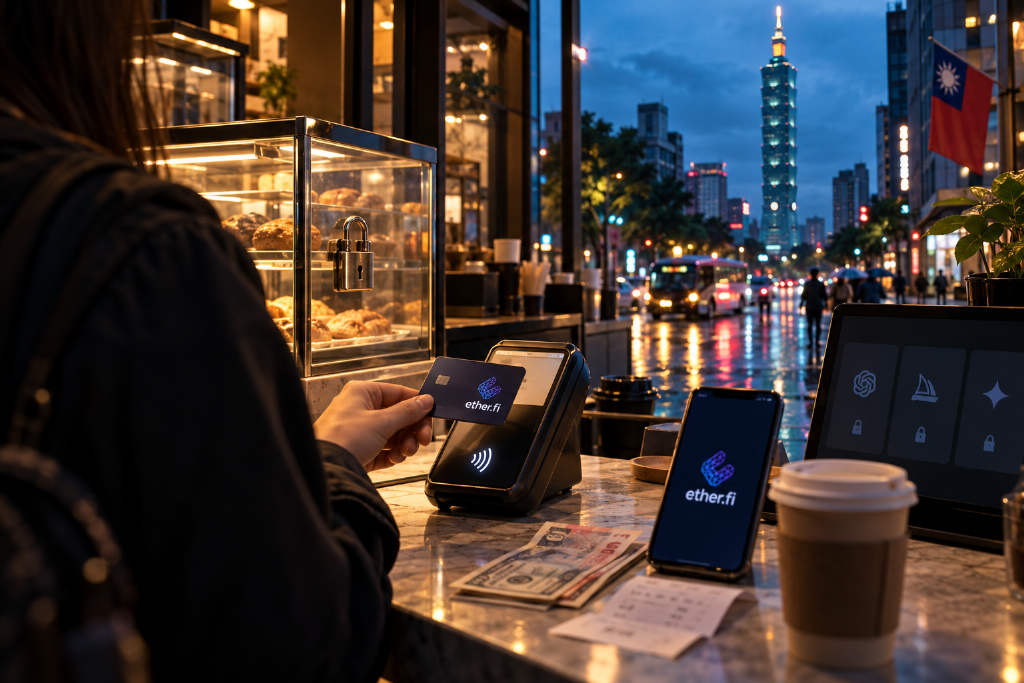
ABMedia said its October 2026 hands-on test in Taiwan found that the Ether.fi card can be applied for locally and offers spending rewards of up to 3%, with extra incentives for AI subscriptions, but the card is not equally attractive for every user.
The report focused on account application, funding and card spending, and listed seven drawbacks that tend to appear only after actual use. It also outlined which users may be a better fit for the product and which may not.
Rewards are paid in ETHFI, not cash
Ether.fi card rewards are distributed in ETHFI, the platform’s native token, rather than cash or points. According to CoinGecko data cited by ABMedia, ETHFI was about $0.61 on Nov. 2, 2026, down about 39% over the past year and more than 90% below its all-time high of $8.53 in March 2024.
That means a headline 3% reward rate may be worth less in dollar terms by the time users claim it. For users who want steadier reward value, the report noted that points from Taiwan-issued credit cards do not fluctuate with token prices.
Higher-tier benefits are aimed at users with larger balances
ABMedia said the card’s more attractive benefits, including extra rewards on AI subscriptions, lower FX charges on TWD spending and airport lounge access, are available only from the Luxe tier upward.
Based on Ether.fi’s official membership tier description, users who do not want to pay an annual fee have three ways to unlock status. For Luxe, they can accumulate 5,000 points in a single month, roughly equal to $5,000 in card spending, deposit $15,000 into the Liquid vault, or stake 30,000 ETHFI. For Pinnacle, the thresholds are 25,000 points in one month, about $25,000 in spending, a $100,000 Liquid vault deposit, or staking 150,000 ETHFI.
Points reset every month and do not roll over. Spending made before an upgrade is not recalculated at the higher reward rate. Users can also pay directly for status, with Luxe priced at $199 per year and Pinnacle at $999 per year.
ABMedia said that users who do not want to pay the fee and do not plan to spend heavily every month would need to keep at least $15,000 in assets or 30,000 ETHFI on Ether.fi over time, while taking on token price volatility and risks tied to the vault and smart contracts.
Claiming rewards takes time and a minimum balance
Rewards unlock seven days after a transaction is completed. Users must accumulate at least $5 in claimable rewards before they can tap the Claim button in the app, and the rewards are not credited automatically.
Even after claiming, ETHFI cannot be spent directly through the card. In Direct Pay mode, the card can only draw from dollar- or euro-denominated assets such as USDC, USDT and EURC, so users need to swap ETHFI into USDC inside the app before spending. For smaller spenders, that means rewards may need time to build up before they can be claimed.
No TWD funding rail is available
Ether.fi does not currently support TWD deposits. Taiwan users need to buy USDT or USDC with TWD on a local exchange first, then transfer the stablecoins to an Ether.fi deposit address. ABMedia said that process adds exchange fees and on-chain transfer fees, while also requiring users to choose the correct network and confirm the destination address.
The report added that Direct Pay is a pre-funded model. It is not like a conventional Taiwan credit card that lets users spend first and settle the bill later.
TWD spending comes with extra FX charges
Ether.fi accounts are denominated in U.S. dollars. When users spend in TWD, which is neither a U.S. dollar nor a euro transaction, the platform adds an extra fee on top of the exchange rate: 0.5% for Core, 0.25% for Luxe, and no extra charge for Pinnacle and above.
ABMedia said that for a Core user, a nominal 3% reward rate falls to about 2.5% after the 0.5% FX charge, while the reward is still paid in ETHFI, whose price can move sharply.
AI subscription boosts alone do not cover the Luxe fee
Extra rewards for AI subscriptions such as ChatGPT and Claude are available only to Luxe-tier users and above. Luxe offers a 10% boost with a monthly cap of $10, or up to $120 a year. ABMedia said that amount alone does not offset the $199 annual fee and needs to be considered together with ordinary card rewards.
The report also flagged two conditions that users may miss. Subscriptions billed through app stores such as the App Store do not qualify for the extra reward; payment must be made directly on the service provider’s website. Also, subscriptions charged before a tier upgrade are not backfilled.
Borrow mode carries liquidation risk
Besides spending from an existing balance, the Ether.fi card also offers a Borrow mode that lets users pay by borrowing against assets in their account instead of selling them. According to the platform’s collateralized borrowing description cited by ABMedia, users can borrow up to 81% of collateral value against USDC and USDT, 55% against weETH, and 20% against ETHFI.
If collateral prices fall and the loan moves beyond the liquidation threshold, the assets can be liquidated. ABMedia said users who spend against more volatile crypto collateral should watch how close they are to that threshold during sharp market declines.
Who the card may suit, and who it may not
ABMedia said the Ether.fi card may be a better fit for users who already hold stablecoins and spend frequently in U.S. dollars, since they may avoid the 1.5% foreign transaction fee commonly charged by Taiwan credit cards. It may also suit users who already hold more than $15,000 in stablecoins or 30,000 ETHFI, are willing to keep those assets on Ether.fi to unlock Luxe, and regularly pay for AI tools. The report added that users should also be comfortable with reward value moving with the ETHFI price.
It may be less suitable for users who mainly spend in TWD and want stable rewards, for people who do not hold crypto and do not want to fund through an exchange, and for those considering the $199 annual fee only for the AI subscription boost.
ABMedia said users who still want to apply can refer to its separate guide covering the Ether.fi card application process in Taiwan, KYC, membership tier selection and actual spending records.



