

Brussels is reviewing whether crypto lending should be brought into the Markets in Crypto-Assets Regulation, but DeFi lending vaults are exposing a basic problem: they can perform the economic function of lending without offering an obvious entity to regulate.

MiCA left crypto lending outside its original rulebook. That position is now under review.
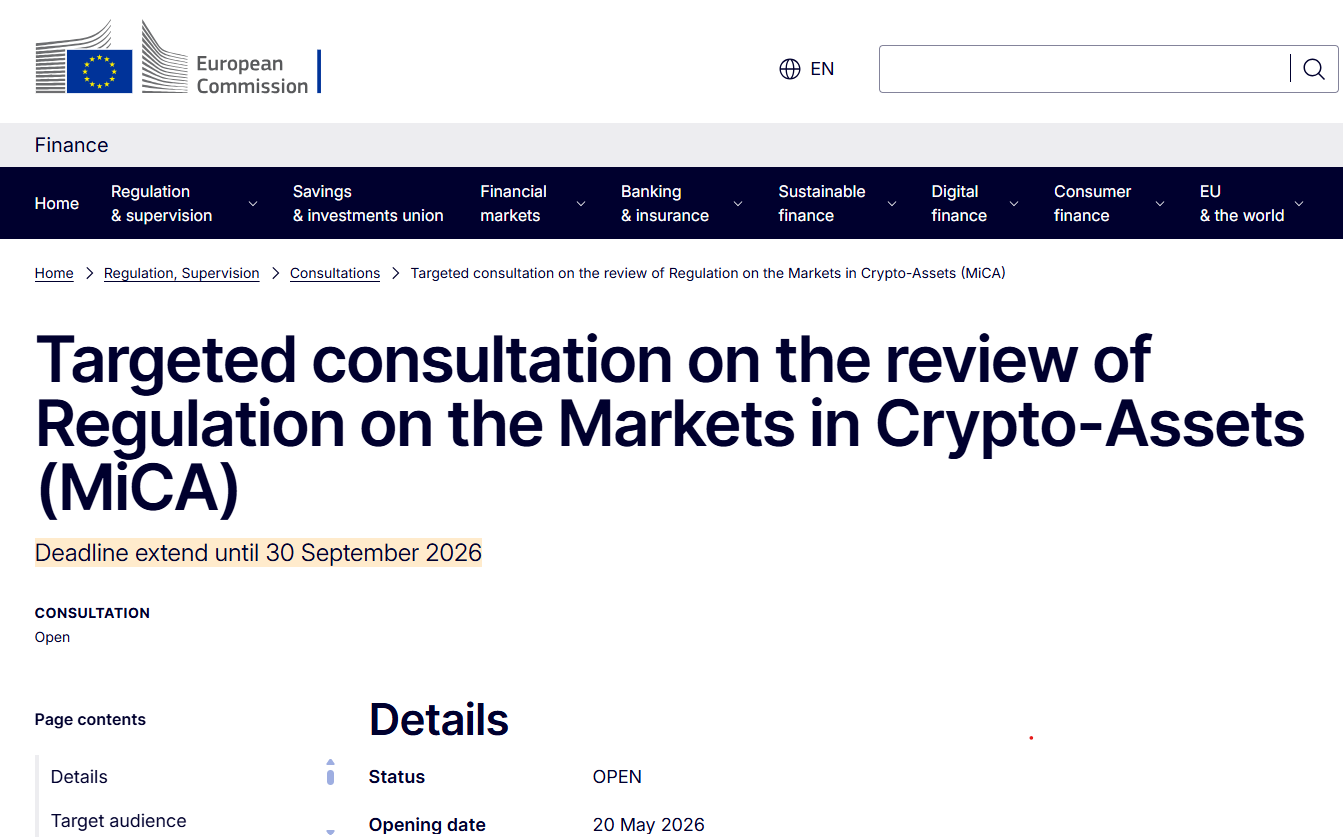
On May 20, 2026, the European Commission asked stakeholders to comment on areas that were not covered by the first version of MiCA. The list includes decentralized finance, or DeFi, as well as crypto lending and borrowing.
A major point of contention is the rise of lending vaults. These structures can direct billions of dollars into onchain credit markets while looking very different from a standard lending business. Their legal status currently depends on nonbinding interpretations that place them outside both MiCA and EU fund rules.
Yuriy Brisov, an EU digital assets lawyer and partner at Digital & Analogue Partners, told Cointelegraph Magazine that the law around vaults is unclear at this stage.
The uncertainty goes beyond classification. Vaults may deliver the economic function of lending while distributing other tasks across smart contracts and multiple participants instead of a single company. That makes the usual question of who provides the service much harder to answer.
If Brussels decides that lending belongs inside the regulatory perimeter, the consequences would reach beyond code. The decision would also affect the people and protocols connected to these vault structures.
Morpho shows why the issue is hard to fit into existing rules
Decentralized lending protocol Morpho offers a practical example of why the debate is difficult. Its lending infrastructure does not fit neatly into any existing regulatory model.
The European Commission’s targeted consultation on the review of MiCA is aimed at questions like this one.
Morpho’s Vault V2 architecture splits responsibilities among an owner, curator, allocator and sentinel. The curator sets strategy and risk parameters. The allocator executes allocations. The sentinel holds powers intended to reduce risk.
None of those roles automatically establishes a participant as a regulated lending provider under MiCA. Still, the structure shows why it is less straightforward to identify the relevant provider than it would be with a conventional lender.
The article also notes a related development: Bitwise plans to launch onchain vaults through Morpho.
Jonathan Galea, a partner at Cahill Gordon & Reindel, examined lending vaults and their treatment under EU financial regulation in a recent client update. His analysis considers how vault structures may sit across MiCA, stablecoin rules and European fund law at the same time.
Galea said policymakers should be careful about treating lending vaults as a single category. He told Cointelegraph Magazine, 「lending vaults solve more practical problems than they create.」
In his view, some vaults help direct fragmented liquidity into lending markets, while others may buy and sell crypto assets and should be handled differently.
That distinction would matter if Brussels decides to regulate lending. A broad label such as DeFi lending could pull in structures with very different economic functions, along with the people who exercise control over them.
The central question is who, if anyone, should be regulated
MiCA currently excludes crypto-asset services provided in a fully decentralized manner, though it can still apply when only part of an activity is decentralized.
That leaves architectures like Morpho Vault V2 in a gray area, especially when responsibilities are distributed by design.
One option would be to use decentralization as the main dividing line. Galea argues that approach could disadvantage newer protocols.
Brisov takes a different view. He says the focus should be on the structure of the vault and the degree of control that people have over it.
He also argues that if Brussels concludes lending and borrowing need regulation, those activities should be added explicitly to the list of regulated crypto-asset services rather than expanding the definition of a crypto-asset service provider itself.
The article also references another related line from Andre Cronje: 「DeFi doesn’t exist anymore,」 just onchain finance.
Curve Finance founder Michael Egorov said any rulemaking also needs to account for the gap between decentralized lending and conventional finance.
Egorov said regulation should be approached 「really carefully」. In his view, a dedicated framework could improve safety and open DeFi lending to new users, while avoiding rules that some protocols cannot comply with because of how they are built.
Consultation closes on Sept. 30
The Commission’s consultation closes on Sept. 30. What comes after that could determine whether lending vaults stay outside MiCA or end up inside a new regulatory framework.
For Brussels, the challenge is not only whether to regulate DeFi lending. It is how to write rules that distinguish between very different forms of onchain lending, and how to identify the people, if any, who actually exercise control over them.