MiCA Transition Period Ends: A Regulatory Watershed for European Crypto
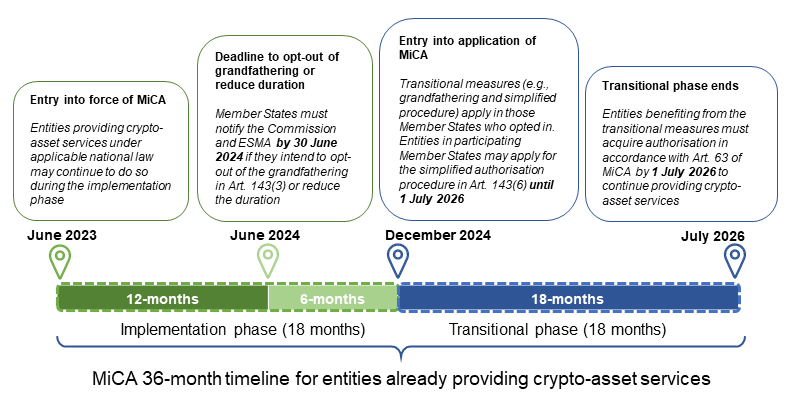
On July 1, 2026, the transitional grace period for the European Union's Markets in Crypto-Assets Regulation (MiCA) officially expired. From this date onward, any entity offering crypto-asset services within the EU must hold a full MiCA license. The French regulator AMF warned that violations could lead to up to two years in prison and fines of €30,000, with the power to publicly blacklist non-compliant platforms and request website blocking. This marks a shift from fragmented national oversight to a unified compliance regime across Europe.
Licensing Gap: 75% of Legacy Platforms Lose Legal Status
According to data cited by Crypto News, as of May 2026 only about 194 crypto firms had obtained full MiCA authorization across the EU, far below the estimated 1,100 to 3,000 that previously operated under national regimes. Law firm Hogan Lovells estimates that roughly 75% of legacy platforms will lose their legal eligibility after the grace period. Major exchanges like Binance and MEXC remain unlicensed and cannot continue serving EU users. Lithuania saw over 240 locally registered crypto firms shut down when its transition ended. The Netherlands ended its grace period on July 1, 2025, while Germany shortened its window to the end of 2025 to accelerate licensing.
MiCA Framework Explained: Unified Rules and Passporting Mechanism
MiCA is the EU's first comprehensive regulatory framework for crypto assets, covering all 27 member states plus Norway, Iceland, and Liechtenstein. It classifies Crypto-Asset Service Providers (CASPs) into ten categories, including exchange operation, custody, conversion, order execution, portfolio management, and advisory services. A single license only covers the categories specified in the application; multi-service firms must integrate authorization. MiCA also includes a dedicated stablecoin sub-framework: fiat-referenced tokens (e.g., USDC) and asset-referenced tokens (ART) must meet issuance authorization and reserve requirements, with stricter oversight for those exceeding thresholds. The passporting mechanism allows a firm licensed in one member state to offer services across the EU via a simple notification process, eliminating the need for country-by-country applications.

Exchange Shakeout: Binance, KuCoin Stalled; Stablecoin Landscape Redrawn
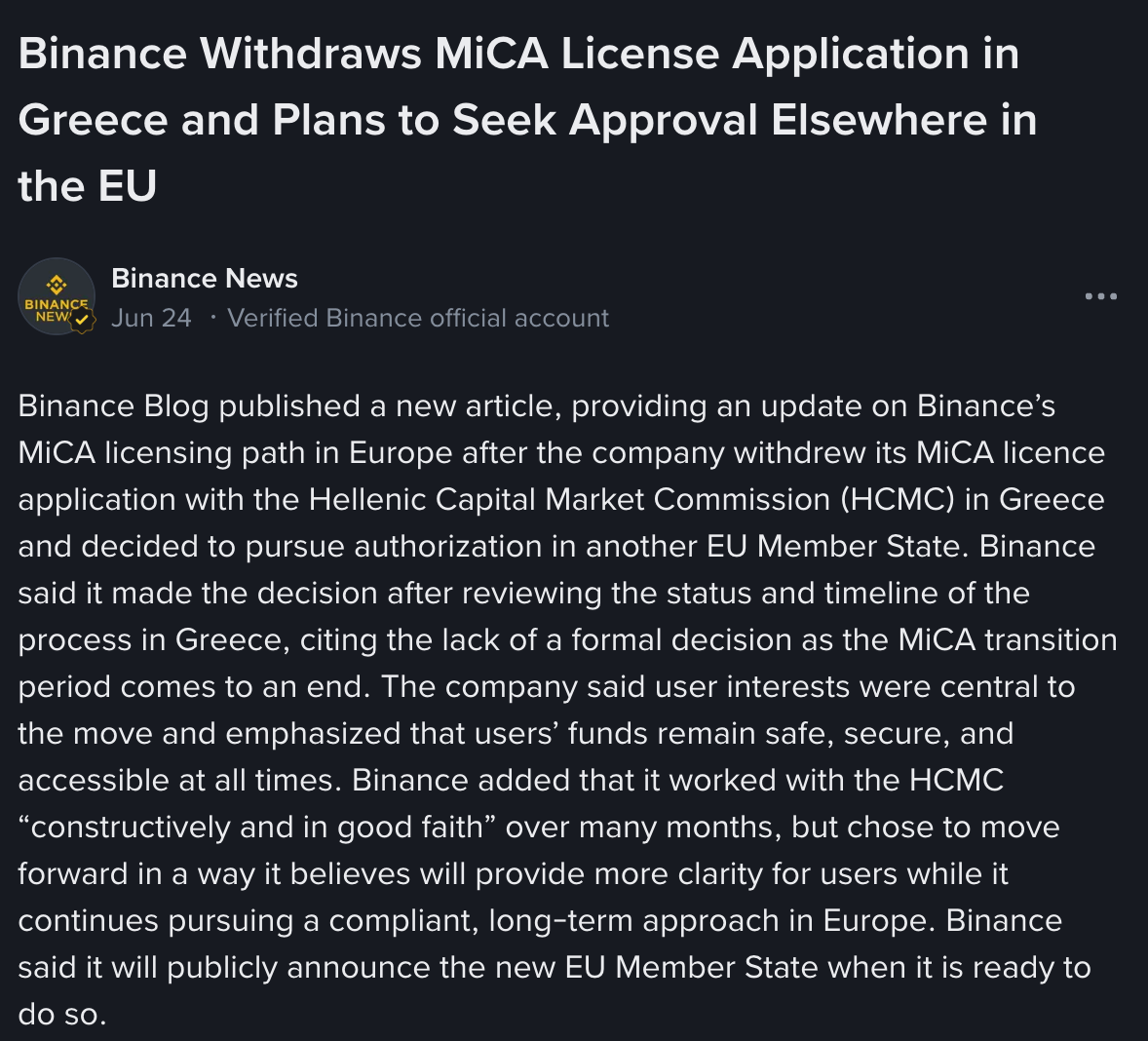
KuCoin obtained a license from Austria's FMA in November 2025 but was barred from operating due to vacancies in key AML and sanctions compliance roles. The exchange has appealed and still cannot accept new EU users. Binance applied for a MiCA license via Greece's HCMC in January 2026, but on June 16 Reuters reported that HCMC plans to reject the application over concerns about Binance's legal history and governance. Stablecoin reshuffling is already complete: USDT, lacking MiCA authorization, was delisted by Coinbase (Dec 2024), Crypto.com (Jan 2025), Binance and Kraken (Mar 2025). Circle's USDC and EURC, which secured authorization, now dominate the compliant market with a combined market cap of ~$75 billion. No issuer has yet obtained authorization for asset-referenced tokens (ART), the strictest MiCA sub-category.

User Risks and Account Migration Guidance
After July 1, EU users on unlicensed platforms face real risks: platforms may stop accepting new deposits, restrict withdrawals, or limit account actions without prior notice. An OKX Europe analysis found that between May 2025 and May 2026, about 41% of European crypto app downloads came from exchanges without MiCA authorization, and an estimated 60% of European crypto users are currently on unlicensed platforms. If a platform has announced account migration (e.g., Bybit, Bitvavo, Kraken, Coinbase, Crypto.com), users typically need to complete new KYC and accept updated terms of service as part of MiCA's AML requirements.

What's Next: MiCA Review and Direct ESMA Oversight Debate
MiCA is not the end. On May 20, 2026, the European Commission launched a formal review of the regulation, with 86 questions covering stablecoin competitiveness (especially the weak position of euro stablecoins against dollar-pegged ones), DeFi, staking lending, RWA tokenization, and whether ESMA should gain direct supervisory powers over major CASPs. France, Austria, and Italy support direct ESMA oversight to close gaps between member states. Meanwhile, a consortium of 37 banks—including BNP Paribas, ING, and UniCredit—has launched the Qivalis alliance to develop a euro-pegged compliant stablecoin, aiming to carve out a share in a market dominated by dollar-backed stablecoins.