
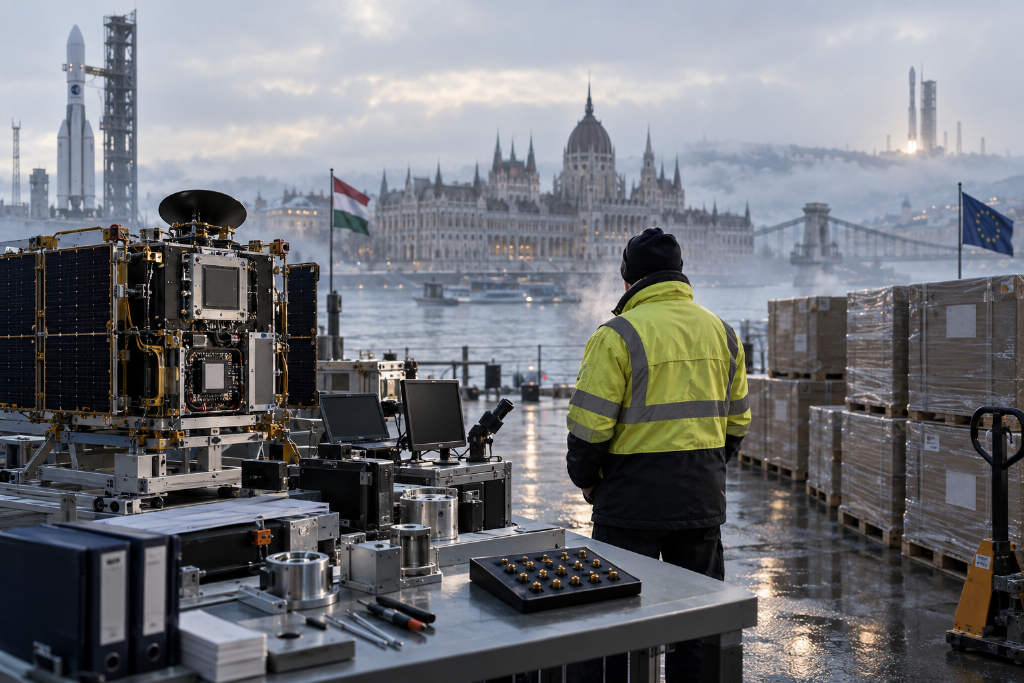
Europe’s space industry has been talking more often about supply-chain security in recent years. The anxiety is not abstract.
Kate Underhill of the European Space Agency offered a simple example in Budapest: ESA wanted to order 20 laser diodes from a German company and was told the minimum order quantity was 10,000. The gap between 20 and 10,000 is 500-fold. The issue was not price. It was business logic. Space programs launch only a limited number of times each year, and each mission uses very small volumes of parts, so suppliers have little reason to dedicate production lines to that kind of fragmented demand.
For semiconductor companies, the priority customers are consumer electronics, autos and AI data centers. Space orders come later. ESA itself has acknowledged that space systems are usually “at least 10 years behind consumer electronics.” The reason, the article says, is straightforward: the market is too small.
Satellite launch volumes remain limited, while buyers are spread across national space agencies, research institutes and commercial operators. Each one buys only a small amount. Suppliers facing that customer base either quote very high prices or decline to serve it at all. ESA has tried to respond in two directions: bringing high-volume commercial off-the-shelf electronics into space systems, and finding outward paths for space-qualified designs to enter commercial ground markets. Progress has been slow because space qualification cycles take too long for commercial markets to wait.
Export controls make the problem sharper. Underhill said, “If your satellite contains any U.S. components, you must comply with U.S. regulations.” That is the extraterritorial reach of the International Traffic in Arms Regulations. European satellite manufacturers may want to build spacecraft outside U.S. jurisdiction, but some specialized parts can only be sourced from the United States or China. In that sense, part of Europe’s satellite sovereignty still sits outside Europe.
Europe’s deeper weakness is fragmented demand
ESA’s response is to identify the components still sourced from the United States or China and assess what can be built in Europe instead. The logic is sound. Execution is difficult.
A space supply chain is not a straight line. It is a network. Replace one U.S. component and three new dependencies may appear. Replace one Chinese component and Europe may find there is no substitute at all. The article argues that the deeper problem is fragmented demand. National space agencies operate separately, procurement standards are not unified, and certification systems are not mutually recognized. A German company that wins an order from the French space agency may still have to repeat certification work. That fragmentation leaves Europe in a weak position across the supply chain.
Suppliers know their customers have few alternatives, so they can demand a minimum order of 10,000 units. If the order book covered 800 satellites instead of a handful of parts, the conversation would look very different.
That is where IRIS² comes in. Europe plans to build a secure satellite constellation, shifting the scale of demand from “I need one satellite” to “I need 800 satellites.” Underhill said that order volume would reach a semi-industrial level and begin to create scale advantages. Eight hundred satellites will not solve every problem, but it is enough to get suppliers to the table. Once order size is large enough, minimum order quantities stop being a hard barrier and pricing can move back toward a more reasonable range.
AI does not fix the supply chain directly, but it can shorten qualification cycles
ESA is also pushing artificial intelligence into design, testing and manufacturing. AI can help engineers run complex simulations and reduce the need for physical testing. Digital twins for rocket engines can monitor health and predict service life. In 3D printing, AI can inspect each layer to make sure parts are strong and free of defects.
Those tools do not remove supply-chain dependence on their own. They can, however, shorten certification timelines and lower manufacturing costs, which would make Europe’s space industry more competitive.
Launch costs are forcing a shift from project logic to industrial logic
Launch cost is another key variable.
Europe’s Ariane 5 retired in July 2023. At its peak, it flew six to seven missions a year, with payload costs of about $10,000 per kilogram. SpaceX, by contrast, plans to push launch costs down to $30 per kilogram through the fully reusable Starship. The two numbers are not in the same league.
ESA has set a target of nine to 10 Ariane 6 launches a year starting in 2027. That may not sound dramatic, but it is already 1.5 times the peak cadence of Ariane 5. Underhill said Europe needs to make space transportation work more like aviation, with rapid turnaround, predictive maintenance and frequent launches. Traditional launch-vehicle production cannot deliver that. The model has to be rethought.
At the core is a shift from project-based space activity to industrialized space activity. A project model treats each launch as unique. An industrial model depends on standardization, repeatability and scale. Only industrialization can lower costs. Only lower costs can expand the market. Only a larger market can improve bargaining power in the supply chain.
Stricter regulation may slow Europe now, but could become an advantage later
Europe’s regulatory environment is stricter than that of the United States, and that may slow projects in the near term. Underhill pointed to the European Union’s proposed restrictions on PFAS, a class of synthetic chemicals that persist in the environment but remain necessary under extreme aerospace conditions. She said low-temperature systems cannot be built without PFAS in seals.
ESA is working with regulators to seek temporary exemptions while funding research into cleaner substitutes. PFAS-free seals will take five to seven years to develop.
Over a longer horizon, the article argues, this regulatory approach could become an advantage. Europe’s stricter standards on environment, labor and safety may help build long-term industrial strength. If Europe sets the pace on green space rules, debris mitigation and safety certification, those standards could become both non-tariff barriers and exportable rule sets. The United States may move faster in the short run because it has fewer rules. But if European standards become international standards, European companies gain leverage.
RISC-V as a route to optionality
The shift in processor architecture is presented as the clearest example of supply-chain sovereignty in practice.
Roughly 30 years ago, ESA chose the SPARC architecture because it was open and had a mature toolchain. In 1997, Frontgrade Gaisler co-founder Jiri Gaisler received a scholarship to develop an independent VHDL SPARC processor model for space applications. That design later became known as LEON. It was the first high-level VHDL chip and was released as an ESA open-source project.
LEON became a standard component in Europe’s aerospace industry and helped create a collaborative ecosystem in which multiple suppliers could build chips around the same core IP. The model worked, but it ran into a problem: fewer engineers were available for SPARC, and moving to 64-bit computing required major investment.
Habinc said, “SPARC will be used forever, because once you have used something in space, you will use it forever. But we had a 32-bit machine. To move to 64-bit was a huge investment for us.”
RISC-V changed that equation. The open 64-bit foundation already exists, so 64-bit support does not require the same level of fresh investment. Habinc said the move let the company bypass many development obstacles. It also gave engineers room to remove outdated components and tailor processors to the strict size, weight and power limits of space missions, as well as to newer workloads such as neural networks.
Frontgrade Gaisler built a processor that supports both architectures, called NOEL, which is LEON spelled backward. At boot, it can run in SPARC mode or RISC-V mode, while preserving legacy support and backward compatibility with existing code. Habinc said a company already using older chips can move to the new chip easily. Later, if SPARC engineers become hard to find, the company can switch software without replacing the board or enclosure.
The key, in this telling, is to keep the ecosystem open and avoid restrictive licensing. Frontgrade Gaisler sells fault-tolerant technology, but it also releases the base processor code as open source. Habinc said, “We make sure everything we do is RISC-V compatible. We have no vendor lock-in. If you work with us now and later find another supplier, we will not stop you.”
NASA, Microchip and SiFive are also moving RISC-V into space computing
RISC-V is gaining ground in the United States as well. In 2022, Microchip won a NASA contract to build a next-generation high-performance spaceflight computing processor. The new PIC64-HPSC uses eight SiFive RISC-V cores and includes modern features such as Ethernet and PCI Express.
Thia-Martina Gauthier, project architect at NASA’s Jackson space center, stressed why that matters. She said NASA likes the PowerPC-based RAD750 and often flies it, but general-purpose computing capability has to move forward. Deep-space missions need more autonomy so data can be processed onboard instead of being sent back to Earth over slow links.
The new HPSC combines high-performance computing, a 240-gigabit network switch and stronger cybersecurity functions in one reliable system. Gauthier also stressed the value of an open instruction set. She said the PIC64-HPSC is designed entirely around open standards. RISC-V, in her view, will help science missions cut costs and move valuable data faster.
RISC-V International CEO Andrea Gallo said at the 2026 European Summit that RISC-V is nearing a major commercial growth phase. SHD Group forecasts that RISC-V will reach a 33.7% share across all hardware markets by 2031. Growth is expected to be especially strong in edge computing and data centers, with those markets projected to reach $45 billion and $70 billion, respectively, by the end of the decade.
Against that backdrop, formal approval of the RISC-V Server Platform Specification 1.0 is described as a key moment. The specification standardizes hardware by bringing industry-standard boot systems and runtime services directly into RISC-V, helping system software run across different server hardware. The year 2026 is described as the “year of RVA silicon,” with several companies preparing new server-class processors. The list in the source includes SiFive’s Performance P870D with up to 128 cores, Akeana’s Alpine test chip, NextSilicon’s Arbel server CPU, and Epic Semi’s Contrail AIX, a superchip that combines 32 RISC-V processor cores with 16 built-in AI cores for up to 75 TOPS.
For hyperscalers and data-center operators, RISC-V offers an alternative to proprietary architectures and lowers the risk of dependence on a single vendor. The market is large enough that this is not framed as one side displacing another. It is framed as room for RISC-V to grow. For multinational companies and governments pursuing digital sovereignty, the article says, the central issue is choice. RISC-V offers that freedom.
Europe is trying to shape the standards layer in space
In space, RISC-V is becoming a key building block for the next generation of flight computers. A dedicated RISC-V Space Special Interest Group was formed at the end of 2025, chaired by representatives from ESA and E4 Computing. The group brings together experts from NASA, Microchip, SiFive and Frontgrade Gaisler to draft strict standards and white papers for professional space missions.
NASA is testing a high-performance spaceflight processor with Microchip and SiFive. The European Commission’s COSMIC7 project is developing a 7-nanometer RISC-V chip designed for orbital operation. For established aerospace suppliers such as Frontgrade Gaisler, the move from SPARC-based LEON processors to RISC-V-based NOEL chips is driven mainly by openness.
Aerospace groups need full transparency into their hardware to secure safety certification. Public specifications are part of that requirement. Without them, they do not truly control the product. In the article’s framing, RISC-V is the only natural evolutionary alternative.
That is why Europe’s RISC-V strategy is described as a way to trade open standards for an exit option in the supply chain. SPARC is open but aging. PowerPC is reliable but under U.S. control. ARM and x86 are proprietary and come with stronger vendor lock-in. RISC-V lets European companies audit, customize and switch suppliers without being tied to one vendor.
The article treats this as a strategic choice. Europe does not dominate advanced process technology, but it can still build influence in RISC-V space standards, radiation-hardened IP and certification testing. The fact that the RISC-V Space Special Interest Group is chaired by ESA and E4 Computing is presented as evidence that standard-setting power is now part of the contest.
There is also a risk. If the United States extends export controls to RISC-V cores or EDA tools, even open standards could be weaponized. Europe, the article says, would need to prepare by investing in open-source EDA and European foundry capacity. Even so, it calls RISC-V Europe’s smartest move in the space supply chain because it uses openness to pursue sovereignty and standards to pursue security.
The economics of space are being rewritten
Europe’s push for stronger supply-chain control still leads back to an economic question: what is the underlying logic of the space economy?
In the past, space was organized around projects. Each launch was unique, costs were high, timelines were long and markets were small. Now the sector is moving toward industrialization, built on standardization, repeatability and scale. The main forces behind that shift are lower launch costs and more computing power in orbit.
Ariane 5 at roughly $10,000 per kilogram and Starship at a target of $30 per kilogram are more than 300 times apart. If launch costs really fall to around $30 per kilogram, many assumptions in the space economy change. Satellites can become larger, heavier and more complex because launch is no longer the main constraint. Constellations can deploy more spacecraft because the launch cost per satellite becomes almost negligible. In-orbit services, manufacturing and data centers start to look feasible.
Habinc said SpaceX is taking everything to a new level. These companies are cutting launch costs and deploying large networks for communications and computing. He also said SpaceX spans the full chain from chips to end services. That vertical integration gives it control from processor design to launch services to on-orbit operations.
Terafab, as described in the source, pushes vertical integration to an extreme
The article presents the Terafab project as the most extreme version of that model. It says Intel is working with Tesla, SpaceX and xAI to build a semiconductor manufacturing facility in Austin, Texas. About 20% of capacity would go to AI5 and AI6 architectures aimed at edge inference and energy efficiency, supporting Tesla’s autonomous driving system, Cybercab fleet and Optimus humanoid robot program.
The remaining 80% of compute output would be dedicated to space applications, especially the D3 chip. That radiation-hardened processor is described as being designed for deployment in SpaceX satellite constellations and aligned with xAI’s goal of using the vacuum of space for thermal management and continuous solar power for orbital data centers.
The scale is enormous. Yole Group analysts estimate that reaching 1 terawatt of capacity would require $5 trillion to $13 trillion in capital expenditure over the project life cycle, along with 22.4 million advanced logic wafers processed each year. Memory demand would be just as striking. To meet Terafab’s needs, the article says, memory alone would eventually require 10 million wafers a month, equal to five times current DRAM output.
Still, vertical integration has limits. ASML delivered only 48 EUV systems in 2025, and its order book through 2027 was already allocated to TSMC, Samsung and Intel. The article says Terafab does not have confirmed ASML orders and would face procurement challenges as a new entrant. Rather than building a fully new fab from scratch and waiting years for equipment, it may be more realistic for Terafab to use Intel’s existing 18A process technology, equipment allocation and packaging infrastructure.
In that reading, Terafab is more likely to be an Intel fab expansion project with Tesla, SpaceX and xAI as anchor customers than a fully independent manufacturing company.
The article points to another bottleneck as well: memory manufacturing. It expresses skepticism about Europe producing memory independently and says Terafab is still years away from making anything. Memory production requires a very different skill set, and Tesla, SpaceX and Intel do not have it. The more immediate pricing risk, in this view, is not Musk building DRAM on his own. It is the possibility of overcapacity once all these new fabs begin operating around 2028 to 2029.
Raw materials, foundry competition and Intel’s anchor contract
Raw-material dependence is part of the picture. A Texas location offers some supply-chain advantages, especially for high-purity helium, which is used as a coolant in advanced lithography and packaging. Asian foundries rely heavily on imports from the Gulf Cooperation Council region, and that supply line suffered production disruptions in early 2026. The United States produces a large share of global helium from domestic reserves in Texas, Wyoming, Kansas and Oklahoma. Building in Austin could help on that front because the United States accounts for nearly half of global helium production.
But bare silicon wafers still come mainly from Asian suppliers, and semiconductor manufacturing at this scale would place major demands on water and electricity.
The competition is already changing the contract foundry market. Tesla currently buys semiconductors from TSMC and Samsung. Terafab introduces a domestic alternative. Stephen Ezell of the Information Technology and Innovation Foundation said, “This announcement is a very significant win for Intel as it seeks to build a complementary foundry business beyond its core chip manufacturing operations and compete with industry leaders such as TSMC. This will strengthen Intel’s ability to manufacture chips focused on AI and mobile applications.”
The article says the project may not directly challenge TSMC’s roughly 70% market share, but it could create a more complicated situation for Samsung Electronics. Some market researchers cited in the piece say Samsung may see a surge in Tesla orders while the Texas facility is being built, helping fill the supply gap. Once Terafab is fully operational, however, Samsung could lose a high-volume anchor customer at advanced process nodes.
For Intel, the strategic value lies in the anchor contract. The article argues that Terafab is first and foremost a breakthrough for Intel’s foundry business, and that adding Tesla, SpaceX and xAI as anchor customers gives Intel Foundry the credibility it has been seeking for years.
Europe cannot copy the U.S. model, so it is looking for a lighter path
The article’s conclusion is that Europe cannot replicate the Terafab model. Capital expenditure of $5 trillion to $13 trillion is far beyond Europe’s fiscal capacity. The more realistic strategy is what it calls “light-asset sovereignty”: do not build a full-stack fab system, but use IRIS² orders to anchor mature-node foundry demand, use RISC-V to reduce lock-in, use ESA certification to control quality, and rely on the European Investment Bank and pension capital for long-duration funding.
Financially, the article says U.S. space is moving from project finance to platform finance. SpaceX IPO, the xAI merger and Terafab are all placed in the same category: packaging space, AI and robotics as infrastructure assets. Europe lacks that venture-capital culture, but it could use public procurement to create stable cash flow and turn IRIS² into a securitizable long-term contract.
A three-pole space supply chain may emerge over the next decade
The article ends by sketching three models for the global space supply chain over the next 10 years.
- The United States is described as vertically integrated, capital intensive, and built on a mix of government equity and commercial space, represented by SpaceX, Terafab and NASA HPSC.
- China is described as state-led, self-controlled and system-integrated.
- Europe is described as an alliance of open standards, rule-based certification and aggregated demand, represented by the RISC-V Space Special Interest Group, IRIS², Galileo and Ariane 6.
By the article’s own measure, Europe’s success should not be judged by domestic substitution rates alone. It should be judged by whether Europe can switch to a second supplier within 18 months if the United States cuts off supply, switch architectures through RISC-V when vendor lock-in appears, and defend its market through its own certification system when standards split.
On the investment side, the article highlights four lines of interest: RISC-V space IP and radiation-hardened chips, including the Frontgrade Gaisler, SiFive and Microchip ecosystem; direct-to-satellite and 6G non-terrestrial networks, including the IRIS² supply chain, laser communications and ground stations; AI design tools and digital twins that reduce physical testing and shorten certification cycles; and PFAS substitutes and green space materials, including seals, propellants and thermal-control materials.
The piece closes with a clear argument: Europe’s push for stronger supply-chain control is ultimately about building a system of substitutability. It accepts Europe’s weakness in physical manufacturing capacity and shifts the contest toward architecture standards, certification rules and demand aggregation. If that works, Europe’s space supply chain may not be the cheapest and may not be the fastest, but it will have a second option. In a world where supply disruptions are becoming normal, the article says, that second option matters more than first-best efficiency.
The original article was published on the WeChat public account Dongzhen Shanglüe and credited to Dongzhen Shanglüe.