
What event contracts are
An event contract is built around a question that can be verified, with outcome choices and settlement conditions defined in advance. Common structures include yes/no, higher/lower, threshold-based contracts, and multi-outcome markets where each mutually exclusive result is quoted separately.
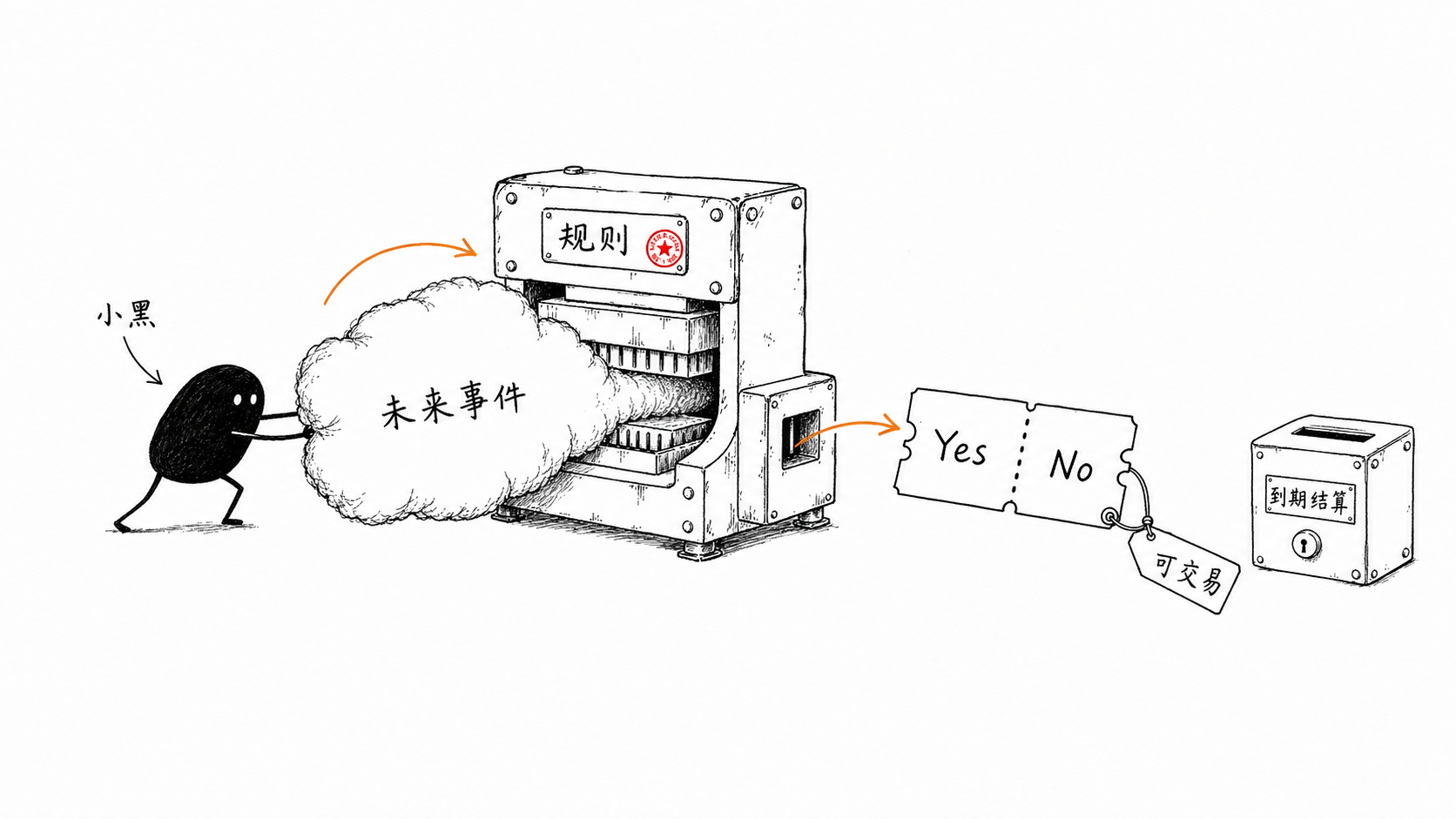
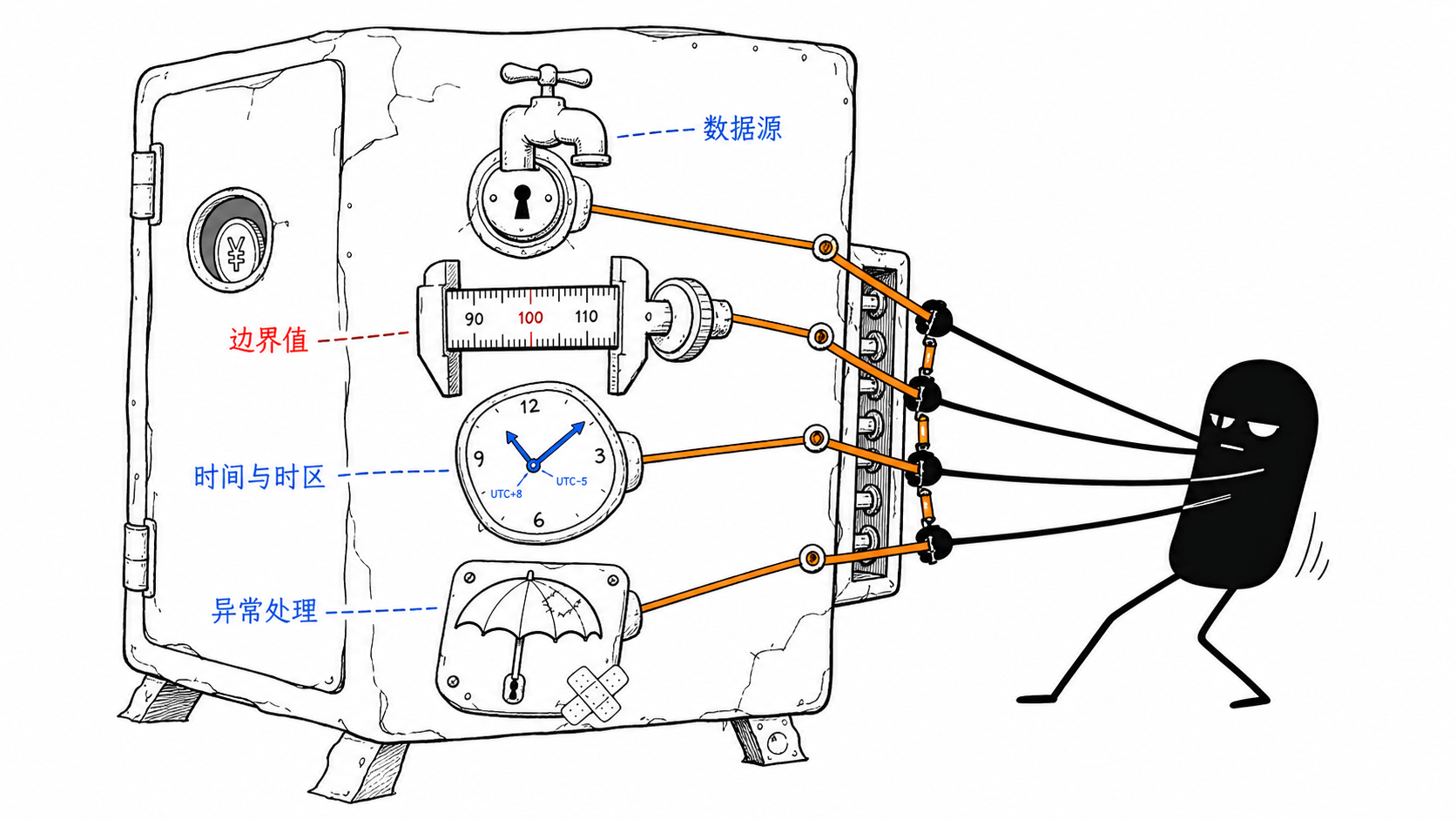
What traders buy and sell is the contract outcome, not the underlying asset itself. Contract terms usually specify the market question, cutoff time, time zone, official data source, boundary conditions, and how cancellations or delays are handled. Markets with similar titles can still operate under different rules.
How event contracts work
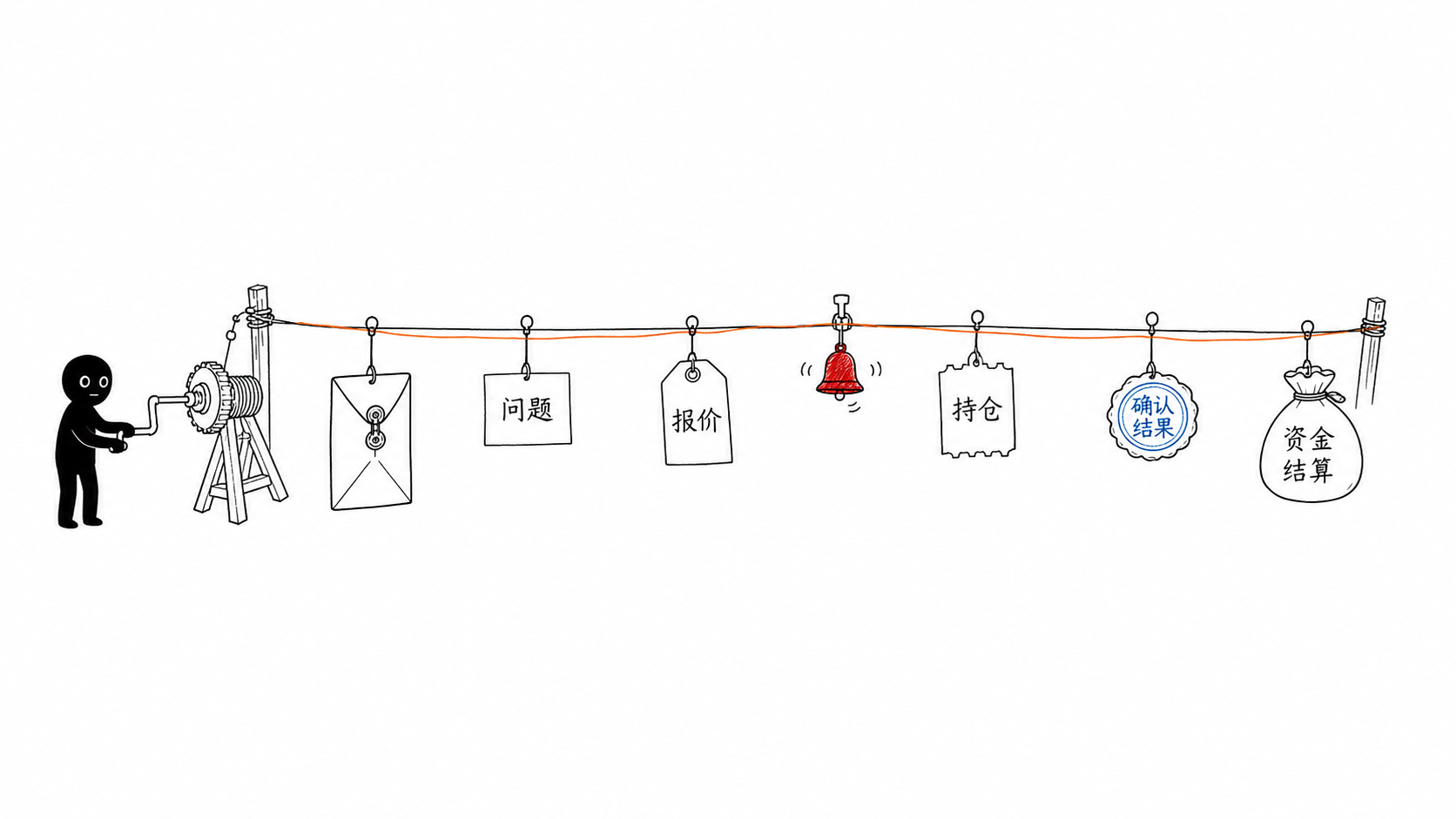
Foresight describes six common steps in the lifecycle of an event contract.
- Market creation: the platform defines the question, outcomes, trading cutoff and settlement source.
- Price formation: on order-book venues, buyers and sellers quote the market; products using automated market making rely on a pricing model and show stake size and payout information before confirmation.
- Position building: once an order is filled, the trader holds exposure to one outcome. Some platforms let users sell before the market closes, though actual execution depends on liquidity.
- Trading stop: once the cutoff time is reached, the event begins, or another platform-defined condition is met, the market stops accepting trades.
- Result confirmation: the platform, exchange or a pre-designated oracle confirms the outcome based on contract terms and the named data source.
- Settlement: binary contracts usually pay $1 per winning share and $0 to the losing side. Fixed-return products settle according to the payout rule locked in at confirmation.
What a 70-cent price means
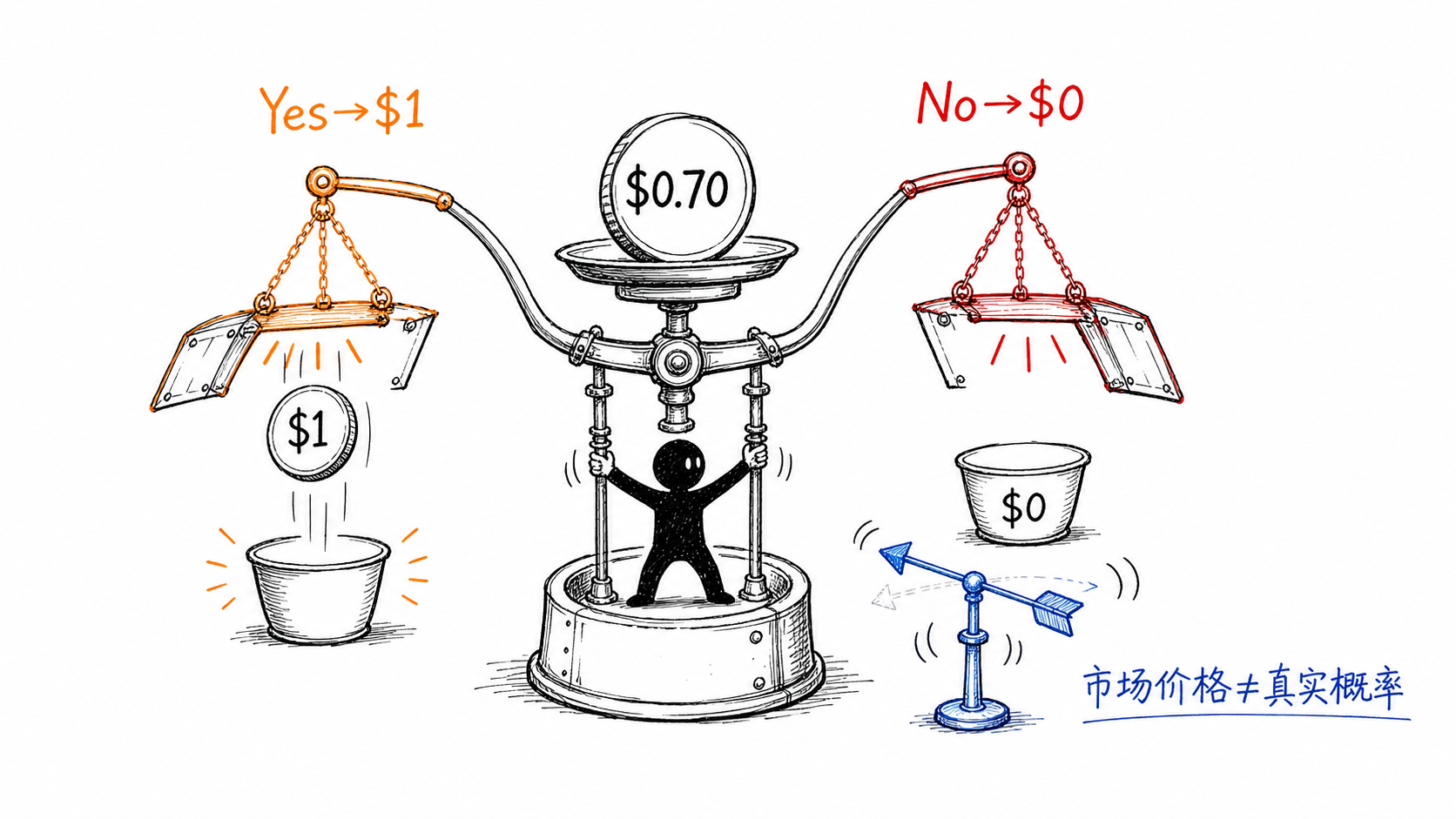
In binary contracts quoted from $0 to $1, price is often read as the market-implied probability. If a “Yes” contract trades at $0.70, the market is roughly pricing in a 70% chance of that outcome at that moment.
If the final outcome is “Yes,” one share will usually settle at $1, implying a gross gain of $0.30 before fees and spread. If the result is “No,” the share goes to zero and the maximum loss is the $0.70 paid in.
That reading has limits. A displayed 70% reflects the prevailing market price, not a guarantee that the real-world probability is 70%. Pricing can shift with new information, order-book depth, bid-ask spread and supply-demand conditions. Fixed-return products that use automated market making may also incorporate time period, volatility and risk parameters into the quote while showing return rates, so users need to check principal, estimated return and maximum possible loss together.
Settlement details that matter
Foresight says users need to pay attention to several rule-level details before entering a market.
- Settlement source: this can be a government agency, sports organizer, price index, exchange data feed or oracle.
- Comparison symbols: “above 100” generally means strictly greater than 100, while “100 or above” includes equality.
- Time and time zone: traders need to know which timestamp and time zone apply, and whether pricing uses a spot print, closing value or time-weighted average.
- Exceptional cases: contracts may specify how delays, cancellations, data revisions, broken price feeds or unresolved outcomes are treated.
- Dispute process: the rules may define who can submit a result, how long the objection window lasts and who has final authority.
- Fees and payout: trading fees, platform commissions, on-chain costs and withdrawal expenses all affect realized return.
Platform review
Polymarket: continuous trading in event probabilities
Polymarket is presented as a prediction market centered on continuous trading of event probabilities. Prices are formed through an order book, and UMA takes part in result confirmation.
Its product set mainly consists of yes/no outcome shares across politics, macro, sports, crypto assets and culture. Markets generally stay open until the event occurs and settlement is completed.
On pricing, the platform uses an order book. The displayed probability is usually the midpoint between the best bid and best ask. If the spread goes beyond $0.10, the interface switches to the most recent trade price. Matching “Yes” and “No” quotes add up to $1.
On trading and exit, users can buy or sell outcome shares through the order book as long as the market is open and a counterparty exists. Limit orders help control execution price, but thin liquidity can make exits harder at the expected level.
On settlement, markets follow rules published in advance and are handled through UMA’s optimistic oracle process. After an outcome is proposed, there is a challenge period. Winning shares settle at $1 each, while losing shares go to zero.
On fees, Foresight notes that current official guidance says some markets charge taker fees while makers are not charged, with parameters varying by market category. Users need to review the latest fee schedule before entering.
The report says Polymarket is suited to users who want to trade event probabilities continuously, place limit orders and monitor market depth. Rule wording, bid-ask spread, wallet setup, oracle dispute procedures and regional availability are listed as key items to check.
Kalshi: standardized yes/no event contracts
Kalshi is described as an event market focused on standardized yes/no contracts, explicit market rules and order-book trading.
Its products mainly include yes/no and threshold contracts. Each market typically shows a clear rules summary, expiration conditions and the source used to verify the result.
Prices are quoted through an order book and displayed in cents. A 70-cent “Yes” contract and a 30-cent “No” contract can combine into $1. Best bid, best ask and available size all affect execution.
Users can build positions through the order book and exit with a sell order while the market is open and liquidity exists. Unfilled orders can be canceled.
For settlement, each contract specifies the information and sources it relies on. After expiration, Kalshi confirms the outcome under those terms. According to the platform guidance cited by Foresight, settlement confirmation may take from one hour after market close to more than 12 hours, depending on the data source.
Fees are calculated using expected profit and other factors, and some markets may also charge maker fees. There is no charge to cancel an unfilled resting order, but users need to review the actual fee display on the market page before confirming.
Foresight says Kalshi’s terms and verification sources are displayed relatively clearly, making it fit for users who prioritize standardized rules, order-book access and the ability to exit early. Fee formulas, market liquidity and eligibility by region still need separate verification.
Robinhood: access through a familiar interface
Robinhood is framed as an entry point to event contracts through a familiar interface, while actual pricing, settlement and special rules are determined by the exchange that carries the contract.
Its derivatives business offers event contracts through KalshiEX, ForecastEX or Rothera Exchange and Clearing. Common structures include single yes/no markets, threshold contracts and combination outcomes.
Individual contracts are usually priced between $0.01 and $0.99. Correct outcomes settle for $1 in cash and incorrect outcomes settle at $0. Before an order is placed, the app shows the price and applicable fees.
Unfilled orders can be canceled, but filled orders cannot be reversed. If the market is still open and there is a buyer, a position can be sold at the current market price. If the market is closed or liquidity is missing, the position must be held through settlement.
The final result is determined by the relevant partner exchange using the official data source and terms stated in the contract. Robinhood cannot alter the exchange’s settlement decision.
Fees may include both exchange charges and Robinhood commissions, with the exact amount shown on the order confirmation page.
Foresight says the setup is suitable for users who already use Robinhood and prefer a unified interface. The report stresses that traders still need to identify the exchange carrying the contract, because settlement, fees and special-event rules depend on the underlying venue.
TurboFlow: an on-chain trading ecosystem for retail users
TurboFlow is described as an on-chain trading ecosystem aimed at global retail users. It combines prediction markets and perpetual contracts on the same platform, alongside event contracts, and presents transparent execution and professional liquidity as a way to lower the participation barrier.
The product reviewed in the article is TurboFlow’s event contract offering, which takes the form of fixed-window higher/lower contracts. Users choose the market, stake amount, duration and direction. The minimum participation amount is $2, and a round can be completed in as little as 30 seconds, with live parameters shown on the product page.
Pricing and participation rely on a propAMM model. Before confirmation, the interface displays entry price, participation amount, cycle, direction, return rate and expected result. Once the order is confirmed, the return rate for that contract is locked.
For settlement, the entry price is the price at which the order is accepted, while the settlement price is the price used when the contract expires. If the user chooses “Higher,” the settlement price must be above the entry price. If the user chooses “Lower,” the opposite applies. If the two prices are equal, principal is returned under the official rules.
On position management, the contract settles automatically once the countdown ends. During the holding period, users do not need to manage margin, funding rates or liquidation risk. Foresight notes that this differs from the platform’s perpetual contract product.
The report says TurboFlow is designed for retail users and lowers the threshold with a $2 minimum and rounds as short as 30 seconds, while integrating perpetuals and prediction markets on one platform. It also notes that short-cycle higher/lower contracts are more sensitive to entry timing, market volatility and price data.
Key differences across the four models
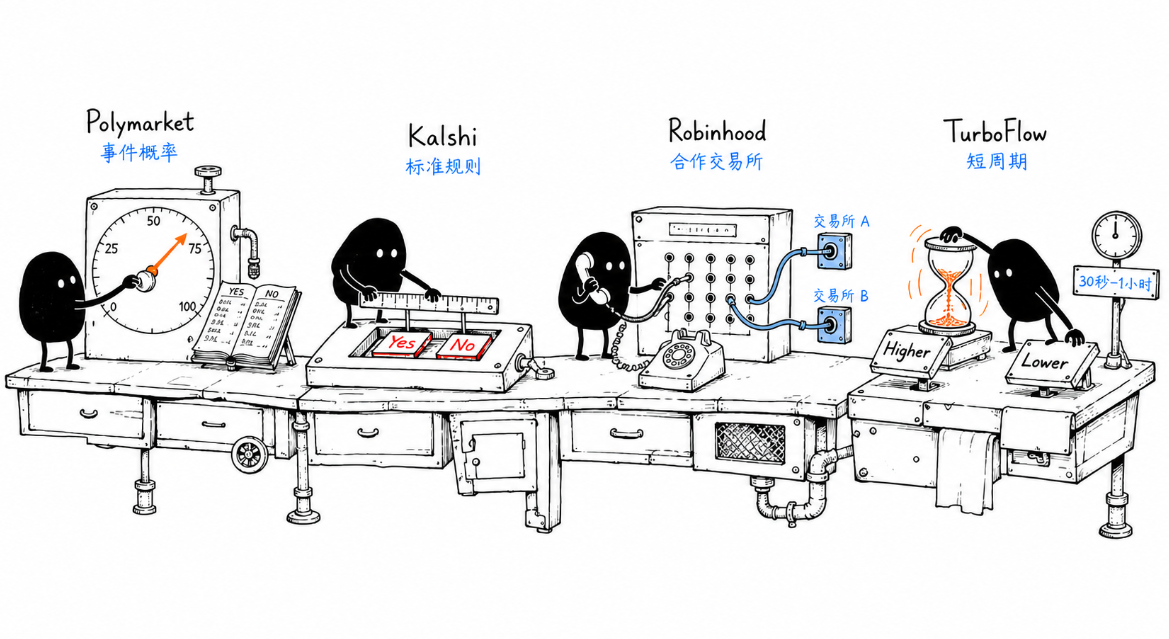
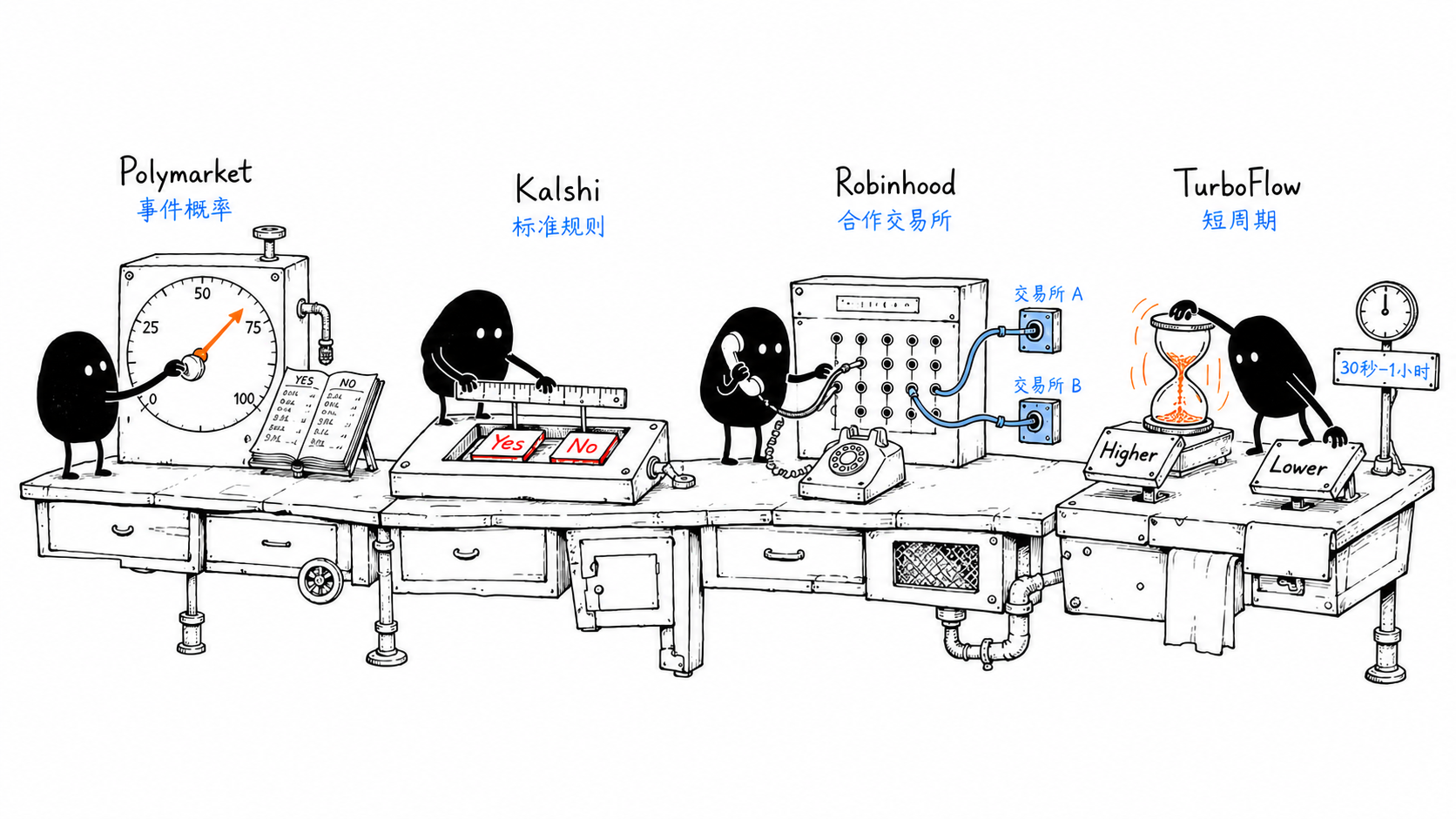
On price formation, Polymarket and Kalshi mainly rely on order books. Robinhood displays market quotes from partner exchanges. TurboFlow’s event contracts use a propAMM model and show the entry price, stake amount, duration, direction and locked return rate before confirmation.
On time horizon, contracts on Polymarket, Kalshi and Robinhood are usually tied to an event deadline. TurboFlow’s event contracts use a fixed window and can finish a round in as little as 30 seconds.
On early exit, the first three product types generally allow positions to be sold when the market is open and liquidity is available. TurboFlow’s published flow is more focused on holding until the countdown ends and then settling automatically.
On settlement authority, Polymarket uses UMA; Kalshi confirms outcomes under its own market terms and designated sources; Robinhood defers to the partner exchange; TurboFlow’s event contracts settle automatically under pre-disclosed contract rules using trusted market data sources and entry and settlement prices generated by multiple oracles.
On use cases, Foresight says Polymarket is worth examining for traders focused on continuously changing event probabilities, Kalshi for users who care about standardized market rules, Robinhood for those who prefer a unified interface, and TurboFlow for users who want low-threshold access to short-cycle higher/lower contracts.
Main risks
- Principal loss: a wrong directional call can send a single contract to zero, and fixed-return products can also lose the participation amount.
- Rule risk: ignoring boundary values, time zone, data source or exceptional clauses can lead to a mistaken expectation of settlement.
- Liquidity and spread: displayed probabilities, executable prices and exit prices may differ noticeably.
- Settlement and data risk: delayed official data, revisions, oracle disputes or broken price feeds may extend settlement and trigger special rules.
- Fee risk: trading fees, commissions, on-chain network fees and deposit-withdrawal costs reduce actual return.
- Technical and compliance risk: account security, smart contracts, platform operations and regional restrictions can all affect product availability.
Five checkpoints for reviewing an event contract
Foresight concludes that event contracts are best understood through five linked checkpoints: question definition, price formation, trade exit, result confirmation and cash settlement.
Polymarket, Kalshi, Robinhood and TurboFlow follow different product paths. The report adds one clarification on TurboFlow: the platform itself combines prediction markets and perpetuals, while the review here covers only its event contract product. In every case, the platform name is not a substitute for reading the contract. The terms that ultimately decide the outcome are the time specification, data source, boundary conditions and exceptional-case rules written into the contract itself.
The article also carries a disclaimer saying markets involve risk and the piece does not constitute investment advice. Users should consider whether the views or conclusions discussed are suitable for their own circumstances and bear responsibility for any investment decisions made on that basis.