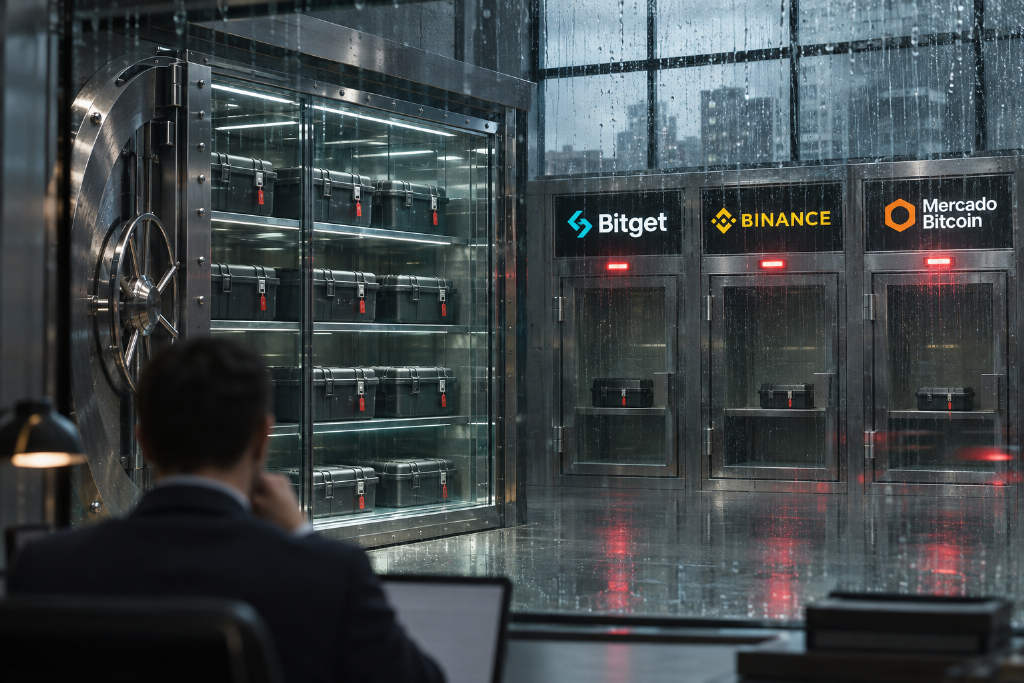
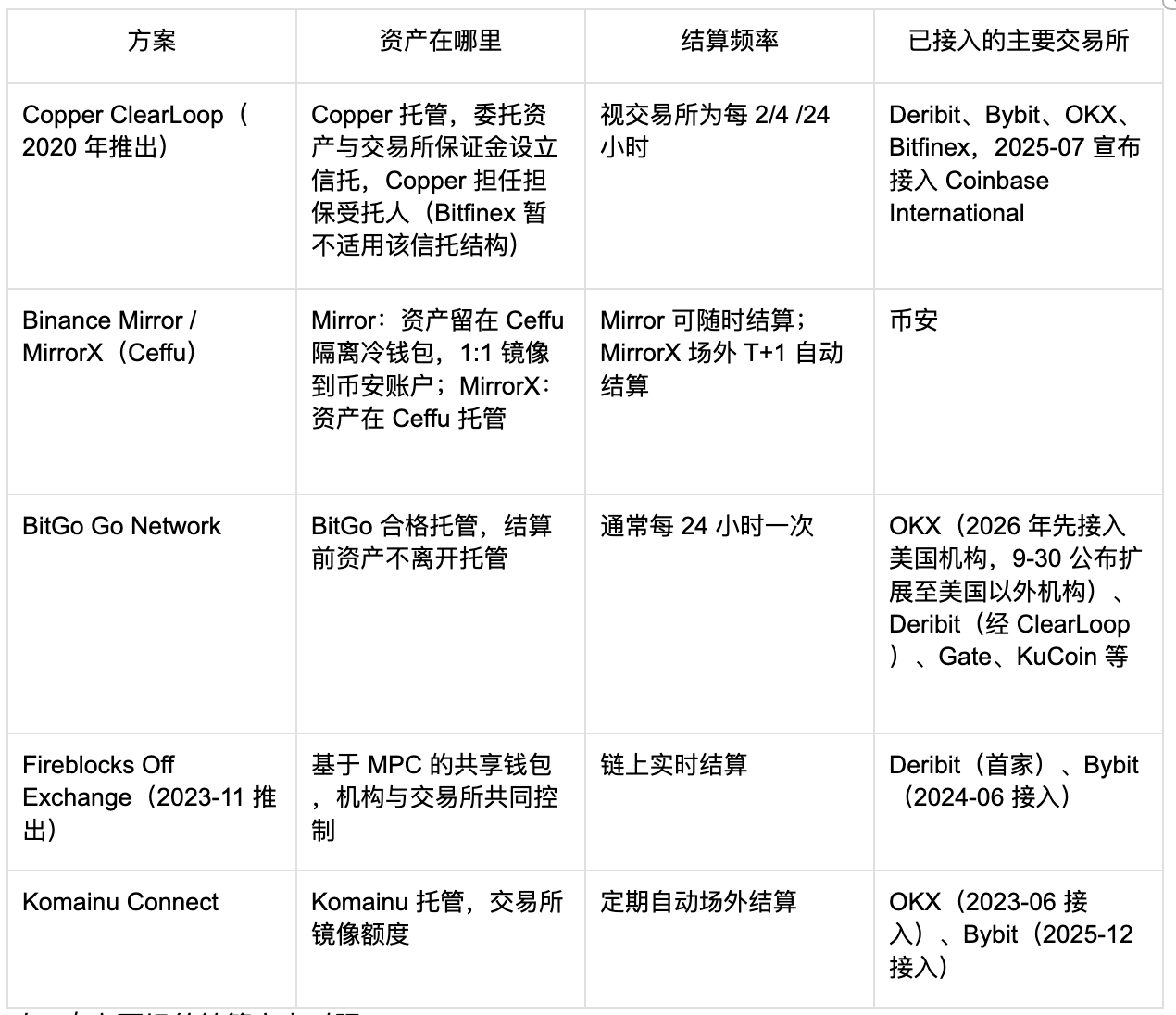
Bitget, Binance and Mercado Bitcoin suffered hacks within six weeks, and all three said they would cover the losses. Even if users ultimately recover their principal, institutions still bear the cost of having funds unavailable during withdrawal suspensions. A BigTime research report sets out three layers of exposure management: cap balances at each exchange as a share of net assets; use off-exchange settlement to keep assets with third-party custodians; and assess risk using verifiable reserve information and regulatory requirements.
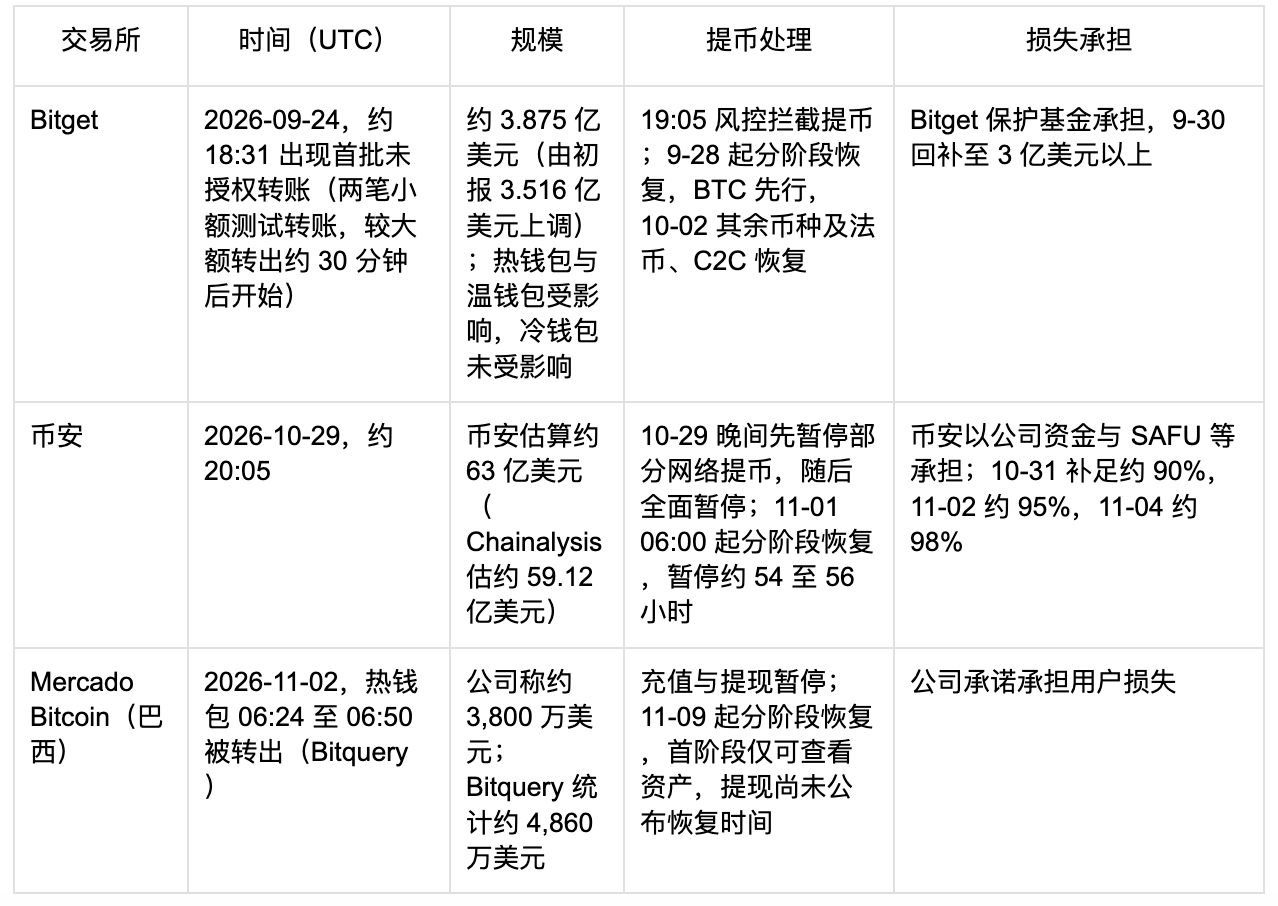
Binance, OKX, Bybit and Bitget have each connected to one or more custodians, and off-exchange settlement networks now cover major exchanges. Public information, however, is not sufficient to establish how these arrangements performed during the Binance incident. Before adopting them, institutions need to ask whether custodied assets remain accessible if an exchange suspends withdrawals, and how settlement would work in that situation.
Written by BigTime, the report covers hacks at centralized exchanges from September to November 2026 and tools for managing institutional exchange exposure. Its information was checked through November 9, 2026. BigTime says the analysis draws on market-making, liquidity and trading-technology practice. Data comes from public reporting, official disclosures and third-party data platforms; some figures are media-reported, have not been independently audited and do not constitute investment advice.
Three exchange hacks in six weeks
Three exchanges of different sizes and from different regions were hit over six weeks. By Binance’s own estimate, its incident caused losses of about $6.3 billion, making it the largest recorded cryptocurrency theft. Exchange hacks are now a risk institutions cannot avoid considering. They must decide how much to keep at each venue, how to hold it and whether funds can be recovered promptly if an incident occurs.
On November 6, 2026, South Korean exchange GOPAX suspended deposits, regular withdrawals and trading. The move followed an email from a sender who claimed to have breached the exchange and threatened an attack. GOPAX reported no actual loss. Mercado Bitcoin’s response was more complicated. Bitquery found that attackers continued draining user deposit addresses for about four hours after the exchange said at 12:56 UTC that it had “controlled” the situation.
The Binance incident sharply lifted estimates of industry losses for the year. CertiK put crypto-industry losses at about $9.2 billion through the end of October 2026, a record. DefiLlama’s figure through October 31 was about $8.74 billion. Data from holder.io put losses at about $2.51 billion over the same period in 2025. Excluding Binance, 2026 losses were about $2.38 billion, roughly 5% below the 2025 figure. For comparison, Chainalysis said more than $3.4 billion was stolen from January through early December 2025.
Holder.io counted 325 incidents through October 2026, compared with 120 over the same period in 2025. BigTime’s assessment is that incidents have become more numerous while the average loss per incident has fallen. One sufficiently large event can still rewrite the annual totals. Institutions need to plan for shocks that are relatively unlikely, large in scale and capable of arriving quickly.
Frozen funds impose costs beyond principal losses
All three exchanges said they would bear the losses themselves. Binance set aside more than $6.34 billion in corporate funds, Bitget drew on its protection fund, and Mercado Bitcoin said users would not be harmed. If those commitments are honored, institutions’ principal would not be directly lost.
Waiting for funds to become available still carries a cost. Binance suspended withdrawals for about 54 to 56 hours. Bitget took about a week to restore withdrawals for all assets. As of the report’s publication, Mercado Bitcoin had not announced when withdrawals would resume. Funds may remain visible in an account, but institutions cannot move them to another exchange to replenish margin, redeem as planned or shift positions during price volatility.
Outflows began quickly after Binance reopened withdrawals. Data showed that users withdrew about $4.65 billion and deposited about $1.01 billion during the roughly 9.5 hours after withdrawals resumed on November 1. Reuters later reported that Binance put cumulative net outflows since reopening at about $4.72 billion.
U.S. spot Bitcoin exchange-traded funds also recorded outflows during the same period. Reuters reported about $643 million in net outflows on October 30. SoSoValue data showed roughly $1.282 billion in net outflows for the week of November 2 to 6. ETF flows are affected by multiple factors and cannot all be attributed to the exchange hack. The direction of those flows, however, reflected a similar turn toward caution.
Institutional concern about custody security had been increasing before this round of incidents. A survey conducted by Coinbase and EY-Parthenon in January 2026 found that the share of asset owners ranking “custody security” among their top three concerns rose to 79%, from 35% in January 2025. The corresponding share for asset managers increased to 76%, from 36%. Among surveyed institutions already invested in digital assets, 61% used more than one custodian. The series of hacks turned an existing concern into an issue requiring immediate attention.
Layer one: Set exchange limits as a share of net assets
Institutions can start by setting balance limits. On the night of the Binance incident, two leading market makers quickly disclosed their exposure to the exchange. Cointelegraph reported that Wintermute CEO Evgeny Gaevoy said the firm’s Binance exposure was below one-fifth of its net assets. GSR CEO Xin Song said GSR’s exposure was below one-twentieth of net assets.
Expressing exposure as a share of net assets makes one question explicit: could the firm continue operating if those funds were temporarily inaccessible? A limit should account for both the amount of capital the institution can afford to have frozen and the length of time it can tolerate the freeze.
Limits should go hand in hand with diversification. Bloomberg, citing Kaiko data, reported that Binance’s spot share among the top 10 exchanges was about 42% in the seven days through November 3, down from about 48% before the incident. OKX’s share rose to about 14%, from roughly 11% the previous week. Institutions that want to shift trading activity within a week need to keep margin and inventory ready across multiple exchanges in advance.
A cap limits losses tied to a single exchange, but funds within that cap remain on the exchange. Institutions that need to quote and hedge at scale may find it difficult to keep balances very low, which is why they may also need tools such as off-exchange settlement.
Layer two: Keep assets off exchanges through settlement arrangements
Off-exchange settlement separates asset custody from trading. A third-party custodian holds the assets; the exchange grants the institution trading capacity against those assets and settles profits and losses on an agreed schedule. Because the exchange does not normally hold the assets, an attack targeting assets held by the exchange cannot directly reach them.
Exchanges are also promoting these arrangements. On November 5, more than a month after the hack, Bitget launched its Open Custody Network, bringing together six custody partnerships it had announced on October 13: Copper ClearLoop, Cactus Oasis, Fireblocks Off Exchange, OSL MirrorEX, Bitfire PrimeMirror and Sygnum Protect.
BitGo CEO Mike Belshe said on the company’s third-quarter 2026 earnings call: “Only in crypto do institutions have to put assets on exchanges, exposing them to exchange counterparty risk, in order to use exchanges’ trading products and liquidity.” Off-exchange settlement is intended to address the counterparty risk he described.
Institutions can also use traditional financial assets as collateral. In November 2023, Binance piloted a triparty custody arrangement with an unnamed bank, allowing collateral in the form of Treasuries and other fiat equivalents. The Financial Times reported that BBVA held some Binance traders’ collateral in U.S. Treasuries.
From November 2025, BlackRock’s tokenized fund BUIDL could be used as off-exchange margin on Binance. In February 2026, Franklin Templeton’s tokenized money-market fund on the Benji platform joined the arrangement, with Ceffu as custodian. These structures can allow collateral to continue earning a return, but they also increase complexity and the number of participating institutions.
Institutions considering off-exchange settlement still need to account for several limitations:
- Exposure remains between settlements. Whether settlement occurs every two hours, every 24 hours or on a T+1 basis, profits generated between settlements remain claims against the exchange until settlement takes place.
- Moving assets to a custodian shifts, rather than removes, risk. Institutions need to assess the custodian’s security controls and legal structure. ClearLoop’s trust arrangement, for example, does not apply to every connected exchange.
- Public evidence from stress scenarios is limited. BigTime said it had found no public reporting explaining how Mirror, MirrorX or triparty-custody clients were settled while Binance had suspended withdrawals. Institutions should clarify the process with both the exchange and custodian before signing.
Layer three: Assess reserves and regulatory requirements
Proof of reserves, protection funds and regulatory requirements can help institutions evaluate whether an exchange could absorb losses. They provide external constraints, but institutions still need to manage their own exposure.
Binance’s October 1 proof-of-reserves (PoR) snapshot showed reserve ratios of 100.35% for BTC, 100.00% for ETH and 103.88% for USDT. After the hack, Binance completed another proof of reserves using a snapshot dated October 31 at 00:00 UTC and zero-knowledge proofs. It covered 10 assets, and Binance said user assets were backed at a minimum ratio of 1:1. Public reporting did not provide the individual reserve ratios for that release.
OKX published its 49th monthly report on November 4, showing reserve ratios of 108% for BTC, 101% for ETH and 106% for USDT. Such figures have limits. Critics have long noted that proof of reserves does not show a platform’s liabilities. In December 2022, auditor Mazars suspended its proof-of-reserves services for exchange clients, including Binance.
The capacity of a protection fund also needs to be examined. CoinDesk, citing on-chain data, reported that Binance’s SAFU fund, valued at about $1 billion, had been converted entirely from stablecoins into roughly 15,000 BTC in February 2026. About half was used on October 31, leaving roughly 7,500 BTC, worth around $580 million. Binance pledged to restore the fund to about $1 billion but gave no timetable. SAFU covered part of the loss, but it remained much smaller than the roughly $6.3 billion damage estimate. Binance’s corporate funds therefore remained the main backstop.
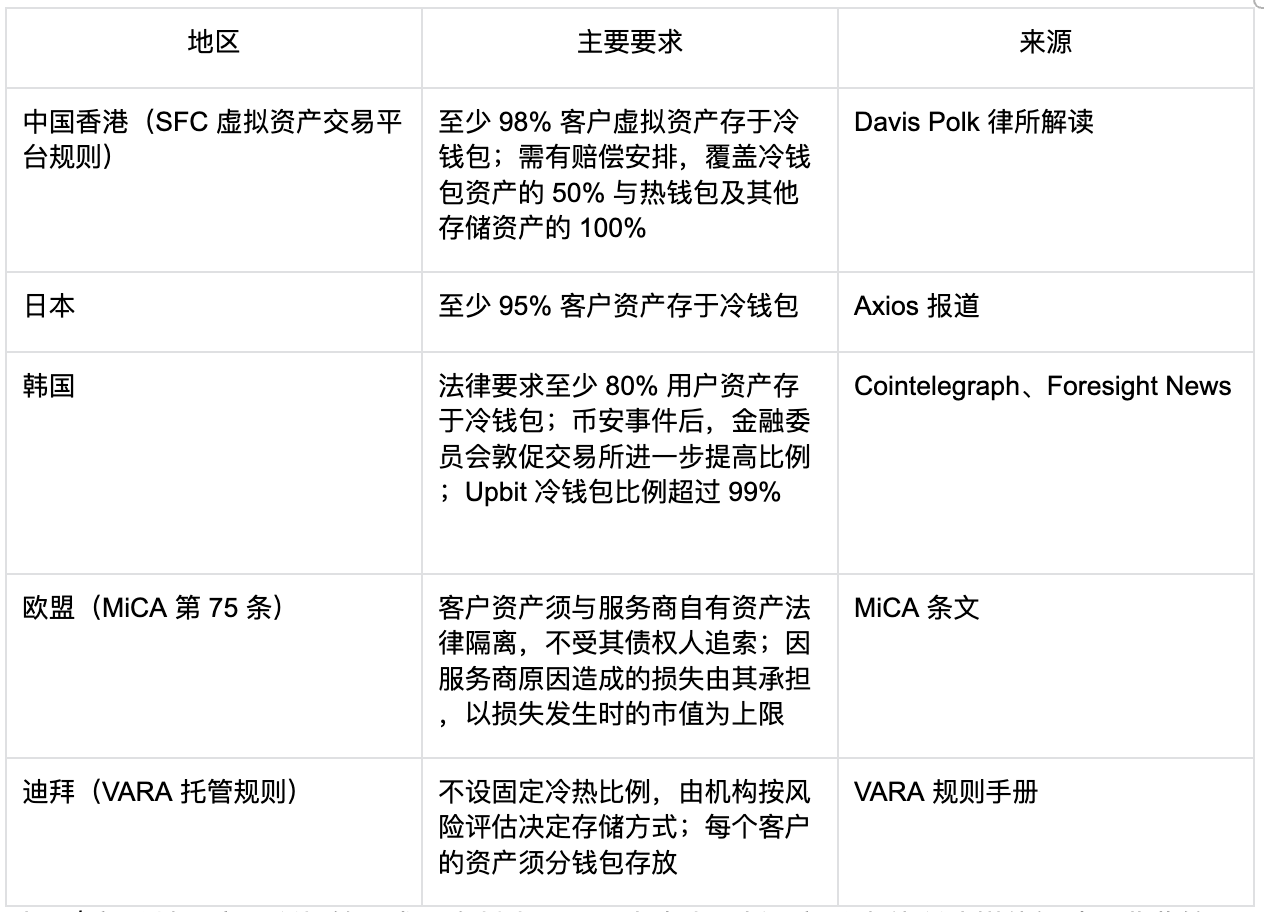
Cold-storage requirements and customer-asset protections vary widely by jurisdiction:
| Jurisdiction or rule | Main requirement | Source note |
|---|---|---|
| Hong Kong (SFC virtual-asset trading platform rules) | At least 98% of client virtual assets must be held in cold wallets. Compensation arrangements must cover 50% of cold-wallet assets and 100% of hot-wallet and other stored assets. | Davis Polk law-firm analysis. |
| Japan | At least 95% of client assets must be held in cold wallets. | Axios reporting. |
| South Korea | Law requires at least 80% of user assets to be held in cold wallets. After the Binance incident, the Financial Services Commission urged exchanges to raise the share further. Upbit’s cold-wallet share exceeds 99%. | Cointelegraph and Foresight News. |
| European Union (MiCA Article 75) | Client assets must be legally segregated from a service provider’s own assets and protected from claims by its creditors. The provider is responsible for losses caused by it, capped at the market value when the loss occurred. | MiCA text. |
| Dubai (VARA custody rules) | No fixed hot-to-cold wallet ratio is set; firms decide storage methods based on risk assessments. Each client’s assets must be held in separate wallets. | VARA rulebook. |
Some requirements in the comparison come from law-firm or media interpretations rather than regulatory texts. A higher cold-wallet ratio can reduce the scale of a theft, but it cannot eliminate the risk. In February 2025, Bybit lost about $1.46 billion in a hack in which attackers moved funds from an Ethereum multisignature cold wallet. Meeting a regulatory minimum does not prove that assets are safe.
Institutions should plan for an exchange unable to cover losses
BigTime labels its institutional exposure checklist as six questions, based on its research. The supplied article text does not include the individual checklist items.
Based on platform commitments and disclosures available at the time, no public reporting showed that institutions had directly lost principal to exchange theft in these three incidents. Whether principal is protected depends on an exchange having enough resources to make good on its promise, and that cannot always be assumed. Institutions setting exposure limits should also model what happens if an exchange cannot cover the loss: how much capital could be lost, and whether the remaining funds would support operations.
BigTime points readers to an earlier article in the series, “Where Did Liquidity Go the Night Binance Suspended Withdrawals?”, on liquidity changes during Binance’s withdrawal halt. It also cites “GSR Deep Dive: Why Is a Market Maker Starting to Build a Crypto Capital Market?”, about how market makers build crypto capital markets.
Data notes and risk disclosure
The report draws on official disclosures, third-party data platforms and media coverage. Statistical methods, cutoff times and asset-denomination approaches differ; some figures come from a single source or media accounts and may be revised as more information becomes available. Hack-loss estimates, freezes and replenishment progress are estimates by the parties involved or statements by platforms, and have not been independently audited. Industry-loss figures from different organizations use different methods and should not be compared directly.
Descriptions of off-exchange settlement, triparty custody and proof of reserves are based on public information and do not establish how the arrangements would perform in a specific stress scenario. Regulatory requirements partly rely on law-firm or media interpretations; the underlying regulatory texts should take precedence.
Information on the hacks came from official disclosures by Bitget, Binance and Mercado Bitcoin, as well as reporting by The Block, The Hacker News, CoinDesk, Bitquery and Korea JoongAng Daily. Industry-loss figures came from CertiK, DefiLlama and Chainalysis. Flow data came from Binance disclosures, Reuters and SoSoValue. The institutional survey came from Coinbase and EY-Parthenon. Market-share data came from Kaiko, as reported by Bloomberg. Off-exchange settlement and collateral arrangements were based on materials from Copper, Ceffu, Binance, BitGo, Fireblocks and OKX, along with related reporting. Regulatory information came from Davis Polk, Axios, Cointelegraph, the MiCA text and the VARA rulebook. The exposure-management framework is BigTime’s research analysis and is not investment advice.
The report was produced by BigTime Industry Research and compiled from public sources. It is not investment advice, an offer or a promise of returns; past performance does not indicate future results. Reproduction or excerpting without written permission is prohibited. BigTime Industry Research covers market making, liquidity and institutional asset markets, with additional reports in the series to follow. Markets involve risk. Readers should assess whether the opinions, views or conclusions suit their circumstances and bear responsibility for investment decisions based on them.