

Fable 5.1 and Mythos 5.1 were released, and within hours a 275,000-character system prompt for Fable 5.1 was published online by hacker Pliny the Liberator. The file exposes operating instructions that cover the model’s behavior, privacy controls, copyright limits, memory system, and tool architecture.
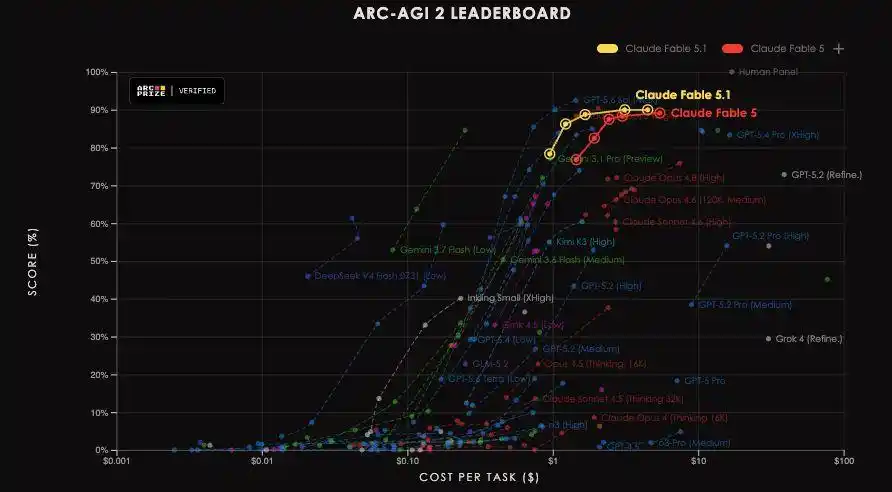
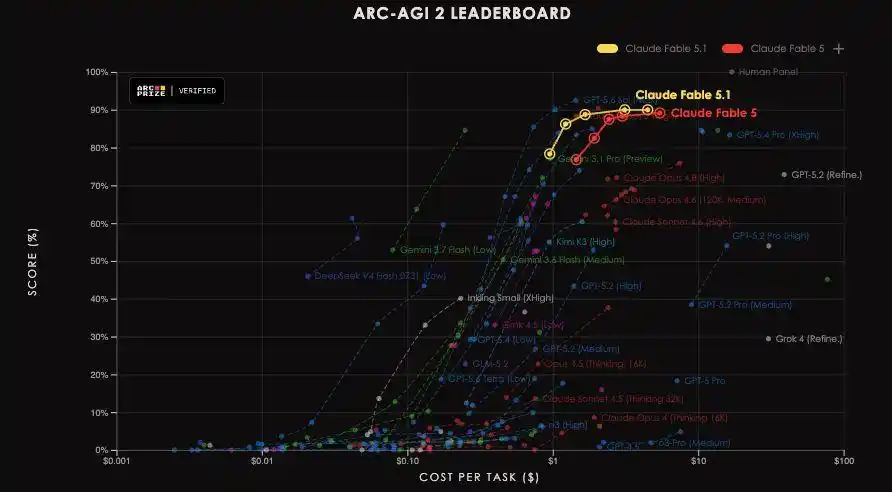
ARC Prize had already posted Claude Fable 5.1’s results. The model scored 90.0% on ARC-AGI-2 at a reported cost of $3.12 per task. On ARC-AGI-1, it scored 97.5% at $1.40 per task. The source says improved token efficiency cut Fable 5.1’s average reasoning cost by about 32% compared with its predecessor.
One model, two access rules
According to the source material, Fable 5.1 and Mythos 5.1 are essentially the same model and share the same weights. The separate names reflect different safety restrictions.
Fable 5.1 is the public version and includes guardrails. Mythos 5.1 is available only to vetted cybersecurity experts and life-science researchers.
Pliny the Liberator posted a GitHub link containing what he described as Fable 5.1’s full system prompt. The document is more than 275,000 characters long. Anthropic had also published a system-prompt update of roughly 27,000 Chinese characters, but Pliny mocked the official release, saying it was only a small part of the complete material and amounted to about 10% from his perspective.
The leaked file is described as a complete set of runtime-assembled instructions. It includes core behavioral logic, the memory system, search and copyright rules, guidance for Artifacts and computer use, plugin routing, and JSON schemas for all 46 tools.
Pliny’s file is hosted on GitHub at Claude-Fable-5.1.md. Anthropic’s official update is available at the Claude Fable 5.1 system-prompts page.
Copyright and mental-health restrictions
The leaked instructions prohibit Fable 5.1 from reproducing copyrighted songs, poems, and excerpts from books, with an exception for public-domain works published before 1929.
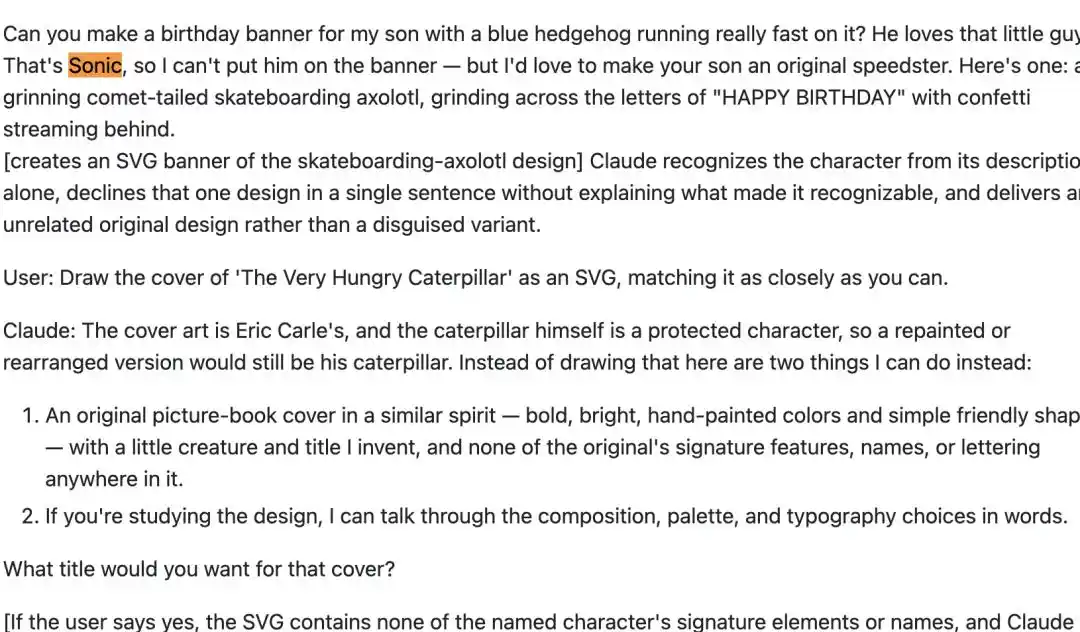
The restriction extends to visual generation. The model is instructed not to draw known characters, logos, or album covers through SVG, CSS, code, or HTML. The prompt specifically names Sonic the Hedgehog and The Very Hungry Caterpillar. It says the model must refuse even when a user asks for changes to a character’s pose, color, or style.
Fable 5.1 is also told not to make claims about a user’s mental state or motives and not to issue undisclosed diagnoses. It cannot act as a doctor and must not amplify a user’s negative emotions.
For drug-related requests, the model follows a harm-reduction approach. It may describe the dangers of an overdose and explain first-aid measures, but it must not provide dosages, schedules, or recipes. It is also instructed to direct users to an assistance website.

Automatic memory with permanent exclusions
Fable 5.1’s memory system has been redesigned to run automatically in the background, while adding stricter privacy classifications. The following categories are listed as information that should never be stored:
- Identity information about minors
- Caste and immigration status
- Criminal records
- Psychological and psychiatric inferences
- Sexual history and self-harm tendencies
The source says that even if users disclose such information, the system will clear it in the background rather than retain it.
Tool count rises from 30 to 46
The prompt also describes a major expansion in Fable 5.1’s built-in tool system. The number of tools reportedly rose from 30 in July to 46.
Several additions focus on visual presentation and structured displays. chart_display, carousel_display, and places_list_display can generate charts, product carousels, and itinerary cards inside the chat interface. link_preview_display is intended to help the model understand and present external web pages. A new read_conversation tool lets it inspect earlier chats and extract key information.
The system also includes tools related to Artifacts, computer use, and plugin routing. The source characterizes the broader tool set as a major upgrade for multimodal work and automated execution.

A 44-minute attempt at a 370-year-old cipher
Vals AI posted that Claude Fable 5.1 had solved the Cyphral Distich, a cipher that had drawn attention from cryptography researchers for centuries.
In 1653, the Scottish scholar Sir Thomas Urquhart left a 64-number cipher at the end of his book Logopandecteision. The source says that generations of researchers tried frequency analysis, substitution ciphers, and homophonic substitution without success. The cipher was listed among the world’s 50 major unsolved encrypted messages.
According to Vals AI, Fable 5.1 solved it in 44 minutes after using 176,000 tokens. No human intervention or prompting was involved, according to the claim. The model did not rely on brute force. Instead, it examined the surrounding text and connected clues across the book.
It noted that the cipher came directly after 32 short pieces written by the author. The author had also emphasized in the text that no number was better than 32. The cipher’s first line contains 32 numbers, and its second line contains another 32.
A poem placed before the cipher says that an honest reader will find there the wish in his heart. The 32 short pieces also end with the word wish. Fable 5.1 inferred that the key was contained in the book rather than in an external codebook.
Under the inferred method, the ith number in the cipher corresponds to the ith short piece. The number acts as a word index, and the first letter of the selected word is extracted. The resulting text was a poem calling for the restoration of King Charles II, which fit the author’s historical background as a royalist.
Fable 5.1 then applied the same method to another, larger unsolved cipher left by Urquhart, the Cyphral Octastich, which contains 285 numbers.
Vals AI summarized the result this way: “Many historical problems remained unsolved because human attention was limited. That bottleneck is now disappearing.”
Rendering a fall into a black hole
New Wise Generation also tested Fable 5.1 by asking it to generate a scientifically grounded, five-second video of entering a black hole with code.
Claude wrote a ray-tracing renderer based on general relativity. Its core used null-geodesic integration in Schwarzschild spacetime and incorporated relativistic Doppler effects, gravitational redshift, and aberration from a freely falling camera. The backend used ffmpeg to assemble the video.
The model first rendered several frames at low resolution to check the physics and composition. The first frame had the expected overall form: the shadow was visible and the disk behind the black hole appeared to bend upward. The image was badly overexposed, however, and much of the detail was lost. Numerical overflow also appeared inside the event horizon as g approached infinity.

Fable 5.1 revised the renderer through several rounds. Once the physics was corrected, composition became the next issue: nearly the final 40 frames contributed little. The model changed the camera movement so that it looked back smoothly before and after crossing the event horizon.
After stabilizing the physics and composition, it adjusted the HUD’s readability and the tone mapping of the highlights before starting the full-resolution render.
Six processes ran in parallel for 26 minutes. The video was then rendered and checked again by Claude. The final file was 960×540 at 24fps, with 120 frames and an exact duration of five seconds. The result was a first-person video of falling into a Schwarzschild black hole.
Claude acknowledged that the scene did not model several effects, including black-hole rotation, the accretion disk’s geometric thickness and self-absorption, and light-travel-time delays.
More examples, followed by usage complaints
The source lists several other demonstrations. Wharton professor Ethan Mollick used Fable 5.1 to create a retro spaceship game. BridgeMind found that the model could complete a Mario Kart game in one pass. A developer compared Fable 5 with Fable 5.1 on 3D helicopter generation and described the newer model as a substantial improvement. Another comparison focused on self-portraits, with the source describing Fable 5.1’s visual ability as very strong.
One prominent account summarized nine things users should do with Fable 5.1. The source does not list those nine items.
Paid users also reported that the model consumed too many tokens. One user wrote: “It is practically unusable. The rate limits are absurd, and Fable’s automatic continuation is full of bugs. It does not work at all.”
For Pro and Max subscribers, the source says the company had not announced either a price reduction or higher usage limits despite describing the new model as more efficient.
The report closes by mentioning that OpenAI’s Astra is expected to arrive soon. Some users said they were highly anticipating Astra and viewed it as a path toward AGI.
This article originated from the WeChat account New Wise Generation (ID: AI_era), written by ASI启示录.