
Fables, a dynamic-fee market-making protocol on Robinhood Chain built with a Uniswap v4 Hook, is heading toward the end of its points campaign while official messaging on its token launch date remains inconsistent.
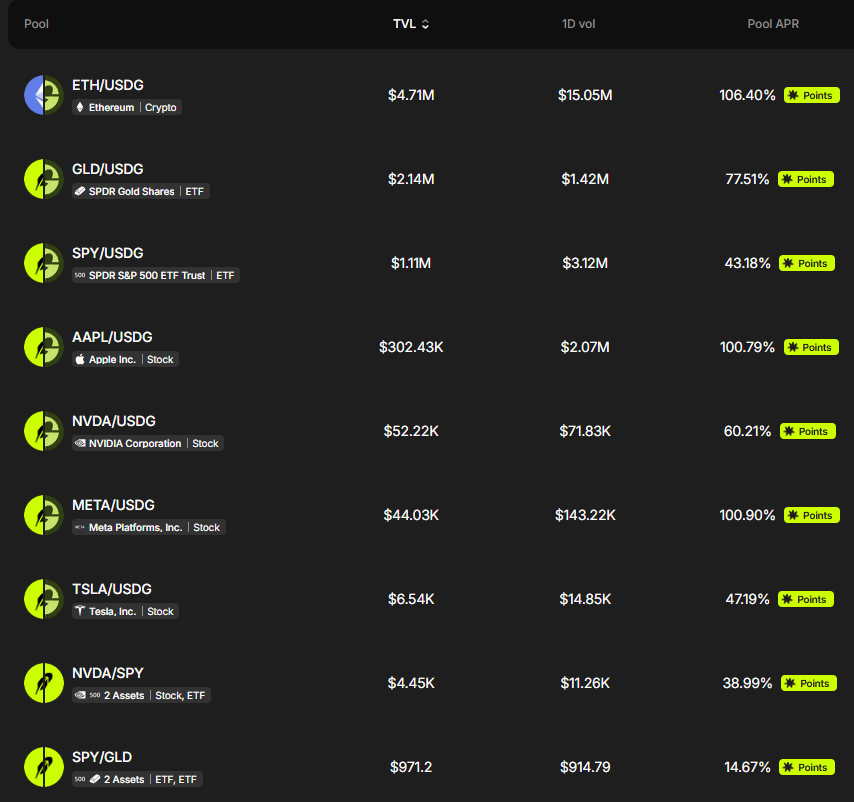
The points program is scheduled to end on Oct. 5. In an Aug. 22 post on X, the project said, 「On October 5, the points program will conclude with the Fables TGE, and token, Gauge, voting, and staking will go live that day.」 But documentation on fables.fi marks the date as unconfirmed and says earlier public messaging had referenced Oct. 5, with the final date to be confirmed through the latest official channel carrying a date. That leaves a discrepancy between two official sources.
Fables is a tokenized U.S. equities liquidity market-making interface deployed on Robinhood Chain. It went live in mid-August 2026 and plans to adopt a ve(3,3) model after TGE. Users deposit assets, choose a price range, earn fees, and can withdraw at any time. The product is non-custodial, with underlying assets held in Uniswap v4’s official PoolManager.
How the protocol is structured
Fables currently covers USDG-denominated pairs including ETH, GLD, SPY, AAPL and NVDA.
Each Fables market consists of one Uniswap v4 pool and one non-upgradeable Fables hook. The hook calculates fees in real time and records market-making share.
Fees are determined by one of three proprietary models. The calendar model references market open, market close, overnight hours and weekends for the underlying asset. The fixed baseline model is used for assets that trade around the clock. The directional model references the trade direction itself. The three-model setup is intended to reduce information asymmetry created by the mismatch between 24/7 onchain trading in tokenized assets and traditional U.S. stock market hours.
On top of those automated models, an authorized offchain keeper can make temporary fee adjustments within narrow limits. Any adjustment can reduce the autonomous fee by no more than 50%, and it expires automatically after a maximum of 72 hours. The absolute cap is hard-coded into the contract bytecode, and the keeper cannot move user funds. Broader parameter changes require AccessManager approval and a fixed delay.
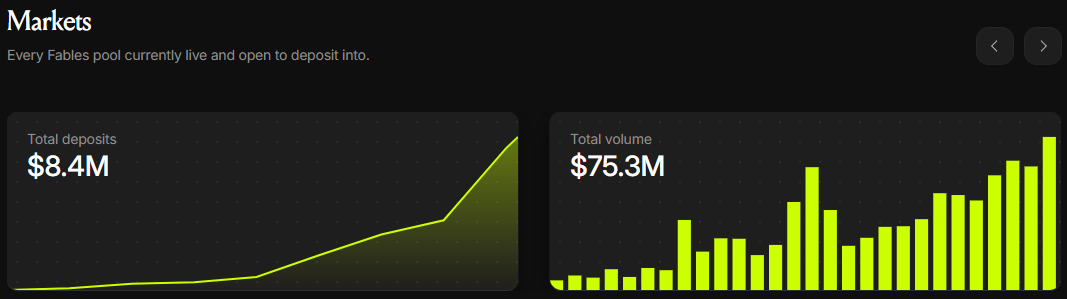
As of publication, Fables had about $8.4 million in deposits and around $75.3 million in total trading volume.
Team background and current security disclosure
The protocol’s technical lead is Yanis Berkani, whose background includes computer science at EPFL and cybersecurity at ETH Zurich, according to the article.
Berkani previously served as smart contract lead at APWine, later renamed Spectra Finance. He later became co-founder and technical lead of Alphix, another market-making protocol that uses a Uniswap v4 hook for dynamic fees and operates on Arbitrum and Base.
Another core contributor who appears frequently in public communications goes by the handle cs361. Public channels reviewed for the article did not identify his real name. A project developed by cs361 and Berkani, called Canary, was selected as a top-10 finalist at ETHGlobal New York 2026. Canary is described as a parametric insurance tool priced and underwritten through prediction markets.
The article says no public financing disclosure record, team size details, or equity structure information could be found through public channels.
On security, the project says development used unit testing, fuzz testing, invariant testing, and automated review tools and processes tied to Olympix, Sherlock AI and pashov. So far, the team has not published an independent third-party audit report naming the auditor, code commit hashes, audit scope, and specific findings.
Six-week points program and creator fee setup
Fables is running a six-week points campaign from Aug. 24 to Oct. 5, 2026, with a total of 1 billion points. Of that amount, 900 million points are allocated to market makers and 100 million are reserved for referral rewards.
The weekly allocation to market makers increases over time at 8%, 11.5%, 15%, 18.5%, 22%, and 25%. Distribution is based on effective fees actually generated each day, not on the amount of capital locked.
There is also a separate creator fee mechanism. The funding comes from fees generated by the PROLOGUE/ETH pool. After treasury conversion into USDG, the project decides the weekly payout amount. Disclosed figures show 600 USDG for week one on Aug. 31 and 3,000 USDG for week two on Sept. 7.
For later weeks where no amount has been disclosed, the project does not publish a creator reward APR and does not pay any assumed rollover amount. The PROLOGUE/ETH and ETH/USDG pools do not participate in that distribution. All other markets are counted by their actual fee share rather than point weight.
The article also notes that points are only an internal accounting unit. They are not an asset and do not represent a redemption promise. The team has not published any conversion path from points to PROLOGUE or FABLES.
Token structure now under discussion
FABLES is the protocol’s intended governance token. At present, there is only one proposed allocation plan, covering a total supply of 1 billion tokens.
- 50% emissions, or 500 million tokens, not circulating at issuance
- 12% community distribution, or 120 million tokens, with up to 60 million potentially circulating at issuance
- 8% team, not circulating at issuance
- 8% ecosystem, not circulating at issuance
- 7.5% strategic reserve, not circulating at issuance
- 5% grants, not circulating at issuance
- 4% operations, not circulating at issuance
- 3% FABLES/USDG liquidity, or 30 million tokens, circulating at issuance
- 2.5% PROLOGUE reserve, or 25 million tokens, circulating at issuance and designated as the conversion pool mentioned earlier
Vesting details, issuance timing, and the emissions curve have not been finalized. The project has not deployed a redemption contract and has not opened an eligibility snapshot.
PROLOGUE, by contrast, is already trading publicly on pools.trade, a token launchpad built by Uniswap for Robinhood Chain. The team has proposed a future conversion arrangement between PROLOGUE and FABLES. Under that proposal, the minimum exchange rate would be 40 PROLOGUE for 1 FABLES, with permanently locked positions excluded from eligibility. The final ratio could be better than that floor.
As of publication, PROLOGUE ranked second by valuation on the pools.trade hot tokens list, with an FDV of about $10 million and roughly 7,300 holder addresses. Community estimates have used the secondary-market price of PROLOGUE and the proposed 40-to-1 minimum ratio to infer an implied FABLES valuation of about $400 million.
The article says that estimate should not be treated as a TGE price signal, because the conversion arrangement is still unsettled and PROLOGUE has seen large price swings.
Risks listed in the article
The source article flags several risks tied to participation.
- Sharp asset-price moves can change inventory composition, and fee income may fail to offset principal losses.
- The hook contract is fixed onchain. If a vulnerability exists, it cannot be patched and could affect all market-making funds in the pool.
- Keeper powers are bounded by coded limits and timelocks, but short-term pricing errors may still occur.
- Points and creator fees depend on offchain accounting, and rules can be changed retroactively by the project. They are not irreversible onchain assets.
- The underlying assets are not actual U.S. equities. The issuer can freeze addresses, pause trading, and change rules.
- Robinhood Chain carries infrastructure risk, including congestion, data delays, or an inaccessible frontend.
- Current volume is driven mainly by the six-week incentive campaign. Before audit details and token rules are fully in place, post-incentive volume will depend on actual market demand.
The article also notes that there is an unrelated meme coin onchain named fable, which has no connection to the Fables protocol.
Foresight News added that the piece does not constitute investment advice.