

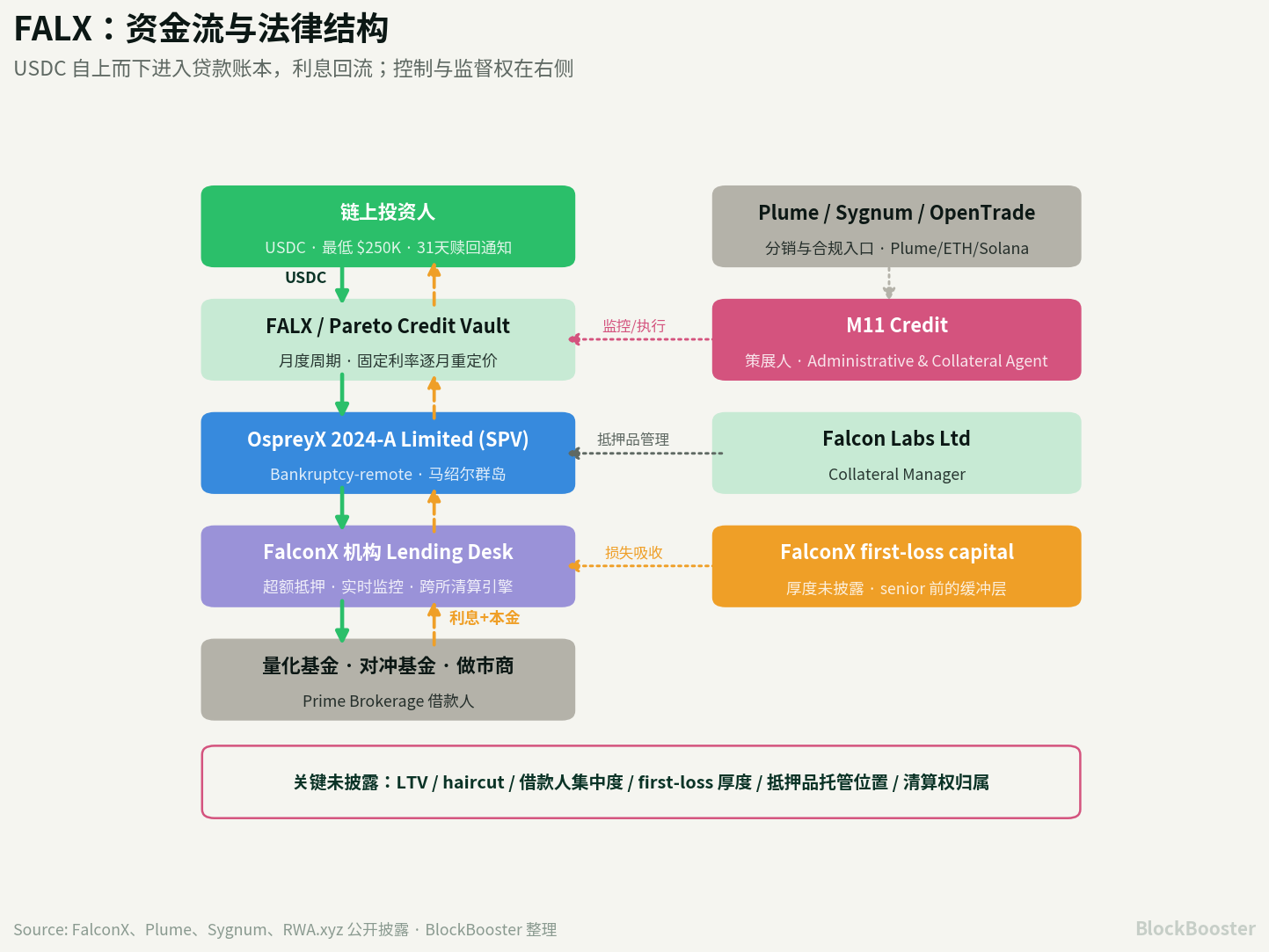
FALX is better understood as a capital formation mechanism than as a simple yield vault. Based on the disclosures cited in the source, it takes prime brokerage loan exposure originated by FalconX and packages it into an on-chain fixed-income product. The structure runs through several layers: FalconX originates institutional collateralized loans, the exposure moves into a FalconX-managed SPV, Pareto provides the on-chain credit vault, M11 Credit acts as curator and agent, and distribution happens through entry points on Plume, Ethereum, Solana, and similar venues.
The key point is not that FALX introduced a brand-new asset pool. The mechanism connects the process of forming institutional credit assets to on-chain capital.
What FALX is
In practice, FALX looks like an on-chain structured credit facility. Investors deposit USDC into a Pareto/FALX-related vault. Capital then enters a bankruptcy-remote SPV linked to FalconX, and FalconX’s institutional lending system extends overcollateralized loans to clients such as quant funds, hedge funds, market makers, and asset managers.
FalconX announced its Structured Credit Facility in March 2025. According to the source, the firm packaged FalconX-originated loans into a structured product that investors could access through a Pareto private credit vault, with M11 Credit serving as curator. FalconX framed the product as a way to bring the process of institutional credit asset formation on-chain.
On June 30, 2026, Plume announced the launch of the FALX Structured Credit Facility. Plume said the vault uses Pareto for infrastructure, M11 Credit for curation, and a FalconX-managed SPV for capital routing, while the underlying exposure comes from overcollateralized loans originated on FalconX’s prime brokerage platform. Plume also described the facility as scalable to roughly $1 billion in capacity.
That timeline matters. FALX on Plume appears to be a new distribution point and an expansion of an existing FalconX-Pareto-M11 structured credit setup, not a fresh pool built from scratch.
Capital flow and the parties involved
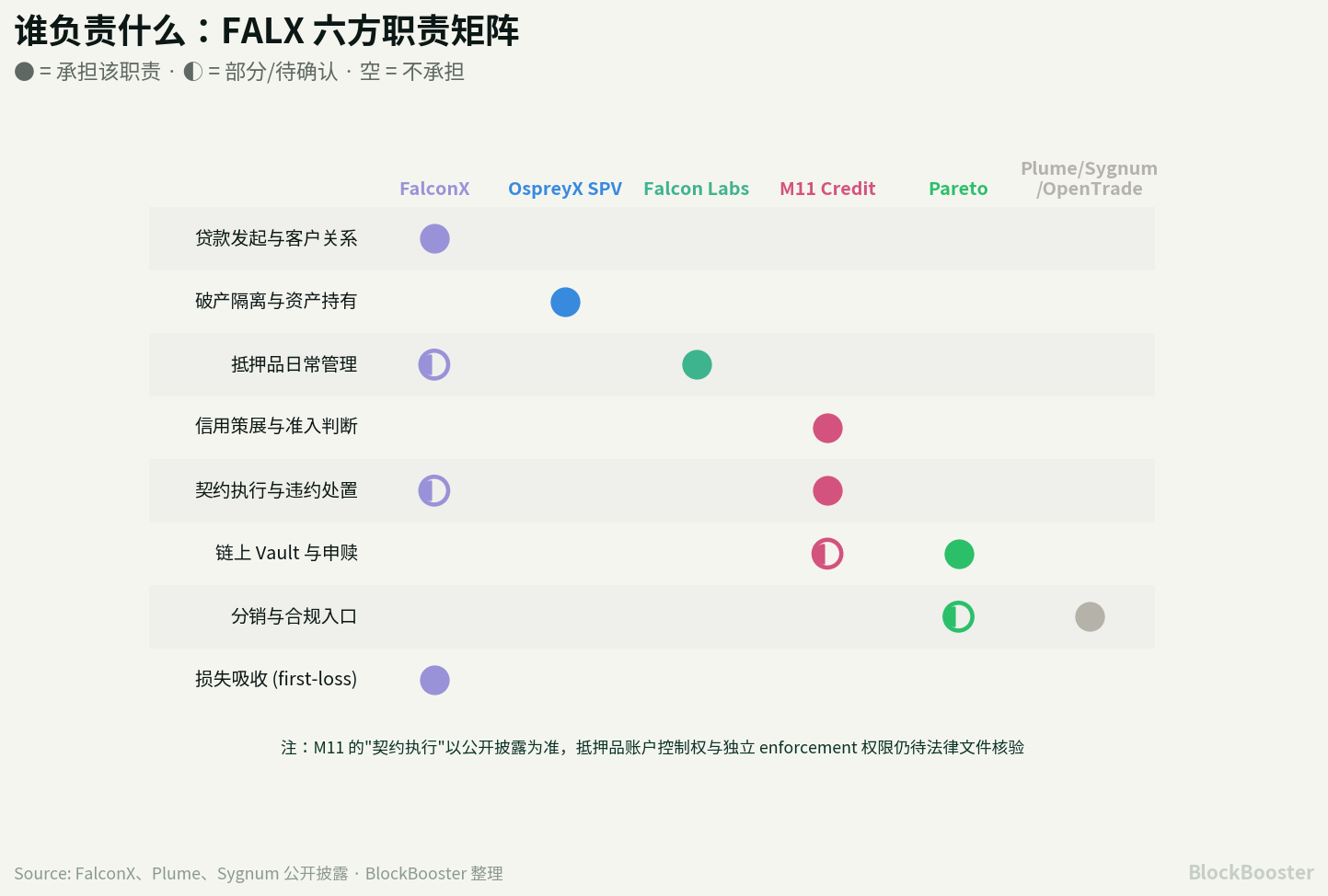
The structure can be broken down into distinct roles. FalconX said in its June 2026 materials that the vault lends to OspreyX 2024-A Limited. The SPV is designed to be bankruptcy-remote, separating investor capital from FalconX’s corporate balance sheet.
Within that framework, Falcon Labs Ltd serves as Collateral Manager, M11 Credit acts as Administrative and Collateral Agent, and FalconX provides a first-loss capital contribution.
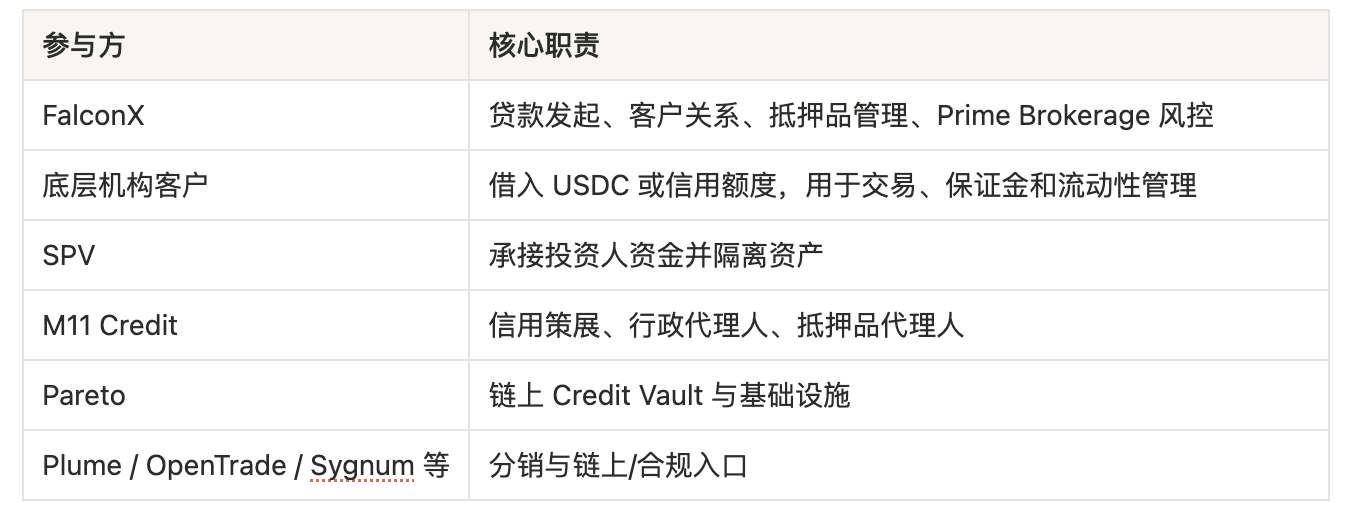
From the disclosures referenced in the source, the main participants are:
- FalconX, as the originator of prime brokerage overcollateralized loans and provider of first-loss capital
- A FalconX-managed SPV, used to isolate the exposure
- Pareto, which provides the on-chain credit vault infrastructure
- M11 Credit, acting as curator, administrative agent, and collateral agent
- Plume, Ethereum, and Solana, which function as on-chain distribution channels
- Institutional borrowers, including quant funds, hedge funds, market makers, and asset managers
Who pays the yield
The return is not driven by on-chain token incentives. It comes from the financing cost paid by prime brokerage borrowers seeking capital efficiency.
The source says FalconX’s financing business spans margin loans, flexible settlement, OTC lending, DMA credit, prime brokerage financing, structured products, and yield generation. That product list suggests the underlying cash flow comes from institutional demand to move capital across venues, collateral types, and settlement windows.
As laid out in the source, FALX yield can be thought of as a combination of four premia:
- the U.S. dollar benchmark rate
- volatility premium on digital-asset collateral
- a premium for immediate liquidity and cross-exchange capital movement
- a prime brokerage service premium
That is why the product is not directly comparable with a USDC supply rate on Aave. Aave is an open, algorithmic, overcollateralized on-chain pool. FALX is a portfolio of institutional prime brokerage loans, and the risk stack includes FalconX, the SPV, M11, collateral enforcement, and the borrower base itself.
Return framework: 7.4% net yield and roughly 340 bp of excess compensation
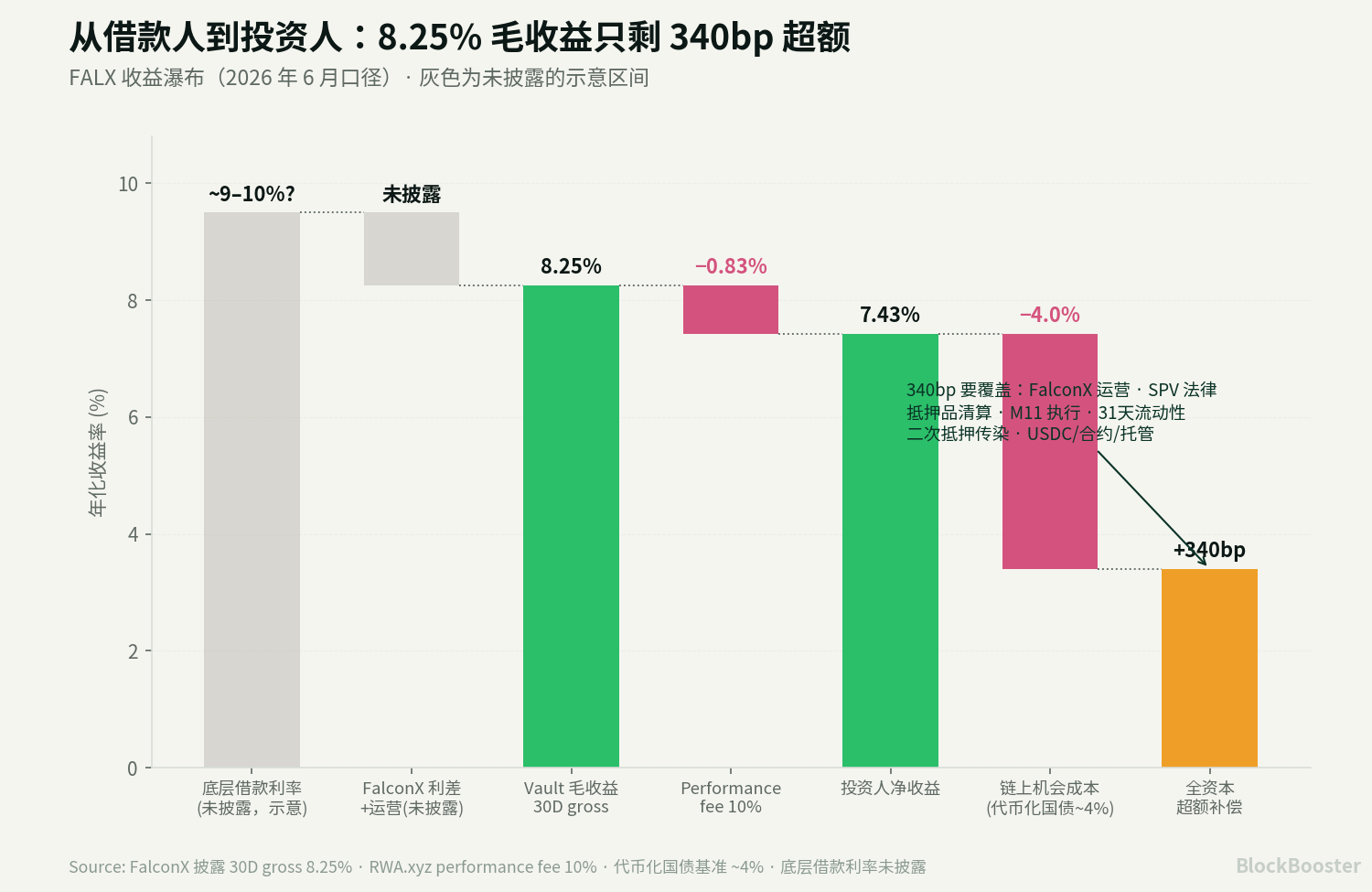
FalconX disclosed a 30-day gross yield of 8.25%. After deducting a 10% performance fee, the investor’s approximate net yield comes to about 7.4%.
To estimate the excess return for an on-chain USDC investor, the source compares FALX with lower-credit-risk on-chain alternatives such as tokenized Treasuries, BUIDL-like money market products, or Aave USDC. FalconX itself compared the strategy with Aave USDC at 3.26%. The article then uses 4% as a rough opportunity cost for lower-risk on-chain dollar capital, based on tokenized Treasuries being around that level.
That produces the following rough spread:
- FALX net yield: about 7.4%
- Low-risk on-chain USDC opportunity cost: about 4.0%
- Excess compensation: about 3.4%, or 340 basis points
According to the source, that 340 bp has to compensate investors for:
- FalconX operational risk
- SPV legal risk
- collateral liquidation risk
- M11 execution risk
- the liquidity discount implied by a 31-day redemption notice
- contagion risk from DeFi rehypothecation
- USDC, smart contract, cross-chain, and custody risk
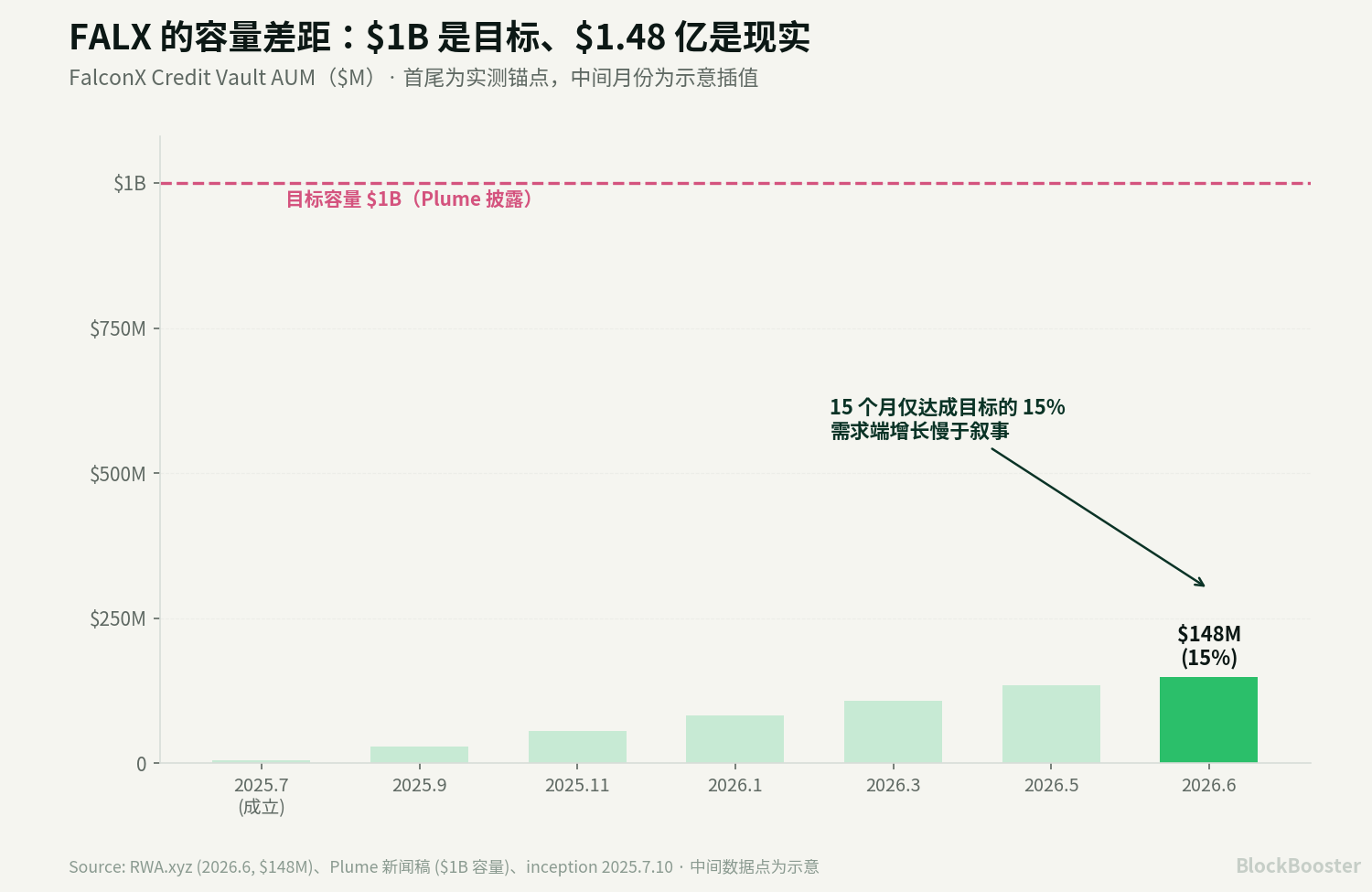
The gap between a $1 billion capacity claim and $148 million in assets
Plume said FALX’s current capacity can scale to around $1 billion. FalconX separately disclosed in March 2025 that its 2024 loan originations reached $2.5 billion, which suggests the firm is not short of origination capability.
Yet the actual on-chain asset base is much smaller. The source says the current RWA.xyz page shows total assets of about $148 million in the FalconX Credit Vault.
That contrast is one of the clearest signals in the piece. From the SCF announcement in March 2025 to roughly June 2026, vault AUM reached about $148 million, or around 15% of the stated $1 billion target capacity. At minimum, the public figures suggest that growth in on-chain demand for this type of product has not been easy.
The article breaks “capacity” into five separate layers:
- legal and contractual capacity, meaning what the SPV and vault can theoretically hold
- origination capacity, meaning total institutional loan demand available to FalconX
- eligible loan capacity, meaning loans that meet LTV, collateral, borrower concentration, and covenant requirements
- yield-target capacity, meaning how much borrowers will take at a 7% to 8% investor net return level
- investor demand capacity, meaning whether on-chain capital is willing to accept a 250,000 USDC minimum, a 31-day redemption notice, and a complicated credit risk stack
M11 Credit’s role and its record
Why M11 matters in this structure
M11 is not presented as a mere distributor. FalconX said M11 serves as vault curator and handles reporting, epoch cycles, subscription and redemption requests, credit assessment, loan covenant enforcement, and real-time risk monitoring. Plume also identified M11 Credit as curator. Sygnum, according to the source, explicitly described M11 Credit as the Administrative and Collateral Agent.
That places M11 in a central middle layer of the product. It is there to assess whether assets should enter the pool and to oversee both the originator and the borrowers throughout the life of the loans.
The shadow of the 2022 Maple default
The article argues that M11 also has to be viewed through its earlier failure on Maple. In December 2022, Orthogonal Trading defaulted on roughly $36 million on Maple. Of that amount, $31 million came from an M11-managed USDC pool and about $5 million came from an M11-managed wETH pool. The source says the remaining investors in the M11 USDC pool were facing roughly an 80% hit.
M11’s own explanation, as cited in the source, said Orthogonal materially misreported its financial condition after the FTX collapse and only on Dec. 3 disclosed losses that were far larger than previously stated, leaving it unable to repay. M11 said Orthogonal had repeatedly claimed in writing and verbally that its FTX exposure was limited, which materially impaired M11’s ability to manage credit risk.
The article draws four lessons from that episode:
- overreliance on borrower self-reporting, since deliberate concealment may not be detected in time
- concentration risk, with about 80% of loans in one M11 USDC pool tied to Orthogonal by December 2022, up from about 14% at the end of August
- insufficient pool cover and flawed risk pricing, since the pool cover for three M11-managed pools was largely exhausted and covered only a small portion of bad debt
- the weakness of governance-token-denominated protection, as Maple’s native MPL token fell sharply during the stress event and any first-loss or insurance primarily tied to an affiliated governance token can decline alongside the insured asset
How FALX differs from Maple in 2022
The source stresses that FALX is not the same structure that failed on Maple. The Maple/M11 problem in 2022 was fundamentally unsecured or lightly collateralized institutional credit. It relied heavily on borrower disclosures about balance sheets, exchange exposures, and financial condition. If a borrower lied, on-chain transparency alone could not reveal an off-chain balance-sheet hole.
FALX is set up differently. It is based on overcollateralized prime brokerage lending, and FalconX said it uses real-time collateral monitoring, automatic margin calls, a cross-exchange liquidation engine, and a first-loss capital contribution.
Loss waterfall: who takes losses first
Public disclosures point to at least three protective layers in the FALX structure:
- the underlying loans are typically overcollateralized
- FalconX provides a first-loss capital contribution
- M11 serves as Administrative and Collateral Agent, adding an external oversight layer
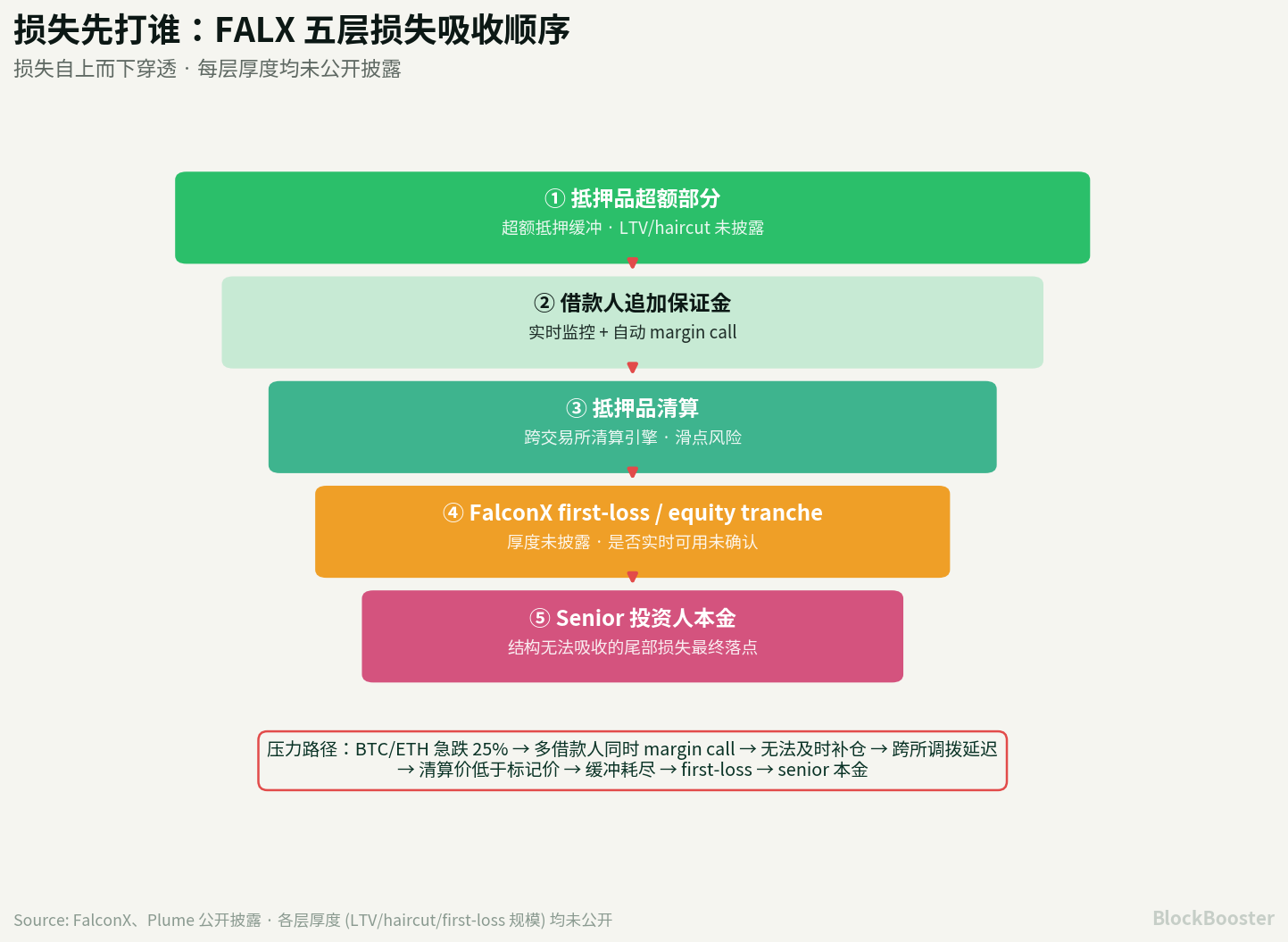
In an idealized waterfall, losses would be absorbed in this order:
excess collateral, then borrower margin top-ups, then collateral liquidation, then FalconX first-loss or equity tranche, then other junior protection, and only after that principal losses for senior investors.
What remains undisclosed is the thickness of each layer. The source says public materials do not provide that detail.
Redemption pressure and rehypothecation risk
One of the basic terms of FALX is a monthly cycle with a 31-day redemption notice. The source says RWA.xyz lists a 31-day notice period for redemptions on the FalconX Credit Vault and says there are no management, subscription, redemption, or entry-exit fees other than the 10% performance fee.
That creates an asset-liability management question. Investors are subject to a 31-day notice period and the underlying loans roll on a monthly basis. But if investors sought to redeem 50% in a single month, the source asks what happens next: does the SPV force FalconX to shrink the loan book early, do redemptions queue behind a gate, or does a secondary market absorb the selling? Public materials, it says, do not fully answer that.
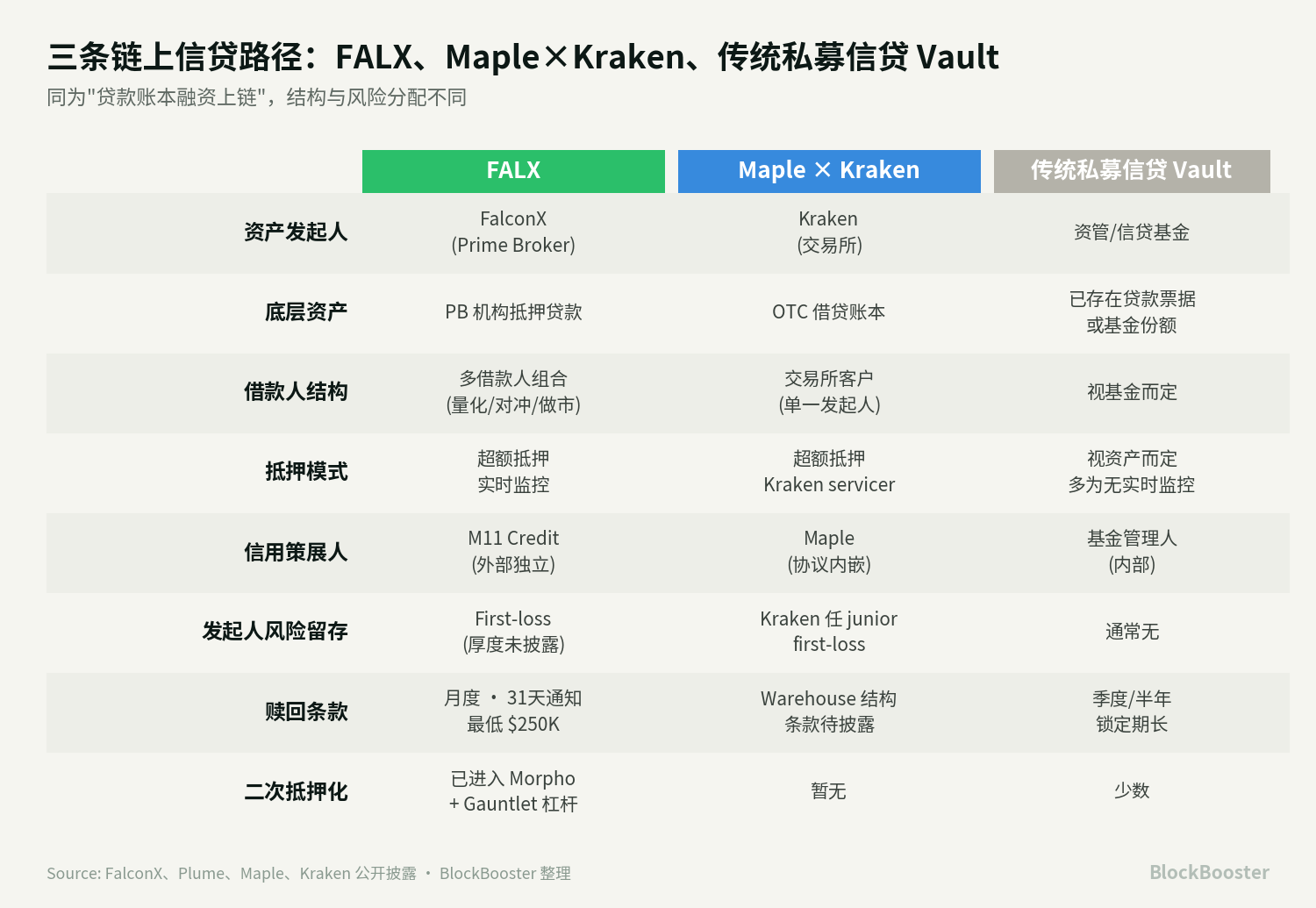
The other issue is composability. FALX has already entered a second layer of DeFi collateral use. The FalconX Credit Vault Token has become one of the important RWA collateral assets on Morpho, and Gauntlet has launched a FalconX Levered RWA Strategy that borrows USDC against FalconX CV tokens and uses the proceeds to buy more CV tokens.
The source outlines the following transmission chain under stress:
- FALX tokens are posted as collateral on Morpho
- under market pressure, FALX tokens trade at a discount or NAV is adjusted
- health factors on Morpho decline
- liquidators sell or discount FALX tokens
- secondary prices fall further
- more holders seek redemption
- the SPV needs to release cash
- FalconX is pushed to shrink the loan book or suspend redemptions
In other words, rehypothecation improves capital efficiency but also connects what was once a relatively closed private-credit risk to DeFi liquidation systems. The product stops being just a credit instrument and becomes composable collateral, which can accelerate the speed of risk transmission.
What FALX actually shows
The source’s broader point is that FALX’s innovation lies in the assembly rather than in a single component. It combines FalconX’s prime brokerage loan book, an SPV legal wrapper, M11’s external credit curation, Pareto’s on-chain vault infrastructure, and distribution channels such as Plume, Sygnum, and OpenTrade into one on-chain capital formation system.
That structure suggests a practical route for on-chain credit. It does not require the market to solve fully native on-chain credit scoring first. Instead, the model starts with a professional originator that has real cash flows and real loan demand, then uses an SPV, first-loss protection, overcollateralization, external curation, and on-chain transparency of fund flows to turn those loans into investable assets.