
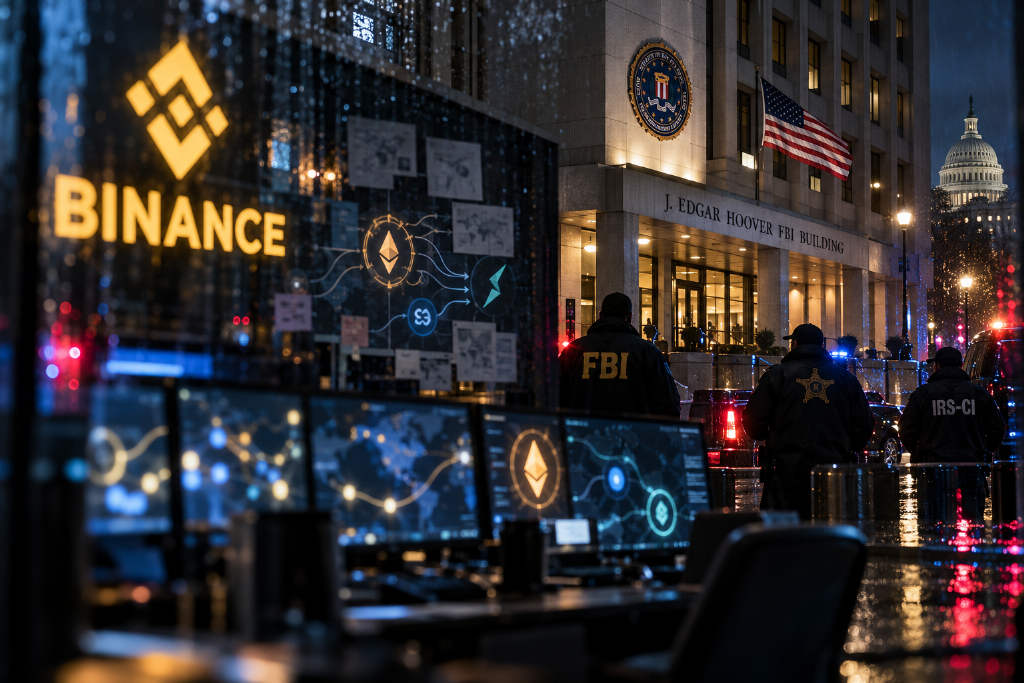
The U.S. Federal Bureau of Investigation said North Korea was responsible for Binance’s theft of more than $6 billion in virtual assets, identifying the malicious cyber activity as "TraderTraitor." The FBI said the same group had also been identified by the agency as the attacker behind last year’s roughly $1.5 billion Bybit theft.
A day earlier, when asked whether North Korea was behind the attack, Donald Trump said, "We don’t know, we’re investigating." The FBI’s formal attribution now adds a new development to the investigation into what the report described as the largest theft in the crypto industry.
FBI publishes addresses and asks the industry to block related flows
The FBI said it had observed, together with the U.S. Secret Service and IRS Criminal Investigation, that the attackers had mainly converted the stolen assets into ETH. The agency said it expects the funds to keep moving through DeFi services and instant swap platforms as part of the laundering process before further transfers.
It published addresses tied to the case at https://www.fbi.gov/investigate/cyber/alerts/2026/north-korea-responsible-for-6-billion-binance-attack and called on THORChain node operators, RPC node operators, instant exchange platforms, DeFi services, blockchain analytics companies, and other virtual asset service providers to block transactions connected to those wallets.
The FBI said the request also applies when funds have already been moved into new wallets, as long as those assets can still be traced back to the listed addresses. It also asked individuals and organizations with relevant information to contact a local FBI field office or the Internet Crime Complaint Center, or IC3.
On-chain monitors say the stolen funds are still being split and moved
While law enforcement is seeking help from the industry, the attackers are still shifting funds across wallets, according to on-chain monitoring cited in the report. Some of the money has been repeatedly split, cycled, and redistributed across both new and previously used wallets before reaching swap and cross-chain services.
Onchain Lens said the attackers moved 120 million TRX, worth about $38.78 million at the tracked price, and then dispersed the funds to multiple destination addresses. Some of the assets moved through several wallets, returned to addresses used earlier, and were then sent on to fresh wallets, making the trail harder to follow.
Elliptic said in an update that a main distribution wallet on Tron had sent about $93.5 million to roughly 150 wallets while continuing to receive large top-ups. Transfer activity accelerated overnight to about $3 million to $7 million per hour.
Elliptic said the pattern looked automated. The main distribution wallet sent funds every hour for 31 consecutive hours, with the longest pause lasting only 46 minutes. Receiving wallets usually forwarded the money again in about two minutes. Based on that behavior, Elliptic said the operation was very likely being run by software and continued through the night.
Funds have already reached THORChain, SunSwap, and Bitget Swap
As the assets were dispersed, part of the stolen money began moving into swap and cross-chain channels. As of 16:11 yesterday, Elliptic said it had tracked about $25 million flowing into THORChain, with another $5.3 million and $1.8 million moving to SunSwap and Bitget Swap, respectively.
The movement shows that the laundering path has expanded beyond repeated wallet-to-wallet transfers and into multiple swap and cross-chain venues.
Binance says about 90% of affected assets have been replenished
At the same time, Binance said it has been buying tokens to close the asset gap. In its latest statement, the exchange said about 90% of affected assets had been replenished, up from roughly 80% disclosed earlier.
Binance said full reserve backing had been restored for BTC, ETH, USDT, BNB, SOL, USDC, XRP, USD1, RLUSD, and ZEC. The remaining roughly 10% mainly involves lower-liquidity tokens that still need to be sourced through market purchases and over-the-counter channels.
According to Binance, the replenishment funds came from the company’s own capital, part of the SAFU fund, and part of its contract insurance fund. Early this morning, Binance co-CEO Yi He said 50% of the funds in the SAFU wallet would be allocated to cover the losses, while the other half would remain untouched.
On-chain data cited in the report showed that the wallet had already sent out a total of 7,500 BTC in three transactions, leaving 7,500 BTC in the address. At the reported market price, the remaining balance was worth about $580 million.
Proof-of-reserves snapshot completed, withdrawal timing still not announced
Binance said it had completed a proof-of-reserves snapshot at 8:00 a.m. Beijing time on Oct. 31, and that a full zero-knowledge proof is expected to be generated on Nov. 3.
On withdrawals, Binance said restoring the service remains a target for today, though it has not yet announced a specific schedule.
The FBI’s attribution gives the investigation a clearer direction, but the stolen assets are still moving. For Binance, the next steps remain the same: finish replenishing the remaining assets, restore withdrawals, and release a full security review.



