

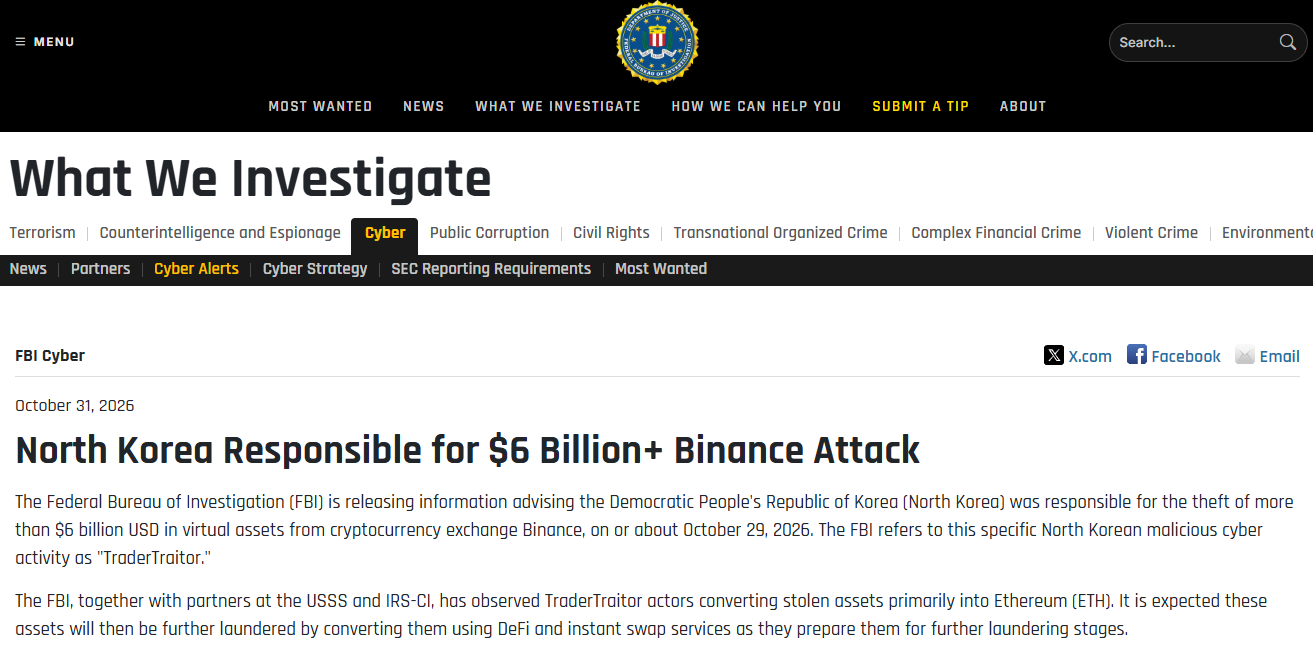
The U.S. Federal Bureau of Investigation has formally attributed the more than $6 billion virtual asset theft tied to Binance to North Korean cyber actors, calling the malicious activity "TraderTraitor." In its notice, the FBI said the same group had also been identified as the attacker behind last year's roughly $1.5 billion Bybit theft.
That attribution came a day after Donald Trump, when asked whether North Korea was behind the attack, said, "We don't know, we're investigating." The FBI's statement now gives the case a defined direction as the investigation into one of the crypto industry's largest thefts moves forward.
FBI publishes addresses and asks the industry to block related flows
Alongside the attribution, the FBI disclosed how the stolen assets have been moving. The agency said it, the U.S. Secret Service (USSS), and the Internal Revenue Service Criminal Investigation division (IRS-CI) had observed the attackers converting the stolen assets mainly into ETH. It said the funds were expected to keep moving through DeFi services and instant swap platforms as part of a laundering process ahead of further transfers.
To slow that movement, the FBI published wallet addresses tied to the case and called on THORChain node operators, RPC node operators, instant swap services, DeFi platforms, blockchain analytics firms, and other virtual asset service providers to block transactions connected to those addresses and any derived funds. The agency said the request also applies when funds have already been moved into new wallets, as long as they can still be traced back to the listed addresses.
The FBI also asked individuals and organizations with relevant information to contact a local FBI field office or submit tips through the Internet Crime Complaint Center (IC3). The address list was published here: https://www.fbi.gov/investigate/cyber/alerts/2026/north-korea-responsible-for-6-billion-binance-attack
Even as law enforcement sought help from the industry, the stolen funds kept moving. On-chain monitoring showed part of the assets cycling repeatedly through old and new wallets before entering swap and cross-chain services.
On-chain trackers say transfers ran for 31 consecutive hours
According to Onchain Lens, the attacker moved 120 million TRX on the previous day, worth about $38.78 million at the tracked price, and then split the funds across multiple destination addresses. Some of the assets passed through several wallets, returned to addresses used earlier, and then moved again into fresh wallets, making the trail harder to follow.
Elliptic said in an updated report that a main distribution wallet on Tron had already sent about $93.5 million to around 150 wallets, while continuing to receive large top-ups. Transfer speed increased overnight to roughly $3 million to $7 million per hour.
Elliptic said the pattern looked highly automated. The main distribution wallet sent out funds every hour for 31 straight hours, with the longest break lasting only 46 minutes. Receiving wallets usually forwarded the funds again within about two minutes. Based on that behavior, Elliptic said the operation was very likely software-driven and continued running through the night.

As of 16:11 on the previous day, Elliptic said it had tracked about $25 million flowing into THORChain, with another roughly $5.3 million and $1.8 million moving to SunSwap and Bitget Swap, respectively. What began as repeated splitting and recycling between wallets had already spread into multiple swap and cross-chain channels.
Binance says about 90% of affected assets have been replenished
While the attacker kept moving the stolen funds, Binance said it had been buying tokens to close the asset gap. In its latest official update, the exchange said about 90% of affected assets had now been replenished, up from roughly 80% disclosed earlier.
Binance said BTC, ETH, USDT, BNB, SOL, USDC, XRP, USD1, RLUSD, and ZEC had returned to full reserve backing. The remaining roughly 10% is mainly tied to lower-liquidity tokens that still need to be sourced through market purchases and over-the-counter channels.
The replenishment funds came from Binance's own capital, part of the SAFU fund, and part of its futures insurance fund. Earlier in the day, Binance co-CEO He Yi said 50% of the funds in the SAFU address would be allocated to cover the losses, while the other half would remain in place.
On-chain data showed that address had already sent out a total of 7,500 BTC in three transactions and held 7,500 BTC after the transfers, worth about $580 million at the time of reporting.
Reserve proof and withdrawal resumption are still pending
As replenishment progressed, attention shifted to whether reserves could be verified and when withdrawals would resume. Binance said it had completed a proof-of-reserves snapshot at 08:00 Beijing time on Oct. 31, and that a full zero-knowledge proof was expected to be generated on Nov. 3.
For withdrawals, Binance said it was still targeting a resumption later that day, with detailed arrangements yet to be announced.
The FBI's attribution gives investigators a clearer basis for accountability, but the stolen assets are still in motion and recovery is likely to take time. For Binance, the next steps are to finish the remaining replenishment, restore withdrawals, and publish a full security review.



