
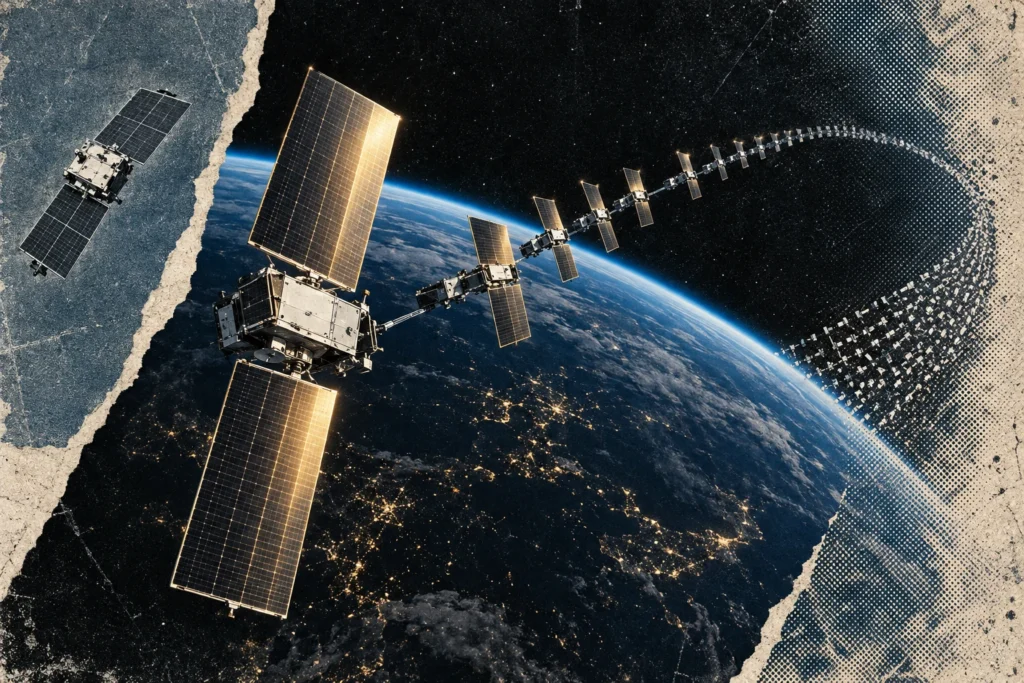
The Federal Communications Commission (FCC) on November 25 authorized SpaceX to deploy up to 1 million Starmind orbital data center satellites, although the order grants radio frequencies only for backup and emergency use. Satellites above 600 kilometers have not yet been cleared for deployment, and the authorization carries milestones from 2033 through 2040.
The FCC called the decision the first authorization for a space data center constellation in U.S. history. SpaceX, meanwhile, warned in its initial public offering (IPO) filing that orbital artificial intelligence (AI) data centers are unproven and may not become commercially viable.
Radio authorization covers backup and emergencies
SpaceX says on its official Starmind page that the satellites will perform computing in sun-synchronous orbit and send results back to Earth through laser links to Starlink. Because the FCC regulates radio communications, its order grants only Ka-band frequencies: 18.8 to 19.3 GHz for downlinks and 28.6 to 29.1 GHz for uplinks.
The frequencies are restricted to telemetry, tracking and commands in backup and emergency situations. They operate on an unprotected, non-interference basis: SpaceX cannot interfere with other users and cannot claim protection from interference itself.
Deployment milestones run through 2040
The order describes the application as partly granted, partly deferred and subject to conditions. SpaceX filed on January 30, and the FCC’s Space Bureau announced acceptance of the application on February 4. Bureau chief Courtney Reinhard signed the authorization on November 25.
The deployment deadlines are binding. Missing a milestone will cause the authorization to expire automatically:
- At least 1 satellite must be operating in orbit by November 25, 2033.
- Deployment must reach 10%, or 100,000 satellites, by November 25, 2035.
- Deployment must reach 50%, or 500,000 satellites, by November 25, 2038.
- All 1 million satellites must be in place by November 25, 2040.
The license lasts 15 years from the date the first satellite begins operating in orbit. SpaceX has 30 days to decline the conditional grant; no response counts as acceptance. During the license term, the company must report every six months on collision warnings, the number of satellites retired and reentered, and the number in orbit.
The order waives the application queue mechanism for non-geostationary orbit (NGSO) satellites, but gives SpaceX no queue priority. The company must protect existing and future operators and coordinate with all users.
Satellites above 600 kilometers need another application
SpaceX sought a waiver of a rule requiring satellites below 2,000 kilometers to reenter the atmosphere and burn up at the end of their missions. For satellites above 600 kilometers, the company instead wants to use an Earth disposal orbit or a solar orbit. The FCC deferred that request, saying SpaceX had not supplied enough information to determine whether it complied with the rules.
Before deploying Starmind satellites above 600 kilometers, SpaceX must apply to modify its authorization and submit a final orbital debris mitigation plan. The FCC found the plan for satellites below 600 kilometers compliant.
The authorization covers altitudes from 500 to 1,002 kilometers, divided into multiple orbital layers spanning 50 kilometers each. For now, only the two groups below 600 kilometers, at altitudes of 550 to 585 kilometers, can be deployed directly.
One million satellites would dwarf Starlink’s current fleet
Starlink figures compiled by space observer Jonathan McDowell show that, as of November 22, the network had 11,203 satellites in orbit, including 9,642 in operational orbits. A total of 13,122 had been launched.
In an October 6 space safety statement, SpaceX said it planned up to 100,000 Starlink satellites alongside as many as 1 million Starmind satellites. The Starmind total is roughly 89 times Starlink’s current in-orbit fleet. Its 100,000-satellite milestone for 2035 matches the planned Starlink ceiling.
FCC rejects petitions and addresses objections
Amazon, Viasat and the American Astronomical Society (AAS) each petitioned the FCC to reject SpaceX’s application. The agency denied all three petitions.
On environmental reviews, the FCC relied on new National Environmental Policy Act (NEPA) rules finalized in October that treat space activities as extraterritorial and do not require a NEPA environmental review. The order also said the atmospheric effects of satellites burning up on reentry 「remain speculative」 and that rocket emissions fall under the Federal Aviation Administration (FAA).
For optical astronomy, SpaceX promised to coordinate with the National Science Foundation (NSF), a commitment the FCC considered sufficient. The AAS also raised concerns that waste heat from satellites could brighten the infrared sky background. The FCC responded that the issue was not a radio matter and fell outside its jurisdiction.
On orbital congestion, the FCC said its rules do not limit the number of satellites that can be authorized, and that the Space Bureau would not 「invent a de facto rule in an individual case」. As for questions about commercial feasibility and heat dissipation, the agency said those objections would require the government to decide whether a company’s business could succeed. 「We decline to do so,」 it said.
Scientists have raised separate warnings. Space.com reported on August 11 that University of British Columbia astronomy professor Aaron Boley, University College London atmospheric chemistry professor Eloise Marais and other researchers warned that launches and reentries put pollutants directly into the upper atmosphere, where they remain longer. If hundreds of thousands of data center satellites were launched, they said, the number of reentries would be 100 times the current level.
Factory plans and a warning on commercial viability
SpaceX says on the official Starmind page that it plans to build a 「Gigasat Factory」 in Bastrop, Texas, to mass-produce AI satellites. Large-scale deployment could begin as early as the end of 2027, the page says, adding that the project is not tied to a chip supplier.
Elon Musk said on August 25 that a space version of Vera Rubin NVL72 was expected to reach orbit in the fourth quarter of 2027, followed by large-scale deployment in 2028. In its IPO filing, SpaceX warned that orbital AI data centers remain unproven and may not be commercially viable.



