
Reuters, citing people familiar with the matter, reported that the Trump administration is drafting a ban on imports of new Chinese-made data center components, with the U.S. Federal Communications Commission planning import restrictions on optical transceivers made in China. The goal, according to the report, is to announce the measure and put it into effect this year. The White House and the FCC did not respond to requests for comment.
Premarket gains spread across optical networking names
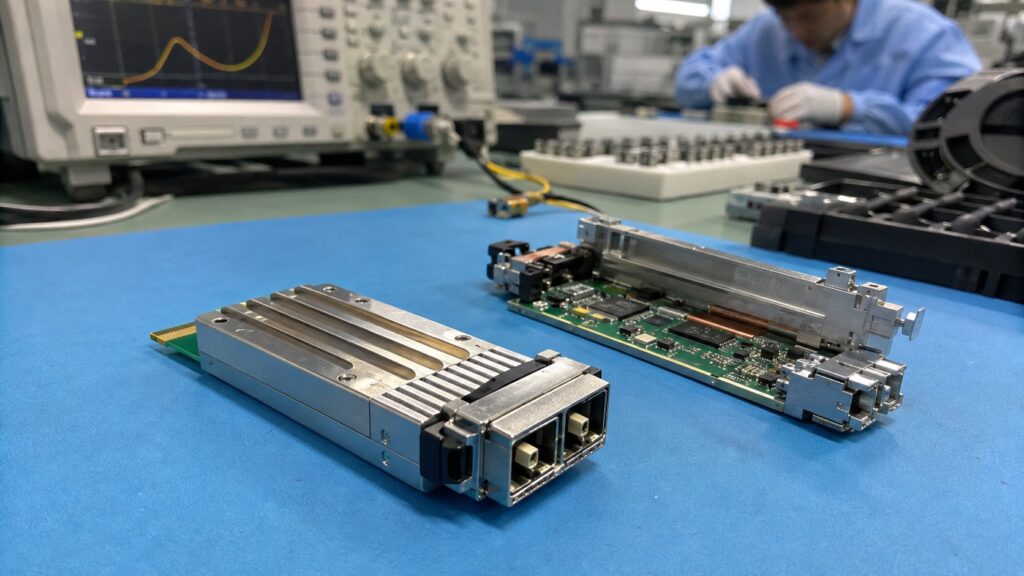
Optical transceivers are the modules that convert electrical signals into optical signals inside data centers. They are used for traffic between racks and between data centers over fiber. The report said AI training clusters with tens of thousands of GPUs require optical modules in step with GPU growth. The main specification in use now is 800G, while 1.6T is beginning to scale.
After the report surfaced, U.S.-listed optical communications stocks moved sharply higher in premarket trading. As of 6:47 p.m. Taipei time, compared with the Aug. 3 close, the article listed the following moves:
- AAOI (Applied Optoelectronics): $130.23, up 18.17%
- Coherent (COHR): $329.15, up 14.23%
- Lumentum (LITE): $868.27, up 11.33%
- Marvell (MRVL): $211.94, up 9.37%
- Tuttle Capital Pure Play Photonics ETF (FOTO): $20.96, up 9.22%
- Corning (GLW): $158.60, up 8.16%
- Ciena (CIEN): $419.01, up 7.23%
- Credo (CRDO): $233.75, up 7.05%
At the same time, Nvidia (NVDA) was up 1.02%.
The group had already been climbing for five trading days
The article said the run in these names began before the latest report. On Aug. 3 alone, AAOI rose 16.85%, Coherent gained 9.60%, and Lumentum added 9.24%. The catalyst that day was Nvidia’s announcement that co-packaged optics, or CPO, had entered mass production.
Looking further back, from the close on July 29 to the latest premarket levels, AAOI had climbed 70.19%, Coherent 48.23%, Lumentum 44.15%, and Credo 31.73%. Nvidia, over the same period, was up 9.86%. The article said that put the five-day gains in optical networking names at roughly three to seven times Nvidia’s move.
Chinese suppliers hold a large share of the 800G market
The report argued that the scale of the move reflected how much of the market is in Chinese hands. Innolight was described as the world’s largest optical module supplier with about 23% global market share. In 800G, its share was put at more than 40%, and in 1.6T at 50% to 70%.
Eoptolink, identified as the world’s second-largest supplier, was said to hold about 25% to 30% of the 800G market. Taken together, the two companies supply roughly two-thirds of the current mainstream 800G segment, according to the article.
The piece also noted that BlockTempo reported in July that Goldman Sachs had set a target price of RMB 2,581 for Innolight, and that the market has referred to the company as the “TSMC of optical communications.”
FCC actions have moved from power and telecom gear to optical components
The article said the FCC last week barred imports of new Chinese-made humanoid robots, quadruped robots, and networked power inverters, citing the protection of data center power systems and grid security. Earlier this year, on April 30, the FCC unanimously approved a proposal to bar China Mobile, China Telecom, and China Unicom from operating data centers and network access points in the United States. Beginning in June, it also expanded existing restrictions to cover older models from Huawei, ZTE, and Hikvision.
In the article’s framing, the sequence has moved from telecom equipment and surveillance gear, to power systems used by data centers, and now to optical communications components used inside those facilities.
It also highlighted a detail that could be overlooked in the stock reaction. Last week’s ban on robots and inverters applied only to “new” products that had not yet been launched, and did not retroactively apply to existing models. The article added that in earlier restrictions on drones and routers, the FCC exempted a large number of non-Chinese suppliers. Reuters used similar language this time, describing the planned measure as one covering “new” components.