
The coming week is packed with macro and regulatory catalysts for crypto, led by the Federal Reserve’s rate decision, a key U.S. Senate vote on the CLARITY Act, and a public debate over who should control tokenized stock products.
Central bank week puts the Fed at the top of the agenda
According to ChainCatcher, global markets are entering a central bank-heavy week. The Federal Open Market Committee is scheduled to release its interest-rate decision and Summary of Economic Projections early Thursday Beijing time, with Chair Warsh set to follow with a monetary policy press conference. The Bank of England and the Bank of Japan are also due to announce policy decisions on Thursday and Friday.
The U.S. Senate is expected to hold a key procedural vote on Tuesday local time on the Cryptocurrency Market Structure Act, better known as the CLARITY Act. On the same day, the U.S. Securities and Exchange Commission will host a roundtable on 24-hour trading.
- Tuesday: key procedural vote on the CLARITY Act; U.S. ADP employment change for the week ending Aug. 29; New York Fed manufacturing index for September.
- Wednesday: U.S. API crude stock change for the week ending Sept. 11; August retail sales, August import price index, September NAHB housing market index; July business inventories; and EIA crude stock change for the week ending Sept. 11.
- Thursday: Fed rate decision and economic projections, followed by Chair Warsh’s press conference; U.S. initial jobless claims for the week ending Sept. 12; Bank of England rate decision and minutes; SEC roundtable on 24-hour trading.
- Friday: Bank of Japan rate decision and press conference by Governor Kazuo Ueda.
Fed expectations remain split as markets focus on Warsh
Jefferies global economist Mohit Kumar said in a report that he expects the Fed to raise rates this week and sees Warsh’s comments as the key variable. "We expect the Fed to hike, but Warsh’s comments on the future policy path will be key," he said.
On the path beyond this meeting, Jefferies said actual Fed action is likely to fall short of the 3.5 hikes implied by forward markets. Kumar added, "From a credibility perspective, the first hike may be necessary, but subsequent hikes will depend on how long the war lasts and where oil prices go."
Another ChainCatcher item said sticky inflation has set up a confrontation this week between Donald Trump and Fed Chair Warsh, with markets preparing for the possibility that the central bank hikes despite the president’s objections. Trump has repeated that the U.S. should have the "lowest interest rates in the world" and may be dissatisfied with a hike.
Barclays economists said uncertainty around the Fed decision has made this week’s FOMC meeting the central focus for markets. If the Fed unexpectedly leaves rates unchanged, or hikes by less than expected, the dollar could come under short-term pressure.
CLARITY Act heads into a crucial Senate test
ETF Store president Nate Geraci said the industry would benefit if the CLARITY Act secures enough support this week to move forward, but he does not view the bill as the deciding factor for crypto’s future.
Geraci argued that under the Trump administration, the SEC and the Commodity Futures Trading Commission would use existing authority to support crypto development. In his view, the bill would mainly add regulatory certainty and speed up innovation. He also said crypto is moving much faster than the policy process, and by the time U.S. politicians fully recognize that the financial system has already changed, that shift may be difficult to reverse.
The Block reported that after Senate Republicans released what they described as a "final" version of the Clarity bill incorporating changes sought by Democrats, the probability of passage in 2026 on Polymarket rose to 30%.
Crypto reporter Eleanor Terrett said Senate Republicans have released an updated CLARITY Act text and called it their "last, best, and final offer" to Democrats before debate ends and a vote is held Tuesday. The revised draft includes changes tied to ethics rules, BRCA, stablecoin yield and provisions connected to the Agriculture Committee.
Trump, Terrett reported, has agreed to roughly 80% of the Tillis-Gallego ethics proposal, including selling "material" crypto-related financial interests or placing them in a blind trust. On stablecoin yield, the new draft adds a "circuit breaker" that would allow federal regulators to step in if community bank deposits flow into stablecoins at scale, with the judgment to be made by Treasury Secretary Scott Bessent.
The BRCA shield has also been narrowed, and the new text adds tighter limits on vertical integration, including affiliated transactions and conflicts of interest involving digital commodity exchanges, brokers and dealers.
Politico reported that Senate Minority Leader Chuck Schumer called a Sunday evening Democratic caucus meeting to discuss the CLARITY Act ahead of Tuesday’s vote.
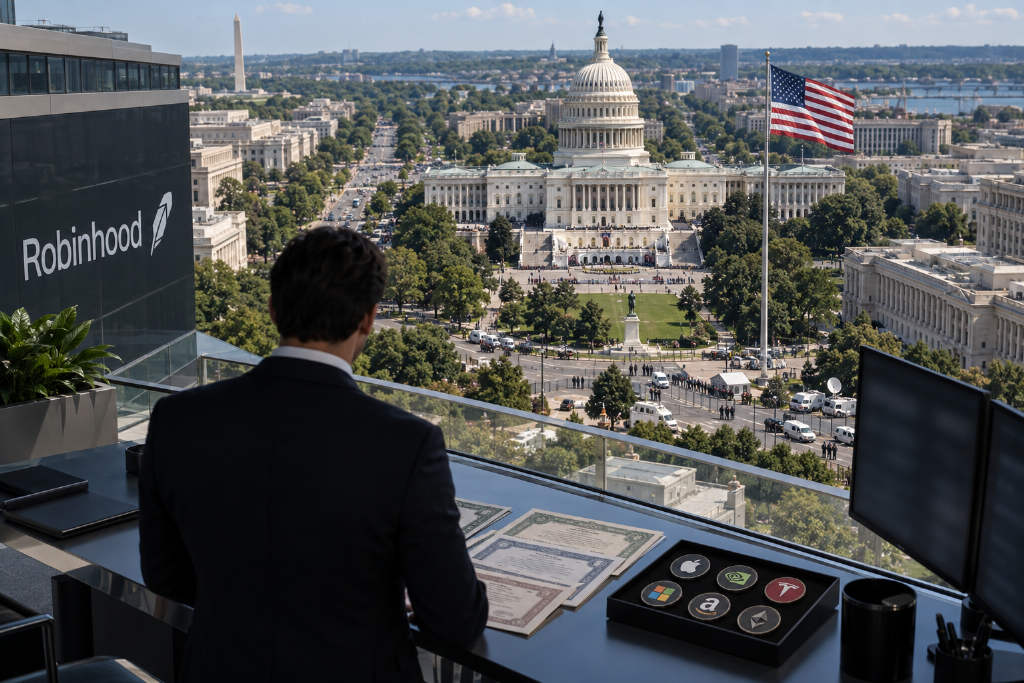
Robinhood CEO says tokenized stocks should not need issuer sign-off
Robinhood CEO Vlad Tenev said issuers should not have veto power over tokenized stock products, so long as those products do not change shareholder rights, issuer obligations or the company’s official share register.
In a post on X, Tenev said whether issuers should be involved depends on whether a tokenized product changes the rights attached to the underlying stock or creates new obligations for the company and its transfer agent. If it does, issuer involvement is appropriate. If it instead creates an independent financial instrument that holds or references freely transferable shares without changing issuer rights, obligations or the shareholder ledger, then issuer approval should not be required.
Tenev said Robinhood Stock Tokens use a third-party structure in which independently issued instruments are backed 1:1 by the underlying stock, giving users economic exposure to stocks and ETFs without altering the issuer’s capital structure or the rights attached to the stock. "Moving onchain should not give issuers a veto they never had offchain," he wrote.
AMC Entertainment CEO Adam Aron had criticized Robinhood’s tokenized stock product on Sept. 4, saying AMC had no connection to the product and would ask securities counsel to review it.
Bitfinex says Bitcoin selling pressure has dropped to one-year lows
Bitfinex Alpha said in its latest report that Bitcoin has now traded for more than 24 sessions inside a range of about 5.5%, with roughly 840,000 BTC cost basis clustered in that zone. Profit-taking has slowed sharply, and seller risk ratio has fallen to 7 basis points, one of the lowest readings in the past year, though limited spot demand is still capping a breakout.
The report added that leverage is concentrated near both ends of the range. About $1.95 billion in short liquidation risk sits near $82,000, while a sizable long position cluster is concentrated between $75,000 and $76,000. That setup could amplify post-Fed volatility.
Bitfinex also pointed to a more complicated macro backdrop driven by higher energy costs, rising real yields and weaker consumer confidence. Whether BTC can break out of the range, it said, still depends on Fed guidance and the path of real yields and energy prices.
EU Cyber Resilience Act takes effect, raising reporting obligations for wallet makers
Cointelegraph reported that the European Union’s Cyber Resilience Act took effect on Sept. 11. The law requires crypto hardware and software wallet providers to file an early warning report within 24 hours of discovering an actively exploited vulnerability or a severe security issue, and to submit a full notification within 72 hours.
Manufacturers must also submit a final report within 14 days after corrective or mitigation action is taken, while serious incidents must be fully reported within one month. The European Commission said the requirements are intended to improve protection for consumers and businesses against cyber threats and apply to all products with digital elements sold in the EU.
Under the final draft penalty provisions, companies that fail to comply with Articles 13 and 14 may face administrative fines of up to 15 million euros or 2.5% of global annual turnover, whichever is higher. Providing incorrect, incomplete or misleading information can trigger fines of up to 5 million euros.
The measure comes after several hardware wallet companies disclosed user data incidents. On Sept. 4, Trezor said a data breach at logistics provider ShipMonk affected about 67,000 U.S. customers, far above the initial estimate of 14,000. This week, Trezor and BitBox also warned users about phishing emails disguised as urgent security notices. In June, Layer-1 blockchain Zilliqa warned that its Ledger app had a flaw that could allow attackers to recover private keys using public onchain data.
RWA perpetuals, Hyperliquid and HYPE buybacks
Cointelegraph reported that CoinMarketCap research head Alice Liu said on the Trade Secrets program that Bitcoin may already have bottomed and is unlikely in the near term to revisit the lower levels seen for much of the year.
She said Bitcoin fell to about $59,000 in June, roughly 53% below its October all-time high of $126,100. In early September it briefly reached $81,600, up about 28% since mid-August, helping lift the CoinMarketCap Fear and Greed Index back into greed territory.
On Hyperliquid, Liu said network activity does not automatically convert into token price performance. She observed that over the past two months, RWA perpetual trading tied to tokenized stocks, ETFs and indexes had previously been concentrated on Hyperliquid, but after Binance launched RWA perpetuals, volume and liquidity shifted quickly. Binance now holds about 50% market share, though Hyperliquid still leads within the DEX segment.
HYPE recently hit an all-time high of $86, and Hyperliquid has spent more than $400 million on token buybacks. Liu said part of the price momentum has been supported by those buybacks, but the key issue is that HYPE depends on continued network revenue inflows to sustain them.
CoinShares reports lower revenue and a first-half net loss
GlobeNewswire reported that digital asset manager CoinShares PLC released results for the first half ended June 30, 2026. Total revenue came in at $51.4 million, down from $80 million in the first half of 2025. Asset management revenue was $40 million, capital markets revenue was $11.4 million, and operating income added another $3.4 million.
Assets under management stood at $5.5 billion on June 30, down from $7.4 billion on Dec. 31, 2025. The group posted net inflows of $27.6 million during the period, including $155.9 million of inflows into CoinShares Physical, partly offset by $104.6 million of net outflows from the legacy CoinShares XBT Provider platform.
Operating loss was $5.1 million and segment EBITDA was $21.6 million. Net loss totaled $23.9 million, including $16.6 million of unrealized losses tied to XBT pricing differences and $15.4 million of unrealized losses on inventory digital asset holdings. Net assets were about $453 million, with no long-term debt and available capital of about $413.9 million.
The board plans to seek shareholder authorization for a share buyback program at an extraordinary general meeting on Sept. 15, 2026. CoinShares also said it launched its first Bitcoin mining UCITS ETF in July and completed the acquisition of Bastion in early September.
Temporal, Kaiko, tZERO and Aeon announce financing updates
Reuters reported that AI startup Temporal has raised $550 million in late-stage financing at a valuation of $12.55 billion, more than doubling its valuation in seven months. Lightspeed Venture Partners led the round, with Wellington Management, Goldman Sachs Alternatives’ Growth Equity arm and Tiger Global joining as co-leads. SV Angel and advisory accounts of T. Rowe Price Associates also took part, while existing investors Andreessen Horowitz, Sequoia Capital and GIC continued to back the company.
The funding will be used to expand global operations and deepen platform research and development. Founded in 2019, Temporal develops open-source software that helps applications, including AI agents, recover from failures and reduces the need for engineers to write custom recovery code. Its customers include OpenAI, Snap, Nvidia, Netflix and JPMorgan Chase. The company has 570 employees and an annualized revenue run rate above $250 million, up more than threefold year over year. In February, it raised $300 million at a $5 billion valuation in a round led by a16z.
Bloomberg reported that crypto market data provider Kaiko secured fresh investment led by S&P Global, taking the latest financing round to $110 million. Participating investors include DRW Holdings, Susquehanna, Royal Bank of Canada, Nasdaq, BNP Paribas, Bpifrance, Broadridge, Canton Ventures, Coinbase Ventures and Stellar.
Kaiko said the financing comes as Wall Street accelerates tokenization efforts and around-the-clock markets drive demand for 24/7 pricing, valuation and risk-management infrastructure. The company plans to use the money to develop new products and services. Kaiko previously raised $53 million in Series B financing in June 2022, led by Eight Roads, with Revaia and existing investors Alven, Point Nine, Anthemis and Underscore participating.
Separately, security token trading platform tZERO said in an official announcement that it completed a new financing round led by existing investors Marc and Max Cohodes, with Intercontinental Exchange, Bill Fleckenstein and partner Dinari participating. Neighborhood Intelligence also committed support, with a portion of its capital to be provided when tZERO announces a binding strategic transaction agreement, such as a change of control, sale of most assets, or a merger with a SPAC or another entity. tZERO said the financing will support ongoing infrastructure development and help the company transition toward independent operations.
EU-Startups reported that Zurich-based preventive healthcare company Aeon completed an extension of its seed round and acquired German blood diagnostics platform Aware Health, bringing total seed funding to more than 12 million euros. The round was co-led by Araya Ventures, with Concentric, GoHub Ventures, Kadmos Capital, Calm/Storm Ventures, N&V Capital and Bigwave Capital participating.
Kraken launches xStocks vaults tied to tokenized equities
The Defiant reported that Kraken has rolled out three xStocks vaults, allowing eligible clients to deposit SPYx, QQQx and NVDAx to earn variable yield while retaining exposure to tokenized stocks or ETFs.
The vaults initially show estimated net APY of 2% for SPYx and QQQx, and 1.8% for NVDAx. Kraken takes a 25% performance fee on vault yield, and the displayed rate is net of that fee. Rewards are converted into the same xStock and automatically reinvested into the client balance.
The strategy was designed by Sentora, which also handles risk controls, while Veda provides vault infrastructure. After a client deposits an xStock, Kraken transfers it into an embedded self-custody wallet on Ink, wraps it and deposits it into a Veda vault. Sentora then bridges the wrapped xStock to Solana, uses it as collateral in the Kamino lending market, borrows stablecoins and deploys them into selected DeFi strategies. Yield is eventually converted back into the deposited xStock.
Clients do not need an external wallet or seed phrase, though they can export their private keys. Redemptions take three days to settle. Kraken’s documentation says the strategy uses leverage by borrowing stablecoins and lists risks tied to smart contracts, liquidity, bad debt, liquidation, cross-chain execution and downstream assets. Any losses are shared pro rata by vault users. xStock holders do not receive voting rights, dividend rights or legal claims on the underlying stock.
The product is currently available in the European Economic Area and other supported open markets. Users in the U.S., U.K., Canada, Australia, the UAE and sanctioned countries are excluded.
WTO says stablecoins still account for just 3% of global payments
Cointelegraph reported that Juan Marchetti, director of trade in services and investment at the World Trade Organization, said at a WTO event in Geneva that the main barrier to broader stablecoin use in international trade is not technology but the absence and fragmentation of regulation.
He cited an October 2025 report from the Financial Stability Board showing that out of 28 surveyed jurisdictions, only 11, or about 39%, had completed stablecoin regulatory frameworks.
A WTO report said stablecoins currently account for only 3% of total global international payments, though cross-border stablecoin payment volume grew 35-fold from 2020 to mid-2024. The report also said stablecoins could help address five major pain points in trade finance: high costs, slow speed, limited access, lack of transparency and foreign-exchange conversion issues.
Grayscale expands advisor offering with model portfolios
GlobeNewswire reported that Grayscale Investments launched Grayscale Model Portfolios, a lineup of professionally built model portfolios designed to provide recommended allocations across the digital asset ecosystem and broaden its advisor-focused product suite.
Laurie Katz, Grayscale’s global head of distribution, said advisors increasingly want to include digital assets in client portfolios without building and maintaining each position one by one. She said the product combines portfolio construction expertise with more than a decade of digital asset experience, allowing advisors to deliver crypto exposure through a single familiar framework.
Each model combines multiple digital asset exchange-traded products into one strategy, covering asset selection, position sizing, diversification and rebalancing. Grayscale Advisors, LLC will deliver the models to financial platforms for use in client accounts, while advisors retain full discretion.
The four launch strategies are market-cap weighted, rebalanced quarterly and cap single-asset exposure at 40%. They are Digital Assets Core Plus, Digital Assets Leaders, Digital Assets Next Gen and Digital Assets Infrastructure. Digital Assets Core Plus uses Bitcoin and Ether as the base allocation and also includes assets such as Solana and Chainlink.
Dogecoin ETF demand remains weak as Bitwise closes BWOW
CoinDesk data show that three U.S. Dogecoin ETFs have attracted only about $12 million in cumulative net inflows over nearly 10 months. By comparison, XRP funds pulled in $12.29 million on Sept. 9 alone.
Across 199 tracked trading days, Dogecoin funds recorded zero net flow on 166 days, or more than 83%. From Aug. 13 to Sept. 10, they also logged about $108,000 in net outflows.
By contrast, XRP funds have brought in $1.7 billion since launching in November 2025, while SOL funds have attracted $1.36 billion since their October 2025 debut, each more than 100 times the total for Dogecoin funds. Over the 20 trading days from Aug. 13 to Sept. 10, XRP funds added $190.5 million and SOL funds added $199 million, while Dogecoin funds posted net outflows. Even a price gain of more than 30% for Dogecoin during the last two weeks of August did not materially change that pattern.
The weak demand has now led to product cuts. Bitwise said it will shut down its Dogecoin ETF, BWOW. The fund launched in November 2025 and had only $687,700 in assets as of Sept. 9. It is expected to stop trading on Oct. 14, with remaining shareholders to receive cash on Oct. 22. A Bitwise spokesperson said the company chose to liquidate the product as part of ongoing efforts to optimize the lineup for changing investor demand.
South Korea investors seek a fourth delay to crypto tax
South Korean investors are again pushing to delay the country’s planned tax on crypto gains, which is scheduled to take effect on Jan. 1, 2027, but regulators are holding to the existing timeline.
Under the National Assembly’s electronic petition system, a petition calling for a two-year delay has collected 50,000 valid signatures, enough to trigger review by the relevant standing committee.
South Korea plans to impose a 22% tax on the portion of annual digital asset gains exceeding the 2.5 million won exemption threshold. That figure includes a 20% base tax and a 2% local tax, and applies to gains from sales, transfers and lending of crypto assets. The measure has already been postponed three times since it was first discussed in 2022.
Petitioners argue that many crypto investors are already facing large losses and that operating profit at major domestic crypto firms has fallen by as much as 90%. In their view, taxing now would remove a path to wealth creation for younger people and could push investors toward offshore platforms. In May, another petition calling for the crypto tax to be scrapped entirely reached the 50,000-signature threshold in eight days but did not advance further.
The government’s position has not shifted. Lee Hyeong-il, nominee for economy and finance minister, said over the weekend that the tax plan remains on schedule and that the National Tax Service will publish detailed standards later this year.
Spot Ether ETFs post a fourth straight week of net inflows
SoSoValue data show that spot Ether ETFs posted $197 million of net inflows over the U.S. trading week from Sept. 7 to Sept. 11, extending the streak to four consecutive weeks.
BlackRock’s ETHA led with $140 million in weekly net inflows, bringing its cumulative total to $13.01 billion. BlackRock’s ETHB followed with $55.2009 million of weekly inflows, taking its cumulative total to $831 million.
Grayscale’s ETHE saw the biggest weekly outflow at $17.2921 million, bringing cumulative net outflows to $5.4 billion. As of publication, total net assets across spot Ether ETFs stood at $16.31 billion, with an ETF net asset ratio of 5.28% relative to Ether’s total market cap. Cumulative historical net inflows reached $13.39 billion.
Symbiosis pauses BTC route after exploit mints unsupported syBTC
Blockchain security platform Blockaid said a vulnerability in Symbiosis’ Bitcoin bridge allowed an attacker to mint about 2^62 syBTC to a newly created externally owned account. At 8 decimal places, the nominal face value was about $46.1 billion. The attacker then sold about 4.39 WBTC on Uniswap V4 on Ethereum, realizing about $336,000.
Symbiosis said the attack took place at around 4:28 on Sept. 11. The team has suspended the BTC route, while other routes remain operational and unaffected. It also said it recovered about 15 BTC and placed the funds in a team-controlled multisig wallet. The protocol offered the attacker a 20% white-hat bounty with a deadline of Sept. 13.
The report noted that Liquid Network, Nomic and Symbiosis have all recently experienced security incidents involving supply expansion through the minting of tokens without real asset backing. As of Sept. 13, Symbiosis had not published a BridgeV2 technical post-mortem, a final loss figure or confirmation on whether the attacker accepted the bounty.
Other developments across tech, AI and onchain markets
South Korea’s JoongAng Ilbo reported that China’s semiconductor industry is being advanced through a coordinated model involving the central government, local governments, state-backed financial institutions and companies. China’s National Integrated Circuit Industry Investment Fund raised 138.7 billion yuan in phase one, 204 billion yuan in phase two and 344 billion yuan in phase three, for a combined 686.7 billion yuan, with capital deployed into companies including SMIC, Hua Hong Semiconductor and YMTC. CXMT reached fourth place globally in DRAM share in 10 years, while posting net losses of 21.13 billion yuan over the past three years and investing 185.2 billion yuan in R&D and equipment over the same period. State capital from Hefei provided about 80% of the funding in early projects.
South Korea plans to guide 622 trillion won of private investment by 2047 and provide 17 trillion won of low-interest loans plus a 1.1 trillion won semiconductor ecosystem fund, though most of the burden remains on companies. Park Geon-su, executive vice chairman of the Korea Semiconductor Industry Association, said semiconductors are an industry where halting investment means falling behind in the next upcycle, making long-term policy finance and tax support necessary even during downturns.
Mech-Mind, the industrial robotics and embodied AI company described as the first listed embodied intelligence firm focused on eyes, brain and hands, went public in Hong Kong on Sept. 1, 2026. Founder and CEO Shao Tianlan said listing is only an action and that what really matters is becoming a public company. He said he still sees himself as an engineer and spends about half his time on core technology, use cases and product iteration. Shao criticized what he called a rush to bring high-risk companies with insufficiently proven business models to the public market.
Business Insider reported that Michael Burry sharply criticized OpenAI and Anthropic CEOs for calling to slow AI development, calling the stance self-interested. He listed four reasons: large language models are not true AI, the push protects incumbents, it helps hype IPO narratives, and it obscures weakening growth.
TOP Chinese Tech Community said Hillhouse Venture partner Yan Wentao may join DeepSeek as CFO and is expected to take the role soon. The report said DeepSeek has begun preparing for a STAR Market IPO, with CITIC Securities already conducting due diligence, though no formal listing guidance agreement has been signed. DeepSeek wants to launch the IPO process this year. Yan has been involved in tech investing for years, with publicly disclosed investments including ByteDance, MiniMax and Zhipu AI. DeepSeek currently has no CFO and no formal investor relations team.
Trading and meme token activity
Trader loshmi said he has closed all positions and realized $327,400 in profit across 30 days of public trading. He said he began buying STONK more than a month ago when the token’s market cap was about $1 million, and kept adding during price declines. Stonkfun, launched on Aug. 3, is a Solana token issuance platform that lets creators pair new tokens with tokenized stocks. STONK is its native token.
Loshmi said his portfolio once rose from $5,000 to more than $25,000 before falling back to $4,000, and that he also lost more than $6,000 in a hack during the period. He said he closed the trade because of fatigue from increasingly intense market competition.
According to GMGN data as of 08:45 on Sept. 15, the top five ETH trending tokens over the past 24 hours were SEND, STOCKER, UNI, MOTO and LINK. On Solana, they were STONK, CATE, baton, biketyson and BRAIN. On Base, they were Basecat, VVV, SOL, FLOCK and LAPTOP.