


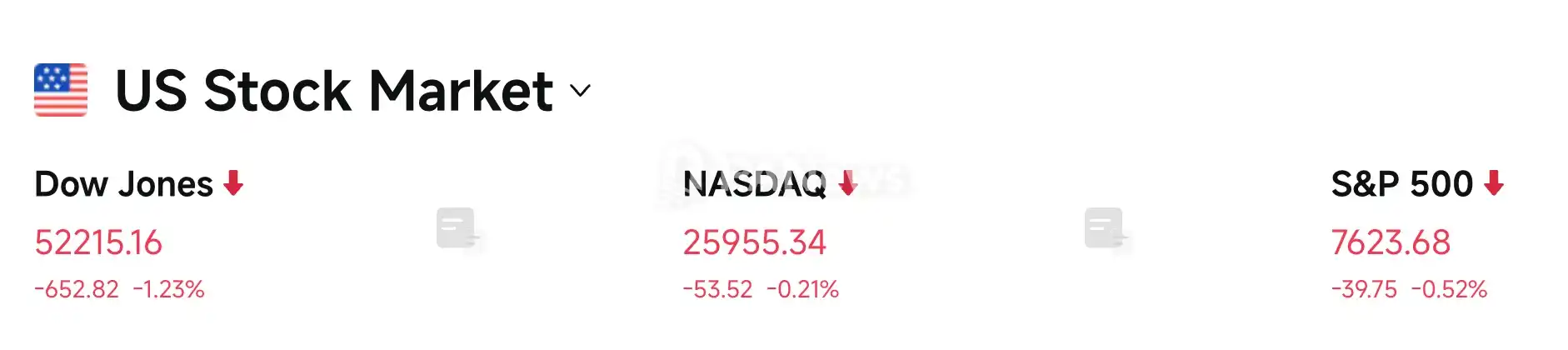
Wall Street entered the so-called “super central bank week” by cutting risk. On Friday, the Dow Jones Industrial Average fell 1.23%, the S&P 500 lost 0.52%, and the Nasdaq Composite slipped 0.21%. Bloomberg macro strategist Michael Ball said rising oil prices are replacing credit concerns as the main threat to the S&P 500’s internal rotation.

Oil, geopolitics and bond yields are back at the center
The report said the Middle East conflict has become the main external driver of inflation. U.S. intelligence director Clayton issued what was described as the strongest warning in eight months, saying an Iranian plan for a deadly attack on U.S. targets had entered an “advanced stage,” while Washington was urgently evacuating non-essential diplomatic staff from Saudi Arabia and other countries.
Donald Trump told Fox News the situation had reached a “moment of decision,” saying there would either be a deal or an “epic fury” operation to eliminate Iran, and he suggested the U.S. and Israel could launch large-scale bombing after the midterm elections. He later changed tone and said there would be no strike “today.” Former President Barack Obama also spoke out, criticizing what he called a war on Iran that “nobody voted for” and saying it was pushing prices higher.
Brent crude futures jumped 3.58% on Friday to $117 a barrel after shipping through the Strait of Hormuz dropped sharply. Spot premium reached $127.54. In Monday Asian trading, crude fell about 2% on news of mediation efforts by Qatar. Goldman Sachs analyst Peter Hackworth said oil already reflects more than $20 of risk premium and that only a full-scale war would push Brent above $120. Morgan Stanley said the market’s deeper concern is the cost of shipping and a shortage of refined products.
Spot gold fell 0.67% on Friday and touched an intraday low of $3,975.65, the first break below $4,000 since July. Spot silver dropped 1.21% to around $53. The 10-year U.S. Treasury yield closed near 4.99% after rising during the session, leaving markets locked in another fight around the 5% level. The U.S. dollar index added 0.2% to 101.811 and has now spent two straight weeks near an 18-month high range.
Florian Ielpo, an analyst at Lombard Odier Asset Management, said the core issue is that bonds are no longer cheap. Goldman Sachs strategists said the AI selloff has brought some hedging demand into Treasuries, but pressure on sovereign debt remains elevated after the France-Germany 10-year spread widened to 176 basis points, the highest since 2011, and weak U.S. Treasury auctions added to the strain.
Fed decision is the main event, with Kevin Warsh in focus
The Federal Reserve decision early Thursday is the week’s central event. Even with core CPI rising 0.3% month over month in September, several Fed officials had recently struck a dovish tone, and the probability of keeping rates unchanged at 3.75%-4.00% in October was seen above 90%.
Markets are more concerned about whether new Chair Kevin Warsh will diverge from his colleagues. Deutsche Bank chief economist Matthew Luzzetti and Goldman Sachs analyst David Mericle expect Warsh to leave room at the press conference for a December rate hike. Market pricing for such a move stands at 72%-80%.
AI trade faces a decisive test
U.S. equities are moving into what the report called a decisive week for the AI bull market. TMT sectors have seen about $20 billion in net outflows over the past two weeks, and the Philadelphia Semiconductor Index fell another 3.2% last week. Goldman Sachs prime brokerage data showed U.S. equities were net sold for a third straight week. Hedge fund short leverage rose to the 99th percentile of the past five years, and long-short portfolios dropped 4.2% in a single day last Thursday, one of the sharpest declines in a decade.
Money has been rotating hard. Investors sold technology and industrial names while moving into consumer staples and real estate at the fastest pace in five years.
Goldman Sachs strategist Ben Snider said retail trading volume is down 45% from the end of last year and now accounts for 9% of total turnover, but U.S. households still hold $65 trillion in equities and bought a net $840 billion in the first half, making them a major anchor for the market. Goldman Sachs, Jefferies and Deutsche Bank all kept year-end S&P 500 targets at 8,000, and UBS’s CIO also stayed bullish.
Goldman recommended buying weakness in power, hyperscale cloud, inference and cybersecurity. Deutsche Bank, which the report said had called the top two weeks earlier, warned that tech stocks could still fall another 5% relative to the broader market before reaching the lower end of their long-term trend channel. Bank of America strategist Michael Hartnett kept a “tactical risk-off” stance through mid-November and said if cloud-company bond spreads widen past 200 basis points from the current 130 basis points, the AI story could shift from a valuation problem to a credit problem.
Higher yields and capex pressure are colliding
With the 10-year Treasury yield pushing through the 5% area, bond yields for “new cloud” leader CoreWeave climbed to 15.76%, implying a 63% default probability over five years. Long-dated bond yields for Microsoft, Amazon and Meta also moved toward 6.4%-7.5%.
SemiAnalysis founder Dylan Patel and Bernstein analyst Stacy Rasgon said the cost of building a 1GW data center has risen from $40 billion to $60 billion. They also pointed to tight supply in substrates, optical modules and HBM wafers. At the same time, in-house chips such as Google’s TPU and Amazon’s Trainium are eating into Nvidia’s pricing power.
Still, the AI spending race has not stopped. Nomura said Alphabet, Meta and Amazon have already seen free cash flow turn negative, yet none of them wants to be first to cut spending. The firm said they would rather issue debt or sell more equity than pull back. It projected global AI capital spending at $1.4 trillion to $1.6 trillion next year, put the probability of the race continuing at 75%, and said memory supply and elevated pricing for 2027 have already been locked in through long-term agreements.
That helps explain why memory-chip profits are surging while share prices have fallen sharply. Samsung Electronics and SK Hynix are expected to post a combined operating profit of 185 trillion won in the third quarter, about $139 billion, yet their shares are down 36% and 52% from June highs. Goldman Sachs cut its target for South Korea’s KOSPI by 25% to 9,000, implying a forward P/E of just 4x and a 65% drop in semiconductor earnings next year, but it also said the market is deeply undervalued and still has more than 60% upside.
Higher memory prices are also feeding back into consumer electronics. Counterpoint data showed global PC shipments fell 21% in the third quarter. Chinese investor Dan Bin at Eastern Harbor was said to have cut AMD, Broadcom and Lumentum in the third quarter while adding Micron, SanDisk, Nvidia, Google and TSMC. S&P Dow Jones also introduced a new rule, effective Dec. 21, that adds intangible assets and free cash flow to value-stock criteria and removes the past 12 months of momentum from growth-stock screening, a change expected to trigger a $375 billion passive reallocation.
Company moves and sector swings
SpaceX and space-related names
SpaceX rose 1.89% after Elon Musk said the company had completed $40 billion in off-balance-sheet GPU debt financing led by Goldman Sachs and Apollo, backed by Starlink cash flow and an investment-grade rating. He also said more than 200 “new cloud” companies without independent revenue would face a brutal shakeout if financing dries up. SpaceX is also in talks to connect with 80,000 cellular towers across the U.S. as it tries to build the country’s fourth-largest wireless carrier through a hybrid satellite-and-ground model.
Space-related stocks moved higher. Viasat gained more than 4%, Lockheed Martin, Rocket Lab and AST SpaceMobile rose more than 2%, while RTX fell nearly 2%. Traditional telecom carriers sold off, with AT&T down 7.94%, T-Mobile down 7.71% and Verizon down 1.19%. Tower operators rallied, with Crown Castle up 9.05%, American Tower up 4.08% and SBA Communications up 3.57%.
Cybersecurity
CrowdStrike climbed 8.25% after its CEO warned that a large wave of cyber intrusions could hit globally in coming months because of a low-level PHP vulnerability. The warning drove defensive buying across cybersecurity. Palo Alto Networks rose 7.22%, Okta gained nearly 6%, Fortinet and Datadog rose more than 4%, Cloudflare and Zscaler added more than 3%, and Cisco gained more than 1%.
Memory and chips
Micron Technology rose 2.46% after saying it will introduce a global quarterly employee bonus from fiscal 2027 tied to net profit after capital spending, split evenly between cash and stock. SK Hynix ADRs rose 4.05% after the company said it plans to use 80% of proceeds from the sale of its stake in Japan’s Kioxia to fund a special dividend of 16 trillion won.
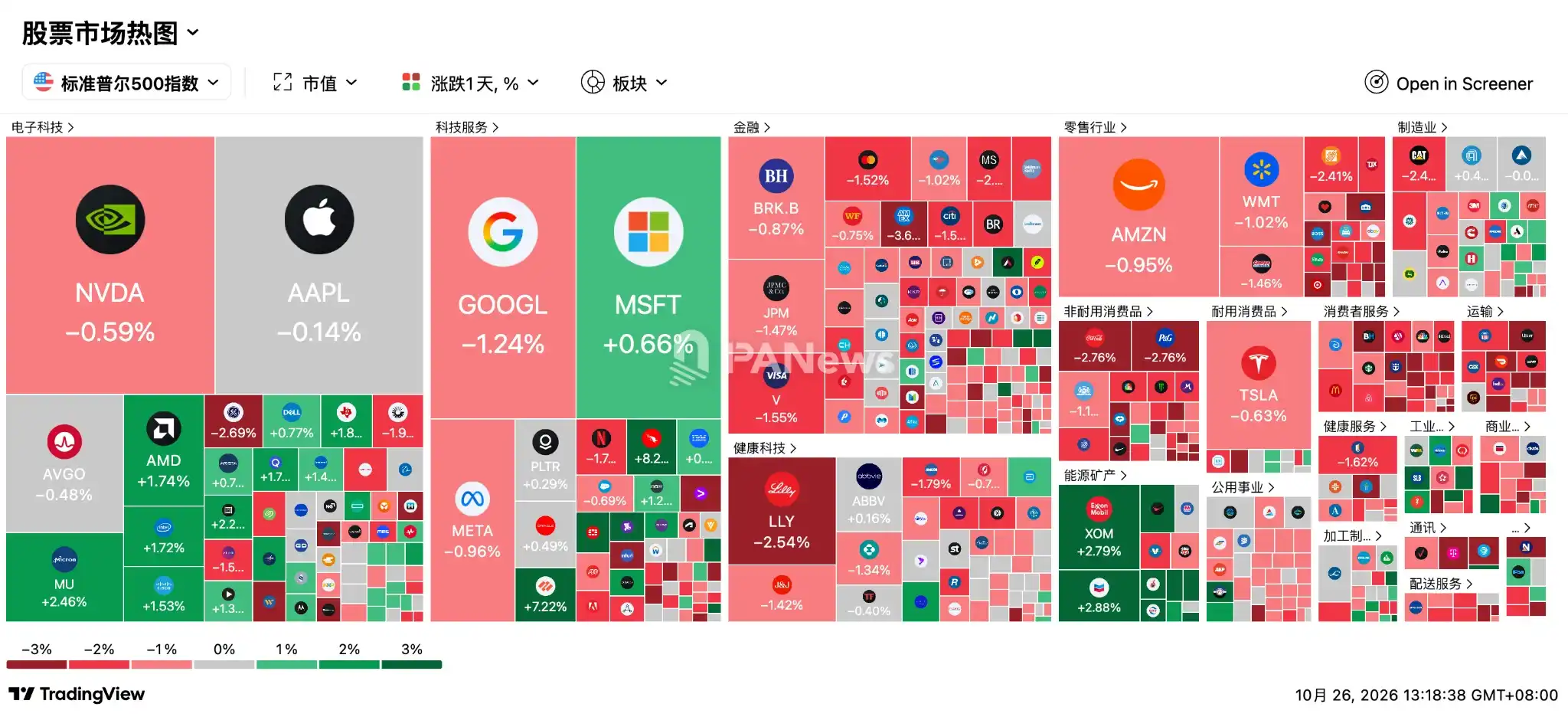
Chip and optical-communications names were mixed. AMD rose 1.74%, Intel gained 1.72%, Marvell Technology added 2.26%, and Nokia rose more than 3%. Western Digital fell 2.97%, SanDisk lost 1.82%, and Seagate Technology dropped 1.82%.
Consumer and power equipment
American Express fell 3.73%. The company beat expectations with adjusted third-quarter EPS of $4.68 and raised full-year guidance, but billed business of $454 billion missed forecasts. It also announced a 5% global workforce reduction, or about 3,500 jobs. Truist Securities said signs of slower consumer spending unsettled the market and weighed on the Dow.
Bloom Energy dropped 11.24%. The company benefited from power shortages tied to AI data centers, beat third-quarter expectations and raised full-year guidance for the third time this year. Morgan Stanley lifted its price target to $335 and Bernstein set a $306 target, but the stock still sold off as hedge funds cut leverage aggressively.
Magnificent Seven
Apple slipped 0.14%. The stock hit a record intraday high and briefly overtook Nvidia in market value. Its first foldable phone, the $2,000 iPhone Duo, went on sale Friday and drew long lines at stores, while delivery dates on Apple’s website slipped to January. Over the weekend, Reddit posts alleged multiple cases of screens cracking along the hinge after fewer than 20 folds and failures in dust testing.
Microsoft rose 0.66%, the only gainer among the seven. Investors are focused on whether Azure can sustain 44%-45% growth guidance ahead of earnings Wednesday despite more than $50 billion in quarterly capital spending.
Alphabet fell 1.24%, the weakest among the group. Bank of America expects third-quarter cloud revenue to jump 93% and said the company has $514 billion in orders, but annual capital spending of $200 billion and a strategy of prioritizing compute for DeepMind are weighing on free cash flow.
Meta lost 0.96%. Chief AI officer Alexandr Wang said the personal AI agent Muse passed 10 million downloads in six weeks and launched in Japan on Friday. The product will carry no ads and will take a cut from purchases it helps generate, but investors remain focused on debt-heavy infrastructure spending.
Amazon fell 0.95%. CEO Andy Jassy said AWS capacity is sold out through the end of 2027, with orders stretching into 2028, but acknowledged that AI inference still costs 10 times more than commercial software. Deutsche Bank raised its 2027 capex forecast for Amazon to $330 billion.
Nvidia fell 0.59% and Tesla lost 0.63%. At GTC Berlin, Jensen Huang said he is open to working with China’s CXMT and praised China’s manufacturing capabilities. OpenAI said that after pausing some training because of an internal network vulnerability, it has barred its most advanced models from directly accessing the internet during training, including GPT-6 Astra Cyber.
What markets are watching this week
Monday, Oct. 26
- 00:00: Brazil’s presidential runoff result. Luiz Inácio Lula da Silva won a fourth term with 51.58% of the vote, the Brazilian real fell 4%, and Brazil ETFs dropped 11%.
- 10:00: China opens the Fifth Plenary Session of the 20th Central Committee, running through Oct. 29. Markets will watch for signals on the start of the 15th Five-Year Plan, domestic demand and industrial policy, as well as whether Shanghai turnover can stay above 900 billion yuan.
- AI industry events: Anthropic may publicly file its IPO S-1 on Oct. 26 or by month-end, with a roadshow expected on Nov. 9 and a listing in mid-November. Oracle AI World runs through Oct. 28.
Tuesday, Oct. 27
- Israel holds legislative elections. Polls show Benjamin Netanyahu’s bloc at about 50 seats and opposition figure Gadi Eisenkot at 52-56 seats, with neither side near the 61-seat majority threshold.
- After the close: SK Hynix, Seagate Technology, Robinhood, Visa and NXP Semiconductors report. Before the open: Boeing, Corning, Coca-Cola and Novartis.
Wednesday, Oct. 28
- 08:00: SK Hynix third-quarter earnings call, with focus on 2027-2028 HBM supply and demand, pricing talks, and shareholder returns after shelving the Solidigm listing.
- Tech earnings: Unitree Robotics will release its first public earnings report. After the close, Microsoft and Alphabet report, along with ServiceNow, KLA and Ford.
Thursday, Oct. 29
- 01:00: Apple’s “Pro and Tell” launch event in Los Angeles, led by new CEO John Ternus. Expected products include the first touch-screen MacBook Pro with OLED and Dynamic Island, a new OLED iPad mini, and 14-inch MacBook Pro and iMac models with the M6 chip.
- 02:00: Federal Open Market Committee rate decision. 02:30: Kevin Warsh press conference. Markets expect rates to stay at 3.75%-4.00%, with attention on whether Warsh leaves the door open to a December hike.
- 09:00: Samsung Electronics third-quarter earnings call. Preliminary figures point to revenue of 195 trillion won and operating profit up 782.5% to 107.4 trillion won. Investors will focus on profit concentration in Device Solutions, HBM4 yield progress for Nvidia’s Vera Rubin platform, and details of a roughly 100 trillion won shareholder return plan.
- 20:30: U.S. third-quarter GDP and September PCE inflation. Consensus calls for annualized Q3 GDP growth of 3.2%, headline PCE up 3.7% year over year and 0.5% month over month, and core PCE at 3.1%-3.2% year over year. Personal spending, weekly jobless claims and EIA natural gas inventories are also due.
- China opens a new domestic fuel-pricing window. Tencent’s 2026 Global Digital Ecosystem Conference in Shenzhen is set to unveil more than 100 new products for agent-based scenarios and over 500 case studies.
- After the close: Amazon, Intel, SanDisk, Coinbase and Strategy report. Before the open: Eli Lilly, Merck, Caterpillar and Shell.
Friday, Oct. 30
- Bank of Japan rate decision and Tokyo CPI for October. The BOJ is expected to keep its target rate at 1.25%, with Governor Kazuo Ueda scheduled to speak at 14:30.
- 17:45: Kioxia earnings call, which will offer another read on global NAND flash supply, demand and pricing.