
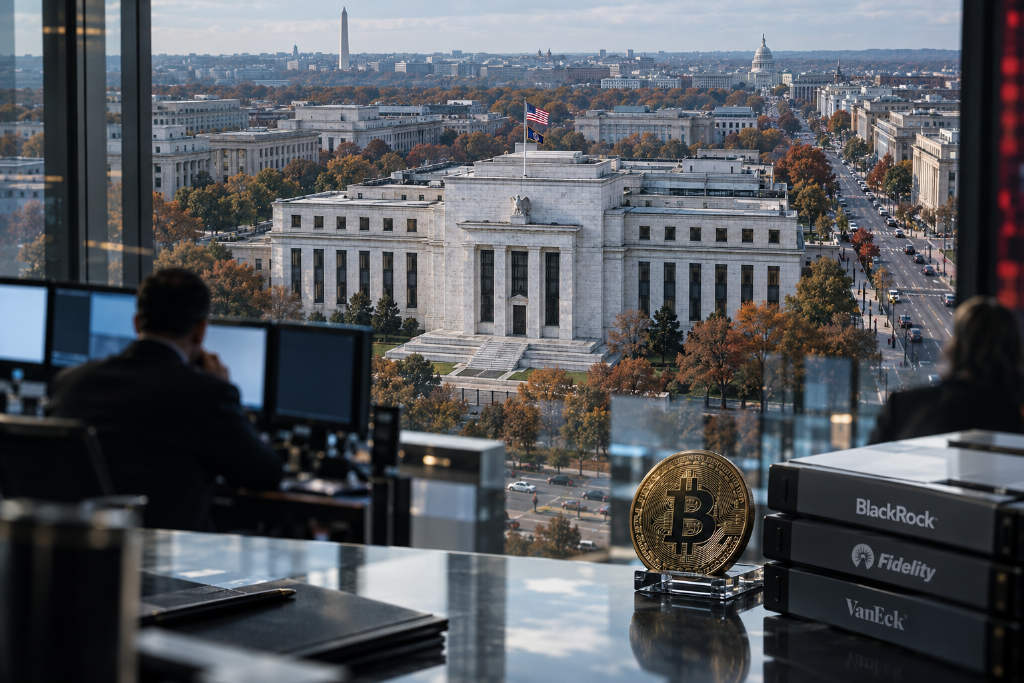
The Federal Reserve released minutes on Oct. 8 Beijing time from its Sept. 15-16 Federal Open Market Committee meeting, putting the market back into a familiar frame: inflation still comes first, and another rate increase before year-end remains the baseline for many officials, even if October is not locked in as the next move.

Risk assets sold off first. Bitcoin fell to as low as $82,300 earlier in the day before recovering to around $83,000. Other altcoins were broadly down more than 3%.
What the Fed minutes said
At the Sept. 15-16 meeting, the FOMC voted 12-0 to raise the target range for the federal funds rate by 25 basis points to 3.75%-4.00%, the first rate hike since July 2023. The minutes added that all 19 participating officials supported the decision.
Most participants judged that one more increase in the target range before the end of the year could be appropriate. At the same time, the minutes said each meeting remains live, with the path ahead dependent on incoming data and what those readings imply for the outlook and the balance of risks. In other words, the document confirmed a tightening bias for the rest of the year, not a requirement to hike again in October.
Inflation sat at the center of the discussion. Staff estimated August headline PCE at about 3.8% and core PCE at about 3.4%. The minutes said progress on disinflation had been insufficient in recent months and that risks were almost uniformly tilted to the upside. Factors cited included energy prices linked to geopolitics, tariffs, and investment, input costs, and technology-related goods prices tied to AI infrastructure buildout.
On growth, the minutes described an economy still expanding at a solid pace. Consumption remained resilient, unemployment stood near 4.1%, and the labor market was close to full employment. Several participants even judged that the policy rate before the hike was "not restrictive or only modestly restrictive." Some officials viewed a higher-rate path as insurance against sticky inflation, while others saw it as necessary under the baseline outlook.
Polymarket data showed that after the minutes were released, the probability of no rate change in October rose to 84%, up 35% over the past week. The probability of one more hike before year-end remained above 70%. That pricing points to a market that sees continued tightening bias this year, but not an automatic back-to-back move in October.
Why higher-for-longer matters more than the hike itself
The pressure on risk assets is not only about the latest 25 basis points. It is also about the possibility that rates stay elevated for longer. If nominal and real yields remain high because of expectations for another hike, the theoretical valuations of long-duration assets, richly valued growth stocks, and crypto assets all come under strain.
During the intermeeting period, yields on U.S. Treasuries from 2-year to 10-year maturities rose by about 35 basis points in total. Financial conditions, though, had not tightened across the board. Equities remained high and credit spreads stayed narrow. The minutes explicitly treated financial conditions that still support growth as part of the inflation risk, not as background noise.
The document did not describe a recession. It described strong investment, steady employment, and inflation that remains elevated. In that mix, risk assets are not being bought as a recession trade, and they are not being bought on expectations of unlimited easing. The market is pricing an economy that can still absorb higher rates, with policymakers willing to go another step in pursuit of the 2% target. For high-beta assets, volatility is coming from data, not from an abrupt policy pivot.
Crypto spot ETFs kept buying after the hike
That is where the crypto flow picture stands out. Institutional demand in crypto did not appear to fade after the September hike.
According to SoSoValue, U.S. spot Bitcoin ETFs posted about $2.65 billion in net inflows in September, and nearly all of that came after the Sept. 16 rate increase. The two days before the decision saw combined outflows of about $750 million. From Sept. 17 through the end of the month, net inflows reached about $2.9 billion. The week ended Sept. 25 brought about $2.4 billion, the largest weekly inflow since October 2025, and Sept. 21 alone was close to $1 billion. BlackRock’s IBIT led the flows.

Spot Ether ETFs also recorded about $690 million in net inflows over the same period. Bitcoin rose from roughly $78,500 during the month to around $83,000, then traded around the $84,000 area afterward.
Longer-range data told a similar story. In mid-July, cumulative net flows for spot Bitcoin ETFs in 2026 were at one point down about $5.8 billion. One week after the September hike, the full-year flow turned positive again. By early October, cumulative net inflows since launch had reached about $57.8 billion, with net assets around $110 billion.
Flows turned choppier after October began. On Oct. 6, spot Bitcoin ETFs still recorded about $120 million in net inflows, and some trackers showed about $3.5 billion in net inflows over a 30-day window. Even so, September’s direction was clear enough: a fully priced 25-basis-point move did not trigger institutional exits.
Why money came back after the decision
The explanation in the source data is straightforward. Before the decision, the probability of a hike had already climbed above 90%, and outflows were concentrated ahead of the meeting. Once the move was delivered, uncertainty fell. Short covering and allocation-driven buying appeared at the same time.
Those purchases happened in regulated spot ETFs, which correspond to subscriptions for actual Bitcoin rather than leveraged futures exposure. That kind of capital is less sensitive to a single 25-basis-point move than it is to whether the regulatory channel remains stable and whether portfolios still need a non-correlated asset.
Not an easing trade, but a trade that says hikes are absorbable
The minutes showed that most officials still see one more hike as appropriate, and some think current rates are not restrictive enough. If the Oct. 14 CPI report or later labor data reinforce the case for sticky inflation, pricing for a December hike could rise quickly again. Higher real yields and a stronger dollar would then squeeze high-beta assets. In crypto, that kind of setup usually hits liquidity expectations first and asset-specific supply and demand second. ETF inflows can cushion the move, but they cannot hedge a jump in the risk-free rate.
For now, the probability of no change in October is clearly higher than it was in the first days after the meeting, giving risk assets a temporary data gap. More important, September’s ETF flows suggest that when growth has not stalled, hikes are already priced, and the spot channel remains open, institutions can treat Bitcoin as an allocatable asset rather than only as a hedge for easier policy.
The source also noted that spot products tied to Ether and Solana saw net inflows in the same week, suggesting the move was not just a short-covering bounce in a single asset.
Three data points to watch next
The next phase depends on whether three sets of signals move in the same direction:
- whether PCE and CPI stay above 3%, locking in expectations for a December hike;
- whether financial conditions truly tighten as Treasury yields rise;
- whether spot ETFs can keep posting net subscriptions when Bitcoin trades near holders’ cost basis.
If rates move higher while flows turn negative, the idea that risk assets can absorb more tightening would start to fade. If inflation eases at the margin, an October pause is confirmed, and monthly ETF flows stay positive, crypto is more likely to trade on allocation demand after volatility cools rather than on expectations for a fresh wave of broad easing.